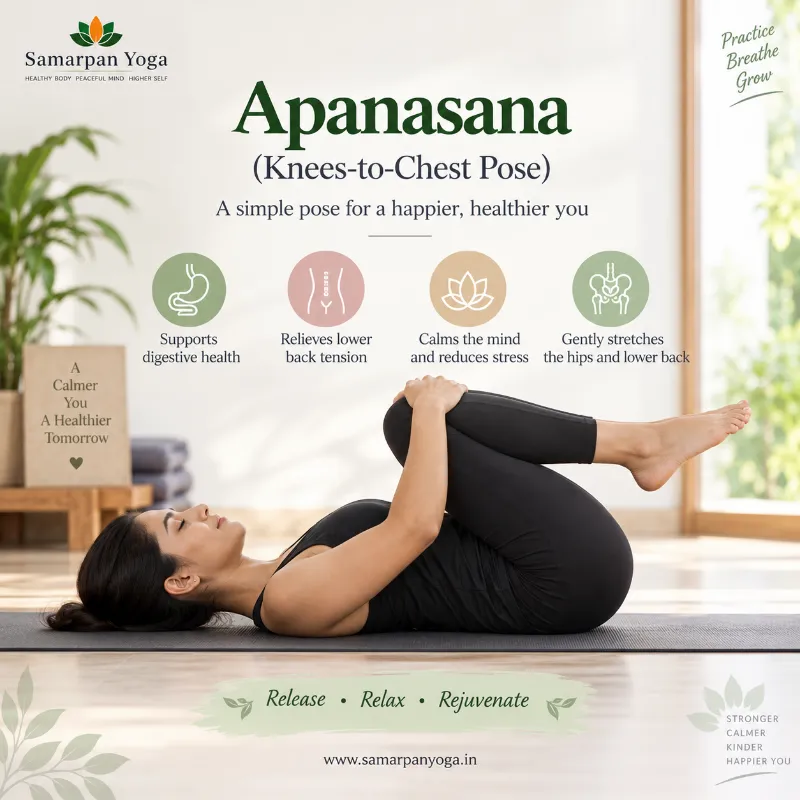
Apanasana (Knees-to-Chest Pose)
What is Apanasana (Knees-to-Chest Pose)?
Apanasana, also known as Knees-to-Chest Pose, is a gentle yoga posture that involves bringing the knees toward the chest while lying on the back.
In the gentle, restorative yoga pose known as Apanasana (Knees-to-Chest Pose), you lie on your back and gently hug both knees toward your chest to release tension in your lower back, calm your nervous system, and encourage deep relaxation. One of yoga’s most calming and approachable postures, pronounced “ah-pah-NAH-suh-nuh,” is ideal for warm-ups, cool-downs, and nighttime practice.
Overview & Meaning
In Sanskrit, Asana is a position or posture, and Apana is the downward flow of energy in the body that facilitates elimination and grounding. When combined, Apanasana means “Pose of Downward-Moving Energy.” By gently compressing the lower belly, this knees-to-chest position promotes both physical and mental relaxation, stimulates digestion, and calms the nervous system.
The origins of apanasana can be found in traditional Hatha yoga, which employed mild, repetitive motions to soothe the mind and warm the joints. Because it’s easy, safe, and incredibly calming, the knees-to-chest pose has become a mainstay in many modern yoga systems, including Hatha, Iyengar, Restorative, and Yin Yoga. In order to ease back tension, calm the mind, and reestablish the connection between breath and movement, teachers frequently introduce it at the beginning or end of a class.
In terms of the body, apanasana releases tense muscles from extended sitting or stress by gently decompressing the lower back and spine. It allows the shoulders and upper back to relax into the mat while gently contracting the hip flexors and core. Internal organs are massaged by the light pressure on the abdomen, which promotes circulation and digestion.
Your body’s parasympathetic nervous system, which lowers heart rate and promotes complete relaxation while you breathe deeply in this reclining position, naturally grounds your body and mind.
At a Glance
- Sanskrit Name: अपानासन (Apanasana)
- Pronunciation: ah-pah-NAH-suh-nuh
- English names: Apana Pose (a mild form of Wind-Relieving Pose) and Knees-to-Chest Pose
- Pose Type: Supine, restorative, spinal release
- Level: Beginner (accessible to everyone)
- Duration: 30 seconds to 10 minutes
- Principal Advantages: Nervous system relaxation, lower back release, stress reduction, and mild hip opening
Benefits of Apanasana (Knees-to-Chest Pose)
Apanasana brings the body and mind back into balance by combining relaxing breathing with mild spinal relief. After a stressful or long day of sitting, this pose is ideal for anyone looking for emotional grounding, pain alleviation, or relaxation.
Physical Benefits
- Tension in the lower back is relieved by gentle traction, which decompresses the lumbar spine and relieves tension from standing or sitting.
- Stretches the glutes and hip flexors to increase hip mobility and reduce stiffness.
- Increases the flexibility of the spine by promoting delicate mobility between each vertebra.
- Mild sciatica symptoms might be relieved by gradually creating room in the lower back to reduce nerve pressure.
- Softly compresses the abdominal organs to aid with digestion and excretion.
- Menstrual cramps can be lessened by applying light pressure to the lower abdomen, which relaxes the pelvic muscles.
- Promotes pelvic floor health by strengthening without strain through gentle involvement.
- Promotes a full-body release response and eases tense muscles.
- Enhances posture: Lengthens the lower back to prevent slouching.
Mental & Emotional Benefits
- Activates the parasympathetic “rest and digest” state, which calms the neurological system.
- Lowers tension and anxiety: The fetal-like form fosters a feeling of security and warmth.
- Enhances the quality of sleep: Perfect for a restorative or nighttime ritual.
- Promotes emotional release: Unprocessed tension is frequently stored in the hips and lower back.
- Grounds restless energy: A great way to settle a racing mind.
- Develops bodily awareness by encouraging deliberate, slow monitoring of breath and feeling.
- Develops self-compassion: Reconnecting with tenderness is made possible by this approachable stance.
Therapeutic Applications
- Lower back pain: Chronic stiffness might be relieved with little traction.
- Hip tightness: Reduces the negative consequences of prolonged sitting.
- Mild sciatica: Promotes safe, assisted movement.
- Digestive problems: Reduces bloating and encourages natural peristalsis.
- Menstrual discomfort: Alleviates lower abdomen heaviness and pains.
- Prenatal comfort (first trimester): When done carefully, it reduces back strain.
- Anxiety or insomnia: The ideal stance to reset before rest.
- Burnout or exhaustion: Assists in regaining equilibrium and serenity.
- Trauma-sensitive yoga: Establishes a solid sense of security and control.
- Note: If you have stomach, spinal, or post-surgical issues, you should always see a doctor. Yoga is a supplement to treatment, not a substitute for it.
Schedule a free one-on-one session right now to practice safely and get the most out of it!
How to Do Apanasana (Knees-to-Chest Pose): Step-by-Step Guide
Knees-to-Chest Pose, or apanasana, is one of the most calming poses for your body and back. When you need a gentle release or grounding, it’s ideal to practice on a soft mat, rug, or even your bed.
Part 1: Preparing for the Pose
- This pose is healing rather than digestive, so it doesn’t require an empty stomach.
- Lying on a soft surface, dress comfortably and loosely.
- Perfect for any time of day: before bed to relax or in the morning to awaken your spine.
- A blanket beneath the head or a support strap across the thighs are optional props.
- Encourages mental calmness and full-body relaxation before beginning a yoga session.
- With your arms at your sides and your legs outstretched, lie flat on your back.
- Soften your shoulders and jaw while closing your eyes.
- For one to two minutes, let your body feel grounded and substantial as you breathe properly.
Ankle and Knee Circles
2. Enhances mobility before deeper poses by gently warming and lubricating the joints.
- Bend your knees and lift your feet slightly off the mat while lying on your back.
- Make short, slow, clockwise and counterclockwise rotations with your knees and ankles.
- For 30 to 60 seconds, move smoothly and in time with your breath.
Single-Leg Knee-to-Chest Stretch
3. Prepares for Apanasana by releasing tense lower back muscles and hip flexors.
- Bend your right knee toward your chest while lying on your back.
- Use both hands to grasp the back of your leg or your shin.
- After three to five breaths, rotate sides, keeping your left leg extended and grounded.
Part 2: Step-by-Step Instructions
- Basic Apanasana
- Lie down on your back with your legs extended and your arms by your sides. To calm your body, let your shoulders drop and inhale deeply many times. Breathe in through your nose and out through your mouth.
- Press your lower back lightly onto the mat to create a neutral spine. Feel your pelvis and shoulders become equally relaxed. Gently exhale as you drop your back to the floor.
- Bend your right knee and move your heel in the direction of your seat as you inhale. Next, raise your left knee in the same manner.
- Put your hands behind your knees or encircle your shins with your arms. Keep your elbows relaxed and your shoulders flat on the mat. Bring your knees together slowly while exhaling.
- As opposed to Pavanamuktasana, where your knees split, keep them together. Make sure your lower back and the mat are fully in contact.
- Soften your jaw and face. Don’t push or pull; instead, let gravity pull your thighs toward your chest.
- Duration:
- Warm-up: Hold 30 seconds–1 minute.
- Gentle practice: Hold 1–3 minutes.
- Restorative: Hold 5–10 minutes with props.
- To massage your spine, move your knees in little circles or rock softly from side to side if it seems comfortable.
- Let go, exhale, and gently plant your feet on the mat. For two to three breaths, remain with your knees bowed.
- Let your body absorb the peace by stretching your legs and resting completely.
Restorative Apanasana
For deep relaxation or bedtime:
- To provide support, place a folded blanket or bolster beneath your hips.
- To gently hold your knees, wrap a strap across your thighs.
- Place a little cushion beneath your neck and head.
- Close your eyes and breathe gently while holding for five to ten minutes.
- This posture is ideal for emotional grounding or getting ready for sleep because you should feel your lower back release, your belly relax, and your mind quiet down.
Common Mistakes & Fixes
- Too much pulling results in strain rather than release. Let gravity do the work and hold gently.
- The grounding effect is lessened by raising the head or shoulders. Keep your shoulders and head back on the mat.
- Tension is created by holding the breath. Breathe slowly and steadily.
- Schedule a free one-on-one session right now to learn safe variations, proper alignment, and breathing techniques customised to your requirements!
Apanasana Variations
There is a variation of Apanasana (Knees-to-Chest Pose) that suits your body, regardless of your level of flexibility or expertise. With these adjustments, the posture can be strengthened for more experienced practitioners, therapeutic for recuperation, and accessible for novices.
Single-Leg Variations
Ardha Apanasana (Half Knees-to-Chest Pose)
- One side of the lower back is safely released, making it perfect for novices or uneven hip stiffness.
- Stretch your left leg along the mat while lying on your back.
- Bring your right knee up to your chest as you exhale.
- Gently grasp the back of the thigh or shin.
- After a few breaths, switch sides while keeping your extended leg anchored and active.
Crossed-Ankle Variation
2. Excellent for releasing stiff outer hips or IT bands; provides a little twist and lateral stretch.
- Cross your right ankle across your left thigh and bring your right knee to your chest (figure 4).
- Draw your left thigh gently toward your body.
- Use a strap or grasp the back of your left thigh.
- Keep shoulders relaxed and switch sides.
Alternating Dynamic Apanasana
3. The ideal warm-up for the morning: it increases circulation and mobilises the hips.
- Exhale while lying on your back and bringing one knee to your chest.
- Breathe in to let go of that leg and out to pull the other leg in.
- Move slowly with your breath for 10–20 repetitions.
- Finally, take a few deep breaths while drawing in both knees.
Restorative & Therapeutic Variations
Supported Apanasana with Bolster
4. It provides effortless, mild decompression and is ideal for deep relaxation or back strain.
- To raise your hips by three to six inches, use a bolster or folded blankets beneath them.
- Clasp your legs gently and bring both knees to your chest.
- Close your eyes and breathe deeply for 5–10 minutes.
- This version is great before bed; let gravity do the work.
Strap-Assisted Apanasana
5. Excellent for extended holding or weak grips; lessens shoulder and arm strain.
- Just above your knees, wrap a yoga strap across your thighs.
- With your arms resting, gently bring your knees to your chest.
- Maintain a relaxed grip and deep belly breathing.
- Perfect for restorative yoga or meditation preparation.
Wall-Supported Apanasana
6. Safe and steady—perfect for elderly people, first-trimester pregnancies, or balance problems.
- A foot or so away from the wall, lie on your back.
- Bend your knees to a 90-degree angle and place both feet on the wall.
- Keeping one knee on the wall, bring the other one closer to your chest.
- Switch sides, maintaining soft breathing and steady support.
Rocking Apanasana
7. Perfect for relaxation and spinal massage; calms nerves and muscles.
- Hug your knees and rock gently back and forth from the fundamental stance.
- Keep your movements small and controlled.
- Allow your hips and back of your ribcage to roll uniformly across the mat.
- Great as a transition into Savasana or a bedtime routine.
Active & Strengthening Variations
Lifted Head Variation
8. Builds gentle core strength while supporting spinal health.
- Raise your head and shoulders a little bit toward your knees from Apanasana.
- Maintain a grounded lower back while using your core.
- Hold for 5–10 slow breaths, then release.
- Avoid if you have neck strain or injury.
Side-to-Side Stretch
9. Targets obliques and side body — relieves tightness from sitting.
- Knees should be kept together when you gently drop them to one side from basic Apanasana.
- Keep the opposite shoulder grounded.
- For 30 to 60 seconds, breathe into your side ribs; then, switch sides.
- Move slowly to protect the lower back.
Extended Leg Variation
10. Combines hamstring stretch with hip release — enhances flexibility and balance.
- One knee should be hugged to your chest, while the other leg should be extended upward.
- Keep both feet flexed and core engaged.
- Hold for 5–10 breaths, then switch sides.
- Don’t push either leg; instead, let the breath intensify the stretch.
Apanasana (Knees-to-Chest Pose) Precautions & Contraindications
Even though Apanasana (Knees-to-Chest Pose) is one of the safest and gentlest yoga positions, mindful practice is essential, particularly if you are recuperating from surgery, have an injury, or are pregnant.
Avoid Apanasana If You Have:
- Recent spinal or abdominal surgery: Await approval from a doctor (typically 6–12 weeks).
- Acute inflammation of the abdomen, such as appendicitis or peritonitis, or an active hernia.
- Lying flat during the second or third trimester of pregnancy can reduce blood flow.
- Spinal flexion may exacerbate symptoms of acute herniated disks or severe osteoporosis.
- Hip replacement: Avoid unless cleared by your surgeon.
- Fractured ribs or vertebrae: Rest until fully healed.
Practice gently or with Modifications in case of:
- Pregnancy (First Trimester): Avoid supine variations after the first trimester, raise the upper body slightly, perform Ardha Apanasana (one leg at a time), and keep compression light (30–60 seconds).
- For persistent lower back discomfort, begin with the single-leg version, place a folded blanket beneath the hips for support, and stop right away if the pain gets worse.
- Knee or Hip Arthritis: Adjust by utilising pillows or straps for comfort, keeping knees slightly apart, and holding behind the thighs.
- High Blood Pressure (Controlled): Keep your head on the mat, breathe smoothly, and let your face and eyes relax.
- Avoid practising after meals if you have acid reflux or GERD, and use a pillow or bolster to raise your upper body.
- Menstruation or Mild Cramps: If discomfort occurs, practice lightly, reduce hold time, and avoid prolonged compressions.
- Postpartum or C-Section Recovery: Start with a single-leg or chair variant, wait six to eight weeks or until a doctor gives the all-clear, and apply very little compression.
General Safety Guidelines
- Be kind; allow gravity and time to unfold your body.
- A slight sensation is sufficient; never push your knees together.
- Breathe continuously — holding your breath adds tension.
- Move slowly in and out of the pose.
- When necessary, use props like bolsters, belts, or blankets.
- Avoid lifting your head or arching your lower back.
- Start with one leg at a time if you’re hesitant.
- Consult a qualified yoga instructor if you’re unsure. Book your free 1-on-1 session today!
Apanasana: Related Yoga Poses
Combine these poses with your Apanasana (Knees-to-Chest Pose) practice to improve it.
Reclined Butterfly Pose (Supta Baddha Konasana)
- Promotes relaxation and circulation by gently opening the inner thighs and hips.
- Lying on your back.
- Bring your feet together.
- Using blocks or cushions for support, let your knees drop open to the sides.
- For one to three minutes, place your arms next to you and breathe slowly into your hips.
Wind-Relieving Pose (Pavanamuktasana)
2. Improves digestion and relieves gas by compressing the abdomen.
- Draw one or both legs to your chest while lying on your back.
- With your shoulders relaxed, give them a gentle embrace with both arms.
- Breathe deeply, allowing your abdomen to stretch and contract as you inhale and exhale.
Happy Baby Pose (Ananda Balasana)
3. Calms the mind, releases tension in the lower back, and expands the hips deeply.
- Bend your knees toward your armpits while lying on your back.
- Keeping your ankles above your knees, grasp the outside borders of your feet.
- For a few moments, let your shoulders drop and sway softly from side to side.
Reclined Spinal Twist (Supta Matsyendrasana)
4. Relieves tension in the shoulders and lower back and stretches the spine.
- Bend your knees and lower them to one side while lying on your back.
- Stretch your opposing arm to shoulder height and turn to face it.
- Breathe deeply for 30 to 60 seconds while keeping both shoulders planted, then switch sides.
FAQs
What is Apanasana (Knees-to-Chest Pose) good for?
Apanasana is a great way to ease tight hips, release tension in the lower back, and soothe the nervous system. It is particularly helpful for reducing stress, enhancing sleep, relieving menstrual cramps, and promoting mild digestion. The posture is a favourite for restorative yoga and sleep routines because of its gentle, embracing motion that helps your body and mind relax.
How long should you hold Apanasana?
Depending on your objective, hold Apanasana for 30 seconds to 10 minutes.
Warm-up: 30 seconds–1 minute
Gentle release: 1–3 minutes
Restorative/Bedtime: 3–10 minutes
Back tension is released, and relaxation is deepened with longer holds and gentle breathing. This stance is about ease, not effort, so always stay within your comfort zone.
Can you do Apanasana during pregnancy?
Yes! Only during the first trimester can you perform this pose with adjustments. Use a bolster to raise your upper body, prevent severe compression, and perform Ardha Apanasana (one leg at a time). To ensure safety and comfort, move to side-lying or wall-supported positions after the first trimester.
Schedule a free one-on-one session now to practice yoga as safely as possible during pregnancy!
Is Apanasana good for lower back pain?
Definitely. One of the safest and best poses for easing lower back stress is apanasana. It eases sciatic pain, relaxes tense hip flexors, and produces mild traction in the lumbar spine. Breathe deeply and gently at first; if you do this every day, even a minute can provide substantial relief.
When is the best time to do Apanasana?
Anytime! Apanasana is readily incorporated into bedtime, evening, and morning routines.
Morning: Gently awakens the spine.
Post-work: Relieves tension from sitting.
Before bed: Promotes deep relaxation.
There’s never a bad time to do it; simply take a deep breath, relax, and savour the calming, grounded feeling it provides.
Is Apanasana good for sleep and insomnia?
Yes! Apanasana is one of the best bedtime poses. Your body’s “rest-and-digest” response is triggered by its soft rocking motion and deep belly breathing, which helps reduce everyday stress and tension. To ease your spine and get your mind ready for a good night’s sleep, hold the pose for three to five minutes before bed.
References
- Allen, W. (2026d, February 27). Apanasana. https://myyogateacher.com/yoga-asana/apanasana
- Knees to chest pose – Apanasana – The Yoga Collective. (2020, April 10). The Yoga Collective. https://www.theyogacollective.com/poses/knees-to-chest-pose-apanasana/
- Lifted Lotus Online Yoga School. (n.d.). Knees to chest pose: Breaking down apanasana. https://courses.onlineyoga.school/pages/knees-to-chest-pose-breaking-down-apanasana

One Comment