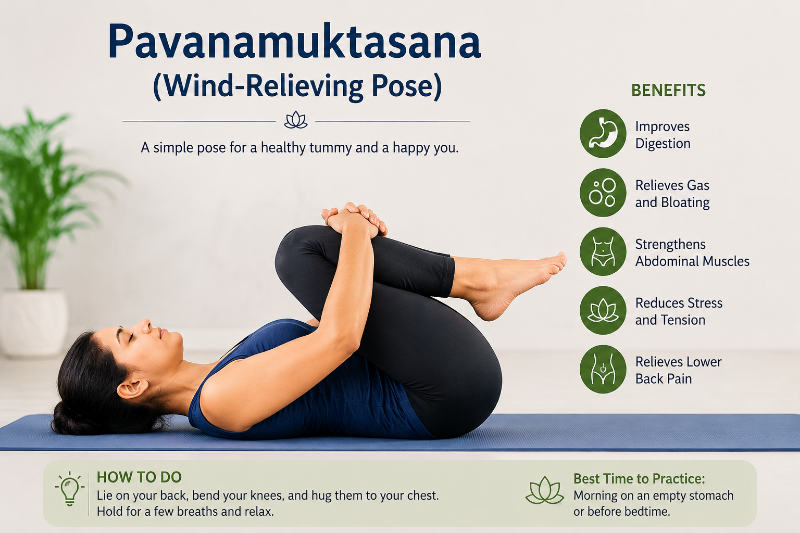
Pavanamuktasana (Wind-Relieving Pose)
What is Pavanamuktasana(Wind-Relieving Pose)?
Drawing one or both knees toward the chest is a peaceful, beginner-friendly supine pose called Wind-Relieving Pose (Pavanamuktasana). This easy exercise relieves lower-back tension, eases bloating, and releases trapped gas.
Pavanamuktasana is often included in warm-ups, cool-downs, or therapeutic routines for belly comfort and relaxation, making it ideal for busy professionals or anyone seeking quick digestive relief.
Wind-Relieving Pose: Overview & Meaning of Pavanmuktasana
Pavanamuktasana is often included in warm-ups, cool-downs, or therapeutic routines for belly comfort and relaxation, making it ideal for busy professionals or anyone seeking quick digestive relief.
Pavanamuktasana, which has its roots in Hatha Yoga and Ayurvedic traditions, is a reflection of the idea that clear energy, attention, and emotional stability are fostered by healthy digestion. For those with sedentary lives, slow digestion, or minor lower back pain, it has been a commonly taught therapeutic position throughout time.
Pavanamuktasana produces a gentle massage for the muscles in your lower back, stomach, and intestines when your knees are drawn toward your chest. This mild compression eases the hips and spine, promotes digestion, and enhances blood flow. Additionally, the posture strengthens the core muscles and relieves stress caused by extended periods of sitting.
At a Glance
- Sanskrit Name: पवनमुक्तासन (Pavanamuktasana)
- Pronunciation: pah-vahn-ah-mook-TAHS-anna
- English Names: Wind-Relieving Pose, Gas-Release Pose, Wind-Removing Pose
- Pose Type: Supine, Digestive, Restorative
- Level: Beginner
- 30 to 5 minutes (single or both legs) is the duration.
Benefits of Pavanamuktasana (Wind-Relieving Pose)
A comprehensive mind-body treatment is provided by Wind-Relieving Pose (Pavanamuktasana), which reduces bloating, supports digestion, eases stress, and fosters calm. Frequent practice can significantly improve emotional balance, spine comfort, and intestinal health:
Digestive & Abdominal Benefits
Do this position on an empty stomach or two to three hours after eating for best digestive benefits.
- Reduces gas and bloating: By compressing the abdomen, trapped gas is encouraged to pass through the intestines, giving immediate comfort.
- Enhances digestion: A light massage of the digestive tract promotes the production of enzymes and facilitates a more efficient metabolism.
- Reduces constipation: The rhythmic compression of the position stimulates peristalsis, the intestines’ wave-like action, which promotes regular bowel movements.
- Lessens the symptoms of acid reflux by encouraging improved stomach flow and posture, which helps control stomach acid and avoids pain.
- Increased blood flow enhances the body’s natural detoxifying processes and stimulates the liver and kidneys.
- The digestive system is supported, and the abdominal muscles are strengthened via mild core engagement.
Physical Benefits
- Tight lumbar muscles are eased by mild spinal traction.
- Hip flexor stretching can relieve stiffness caused by prolonged sitting or long commutes.
- Eases sciatica pain: Reduces nerve compression when practised slowly and mindfully.
- Improves spinal flexibility: Encourages gentle vertebral articulation.
- Reduces menstrual cramps: Abdominal massage supports pelvic circulation.
- Improves pelvic floor health by strengthening the pelvic and core muscles.
- Boosts blood flow to the lower body and abdomen, improving circulation.
Mental & Emotional Benefits
- The parasympathetic (or “rest and digest”) response is triggered by the supine position, which calms the neurological system.
- Stress and anxiety reduction: Deep belly breathing calms the body-mind link.
- Enhances sleep: Relaxing physically gets the body ready for sleep.
- Promotes emotional release: Tension can be released by applying pressure to the hips and abdomen, which serve as emotional storage areas.
- Increases bodily awareness: Coordination of breathing and movement fosters mindfulness.
- Grounds your energy: Perfect for times when you’re feeling agitated or distracted.
Therapeutic Applications
The Pavanamuktasana position can be used therapeutically for:
- Irritable Bowel Syndrome (IBS) and chronic constipation
- Post-meal bloating or indigestion
- Lower back discomfort from prolonged sitting
- Premenstrual cramps and pelvic tension
- Anxiety or stress
- Sleep challenges or insomnia
- Prenatal (first trimester) practice with modifications
- Practice with one-on-one coaching to get the most out of Wind-Relieving Pose. Get your complimentary session now!
How to Do Pavanamuktasana: Step-by-Step Guide
You may fully reap the benefits of Wind-Relieving Pose (Pavanamuktasana) for relaxation and digestion if you know how to practice it correctly. Use these simple, uncomplicated instructions for beginners.
Part 1: Preparing for the Pose
Set aside five minutes to perform this warm-up before beginning Wind-Relieving Pose:
Supine Relaxation (Savasana)
- Calms the body and centres the mind before beginning an activity.
- Arms by your sides and legs outstretched, lie flat on your back.
- Shut your eyes and inhale deeply and slowly into your abdomen.
- For a minute, let your body feel supported and heavy by the mat.
Gentle Knee Circles
2. Loosens tight hips and improves joint mobility.
- Draw one leg close to your chest while lying on your back.
- Holding the shin, move your knee slowly in one way and then the other.
- After a minute, switch sides to maintain effortless and fluid motions.
Cat-Cow (Marjaryasana–Bitilasana)
3. Warms up the spine and improves flexibility.
- Keep your shoulders over your wrists and your hips over your knees while on your hands and knees.
- Breathe in to raise your chest and arch your back (Cow Pose).
- Breathe out to tuck your chin and circle your spine (Cat Pose). Continue for one minute.
Knees-to-Chest Pose (Apanasana)
4. prepares the spine for a deeper release by gently stimulating the core.
- Bring both knees closer to your chest while lying on your back.
- Give yourself a gentle hug by putting your arms around your shins.
- Breathe deeply and slowly for a minute while letting your lower back and shoulders relax.
Part 2: Step-by-Step Instructions
Single-Leg Wind-Relieving Pose (Ardha Pavanamuktasana)
- With your arms by your sides, palms down, and your legs outstretched, lie on your back. Breathe slowly two or three times.
- Gently press your lower back into the mat, using your abdominal muscles. Exhale completely.
- While keeping your left leg active on the floor, take a breath and bend your right knee toward your chest.
- Just below the knee, or behind the thigh if the knee is sensitive, interlace the fingers.
- Breathe out and give the knee a gentle embrace nearer the right armpit. Keep your shoulders loose.
- For a digestive massage, keep the thigh lightly pressed on the abdomen.
- Breathe deeply 5–10 times.
- Beginners: 30–60 sec
- Intermediate: 1–2 min
- Restorative: 3–5 min
- Breathe out, then slowly bring the leg down to the mat.
- Mirror all steps on the opposite side.
- Relax both legs in Savasana for 30–60 seconds.
Double-Leg Wind-Relieving Pose (Full Pavanamuktasana)
- Begin lying flat, knees bent.
- Inhale and hug both knees toward the chest.
- Draw your knees slightly outward toward your armpits while exhaling.
- For a deeper massage, gently press the thighs into the tummy.
- Hold 30 seconds – 3 minutes, breathing steadily.
- Option: For a spinal massage, gently rock from side to side.
- Lower both feet to the mat as you exhale to let go.
Common Mistakes & How to Fix Them
- Lifting the head/neck strains the neck. Keep the head down, chin slightly tucked.
- Breathing becomes difficult when knees are drawn too near the face. Guide knees toward armpits, not straight down.
- Stretching too hard could cause knee or back discomfort. Use slow, mindful movement and props if needed.
- Holding breath reduces digestive benefits. Maintain smooth, rhythmic breathing.
- An imbalance results from elevating an extended leg off the mat. Keep the extended leg grounded and active.
- Want real-time alignment feedback? Schedule a free one-on-one lesson with knowledgeable Indian instructors.
Pavanmuktasana Variations
Whether you’re starting in yoga or developing your practice, these variants make the pose accessible to everyone.
Beginner-Friendly Modifications
Strap-Assisted Version
- Ideal for tightness or restricted flexibility, it lessens the load on the hips and shoulders.
- Put a yoga strap around your foot’s sole.
- Gently draw the knee toward your chest while holding both strap ends.
- Keep shoulders relaxed and neck neutral.
Bent-Knee Support
- Easier on the lower back and hamstrings.
- Keep both knees bent, feet on the floor.
- Keeping one leg bent, draw the other toward your chest.
- Maintain gentle compression without strain.
- Hold, and repeat on the other side.
Wall-Assisted Version
Offers stability and support;
- great for beginners and prenatal practice.
- Lie with your hips near a wall.
- With your knees bent, place both feet flat on the wall.
- With the opposite foot firmly planted, draw one knee toward the chest.
- Hold, and repeat on the other side.
Intermediate Variations
Rocking Wind-Relieving Pose
- Massages the spine and boosts flexibility.
- Hug both knees to the chest.
- Rock gently from front to rear or side to side.
- Keep movement smooth and breath coordinated.
Extended Leg Variation
- Strengthens the abdomen and stretches hip flexors.
- Hug one knee to the chest.
- Hover just above the mat by extending the opposing leg straight.
- Engage the core to stabilise.
- Repeat on the other side after holding for a few counts.
Twisted Wind-Relieving Pose
- Adds a spinal twist for deeper digestive stimulation.
- Hug the right knee to the chest.
- Gently move it in the direction of your left side.
- Keep both shoulders grounded.
- Hold for a few breaths.
- Repeat on the other side.
Advanced Variations
Dynamic Wind-Relieving Pose
- Builds core strength and energises the body.
- Alternate hugging one knee at a time, synchronised with breath.
- Exhale to pull the knee in, then inhale to flip sides.
- Maintain a steady rhythm for 10–20 repetitions.
Wind-Relieving Pose with Head Lift
- Engages upper abdominals for deeper compression.
- Raise your head and shoulders in the direction of your knees from the double-knee position.
- Hold for 3–5 breaths, then relax back down.
Pavanmuktasana: Precautions & Contraindications
Although Pavanamuktasana (Wind-Relieving Pose) is typically safe and suitable for beginners, there are certain situations in which it should be avoided or modified. You can practice with confidence and avoid injury if you are aware of these safety measures.
Make an appointment for a free one-on-one session with a certified coach to practice safely and effectively!
- Avoid practising Pavanmuktasana if you have:
- Recent abdominal or pelvic surgery
- Active hernia or abdominal inflammation
- Eye or heart surgery
- Advanced pregnancy (2nd–3rd trimester)
- Severe osteoporosis
- Recent Hip/Knee Replacement
- If in doubt, get a doctor’s approval before incorporating this pose into your program.
Practice with Caution in case of:
- Only practice the single-leg variation if you have high blood pressure.
- During the first trimester of pregnancy, practice the single-leg version only with light pressure and for a brief period of time (30 to 60 seconds).
- Chronic digestive issues: Begin with very mild compression.
- Lower back pain: Use a folded blanket to support your lower back.
- Menstruation: Avoid deep holds on heavy-flow days.
- Post-Cesarean Recovery: Wait 6–8 weeks minimum.
- Hold behind the thigh rather than the shin if you have hip or knee arthritis.
- Always listen to your body. Discomfort means pause; pain means stop.
General Safety Guidelines
- Never force a stretch; instead, allow your breath and gravity to do the work.
- Breathe continuously; avoid holding your breath.
- Before attempting the double-leg version, start with the single-leg variety.
- For most effective digestive relief, practice on an empty stomach.
- Comfort counts; therefore, feel free to use props (bolster, blanket, or strap).
- If you experience nausea, lightheadedness, or acute pain, stop right away.
- Increase hold time gradually as your body adapts.
Pavanmuktasana: Related Yoga Poses
Here are some related postures to attempt if you like the advantages of Pavanmuktasana:
Reclined Butterfly Pose (Supta Baddha Konasana)
- Calms the nervous system and opens the inner thighs and hips.
- While lying on your back, let your knees drop open and bring the soles of your feet together.
- Put your hands by your sides or on your abdomen.
- Take a few deep breaths here while letting your hips relax.
Happy Baby Pose (Ananda Balasana)
- Releases tension in the lower back and uses a gentle stretch to open the hips.
- Draw your legs close to your chest while lying on your back.
- Hold the outside of your feet, or your ankles if you can’t reach your feet.
- Take a deep breath and gently bring your knees closer to your armpits.
Reclined Spinal Twist (Supta Matsyendrasana)
- Relieves spinal tension and supports digestion.
- Put your legs close to your chest while lying on your back.
- Extend the opposing arm while dropping both legs to one side.
- Breathe into your twist as you slowly turn your head toward the other shoulder.
Legs-Up-the-Wall Pose (Viparita Karani)
- Boosts circulation, reduces fatigue, and promotes full-body relaxation.
- Swing your legs up while lying back after taking a sideways seat next to a wall.
- Make adjustments such that your legs rest comfortably upward and your hips are near the wall.
- Breathe deeply for a few minutes while keeping your arms relaxed by your sides.
FAQS
What is Pavanamuktasana (Wind-Relieving Pose) good for?
By gently compressing the abdomen, Wind-Relieving Pose (Pavanamuktasana) relieves constipation, trapped gas, and bloating. Additionally, it helps digestion, expands the hips, and relieves lower back strain. Frequent practice promotes cleansing and improves digestive movement, or peristalsis. It is frequently suggested in yoga treatment for menstrual cramps, IBS, and persistent constipation.
Apanasana vs. Pavanamuktasana: What’s the difference?
While they are similar, Pavanamuktasana (Wind-Relieving Pose) and Apanasana (Knees-to-Chest Pose) are slightly different. Apanasana is a relaxing pose when both knees remain together with little compression. For deeper belly massage and gas release, the knees in Pavanamuktasana move slightly outside toward the armpits. Although both improve digestion, Pavanamuktasana has more potent therapeutic effects.
How long should you hold Pavanamuktasana?
Hold time varies by experience:
Beginners: 30–60 seconds per side
Intermediate: 1–3 minutes
Restorative: 3–5 minutes
Longer holds (two to five minutes) are best for digestive effects. Never push the position; instead, take a deep breath and let go if it hurts.
Can you do the Pavanmuktasana during pregnancy?
Yes, but only with minimal effort and throughout the first trimester. After the first trimester, avoid resting flat on your back since it can compress important blood vessels. Avoid deep compression and use the single-leg version.
Before continuing the position, always get advice from a pregnant yoga expert. Get a free one-on-one consultation now!
Is Pavanamuktasana good for constipation?
Yes, but only with minimal effort and throughout the first trimester. After the first trimester, avoid resting flat on your back since it can compress important blood vessels. Avoid deep compression and use the single-leg version.
Before continuing the position, always get advice from a pregnant yoga expert. Get a free one-on-one consultation now!
Can Pavanamuktasana help with back pain?
Sure. The position relieves tension from extended sitting by stretching the lower back muscles and decompressing the lumbar spine. It can reduce fatigue, stiffness, and mild sciatica when used carefully.
References
- Allen, W. (2025j, December 10). Pavanamuktasana. https://myyogateacher.com/yoga-asana/pavanamuktasana
- Wind Relieving Pose – Pavanamuktasana – The Yoga Collective. (2020, April 11). The Yoga Collective. https://www.theyogacollective.com/poses/wind-relieving-pose-pavanamuktasana/
- Yoga Journal. (2024, July 19). This 15-Pose sequence was scientifically proven to treat low back pain in the military. https://www.yogajournal.com/poses/yoga-by-benefit/back-pain/military-sequence/
4 Comments