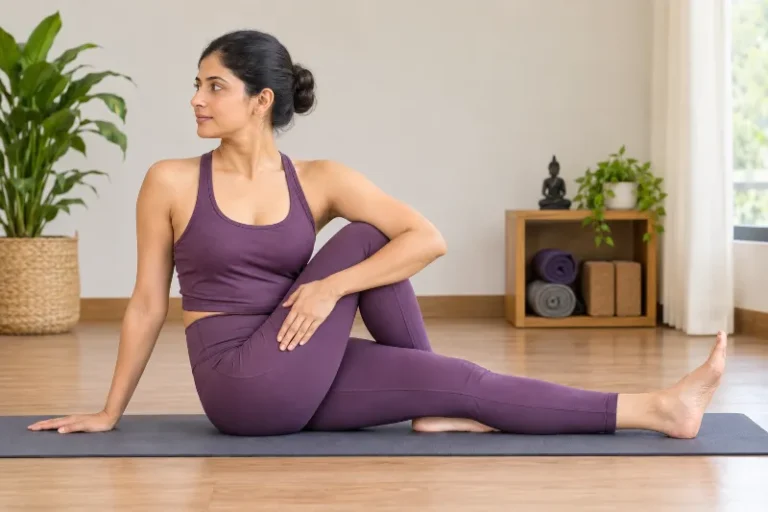
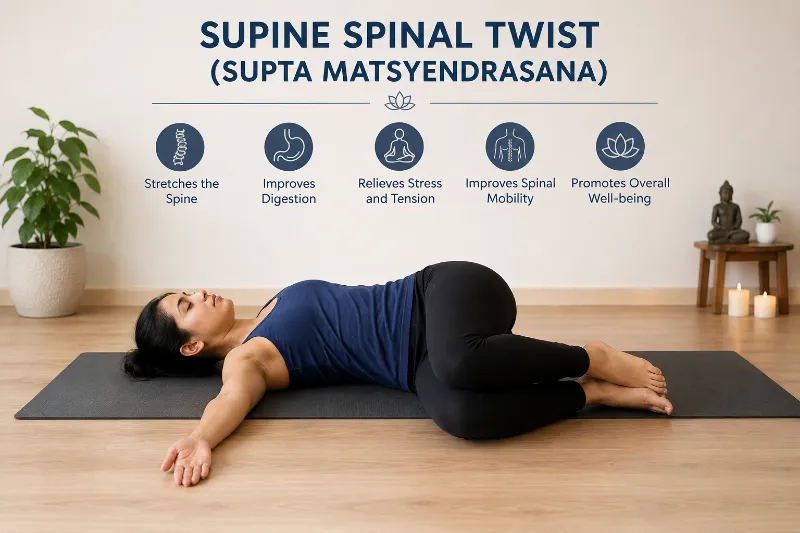
Supine Spinal Twist (Supta Matsyendrasana)
What is Supta Matsyendrasana (Supine Spinal Twist)?
Supta Matsyendrasana, also known as Supine Spinal Twist, is a mild yoga pose in which you lie on your back and gently rotate your spine. It facilitates healthy digestion, increases spinal flexibility, and eases tension in the shoulders, hips, and lower back. This soothing twist is well-liked for restorative exercises, cool-downs, and nighttime routines because it also aids in nervous system relaxation.
This posture encourages deep release and relaxation, whether you’re recovering from a workout or slowing down from a demanding day.
Supine Spinal Twist: Synopsis and Significance of Supta Matsyendrasana
Asana means “pose” or “posture,” Matsyendra refers to the “Lord of the Fishes,” a fabled yogi who is credited with discovering the mysteries of Hatha Yoga, and Supta means “reclined” or “lying down.”
When combined, Supta Matsyendrasana means “Reclined Lord of the Fishes Pose.” In honor of Sage Matsyendranath, one of the pioneers of Hatha Yoga, it is a supine variation of the traditional seated twist, Ardha Matsyendrasana.
Although its current reclining variant evolved for improved accessibility and comfort, this position has profound roots in the classical practice of yoga. This little supine twist promotes calmness, relaxation, and mild spinal decompression by letting gravity direct the movement. Because of its relaxing and healing properties, it is often utilized in restorative, yin, and therapeutic practices in modern yoga.
At a Glance
- Sanskrit Name: सुप्त मत्स्येन्द्रासन (Supta Matsyendrasana)
- Pronunciation: SOOP-tah MAHT-see-en-DRAHS-anna
- English names include Supine Twist Pose, Reclined Spinal Twist, and Supine Spinal Twist.
- Pose Type: Supine twist, restorative, spinal rotation
- Level: Beginner to Intermediate (accessible with modifications)
- Duration: 30 seconds to 5 minutes per side
Benefits of Supta Matsyendrasana (Supine Spinal Twist)
Supta Matsyendrasana provides an amazing combination of energetic, mental, and physical advantages. One of the most healing poses in yoga, this soft reclining twist promotes deep relaxation, helps with digestion, and restores spinal balance.
The main health, digestive, mental, and emotional advantages of regularly performing supine spinal twists are listed below.
Physical Benefits
- Enhances spinal mobility: Maintaining proper spinal alignment, reducing stiffness, and increasing flexibility are all made possible by the mild spinal rotation.
- Relieves hip and lower back strain: The mild twist relieves tension in the hips, glutes, and lumbar spine; it’s particularly useful for easing stiffness caused by prolonged sitting or driving.
- Opening the chest and shoulders helps counteract the forward-head posture and rounded shoulders that are typical of desk workers.
- Relieves sciatica pain: This position promotes spinal decompression and relieves mild sciatic nerve stress with conscious alignment.
- Enhances alignment and posture: Supta Matsyendrasana reestablishes symmetry and neutral spine alignment by rebalancing both sides of the body.
- Increases breathing capacity: Deeper and more effective breathing is made possible by the intercostal muscles being opened by the expansion of the ribcage.
Digestive & Detox Benefits
- Digestion is stimulated by the twisting action, which increases peristalsis and improves nutrient absorption by massaging the digestive organs.
- Reduces bloating and constipation: The mild pressure applied to the abdomen facilitates regular bowel movements and helps release trapped gas.
- Supports liver and kidney function: Twists help the body’s detoxification activities by improving circulation to detoxifying organs.
- Helps with metabolism and elimination: The rhythmic compression-decompression action revitalizes internal organs and promotes metabolic equilibrium.
Mental & Emotional Benefits
- Encourages deep breathing, mental relaxation, and a sense of calm: The soft, reclined twist triggers the body’s relaxation reaction.
- Enhances the quality of sleep: This pose is perfect before bed since it calms the mind, lessens restlessness, and encourages restorative sleep.
- Emotional strain is released: Twists frequently relieve emotional tension that has been stored in the abdomen and torso.
- Encourages mindfulness and relaxation: Promotes inner peace and awareness of subtle sensations.
How to Do Supta Matsyendrasana (Supine Spinal Twist): Step-by-Step Guide
Supta Matsyendrasana (Supine Spinal Twist) may seem straightforward, but when performed mindfully, it is incredibly revitalizing. To safely reap the full benefits of this pose, follow this gentle, step-by-step tutorial.
Part 1: Preparing for the Pose
Prepare your body with gentle movement and grounding breathwork before performing Supta Matsyendrasana.
Supine Knee-to-Chest Pose (Apanasana)
- Releases tension from the hips and spine and warms the lower back.
- With your shoulders relaxed and your legs extended, lie on your back.
- Holding your shins or knees with your hands, bring one or both knees to your chest.
- Breathe slowly for five to eight breaths while keeping your lower back firmly pressed into the mat.
Gentle Supine Hip Circles
2. Enhances pelvic circulation and releases constricted hip joints.
- Hug one knee close to your chest while lying on your back.
- Start softly circling the knee in one way, then turn it around.
- After a few rounds, change sides while breathing.
Reclined Butterfly Pose (Supta Baddha Konasana)
3. Calms the body and mind and opens the inner thighs and groin.
- While lying on your back, spread your knees wide apart and bring the soles of your feet together.
- If you need assistance, place pillows or blocks beneath your knees.
- For one to two minutes, take deep breaths while keeping your hands by your sides or on your tummy.
4. Softly energizes the body while strengthening the spine and glutes.
- With your arms by your sides, knees bent, and feet hip-width apart, lie on your back.
- Keeping your knees in line, push into your feet to raise your hips toward the ceiling.
- One vertebra at a time, slowly descend after holding for three to five breaths.
Part 2: Step-by-Step Instructions
Close your eyes and take a few deep breaths to help you relax while lying comfortably on your back with your legs outstretched, arms spread out in a T shape, and palms facing up.
To relieve your lower back, bend your knees and softly bring them to your chest while rocking slightly from side to side.
Keeping both shoulders firmly planted on the mat, extend your arms back to shoulder height, palms up or down for comfort.
With both knees stacked or slightly apart, slowly drop them to the right side as you exhale. Do not force the twist; instead, let gravity guide them down.
If your neck feels tight, maintain your head neutral or gently turn it to the left, away from your knees.
Use your right hand to gently press your top knee to deepen the twist, or adjust by supporting your knees with a folded blanket or block.
Breathe deeply into your belly and let your body soften with each exhale while holding the twist for one to three minutes.
Breathe in to bring your knees back into alignment, then gently hug them to your chest to balance the spine.
Breathe out, turn your head to the right, and repeat the twist on the left side. Hold for the same amount of time.
Go back to the center, hug your knees to your chest again, and then spread your legs wide on the mat while either lying still or performing Savasana.
Alignment & Safety Tips
- Keep both shoulders grounded as much as possible
- Avoid forcing knees to the floor
- Support knees with props
- If your back feels strained
- Move gently and slowly
- Never push into discomfort
- Keep your head neutral if you have neck sensitivity
- Engage your core slightly when returning to center
- Let gravity guide your twist, not effort
- Learn the Supine Twist with a coach, step-by-step. Get a free one-on-one consultation now!
Supta Matsyendrasana Variations
There are numerous ways to adjust or deepen Supta Matsyendrasana (Supine Spinal Twist) to suit your level of comfort, energy, and flexibility on any given day. The variants below let you safely customize the position, whether you’re trying to push your range, recuperate from stiffness, or explore deeper releases.
Beginner Modifications
Supported Supine Twist
- relieves pressure on the hips and lower back while gently decompressing the spine.
- Bring both knees up to your chest while lying on your back.
- Put a folded blanket or bolster beneath your knees to provide support as you lower them to one side.
- Maintaining both shoulders grounded, extend your arms in a T-shape.
Feet-on-the-Wall Variation
2. Supports tense hamstrings and gives complete control over the twist’s severity.
- After taking a sideways seat near a wall, lie down and raise your legs up the wall.
- Feel a slight twist in your spine as you slowly move your feet to one side.
- Bend your knees or put a blanket under your hips to change the depth.
Single-Leg Twist (Half Supta Matsyendrasana)
3. Relieves stiffness in one lower back side and hip at a time.
- With one leg outstretched and the other crossed over the body, lie on your back.
- Keeping your shoulders firmly planted, place your upper knee on the floor or a cushion.
- For a balanced twist, turn your head away from the bent knee.
Higher-Knee Position
4. Maintain a slight spinal twist while being gentle on tight hips and lumbar spine.
- Bend your knees while lying on your back and only twist them 45 to 60 degrees toward the floor.
- Place a block or pillow underneath to support your legs.
- Both shoulders should be grounded and at ease.
Intermediate Variations
Extended Leg Variation (Supta Matsyendrasana II)
5. Increases flexibility in the hip, hamstring, and IT band.
- Stretch your upper leg straight across your body from the twist.
- Maintain a bent or straight lower leg on the ground.
- If your hamstrings are tight, grasp the outstretched leg with a strap.
Eagle Legs Supine Twist
6. intensifies the strain in the obliques, outer thighs, and hips.
- In the Garudasana (Eagle Pose) pose, cross one leg over the other.
- With your shoulders flat on the mat, lower both legs to one side.
- Breathe evenly and let your legs drop.
Arm Bind Variation
7. Enhances the spinal twist while compressing and massaging the digestive organs.
- Put your arms over both knees and hug them toward your chest.
- While keeping the bind in place, slowly lower the knees to one side.
- Don’t pull; instead, breathe steadily.
Advanced Variations
Both Legs Extended Twist
8. Stretches the hips and hamstrings while using the entire spinal column.
- Extend both legs while lying on your back, then descend them together to one side.
- To preserve your spine, move carefully and keep your shoulders grounded.
- Before changing sides, hold for a few breaths.
Weighted Supine Twist
9. Gently apply grounding pressure to promote deeper release.
- Put a small yoga weight or sandbag on your upper thigh while you twist.
- Allow the weight to improve the stretch while keeping your shoulders relaxed.
- Take a deep breath, then slowly release it.
Supta Matsyendrasana Precautions & Contraindications
Like any spinal rotation, Supta Matsyendrasana (Supine Spinal Twist) is a mild and approachable yoga pose that needs to be done carefully. Safety and long-term benefits are ensured by paying attention to your body and recognizing when to change (or omit) the position.
Avoid Supta Matsyendrasana If You Have:
- Recent abdominal or spinal surgery
- Acute disc herniation or severe back injury
- Advanced pregnancy (2nd or 3rd trimester)
- Uncontrolled high blood pressure
- Recent hip or knee surgery
- Acute muscle spasm
Practice with Caution or Modifications If You Have:
- Mild back pain or stiffness
- Hip tightness or SI joint issues
- Neck sensitivity
- Pregnancy (1st trimester)
- Sciatica
- Digestive issues (IBS, bloating, constipation)
- Osteoporosis
Safety Guidelines
- Let your breath and gravity guide you; never push or force the twist.
- If one shoulder lifts, lower the range and keep both planted.
- To keep comfort and alignment, feel free to use props like blankets, bolsters, and blocks.
- Move slowly between sides to protect the spine.
- If you get radiating or acute pain, stop right away.
- Return to center with a modest engagement of your core to stabilize your spine.
- Breathe continuously — avoid holding the breath.
- To keep equilibrium, hold for the same amount of time on either side.
- Schedule a free one-on-one session right now to practice Supine Spinal Twist as safely as possible!
Related Yoga Poses
Supta Matsyendrasana (Supine Spinal Twist) opens the hips, stretches the spine, and prepares the body for profound relaxation. It also works well with other restorative supine poses. Flexibility, balance, and general spinal health can all be improved by practicing these complementing poses.
Supine Pigeon (Supta Kapotasana)
- Relieves discomfort from prolonged sitting by deeply releasing tightness in the glutes and hips.
- Make a figure-four shape by lying on your back with your right ankle crossed over your left leg.
- Holding the back of your shin or leg, slowly bring your left knee to your chest.
- Breathe into the stretch while maintaining a relaxed head and shoulders.
Reclined Hand-to-Big-Toe Pose (Supta Padangusthasana)
2. Improves hamstring flexibility and helps realign hips and lower back.
- While lying on your back, raise one leg straight up and stretch the other along the floor.
- Maintaining both hips grounded, grasp your elevated foot with your hand or a strap.
- Take a deep breath and slowly pull the leg in your direction.
Wind-Relieving Pose (Pavanamuktasana)
3. Stimulates digestion, eases bloating, and releases lower back tension.
- Bring one or both knees to your chest while lying flat on your back.
- With your head and shoulders relaxed, give your knees or shins a gentle hug.
- To massage the lower back and abdomen, gently rock from side to side.
Happy Baby Pose (Ananda Balasana)
4. Releases tension in the sacrum and lower spine and opens the inner thighs and hips.
- Bend your knees to your chest while lying on your back.
- Using your hands, grasp the outside of your shins, ankles, or feet.
- Maintaining your ankles above your knees, slowly draw the knees toward the armpits.
Seated Spinal Twist (Ardha Matsyendrasana)
5. Strengthens and lengthens the spine while improving spinal flexibility and digestion.
- Bend your right knee and place the foot outside your left thigh after taking a lofty seat with both legs outstretched.
- Exhale to gently twist to the right, putting your left elbow outside your right knee, then inhale to stretch your spine.
- Hold for a few breaths, keeping your shoulders loose and your spine erect.
FAQs
What is the benefit of Supta Matsyendrasana?
Supta Matsyendrasana (Supine Spinal Twist) releases deep tension from the lower back while gently stretching the shoulders, hips, and spine. It helps with digestion, increases spinal mobility, and stimulates the parasympathetic nervous system, which lowers stress and calms the mind.
How long should you hold Supta Matsyendrasana?
Depending on comfort and experience, hold the pose for 30 to 3 minutes on each side. In order to promote relaxation and mild spinal release, you can spend up to five minutes in restorative practice with the right kind of support beneath your knees.
Can beginners do Supta Matsyendrasana?
Definitely. One of the most accessible spinal twists in yoga for beginners is Supta Matsyendrasana. All skill levels can safely and easily participate by using supports like a blanket or cushion under the knees. It’s perfect for ending a yoga practice with balance and serenity and for easing into spinal mobility.
When is the best time to do Supta Matsyendrasana?
Supta Matsyendrasana (Supine Spinal Twist) is best performed before bed or at the conclusion of your yoga practice. It reduces tension from deeper positions, aids in the body’s cooling process, and primes the neurological system for relaxation.
Additionally, you can practice it at any time of day to reduce stress or stiffness in your back from prolonged sitting. For best comfort, just make sure your stomach is empty or light.
How Are Supta Matsyendrasana and Jathara Parivartanasana Different from Each Other?
While both are reclining twists, Supta Matsyendrasana is a mild, healing twist that emphasizes breathing and relaxation while bending and supporting the knees.
Jathara Parivartanasana is a more strenuous variant that presents a deeper challenge to the spine and abdomen. It involves extending the legs and using the core muscles to control movement.
What Makes Supta Matsyendrasana Different from the Seated Version of Matsyendrasana?
Lying on one’s back, Supta Matsyendrasana emphasizes breath awareness, spinal decompression, and relaxation.
Ardha Matsyendrasana, also known as Seated Matsyendrasana, is an upright pose that increases spinal length and core engagement while needing greater strength and flexibility.
References
- Allen, W. (2026, March 24). Supta Matsyendrasana. https://myyogateacher.com/yoga-asana/supta-matsyendrasana-supine-spinal-twist
- Supine Spinal Twist – Supta Matsyendrasana – The Yoga Collective. (2022, February 14). The Yoga Collective. https://www.theyogacollective.com/poses/supine-spinal-twist-supta-matsyendrasana/
- The Art of Living. (2018, October 3). Supine Spinal Twist (Supta Matsyendrasana). Art Of Living (United States). https://www.artofliving.org/us-en/supine-spinal-twist-supta-matsyendrasana