Matsyasana (Fish Pose)
What is Matsyasana (Fish Pose)?
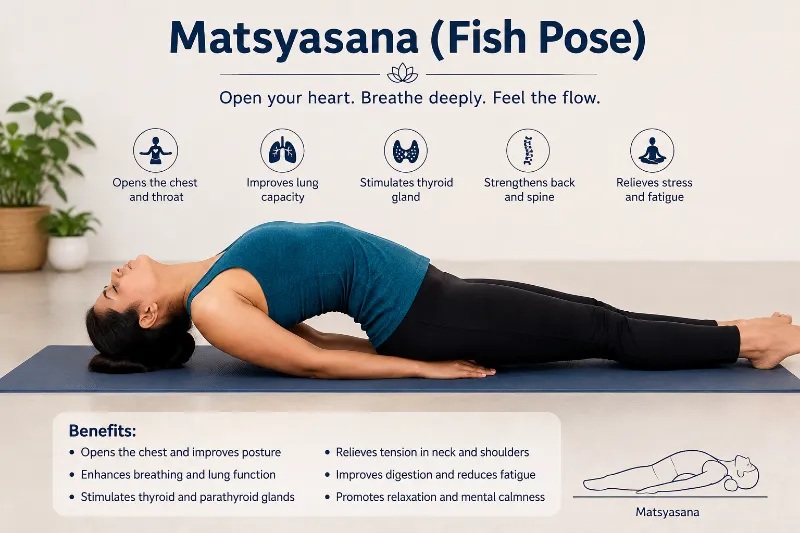
Fish Pose, or Matsyasana, is a reclining back pose that opens the chest. In order to release tension in the shoulders, neck, and spine, it is typically executed as a counterpose following a headstand or shoulder stand.
In Matsyasana, your arms can be positioned beneath your pelvis, which rests on the floor. With your head resting on the mat and your elbows bent to support your core, you can have your legs straight or bent. When you strike this position, you should arch your back and raise your chest.
This pose promotes wisdom, emotional healing, and improved hormonal balance by activating your head, throat, and eye chakras.
Overview & Etymology
The Sanskrit terms “Matsya” (which means fish) and “Asana” (which means posture) are combined to form Matsyasana. This stance can assist the human body in floating if done in the water. It is called Fish Pose because of this.
Ancient yoga writings, such as the 17th-century Gheranda Samhita, an encyclopedia of hatha yoga positions, reference Matsyasana. One of the 12 fundamental yoga poses in Hatha yoga, the fish pose is also included in the foundational postures sequence of Ashtanga yoga.
Hindu mythology states that the ultimate deity Vishnu took on the form of a fish, or Matsyavatar. By constructing a boat, he saved the Vedas, the seven sages, and Vaivasvata Manu, the first man, from a massive flood.
The Matsya Purana, one of the eighteen Mahapuran (a massive body of Hindu literature), elaborates on the knowledge and wisdom that Lord Vishnu imparted to Manu. Thus, the fish position represents knowledge, loyalty, and karma.
- Sanskrit Name: मत्स्यासन
- Pronunciation: maht-see-AHS-uh-nuh
- Pose Type: Fish Pose, often called Backbend and Chest Opener
- Strengthens: Upper Back and Neck
- Stretches: Spine, Throat, Chest, Psoas Muscles, and Abdomen
Health Benefits of Matsyasana
- Improves posture.
- Opens the chest and ribs.
- Improves breathing capacity.
- Activates crown, eye, and throat chakras.
- Activates the thyroid and pituitary glands.
- Lengthens the spine and increases its flexibility.
- Enhances organ functioning in the digestive system.
- Reduces tension and stress in the back and neck.
- Enhances blood flow to the throat, spine, and shoulders.
- Relieves period cramps and maintains the balance of the female menstrual cycle.
When to Avoid Performing Matsyasana
- Avoid if you have osteoporosis.
- Avoid if you are experiencing a migraine or vertigo.
- Avoid if you have degenerative disc disease.
- If you experience persistent neck or back pain, stay away.
- Avoid this pose if you have recently had any injury or surgery.
Key Principles
Remember these essentials before you start. In Matsyasana, the arch originates from the chest and upper back rather than the neck. Gradually enter the backbend, particularly if your spine is rigid. To preserve the lumbar spine and stabilise the lower body, keep your legs moving and softly press them into the mat. Never push through excruciating lower back or neck pain.
How to do Matsyasana (Fish Pose)
The Matsyasana exercise is broken down into four sections below for novices:
Part 1 – Preparatory Poses for Matsyasana
Achieving the ideal fish posture requires warming up the shoulders, neck, low back, and spine.
Warm-up yoga poses to stimulate your muscles and increase blood flow include the following:
- Kneeling back-bend is another name for this pose. With your spine extended and your core muscles steady, begin by standing on your knees. Breathe in to open your chest, then start to bend your neck back.
Hold both ankles with your fingers while slowly opening your chest and arching your lower back. Hold the position while you exhale after taking an extended breath. Every muscle needed for Fish Pose is opened by this pose.
Salabhasana (Locust Pose)
- This back bend position is perfect for beginners and is a great technique to develop the core and lower back muscles. Start by resting on your stomach and using your entire body, including your core.
Then take a breath, raise your legs off the mat, and keep your arms by your sides. Keep your eyes focused on the sky. Hold this position for ten to sixty seconds.
Part 2: Step-by-Step Instructions to Perform Matsyasana
To perform Matsyasana, also known as Fish Pose, follow these steps:
- Step 1: Take a breath and begin by sitting in staff or lotus position. Breathe a few times deeply.
- Step 2: Lower yourself completely onto the yoga mat to start.
- Step 3: Place your arms beneath your lower back, placing your palms against the mat directly beneath your tailbone.
- Step 4: Inhale deeply once again while maintaining a grounded head.
- Step 5: Lift your neck, spine, and chest off the mat gently, as if a thread were dragging them all up to the ceiling. Continue to contract your chest muscles with your subsequent breath.
- Step 6: To brace your spine, put your elbows and palms against the yoga mat while keeping your back curved.
- Step 7: Hold Fish Pose and take long breaths to relax your body.
- Step 8: After a few seconds of holding this stance, gradually release your neck, spine, and chest in that order.
Breath Awareness:
- Inhale: While positioning your arms beneath your low back, lifting your neck and spine, and assuming the starting position.
- Exhale: During the posture hold and while raising your chest.
- For beginners, hold Matsyasana for fifteen to thirty seconds.
- Advanced Performance Duration: Maintain Matsyasana for sixty to ninety seconds.
Part 3: Things to Keep in Mind
Your neck and spine are held in a dangerous posture while you practice the Fish pose. As a result, it’s critical to remember some of the posture cues listed below:
Avoid straining your head or neck: Without any prior strength training, holding your head, neck, and spine in Fish pose for an extended period of time may cause severe spinal injuries or cramping in your muscles. Try taking short pauses every few seconds to first gain adequate strength for extended holding.
Maintain head stability by keeping the crown of your head attached to the ground. Make an effort to align your head with your neck, spine, tailbone, and core.
Avoid overarching your back: The most frequent error made by Matsyasana practitioners is to overarch their lower back while minimising the arch in their upper back. It should be the other way around. Tuck your tailbone flat into the mat and use your core muscles to solve this issue. Now, while your palms press into the mat, attempt to arch your upper spine.
Part 4: Relaxing Poses After Matsyasana
To ensure that your neck, upper back, and spine return to their neutral shape, make sure you’re relaxing them in counter yoga poses.
Following your Fish position practice, try these two counter yoga poses to unwind:
Pavan Muktasana (Wind Release Pose with Head Up):
- The head, neck, shoulders, and spine should all be relaxed on the ground while you lie on your back following your Matsyasana practice. Now take a deep breath while pressing your neck, core, and spine into the yoga mat.
Then, one by one, raise your legs to your chest and use both arms to embrace them. To relax your entire body, close your eyes, keep your spine flat on the mat, and breathe in and out for two to three minutes.
Shavasana (Corpse Pose):
- Proceed to transition from the Wind Release position to the Corpse position. Extend both legs on the floor after releasing them from the yoga mat. Arms and legs should be spread slightly at your sides.
In this posture, close your eyes and take several deep breaths. Focus on how your breath travels from your toes to the top of your head. Recall that your ability to recognise and fully relax any tense muscles in your body will increase with your level of focus.
Common Mistakes to Avoid in Matsyasana
Bearing Weight on the Head and Neck
Allowing too much body weight to press down through the head is the most common mistake made in Matsyasana. The head hardly touches the mat; the elbows and forearms provide most of the support. Re-engage your forearms and raise your chest if your neck feels tight or constricted.
Collapsing the Chest Rather Than Arching It
Many novices just lean their heads back without raising their sternums. Contrary to what the position aims for, the consequence is a compressed chest with an overextended neck. Prioritise the chest’s upward movement; the head will naturally follow as a secondary movement.
Letting the Legs Go Limp
The lower back experiences needless strain when the legs are passive. Maintain both legs active by aggressively reaching through your heels and lightly pressing your thighs into the mat. This tiny change stabilises the entire position while protecting the lumbar spine.
Holding the Breath
Many people unintentionally limit their breathing because the chest position feels strange. This eliminates a large portion of the yoga pose’s relaxing effects. Throughout the hold, intentionally breathe deeply and slowly via your nose; keep your chest open to facilitate this.
Rushing the Entry and Exit
When exiting Matsyasana, jerking the head upward is a frequent and preventable injury risk. Always use the forearms to guide the movement and carefully tuck the chin before lowering the head. Once you are flat on the mat, take at least two breaths before moving on to the next pose.
Placing the Elbows Too Wide Apart
The leverage required to raise the chest is lost when the elbows spread out. Maintaining the arch is much simpler when the elbows are kept as close to the sides of the body as possible. This concentrates the lifting force just beneath the chest.
Matsyasana Variations to Consider
You might want to deepen your Matsyasana practice because each yogi has a different amount of mental and physical stamina. You may make your heart-opening yoga practice more enjoyable, relaxed, and challenging by using these versions of the Fish Pose.
Fish Pose with Lotus Legs:
- Lower yourself onto your back while seated in Padmasana. Take a breath, press your elbows into the yoga mat, and grip your alternate big toes.
Raise your neck, back of your head, tailbone, spine, and chest off the surface with the help of your elbows. After a few seconds of holding the pose with deep exhalations, gradually release the stance by letting your spinal arch relax.
Fish Pose with Arms Overhead:
- Try deepening the arch in your lower back and stretching your arms overhead while in the Matsyasana position if your spine feels strong and you can hold Fish Pose for more than a few seconds without putting any strain on your neck.
You should experience a deep flex in your entire spine and core muscles after holding this posture variation for at least 30 to 60 seconds.
Fish Pose with Raised Legs & Arms:
- It’s time to engage and raise both your legs and arms off the mat now that you’ve mastered the techniques of performing Fish Pose with lotus legs and Fish Pose with arms aloft.
Slowly move both of your arms in front of you at an angle after striking the fish posture with your arms raised. Hold this variation stance for as long as you feel comfortable, using your core muscles to elevate each leg individually.
This form of Fish Pose will help tone your arms, legs, and shoulders and burn fat in your lower abdomen, among many other popular benefits.
FAQs
Can beginners perform Matsyasana?
For improved spine flexibility, neck strength, and chest opening, novices can incorporate the Matsyasana (Fish Pose) into their regular yoga practice.
What are the benefits of Matsyasana?
Among Matsyasana’s advantages are the following:
Stimulates thyroid gland activity.
Boosts immunity
Builds flexibility
Strengthens the neck
Alleviates mild low back pain
Enhances digestive system functioning
What is Ardha Matsyasana?
Half Lord of the Fishes, or Ardha Matsyasana, is a spinal twist performed while seated. This pose is intended for novice and intermediate yogis who wish to strengthen their lower back muscles in order to perform deeper backbends.
What is Saral Matsyasana?
A simple form of the deep Matsyasana practice is Saral Matsyasana, often known as Easy Fish pose. To begin, place both arms by your sides while resting on your back. To elevate your head, neck, and chest slightly above the yoga mat, press your fingertips against it. This variation’s appeal is that anyone may do it without running the risk of suffering a major injury.
What are the different stretches in Matsyasana?
Matsyasana is a yoga pose that simultaneously extends your neck, low back, core, and mid-back, opening your heart and stretching your spine.
Who should avoid performing Matsyasana?
Matsyasana should not be performed by yoga practitioners who have osteoporosis, migraines, vertigo, degenerative disk disease, chronic back pain, or any injuries related to the neck or spine.
References
- Allen, W. (2026g, February 27). Matsyasana. https://myyogateacher.com/yoga-asana/matsyasana
- Yoga Journal. (2025h, February 25). Fish pose. https://www.yogajournal.com/poses/fish-pose/
- Ashish, Y., & Yogshala, H. (2026, August 22). Matsyasana Yoga (Fish pose) For Beginners – How To Do & Benefits? Haritha Yogshala. https://harithayogshala.com/blog/matsyasana-yoga