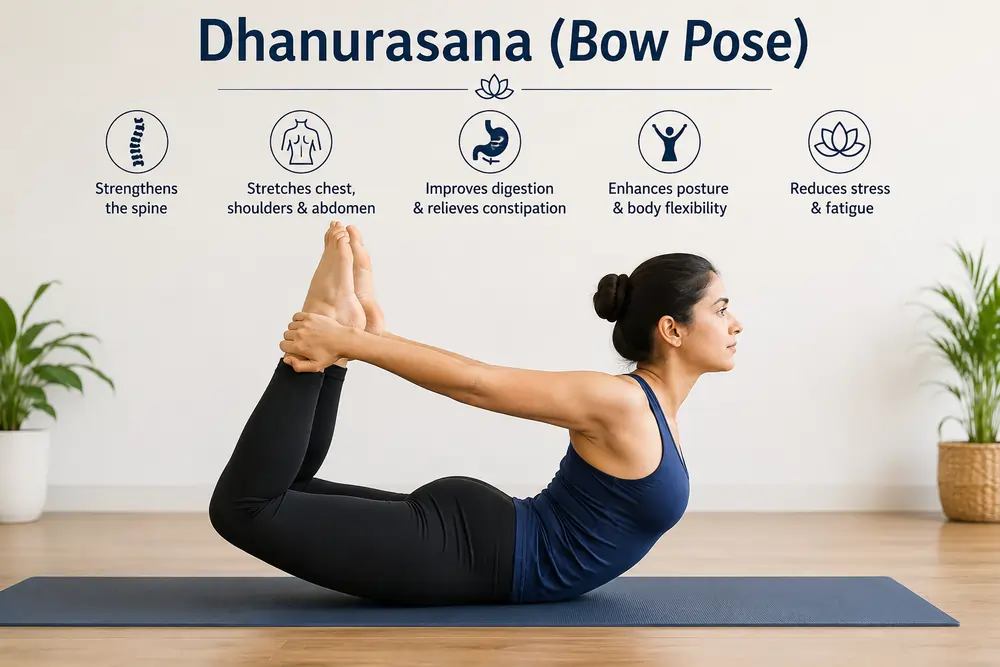
Dhanurasana (Bow Pose)
What is Dhanurasana (Bow Pose)?
“Bow pose” (Dhanurasana), a prone backbending yoga practice, strengthens the entire back, expands the chest, and increases spinal flexibility. The name comes from the Sanskrit terms “Dhanu” (bow) and “Asana” (position). When done attentively, this intermediate-level position improves posture, fortifies the core, and stimulates the digestive system.
Dhanurasana is a potent pose that strengthens the spine and digestive system and awakens vital energy (prana), according to traditional Hatha Yoga literature such as the Gheranda Samhita and Hatha Yoga Pradipika.
It was originally done to develop strength, control, and focus, much like an archer practising to shoot an arrow. Dhanurasana is still a crucial backbend in Hatha and Vinyasa sequences in contemporary yoga because it blends strength, flexibility, and energy activation. In order to revitalise the body and get prepared to do deeper, heart-opening poses, it is often performed midway through practice.
By strengthening the spine, core, and hip flexors, regular practice helps combat slouching and sedentary habits. Additionally, this pose stimulates internal organs, enhances digestion, and corrects posture. By accessing the heart centre, this position promotes energy and emotional release in addition to physical benefits.
At a Glance
- Sanskrit Name: धनुरासन (Dhanurasana)
- Pronunciation: Dah-noor-AH-suh-nuh
- English Name: Bow Pose
- Pose Type: Prone backbend, chest opener, full-body strengthener
- Level: Intermediate?
- Duration: 20 seconds – 5 minutes
Muscle Work During Dhanurasana:
- Arms and Shoulder Muscles
- Back Muscles
- Biceps and Triceps
- Core Muscles
- Gluteus Muscle
- Hamstring Muscle
- Chest Muscles
- Hip and Knees Muscles
- Neck Muscles
Benefits of Dhanurasana (Bow Pose)
A mix of strength, flexibility, and rejuvenation is provided by bow pose. When practised mindfully, this backbend improves posture, digestion, energy, and confidence, among other physical and emotional benefits.
Physical Benefits
- Strengthens the back: Reduces tension in the upper and lower backs and creates a strong, supportive spine.
- Expands the lungs, enhances breathing, and aids in reversing slouching by opening the shoulders and chest.
- Enhances spinal flexibility: Promotes healthy movement and a flexible, mobile spine.
- Enhances digestion: The mild pressure applied to the abdomen increases metabolism and stimulates the digestive organs.
- Tones the legs and glutes: To increase strength and stability, activate the quadriceps, hamstrings, and glutes.
- Enhances posture: By mitigating the effects of slouching or desk work, it helps you stand higher.
- Hip flexors are opened, releasing stiffness brought on by extended sitting.
Therapeutic Benefits
- Promotes respiratory health: Opening your chest can help with shallow breathing and mild asthma.
- Helps with digestion: Constipation, bloating, and slow digestion may all be alleviated by abdominal compression.
- Reduces menstrual pain: Spinal stretches and pelvic stimulation might promote regular cycles and lessen cramps.
- Increases vitality: Activates adrenal glands, fights exhaustion, and lessens sluggishness.
Emotional & Spiritual Benefits
- Lowers tension and stress: Heart-opening posture promotes relaxation and emotional release.
- Increases self-confidence: Expansive poses foster a feeling of strength and self-worth.
- Enhances focus and mindfulness: Maintaining a steady breath while balancing the lift improves focus.
- Represents strength and preparedness: The position, like a drawn bow, represents vigour, attentiveness, and self-determination.
- Promotes emotional equilibrium: To promote serenity and clarity, physical openness and breath awareness are combined.
How to Do Dhanurasana (Bow Pose): Step-by-Step Guide
Part 1: Preparing for Bow Pose
It’s crucial to open up the hip flexors, mobilise the spine, and prepare the back for extension before attempting Dhanurasana.
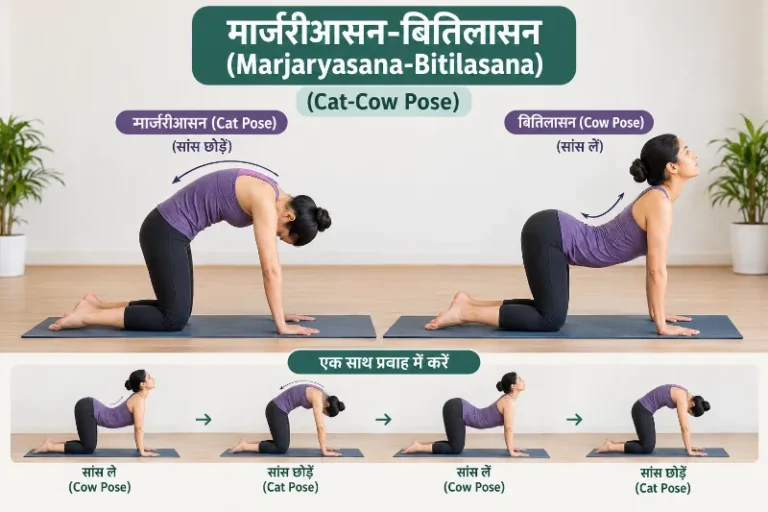
Cat-Cow Pose (Marjaryasana–Bitilasana)
- This vigorous exercise warms the shoulders and back while gently mobilising the spine.
- With knees beneath hips and wrists beneath shoulders, begin on all fours.
- Breathe in as you raise your chest and tailbone while arching your back (Cow Pose).
- Breathe out as you tuck your chin into your chest and round your back (Cat Pose).
- Continue flowing with your breath for 5–8 rounds.
Cobra Pose (Bhujangasana)
- helps the back muscles become ready for Dhanurasana’s deeper extension.
- With your elbows close to your body and your palms next to your ribs, lie on your stomach.
- Take a breath, push your hands together, and raise your chest off the mat.
- Keep shoulders relaxed and elbows slightly bent.
- Hold for 3–5 breaths, then release gently.
Locust Pose (Salabhasana)
- This pose strengthens the back and glutes and engages the spinal extensors.
- Place your arms beside your body, palms down, and lie face down.
- Take a breath and raise your legs, arms, and torso off the mat.
- Engage your core and gaze slightly forward.
- Hold for 3–5 breaths, then lower with control.
- In addition to preparing the front body for backbending, this pose opens the hip flexors.
- Step your right foot forward between your hands from the Downward Dog position.
- Untuck your toes and lower your left knee to the ground.
- Breathe in, raise your chest, and extend your arms overhead.
- Hold for 3–5 breaths, then switch sides.
Part 2: Step-by-Step Instructions
- On your mat, lie face down with your arms by your sides, legs hip-width apart, and your forehead lightly resting on the ground. To centre yourself, inhale deeply many times.
- Breathe out and pull your heels closer to your glutes by bending your knees. Maintain hip-width distance between your knees.
- Hold your ankles tightly by extending your arms back. If you’re unable to reach, wrap a yoga strap over your ankles.
- Take a breath, raise your thighs and chest off the mat at the same time, and press your feet into your hands. Continue to work your lower abdomen.
- To deepen the arch, push your feet away from your hands. Elevate the thighs and extend the chest in front.
- Look straight ahead or up a little. Keep your breathing steady and rhythmic.
- Hold the Pose:
- Beginners: 20–30 seconds
- Intermediate: 30–60 seconds
- Advanced: 2–6 minutes (with rest between rounds)
- Breathe out, relax your thighs, lower chest, and ankles gradually to the mat, and place your forehead on the ground. To ease your back, take a deep breath.
Part 3: Alignment & Safety Tips
- Use your core and glutes to protect your lower back.
- Press feet into hands; don’t pull with arms
- Keep your shoulders away from your ears
- Maintain hip-width leg position
- Never force the depth; use props if needed
- Learn Bow Pose step-by-step with a coach. Book a free 1-on-1 session today!
Bow Pose Variations
Dhanurasana, often known as bow pose, can be modified to accommodate varying degrees of strength and flexibility. These variations, ranging from easy modifications for beginners to challenging advanced versions, help you safely explore deeper heart-opening expressions, improve mobility, and improve your back.
Beginner Modifications
Ardha Dhanurasana (Half Bow Pose)
- Gradually increases strength and reduces lower back pain.
- While maintaining the opposite leg firmly planted, bend one knee and grip the ankle while lying face down.
- Lift chest and thigh gently.
- Hold for 20-30 seconds. Repeat on the other side.
Strap-Assisted Bow
- Maintains alignment while making the pose accessible for people with short arms or tight shoulders.
Lift your thighs and chest while holding a yoga strap that you have looped around your ankles.
Hold for 20–40 seconds.
Supported Chest Bow
- Reduces intensity while building back strength and confidence.
- Place a bolster under the chest.
- If you can, raise the legs and hold onto the ankles.
- Focus on gentle back engagement.
- Hold for 30-60 seconds.
Intermediate Variations
Parsva Dhanurasana (Side Bow Pose)
- Enhances lateral spine flexibility and stimulates digestion.
- Lift your knees and chest as you gradually roll onto one side from a complete bow.
- Hold for 15–20 seconds per side.
Dynamic Bow (Rocking Bow)
- Heats the spine, increases flexibility, and rubs the abdomen.
- Rock forward and backwards gently while in full Bow, coordinating movement with breath.
- Continue for 5–8 rocking motions.
Advanced Variations
Akarna Dhanurasana (Shooting Bow Pose)
- Develops hip flexibility, balance, and concentration.
- While seated, reach the arms in a bow-like position, draw the opposing foot toward the ear, and extend one leg forward.
- Hold for 20–30 seconds per side.
Dandayamana Dhanurasana (Standing Bow Pulling Pose)
- Strengthens legs, improves balance, and integrates full-body coordination.
- Hold the opposing ankle behind you while standing on one leg, then extend the other arm forward while maintaining balance.
- Hold for 15–20 seconds per side.
Dhanurasana (Bow Pose) Precautions & Contraindications
Although bow stance is quite simple, there are a few safety precautions to be aware of.
Avoid Bow Pose if you have:
- Deep backbends might put stress on recovering tissues in cases of serious spinal injuries or recent back surgery.
- Chronic spinal ailments or herniated disks: The position may exacerbate pre-existing conditions.
- Pregnancy: After the first trimester, the prone position is dangerous.
- High or low blood pressure: Circulation is impacted by strenuous backbends.
- Neck injuries: This pose’s head position may make strain worse.
- Severe migraines or headaches: The strength of a backbend may cause symptoms.
- Recent abdominal surgery: Healing may be slowed by pressure on the abdomen.
Practice With Caution in case of:
- Shoulder injuries: Avoid pushing arm position; instead, use a strap or other adjustments.
- Weak lower back: Begin with Half Bow (Ardha Dhanurasana) and progressively increase your strength.
- Tight hip flexors: Work on flexibility independently using supports.
- Menstruation: Pay attention to your body; while some people find this pose energising, others might choose to avoid it.
- Practice on an empty stomach if you have digestive problems; avoid if you have serious conditions.
Safety Guidelines
- Warm up thoroughly: Never skip preparatory poses.
- Always stay inside your comfort zone and avoid forcing the position.
- Actively use your legs by pressing your feet into your hands rather than using your arms to pull.
- Exit slowly: To prevent jarring the spine, lower your thighs and chest in a gradual manner.
- Counter poses: For spinal relief, proceed to Child’s Pose or Forward Fold.
- Make an appointment for a free one-on-one session now to practice as safely as possible!
Dhanurasana (Bow Pose): Related Poses
Here are more backbends that are similar to Bow Pose but present different challenges if you like it:
Cobra Pose (Bhujangasana)
- This easy backbend is a great way to warm up the spine, open the chest, and strengthen the back muscles before doing Dhanurasana.
- Place your hands beneath your shoulders while lying face down.
- Breathe in and raise your chest, bending your elbows slightly.
- Breathe steadily while holding for 15 to 30 seconds.
Locust Pose (Salabhasana)
- The lower back, glutes, and legs are worked in this prone back-strengthening pose, which gets the body ready for deeper backbends like Bow Pose.
- Lie face down, arms alongside your body.
- Lift your arms, legs, and torso off the mat while inhaling.
- Keep gaze forward and hold for 20–30 seconds.
- Complementing the spinal extension of Dhanurasana, this kneeling backbend stretches hip flexors and expands the chest and shoulders deeply.
- With your hands on your lower back or heels, kneel with your knees hip-width apart.
- Breathe in, raise your chest, softly push your hips forward, and open your heart.
- Hold for 20–30 seconds, breathing deeply.
Wheel Pose (Urdhva Dhanurasana)
- An intensified backbend that promotes flexibility and strength across the entire body and is a step up from the Bow Pose.
- Bend your knees and position your hands next to your ears while lying on your back.
- To raise the hips and chest, press onto the hands and feet.
- Hold for 15–30 seconds, then release slowly.
FAQs
How long should I hold Dhanurasana?
Beginners: 20–30 seconds
Intermediate: 30–60 seconds
Advanced: 2–6 minutes with rests between rounds
Focus on proper form rather than duration.
Is Dhanurasana suitable for beginners?
Dhanurasana is an intermediate level. Start with Ardha Dhanurasana (Half Bow) if you’re new, or use a strap to safely reach your ankles.
Can I do Dhanurasana with back pain?
Avoid it if you have severe injuries, chronic diseases, or herniated disks. However, it can assist in strengthening back muscles and relieving moderate pain. Always consult a healthcare provider first.
Why can’t I reach my ankles in Dhanurasana?
It could be prevented by short arms, tight hips, or limited shoulder flexibility. As you increase your flexibility, using a yoga strap over your ankles helps you stay in alignment.
Are there emotional or spiritual benefits of Dhanurasana?
Yes! Bow Pose’s heart-opening pose helps energise the body, lower tension, and increase self-confidence. Spiritually, it symbolises readiness, focus, and personal strength.
References:
- Allen, W. (2026j, March 24). Dhanurasana. https://myyogateacher.com/yoga-asana/dhanurasana
- Captcha Verification | Tummee.com. (n.d.-d). https://www.tummee.com/yoga-poses/bow-pose
- Yoga Journal. (2025c, February 25). Bow pose. https://www.yogajournal.com/poses/bow-pose/

One Comment