Dandasana (Staff Pose)
What is Dandasana (Staff Pose)?
All yogis can practice the basic seated yoga pose known as Dandasana, or Staff Pose, for better body alignment and increased mental awareness.
This pose is named Staff or Stick Pose because the spinal column is held straight and vertically upright, like a real staff or stick. This pose is the first in the Primary Ashtanga Yoga Series.
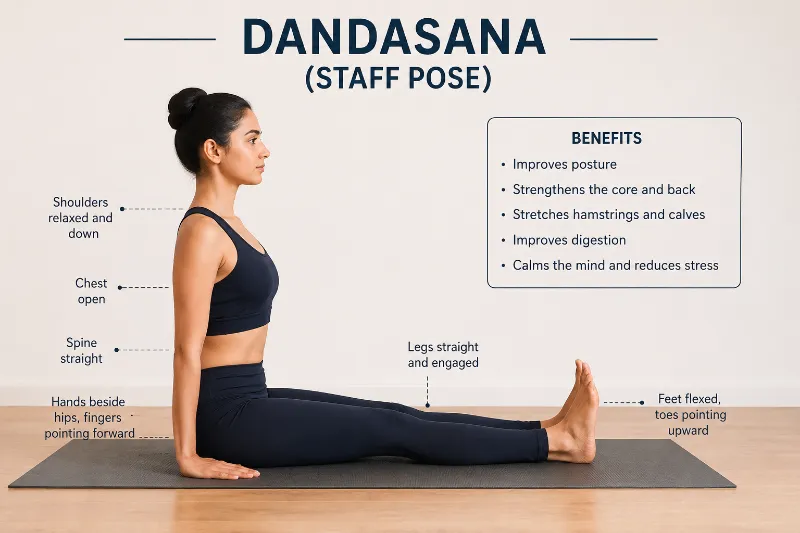
The Staff Pose entails the practitioner sitting up straight, putting both palms on the sides of the glutes, and extending both legs in front of them.
Although it may seem simple, mastering the appropriate level of attentive awareness can be challenging at first.
Overview & Etymology
The Sanskrit terms “Danda,” which means Staff or Stick, and “Asana,” which means Pose or Posture, are combined to create the name Dandasana.
The Staff Pose technique as it is used in contemporary yoga is not well described in many ancient Hatha Yoga manuals.
Nonetheless, Dandasana is mentioned in the Sritattvanidhi literature from the 19th century, which lists 122 hatha yoga poses. However, in this situation, it’s a distinct stance that entails standing upright while using a rope for support.
- Sanskrit Name: दण्डासन
- Pronunciation: dun-DAHS-anna
- Also known as: Staff Pose or Stick Pose
- Pose Type: Seated Pose
- Strengthens: Spine, Back, Tailbone, and Shoulders
- Stretches: Spine, Tailbone, and Neck
Muscles
- Quadriceps: Support the legs while maintaining a straight knee.
- Hip Flexors: Help maintain the upright seated position.
- Core Muscles: Stabilise the spine and maintain good posture.
- Spinal Extensors: Keep the back long and upright.
- Glutes: Provide stability while sitting.
- Hamstrings: Stretch gently while the legs are extended.
- Calf Muscles: Engage to keep the legs active and toes flexed.
- Shoulders & Upper Back: Help maintain an upright posture.
Health Benefits of Dandasana
- Improves body posture.
- Helps calm the mind.
- Relaxes the hamstrings, knees, and ankles.
- Tones muscles around the abdomen and hips.
- Enhances mental awareness and mindfulness.
- Improves digestive and reproductive system function.
- Strengthens, lengthens, and tones the back muscles.
- Activates the Manipura, Swadisthana, and Muladhara Chakras.
Physical Benefits
- Strengthens the core muscles and improves abdominal stability.
- Helps strengthen the quadriceps, hip flexors, and back muscles.
- Improves posture by encouraging an upright and aligned spine.
- Stretches the hamstrings and calf muscles.
- Improves leg strength and stability.
- Enhances awareness of spinal alignment and body posture.
- Helps prepare the body for seated forward bends and other yoga poses.
Mental Benefits
- Promotes mental focus and concentration.
- Encourages a sense of calmness and relaxation.
- Helps develop body awareness and mindfulness.
- Supports steady, controlled breathing.
- Can help reduce everyday mental tension and stress.
- Encourages patience and stability during practice.
Beginner tips
- To assist in grounding your thighs, place a blanket or supports over the tops of your thighs at the hip crease.
- In this pose, flex your ankles and press out through your heels to stimulate your legs.
- Explore the pose
- Imagine your spine as the vertical “staff” of your body in this pose, firmly anchored in the ground and supporting all you do. Place one to three 10-pound sandbags or a dumbbell over the tops of your thighs if you find it difficult to press them into your mat.
Dandasana (Staff Pose) Variations
- Supported Dandasana – Sit on a folded blanket or cushion to make it easier to keep the spine upright.
- Dandasana with Hands Behind – Place the hands slightly behind the hips for additional support while maintaining an upright posture.
- Dynamic Dandasana – Alternate between pointing and flexing the feet to gently mobilise the ankles and activate the legs.
- Dandasana with Arm Raise – Extend both arms overhead while keeping the spine tall and shoulders relaxed.
- Strap-Assisted Dandasana – Place a yoga strap around the feet and gently hold it to support proper leg and spine alignment.
- Wall-Supported Dandasana – Practice with your back against a wall to help maintain a straight and stable spine.
- Half Dandasana – Keep one leg extended while bending the other knee, making the pose more accessible for beginners.
When to Avoid Performing Dandasana
- Avoid if you have a hernia.
- Avoid if you have spondylitis.
- Avoid if you have a slipped disc.
- Avoid if you have had a recent surgery.
- If you have a hamstring, core, or spine injury, stay away from it.
How to do Dandasana (Staff Pose)
We’ve broken up this comprehensive guide into four simple sections below with the assistance of our team of knowledgeable yoga instructors and editors.
Part 1: Preparation for Dandasana
Start your Staff Pose regimen with yoga positions that activate your legs, spine, and hips.
By improving blood flow throughout your body, the following poses will assist you in executing the primary posture without running the risk of getting hurt.
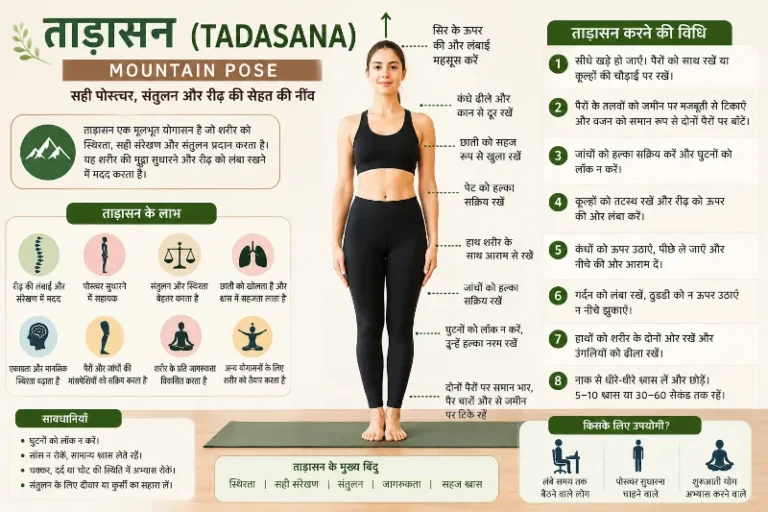
Tadasana (Mountain Pose)
- This pose strengthens the legs and serves as the basis for all standing yoga poses. In order to prepare for Staff Pose, this pose will help you activate your knees, ankles, and core.
Maintain a straight posture with both feet close to one another and your hands by your sides to achieve Mountain Pose. Hold the posture for one to five minutes while breathing lightly.
Uttanasana (Standing Forward Bend)
- This forward-bending exercise is a great method to work your core muscles and activate your lower back. A great method for warming up latent hamstring muscles is uttanasana.
Proceed from Mountain Pose by carefully lowering yourself vertebrae by vertebrae while softly bending your torso forward. Inhale first, then bend as you release the breath, bringing your knees to your forehead. Return to Tadasana after holding this pose for a few minutes.
Baddha Konasana (Bound Angle Pose)
- If you experience tightness in your inner thighs and glutes, this position is wonderful for opening your hips and activating your spine.
Make a Namaste pose with your legs while sitting with your knees bent. Make sure your spine is tall, and your knees are near to the mat. For three to five minutes, hold your feet with your hands in this position.
Part 2: Step-by-Step Instructions to Perform Dandasana
The following is how to practice the Staff or Stick Pose.
- Step 1: Start by sitting in the centre of your yoga mat and extend your legs forward.
- Step 2: Take a slow breath to contract your core and position your spine so that it is perpendicular to the mat.
- Step 3: As you inhale, gently press both palms onto the yoga mat until they are toward the sides of your glutes.
- Step 4: Make sure your big toes are pointing toward the ceiling and close together as you exhale.
- Step 5: Ease your shoulders and maintain a straight line of sight in front of you.
- Step 6: Hold this stance while continuing to breathe. As you breathe, pay attention to how your abdominal muscles tighten and expand.
Common Mistakes
- Rounding the back instead of keeping the spine tall and neutral.
- Slouching the shoulders or lifting them toward the ears.
- Actively extending the legs rather than bending the knees needlessly.
- Letting the feet fall outward rather than keeping the toes pointing upward.
- Locking the knees too forcefully.
- Leaning backwards and putting excessive weight on the hands.
- Forcing the legs flat when the hamstrings are tight.
- Holding the breath instead of breathing slowly and naturally.
- Overstretching or trying to achieve perfect alignment at the expense of comfort.
Breath Awareness:
- As you push your fingers onto the yoga mat and position your torso with a strong core, take a breath.
- Exhale: As you extend your legs in front of you and loosen your core muscles.
- Beginner’s Performance Duration: Hold Dandasana for one minute.
- Advanced Performance Duration: Hold Dandasana for as long as it’s comfortable for you.
Part 3: Things to Keep in Mind
When performing Staff Pose, proper alignment is crucial, particularly for novices. For a safe and successful Dandasana practice, bear in mind the following cues:
- Maintain a straight back: If your shoulders are hunched forward or your back is rounded, you may not be able to feel your core muscles being engaged, which could prevent you from reaping the benefits of this pose. As you inhale, your torso should be upright and straight like a rod, extending from your tailbone to your crown.
- Avoid locking your knees: One common error is to lock your knee joints while extending your legs in front of you. Pay attention to your leg extension to prevent this. By using your quadriceps and keeping your knees slightly bent, try to stretch your legs.
Part 4: Relaxing Poses After Dandasana
Your spine must return to its normal curve after sitting in the Staff Pose. Here are some counteryoga poses to help you unwind your back muscles:
Paschimottanasana (Seated Forward Bend):
- As the name suggests, this position entails bending your torso forward and placing your upper body on your legs. As a result, your lower back, scapular muscles, and shoulders will all be more relaxed.
To facilitate deeper relaxation, you can minimise the resistance in your hamstrings and glutes by placing a bolster beneath your knees.
Purvottanasana (Reverse Plank Pose):
- If your lower back and spine were severely stretched during a long session of Staff Pose, you could do the Reverse Plank Pose.
Inhale as you begin in Staff Pose, tighten your core even more, transfer your upper body weight to your hands, and use your arm strength to raise your glutes off the mat. Hold the position for a few seconds while extending your tailbone toward the ceiling.
Dandasana Variations to Consider
Depending on your comfort level and physical capabilities, practitioners of all skill levels can execute these versions of Staff Pose.
- Sit in the standard staff position and slowly raise both arms over your head. Check your arms, core, and spine for alignment and engagement.
After holding this variation for 60 to 90 seconds, feel the gentle heat in your shoulders and core. The longer you use this variation, the stronger your upper body will become.
Parivrtta Dandasana (Revolved Staff Pose):
- Parivrtta Dandasana is a seated twist position that can help release any residual tension in your spinal column. Sitting in the normal Staff Pose, begin by gently rotating your spine to the side.
You can progressively increase your range of motion and flexibility by increasing the flow of prana in your lower back and spine by holding this pose for 60 to 90 seconds on each side.
Paschimottanasana A:
- If you want to go a little deeper, try this variation of Staff Pose, which is gripping your big toes with your fingers while resting your forehead on your knees.
Your tailbone, shoulders, and back will all feel quite warm. Hold this position for five to ten deep breaths, feeling the flex in your back and leg muscles.
FAQs
What does Dandasana mean?
The Sanskrit term “Danda” (which means stick or staff) and “Asana” (which means posture) make up the name Dandasana. This simple yoga stance is designed to enhance vertebral alignment and stretch the hamstrings.
Can beginners perform the Dandasana pose?
Yes, beginners can easily perform the Dandasana pose. Just begin by sitting on the yoga mat with your spine stretched vertically erect and your torso firmly planted on the floor. While keeping your core strong, extend your legs straight in front of you.
Who should not perform Dandasana?
This position should be avoided by practitioners who have had serious spinal operations or injuries until they are fully recovered. Additionally, it’s a good idea to train with a qualified yoga instructor if you have a hernia, spondylitis, or slipped disk. They can assist you in preventing further injuries and offer guidance on changes.
What is Chaturanga Dandasana?
Perform Chaturanga Dandasana, a four-limb staff posture, in the low plank position for better core balance. Despite the fact that Dandasana and this posture are somewhat distinct from one another, their names are fairly similar.
What are the benefits of Chaturanga Dandasana?
Here are the following benefits of Chaturanga Dandasana:
Improves concentration.
Increases core, arms, and back strength.
Enhances mind, muscle, and breath coordination.
Activates the Solar Plexus and Manipura Chakras.
Gets the body and mind ready for more complex arm-balance exercises.
References:
- Allen, W. (2026d, February 27). Dandasana. https://myyogateacher.com/yoga-asana/dandasana
- Yoga Journal. (2025s, March 23). Staff pose. https://www.yogajournal.com/poses/staff-pose/
- Dandasana Yoga(Staff Pose)| Yoga sequences, benefits, variations, and Sanskrit pronunciation | Tummee.com. (n.d.). Tummee.com. https://www.tummee.com/yoga-poses/staff-pose