Marjaryasana-Bitilasana (Cat-Cow Pose)
What is Marjaryasana-Bitilasana (Cat-Cow Pose)?
Cat-Cow Pose (Marjaryasana-Bitilasana) is a serene, flowing yoga pose that alternates between flexing and extending the spine while coordinating movement and breath. This beginner-friendly warm-up combines two poses, Cat Pose (Marjaryasana) and Cow Pose (Bitilasana), to release back tension, increase spinal mobility, and prepare the body for deeper practice.
- Regular rounding and arching of the spine promotes improved posture, bodily awareness, and mental relaxation. Many yoga traditions teach Cat-Cow as a way to learn about the connection between breath and movement, which lays the groundwork for mindful practice.
Cat-Cow Pose: Overview and Meaning of Marjaryasana-Bitilasana
- The Sanskrit term Marjaryasana-Bitilasana refers to the combination of two different poses, Marjaryasana (Cat Pose) and Bitilasana (Cow Pose). In Sanskrit, “Marjari” means cat, “Bitila” represents cow, and “asana” means position. The flow is like a cat stretching its spine and a cow slowly arching its back while grazing.
- Unlike many of the classical yoga poses found in ancient literature like the Hatha Yoga Pradipika or Gheranda Samhita, Cat-Cow Pose (Marjaryasana-Bitilasana) is a modern yoga sequence. Despite the traditional origins of each position, the fluid combination of Cat (Marjaryasana) and Cow (Bitilasana) originated in the 20th century as yoga developed into a more dynamic and therapeutic practice.
- One of the most popular yoga poses nowadays is cat-cow, which is used in everything from light warm-ups and pregnant classes to physical therapy and office wellness routines. By activating the core, back, shoulders, and hips while alternating between spinal flexion and extension, the position enhances mobility, posture, and breath awareness. The body gradually releases stress and regains equilibrium
At a Glance
- Sanskrit Names: मार्जरीआसन (Marjaryasana-Bitilasana)
- Pronunciation: mar-jar-ee-AHS-anna / bee-tee-LAHS-anna
- Pose Type: Dynamic spinal warm-up, breath-synchronised flow
- Level: Beginner (suitable for all levels)?
- Duration: 5–10 rounds (30 seconds to 3 minutes)
Benefits of Marjaryasana-Bitilasana (Cat-Cow Pose)
This gentle spinal flow brings harmony to your body, breath, and mind, whether you’re relaxing into your morning, taking a mid-work break, or getting ready for deeper practice.
The key mental and physical benefits of regular Cat-Cow practice are listed below.
Physical Benefits
- Enhances spinal mobility and flexibility: Prevents stiffness from extended sitting and keeps the spine flexible.
- Enhances back and core muscles: Enhances back health and spinal alignment by strengthening the core.
- Relieves tension and back pain: Gently releases tension in the neck, shoulders, and lower back.
- Stretches the chest, neck, and shoulders to release tense upper body muscles and enhance posture.
- Uses regular movement to stimulate and massage the digestive organs, promoting healthy digestion.
- Warming up the entire body improves circulation and gets muscles ready for more intense positions.
- Menstrual discomfort is alleviated by massaging the abdomen and gently moving the pelvis.
Mental & Emotional Benefits
- Relaxes the mind and reduces stress: Eases tension and relaxes the nervous system.
- Enhances concentration and mindfulness: Promotes awareness of the present moment through movement and breath.
- Encourages calm and clarity by releasing accumulated tension and promoting emotional balance and relaxation.
Therapeutic Applications
- Pregnancy support: Safe throughout all trimesters when practised gently with a wider knee position.
- Postpartum recuperation: Safely reattaches the spine and abdominal wall.
- Desk worker syndrome: Corrects hunched posture and realigns the spine.
- Joint stiffness and arthritis: Enhances spinal joint mobility and lubrication.
- Stress-related tension: Reduces tense muscles brought on by emotional stress.
- Digestive sluggishness: Promotes improved digestion by increasing circulation in the abdomen.
- Respiratory support: Enables broader, deeper breathing by opening the chest.
How to Do Marjaryasana-Bitilasana (Cat-Cow Pose): Step-by-Step Guide
Despite its seeming simple nature, the power of Cat-Cow Pose lies in your ability to move with your breath rather than against it. You may practice safely and effectively with the aid of a comprehensive, beginner-friendly tutorial.
Part 1: Preparing for the Pose
- Almost everyone can benefit from the Cat-Cow Pose, including novices, senior citizens, or those who haven’t done anything in a long time. It is widely utilised as a secure introduction to spine mobility and mindful breathing. Be sure to adhere to these guidelines:
- Select a surface: Knees and wrists are cushioned by a carpeted floor or yoga mat.
- Warm up slowly: Before beginning, perform a few sitting spinal twists, roll your shoulders, and gently rotate your wrists. This makes it easier for your joints to move smoothly.
- Eliminate distractions: Establish a peaceful environment to concentrate on coordinating movement and breath.
- Mentality: Focus on how the pose feels rather than how it appears; approach it with ease rather than effort.
Part 2: Step-by-Step Instructions
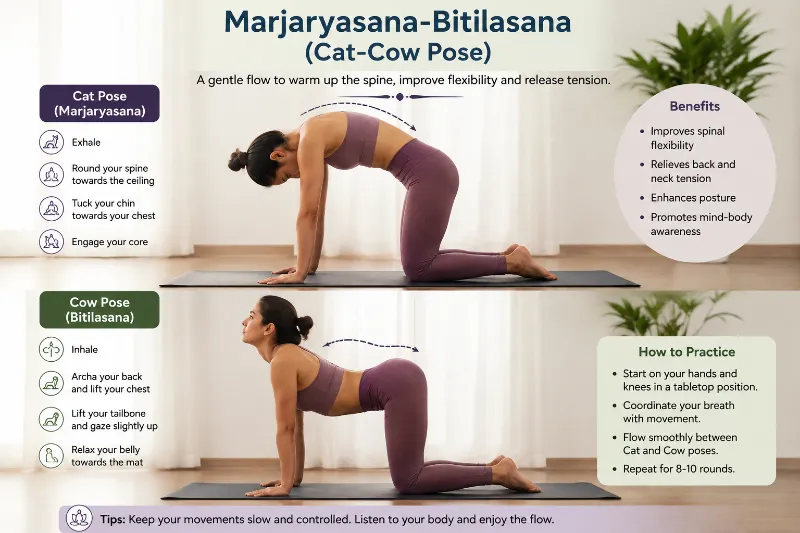
- Spread your fingers, maintain a long neck and neutral spine, get on your hands and knees with your wrists under your shoulders and your knees under your hips, and take a few steady breaths to centre.
- Breathe in via your nose while lowering your tummy, raising your chest, widening your collarbones, pulling your shoulders away from your ears, raising your sitting bones, and slowly lifting your eyes without straining (Cow Pose).
- At the peak of your inhale, take a moment to feel your chest open and your spine naturally curved. Then, be ready to reverse the movement.
- Breathe out completely as you tuck your chin and tailbone in, bring your navel in, press the floor away, round your spine toward the ceiling, and feel your back stretch (Cat Pose)
- Imagine a wave moving from tailbone to crown as you inhale to Cow and exhale to Cat, moving smoothly at the rate of your breath.
- Prioritise rhythm over repetitions and practice 5–8 rounds (1–2 min), 8–12 rounds (2–3 min), or 15–20 rounds (3–5 min). If your breathing gets irregular, stop.
- After finishing on a neutral tabletop, take two to three deep breaths and, if desired, rest for a short while in Child’s Pose.
Breathing Pattern
Exhale as Cat (spine rounds, belly draws in, chin tucks) and inhale as Cow (chest expands, spine arches, gaze lifts). Start the movement with your breath; if it seems too quick, slow it down. The quality of the breath is more important than the quantity of repetitions.
Alignment & Safety Tips
- Maintain knees beneath hips and wrists beneath shoulders.
- Move your neck as a natural extension of your spine rather than pushing it.
- During both exercises, softly engage your core.
- To safeguard your wrists, equally distribute your weight among your hands.
- For support, place a towel or blanket beneath your knees.
- Move deliberately and slowly; the goal is to experience the flow rather than to accomplish a shape.
- If you get sharp or pinching discomfort, stop right away.
Learn Cat-Cow Pose step-by-step with a coach. Book a free 1-on-1 session today!
Cat-Cow Pose Variations
The versatility of Cat-Cow Pose (Marjaryasana-Bitilasana) is one of its outstanding features. There is a variation of Cat-Cow that can adapt to your needs, whether you’re a beginner, recovering from an injury, pregnant, or practising at your desk.
These variations and modifications preserve the pose’s core benefits while making it accessible to everyone.
Beginner Modifications
Hands on Blocks Cat-Co
- Maintains alignment while easing shoulder and wrist strain.
- Place yoga blocks under your hands in the tabletop.
- Flow through Cat–Cow with wrists stacked over blocks.
- Keep shoulders relaxed and spine fluid.
Forearm Cat–Cow
2. Removes wrist pressure and deepens shoulder stretch.
- Lower down onto forearms, elbows under shoulders.
- Inhale to arch, exhale to round.
- Move slowly, keeping breath steady.
Cat-Cow with Supported Knee Padding
3. Cushions and protects sensitive knees for pain-free practice.
- Put a double mat or folded blanket beneath your knees.
- Continue Cat–Cow with even weight distribution.
- Adjust padding until comfortable.
Intermediate Variations
Extended Cat–Cow (Leg Movement)
4. Builds core strength, balance, and hip mobility.
- From Cow, extend one leg straight back.
- From Cat, draw the knee toward the nose.
- Alternate legs every few rounds.
Side-to-Side Cat–Cow
5. Improves side-body flexibility and releases lower back tension.
- Head to one side and swing hips from the tabletop.
- Switch sides, adding gentle hip circles.
- Move fluidly without forcing range.
Threaded Cat–Cow
- Enhances spinal rotation and opens tight shoulders.
- From Cat, thread one arm under the chest.
- Take a few breaths while resting your cheek and shoulder on the mat.
- Return to the flow and repeat the other side.
Advanced & Therapeutic Options
Cat–Cow in a Chair
- Ideal for elders or the office, it relieves back stiffness without the need for a mat.
- With your hands on your knees and your feet flat, take a forward seat.
- Inhale to arch, exhale to round.
- Breathe deeply and move slowly.
Standing Cat–Cow
- Recharges posture and mobility anytime, anywhere.
- Stand with knees soft, hands on thighs.
- Inhale to arch, exhale to round the spine.
- Keep the neck aligned and breathe steadily.
- Cat–Cow with Block Between Thighs
- Gently squeeze a block between your inner thighs.
- Flow through Cat–Cow while maintaining light pressure.
- Keep movements slow and controlled.
Marjaryasana-Bitilasana Precautions & Contraindications
- Even tho Cat-Cow Pose (Marjaryasana-Bitilasana) is one of the safest yoga poses, it’s crucial to practice attentively, particularly if you’re new to movement or are dealing with a medical condition or injury.
- If you know when and how to change this stance, you can practice with assurance and caution.
Avoid Marjaryasana-Bitilasana If You Have:
- Recent back or spinal surgery: Before attempting any spinal movements, get doctor approval.
- Cervical instability or severe neck injury: Cat-Cow’s neck movements may make symptoms worse.
- Weight bearing on the hands may exacerbate acute wrist pain or damage.
- Deep spinal flexion or extension may raise the risk of fracture in cases of severe osteoporosis.
- If you have active back spasms or inflammation, take it easy until the acute phase passes before moving gently again.
Practice with Caution or Modifications in case of:
- Pregnancy: Generally safe, but avoid deep spinal extension and maintain knees widely apart.
- Wrist sensitivity: Use yoga blocks beneath your hands or try Forearm Cat-Cow.
- If you have knee pain, try the chair version or put more cushioning beneath your knees.
- If you have persistent back discomfort or disk problems, start with tiny, moderate motions and concentrate more on breath coordination than range of motion.
- High blood pressure or dizziness: Avoid raising or lowering the head too much; instead, keep it level with the spine.
Safety Guidelines
- Comfort is more important than depth, so never try to mould your spine.
- If you get intense or shooting pain, stop right away (a slight stretch is okay, but agony is not).
- Warm up wrists and shoulders before beginning.
- Yoga is more effective when you use props, such as blankets, blocks, or supports.
- Use your breath to direct the movement and safeguard your joints.
- Yoga is about awareness, not performance; always pay attention to your body.
- Schedule a free one-on-one session right now to practice Cat-Cow Pose as safely as possible!
Marjaryasana-Bitilasana (Cat-Cow Pose): Related Yoga Poses
Usually performed as a warm-up or spinal mobility sequence, Cat-Cow Pose (Marjaryasana-Bitilasana). Its motions are complemented by the following poses, which aid in improving flexibility, relieving stress, and helping with a smooth transition into your yoga flow.
Tabletop Position (Bharmanasana)
Lays the groundwork for stable and aligned spines in yoga positions like Cat-Cow.
- Put your hands and knees beneath your shoulders and your knees under your hips.
- Extend your spine, spread your fingers, and apply even pressure with your hands.
- Gently contract your core and move your shoulders away from your ears.
Spinal Waves (Quadruped)
Fluid, flowing action that improves spine mobility and relieves underlying stress.
- Inhale to arch the spine from the tailbone to the crown while starting at the tabletop.
- Allow the wave to travel through your back as you exhale to round your spine.
- Continue slow, fluid movements synced with breath.
Seated Cat-Cow (Chair Yoga)
Improves posture and eases stiffness, making it perfect for desk workers or vacations.
- With your hands on your knees and your feet flat, take a forward seat.
- Exhale to round the spine and tuck the chin, then inhale to raise the chest and slightly arch.
- Repeat 5–10 slow, mindful rounds.
FAQs
What is Marjaryasana-Bitilasana good for?
Posture awareness, core strength, and spinal flexibility are all enhanced by Cat-Cow Pose. Through the coordination of regular breathing, it calms the nervous system and releases tension in the shoulders and back.
Regular practice helps keep the spine healthy, enhances circulation, and lessens stiffness, particularly in those who spend a lot of time sitting down.
How many rounds of Marjaryasana-Bitilasana should I do?
Fewer deliberate rounds are preferable to numerous hurried ones when it comes to Cat-Cow.
Beginners: 5–8 rounds (about 1–2 minutes)
Standard practice: 8–12 rounds (2–3 minutes)
Extended warm-up: 15–20 rounds (3–5 minutes)
Is Marjaryasana-Bitilasana good for lower back pain?
Yes! One of the safest and best yoga poses for easing lower back pain is the cat-cow pose. It relieves tension in the lumbar region, improves blood flow, and gently mobilises the spine. Focus on breathing smoothly and begin with tiny, deliberate motions.
See a doctor or practice yoga under the guidance of a qualified instructor if your discomfort is severe or chronic.
Is Marjaryasana-Bitilasana safe during pregnancy?
In general, Cat-Cow is safe and strongly advised when pregnant. It facilitates spinal movement, eases back pain, and makes room for the expanding belly.
Simply prevent severe arching in Cow Pose and keep your knees wider apart. Always move lightly, and if in doubt, speak with a prenatal yoga instructor or your healthcare professional.
Can Marjaryasana-Bitilasana help with digestion?
Yes! In Cat-Cow, the abdomen is gently compressed and released to massage the digestive organs, promoting circulation and improving digestion. Many practitioners feel that it helps promote good evacuation and lessen bloating, particularly when done before breakfast or after extended periods of sitting.
References:
- Allen, W. (2025f, November 19). Marjaryasana-Bitilasana. https://myyogateacher.com/yoga-asana/cat-cow-pose-marjaryasana-bitilasana
- Captcha Verification | Tummee.com. (n.d.-c). https://www.tummee.com/yoga-poses/cat-cow-pose
- Yoga Journal. (2025e, February 25). Cow pose. https://www.yogajournal.com/poses/cow-pose/