10 Best Yoga Poses for Plantar Fasciitis
Introduction
The soft tissue (plantar fascia) that joins your heel to the front of your foot develops microtears in plantar fasciitis, which is mainly caused by overuse. This usually happens when you suddenly increase your level of activity before feeling pain.
The painful condition known as plantar fasciitis is triggered by inflammation of the plantar fascia, a thick band of tissue in the bottom of your foot. When you put weight on your foot, this ailment usually causes severe pain near the base of your heel.
Stretching your foot and calf muscles and fascia is the greatest strategy to reduce plantar fasciitis pain. Yoga poses are a good technique to stretch these structures.
What Causes Plantar Fasciitis?
Genetics, posture, physical activity, and/or foot care can all increase your chance of developing plantar fasciitis. If you have issues with your arches, such as if you never developed an arch, have fallen arches, or have abnormally high arches, you are more likely to get plantar fasciitis. The issue may also be aggravated by a tight Achilles tendon.
The anatomy of your feet may also be affected by the way you stand or walk. You can be straining the plantar fascia if your feet have a tendency to supinate (roll outward toward the ankle) or pronate (roll inward and flatten the arch). Your stance and foot structure may also be impacted by wearing shoes with flat or soft soles, insufficient arch support, or unevenly worn soles.
How Can Yoga Help With Plantar Fasciitis?
It’s important to include a good strength-based yoga routine that uses targeted strengthening exercises, stretches, and mobility work to help alleviate and fix the causes of plantar fasciitis because the condition is linked not only to the tightness of the plantar fascia but also to the strength and mobility of your lower leg (the foot, ankle, calf, and Achilles tendon).
How Does the Core Affect Plantar Fasciitis?
Almost every part of our body alignment, including your hips, knees, and feet, is influenced by our core. However, your core is more than just your abs; it also consists of your glutes, hip flexors, back muscles, sides, and stomach muscles.
Your lower body, including the position and mechanics of your feet, may be affected by poor body mechanics and alignment due to weakness in your glutes and core. These abnormalities may cause your foot to pronate excessively.
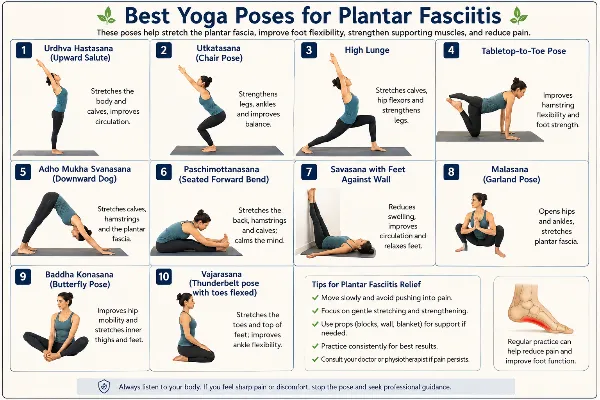
Best Yoga Poses for Plantar Fasciitis
Yoga movements that stretch your plantar fascia strengthen your calf muscles and the bottom of your foot. Tightness in these muscles has been associated with plantar fasciitis. Yoga is a great approach to reduce pain and increase flexibility.
Do these poses without shoes, on a thin mat, and while wearing comfortable clothing. For a few breaths, or 30 to 60 seconds, hold each pose:
Urdhva Hastasana (Upward Salute)
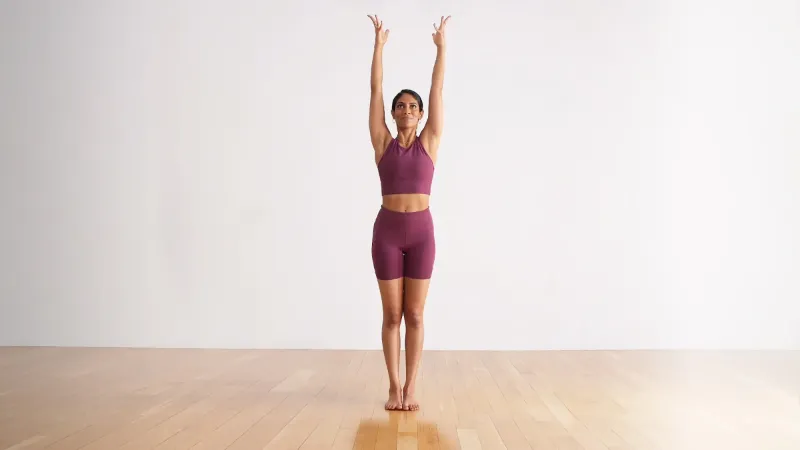
- Maintain a small space between your heels while standing with your big toes touching. Press into your big toes, heels, and the outside of your feet to ground yourself.
- Activate the quadriceps muscles located at the front of your thighs.
- With your elbows straight, slowly extend your arms to the sides and overhead after rotating them so your palms face your body.
- Lower your shoulder blades.
- If you can maintain straight elbows, bring your hands together overhead; if not, align them with your shoulders.
- Look at your fingertips and lift your chin.
Utkatasana (Chair Pose)
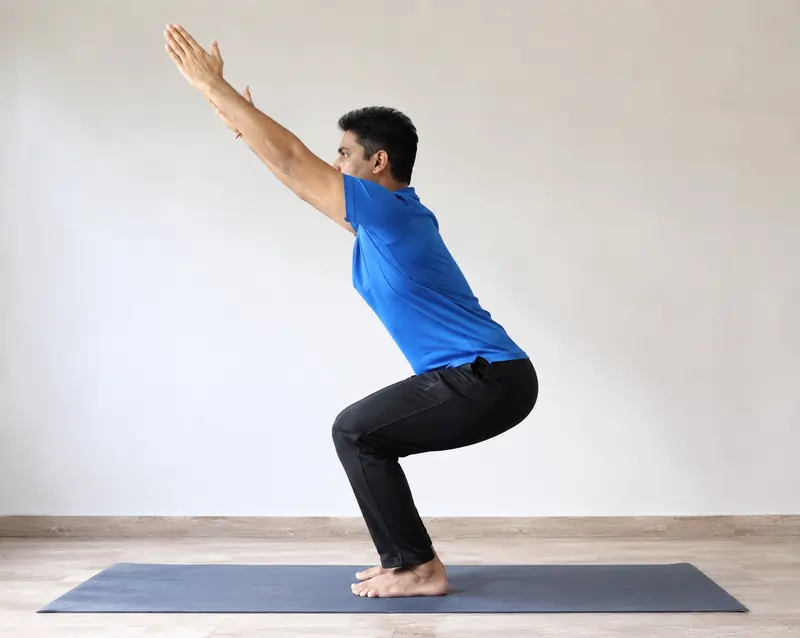
- Place your feet hip-width apart as you stand. Press your big toes and the outside edge of your feet into the ground while spreading your toes apart.
- Take a breath and raise both arms above your head, palms facing one another. Maintain a straight elbow position.
- Bend your knees and slowly descend as if you were going to sit in a chair as you release your breath. Keep your chest raised and your entire weight focused over your heels.
- When your thighs are parallel to the floor, stop (or sooner if it’s more comfortable).
- Hold for a few breaths.
High Lunge
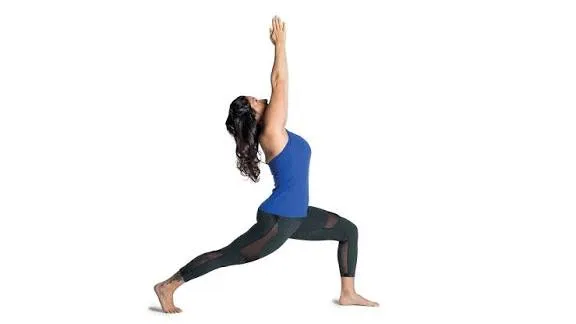
- With your arms by your sides and your feet together, take a tall position.
- As you bend your right knee to a 90-degree angle and connect it with your ankle, step your left foot back toward the corner of the mat.
- With your knee straight and your heel pointing upward, place the ball of your left foot on the ground.
- With your hands facing one another, raise your arms above your head.
- On the other side, repeat.
Tabletop-to-Toe Pose
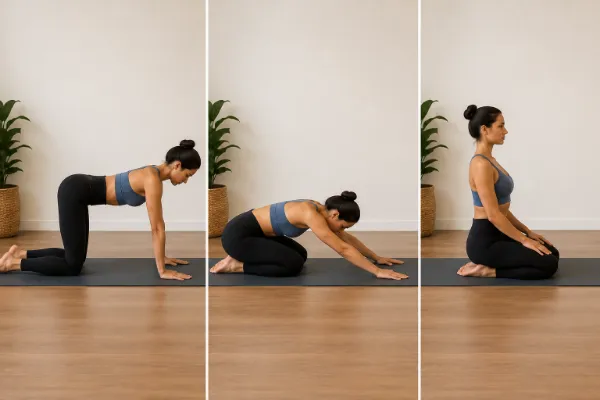
- Start on your hands and knees in the tabletop position, aligning your knees with your hips and your hands with your shoulders.
- Walk your hands slowly back toward your knees while tucking your toes under them.
- With your hands on your knees, raise your chest and recline on your heels.
Adho Mukha Svanasana (Downward Dog)
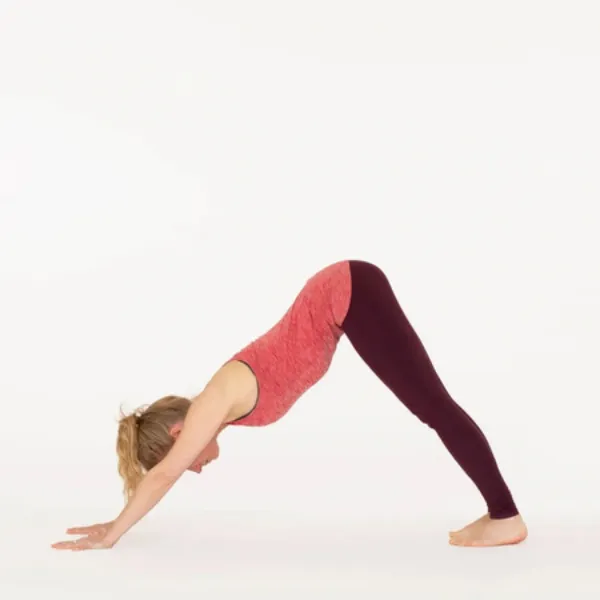
- Place your knees under your hips and your wrists under your shoulders as you begin on your hands and knees.
- As you straighten your legs and raise your hips toward the ceiling, tuck your toes below them and provide pressure with your palms. Maintain a straight spine.
- Press down through your heels while using the quadriceps muscles at the front of your legs.
Paschimottanasana (Seated Forward Bend)
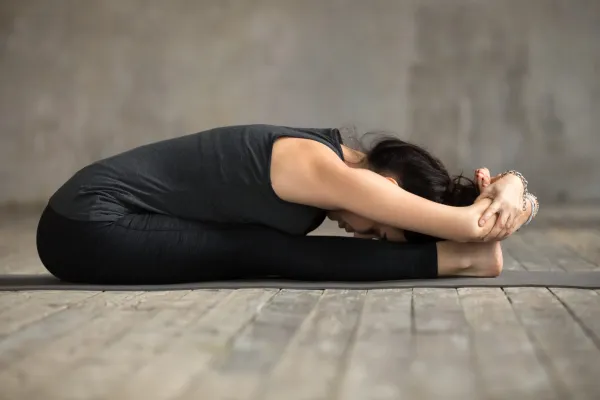
- With your hands on the floor next to your body, sit with your legs straight out in front of you.
- Pull your toes toward you and push them away with your heels to flex your feet.
- Walk your hands as close to your feet as is comfortable while bending forward from your hips. Maintain a straight spine. Hold the sides of your feet if you can.
Savasana with Feet Against Wall
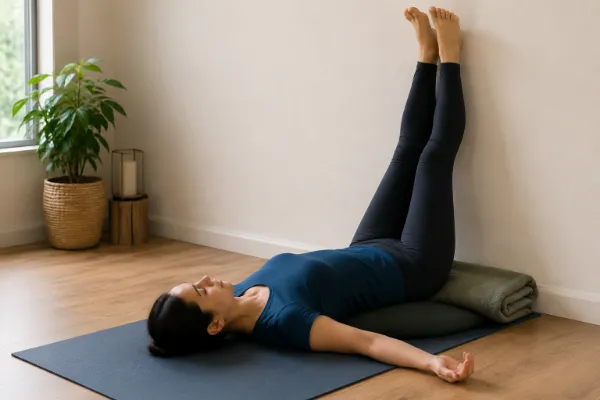
- Place your legs slightly wider than hip-width apart while lying on your back.
- Your feet should be flat against the wall.
- Place your arms palms up and apart from your sides.
- Shut your eyes and let your body’s muscles relax.
- For ten minutes, stay in this position.
Malasana (Garland Pose)
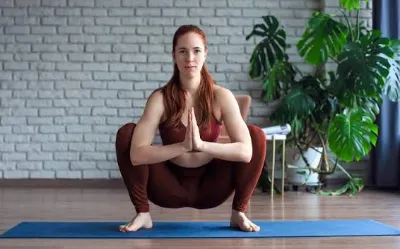
- Your feet should be somewhat wider than your hips when you stand. Extend your toes a little.
- As low as you can, squat so that your hips are below your knees.
- Put each elbow on the inside of your knees and bring your palms together in front of you.
Baddha Konasana (Butterfly Pose)
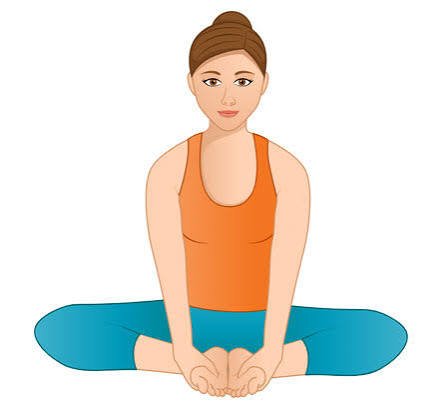
- With your hands by your sides and both legs extended forward, take a seat.
- The legs are bent at the knees so that the soles of the feet touch, and the palms are on the ground with the fingers pointing forward.
- Grasp the ankles, the legs further until the heels touch the perineum.
- The body is upright, the knees stay on the floor, and the eyes are forward. Before returning to the beginning posture, the asana is held.
- Carefully stretch the thighs. Relax. If you have a knee or groin ailment, stay away from this pose.
Vajrasana (Thunderbolt pose with toes flexed)
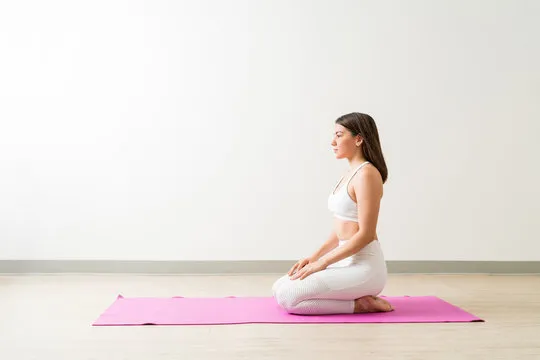
- Get down on your hands and knees.
- Keep your toes curled in and relax on your heels.
- Avoid turning in your toes.
- If you find this too stressful, try placing blocks under your sitting bones or returning your hands to the mat and shifting some of your weight forward onto them while keeping your foot soles stretched.
Home remedies to help you heal plantar fasciitis:
Tennis ball wonder: Every day, roll a tennis ball under your foot. This helps the scar tissue align properly and extends the fascia.
Spend some time stretching your calf muscles to become a stronger version of yourself. Continue breathing while holding the stretch for roughly 30 seconds. In order to heal, breathing is essential.
Happy feet: Determine whether your shoes need to be replaced.
Prevention of Plantar Fasciitis During Yoga
Excessive tension on the plantar fascia can be reduced by practicing yoga with correct alignment, gradual progression, and suitable adaptations. Preventing plantar fasciitis or aggravating pre-existing heel pain can be achieved by taking the following precautions:
Avoid pushing the arch or toes: Stay clear of forcefully extending or loading the foot’s sole. Reduce range of motion or alter the pose if it causes severe or worsening heel pain.
Don’t practice when experiencing severe pain: Pain must not be ignored. Modify or discontinue postures that cause heel pain, especially if the pain doesn’t go away after practice. When symptoms of plantar fascia worsen, activity moderation is frequently advised.
Outside of yoga, wear supportive shoes: When walking or standing outside of your practice, wear shoes with sufficient arch support and cushioning, even though yoga is typically done barefoot. If you have heel pain, avoid walking barefoot for extended periods of time on hard surfaces.
FAQs:
What finally cured my plantar fasciitis?
Plantar fasciitis may typically be permanently cured by wearing supportive footwear with custom orthotics, strengthening the calf and foot muscles to increase tissue load capacity, and continuing regular daily stretching.
Can YogaToes help with plantar fasciitis?
Plantar fasciitis can be relieved by stretching tight fascia, enhancing foot circulation, and strengthening weak arch muscles through active “toe yoga” activities or the use of physical toe-stretching devices like YogaToes.
Should I avoid yoga with plantar fasciitis?
Everyone is aware of the advantages of exercise for both physical and mental health, but if you have plantar fasciitis, it’s crucial to select the proper kind of activity to prevent making the disease worse. Pilates, yoga, and swimming are examples of low-impact exercises.
What’s the worst thing you can do for plantar fasciitis?
Walking barefoot on hard floors or continuing to push through high-impact exercises like running without rest or support is the worst thing you can do for plantar fasciitis since it continually shreds and irritates the healing tissue in your foot arch, worsening the inflammation.
What is stage 4 plantar fasciitis?
The most serious and advanced stage of persistent heel tissue degradation is stage 4 plantar fasciitis. Severe structural alterations, such as widespread fascia thickening, scarring, tissue deterioration, or partial microtears, are present, along with chronic, incapacitating pain that typically does not improve with rest or physical therapy.
References:
- Busch, A. J., Webber, S. C., Brachaniec, M., Bidonde, J., Bello-Haas, V. D., Danyliw, A. D., Overend, T. J., Richards, R. S., Sawant, A., & Schachter, C. L. (2011). Exercise Therapy for Fibromyalgia. In Current Pain and Headache Reports (Vol. 15, Issue 5, pp. 358–367). https://doi.org/10.1007/s11916-011-0214-2
- Cooper, J. (2026). EMSense Foot Massager. https://doi.org/10.55277/researchhub.7ukq709c.1
- Pandi-Perumal, S. R., Spence, D. W., Srivastava, N., Kanchibhotla, D., Kumar, K., Sharma, G. S., Gupta, R., & Batmanabane, G. (2022). The origin and clinical relevance of Yoga Nidra. Sleep and Vigilance, 6(1), 61–84. https://doi.org/10.1007/s41782-022-00202-7
- Bronfort, G., Haas, M., Evans, R., Leininger, B., & Triano, J. (2010). Effectiveness of manual therapies: the UK evidence report. Chiropractic & Manual Therapies, 18(1), 3. https://doi.org/10.1186/1746-1340-18-3