Parivrtta Trikonasana (Revolved Triangle Pose)
Introduction
Parivrtta Trikonasana, another name for the Revolved Triangle Pose, is a strong standing twist that improves hamstring and hip flexibility, balance, and spine mobility. It’s a difficult yet essential pose in many yoga schools, combining qualities of stability, flexibility, and purification.
This pose is frequently used in alignment-based practices, Vinyasa flows, and sequences designed to improve posture and inner awareness. It requires concentration, breathing control, and precise alignment.
- English Name: Revolved Triangle Pose
- Sanskrit Name: Parivrtta Trikonasana
- Pronounced: pah-ree-VRIT-tah tree-cone-AHS-uh-nuh
- Category: Standing, Twist, Balance, Intermediate
What is Parivrtta Trikonasana?
The Sanskrit terms Parivrtta (revolved or twisted around), Trikona (triangle), and Asana (posture) are the origins of Parivrtta Trikonasana, often known as Revolved Triangle Pose in English. It is the rotated version of Trikonasana (Triangle Pose), which creates one of yoga’s most challenging combinations of balance, hamstring flexibility, and axial rotation by adding a complete spine twist to the wide-legged triangle posture.
In addition to being a standing balance posture, Parivrtta Trikonasana is also a deep hamstring stretch, a spine twist, and a chest opener. With specific advantages for spinal mobility, digestion, and full-body flexibility, the combination of these four components makes it one of the most therapeutically comprehensive standing positions in the yoga canon.
At Habuild, Parivrtta Trikonasana is taught with incremental preparation, making sure that before attempting the full rotational expression, the hamstring flexibility, hip stability, and thoracic rotation necessary for safe practice are gradually acquired.
Parivrtta Trikonasana Pose Basics
- Sanskrit Meaning: Parivrtta (Revolved) Tri (Three) Kona (Angle) Asana (Pose)
- Yoga Level: Intermediate
- Pose Type: Standing
- Pose Category: Twist
- Common Props: Block
Benefits of Parivrtta Trikonasana
Physical Benefits
- Develops Spinal Rotation and Thoracic Mobility
The entire range of thoracic spinal rotation is required and developed in Parivrtta Trikonasana; other yoga poses that focus on forward folds and backbends never address this aspect of spinal mobility. Essential for maintaining three-dimensional spinal health throughout time. - Stimulates Digestion and Relieves Acidity and Gas
The twist’s compression-and-release motion massages the abdominal organs, promoting the synthesis of digestive enzymes, enhancing intestinal motility, and relieving acidity and gas. - Stretches the Hamstrings and Opens the Hips Bilaterally
The wide-legged stance develops the lower-body flexibility needed for all deeper postures by stretching the front leg’s hamstrings and the back hip’s external rotation. - Strengthens the Legs, Core, and Back Muscles
The quadriceps, glutes, core rotators, and thoracic extensors must be continuously engaged for the grounded stance, active arms, and prolonged rotation under load. This increases the metabolic requirement and develops full-body functional strength.
Mental Benefits
- Builds Focus and Balance Under Complexity
One of the most potent mental training effects of the position is complete present-moment absorption, which is achieved by simultaneous attention to balance, rotation, alignment, and breath. This provides a meditative focus that totally silences mental chatter. - Energises and Creates Mental Clarity
After performing Parivrtta Trikonasana, the body feels fully alive, and the mind is exceptionally clear due to the unique energy quality created by the combination of head-below-heart inversion, full-body engagement, and rotation.
Observation
Keep in mind that making a good change is a process that always begins with an observation. What’s visible? How does what we observe connect to our perceptions of the posture itself and our knowledge of the student performing it?
A lot was going on in each of those poses, as you may recall from our essay on triangle and revolved triangle pose.
How To Do Parivrtta Trikonasana (Revolved Triangle Pose)
Find your steady foundation
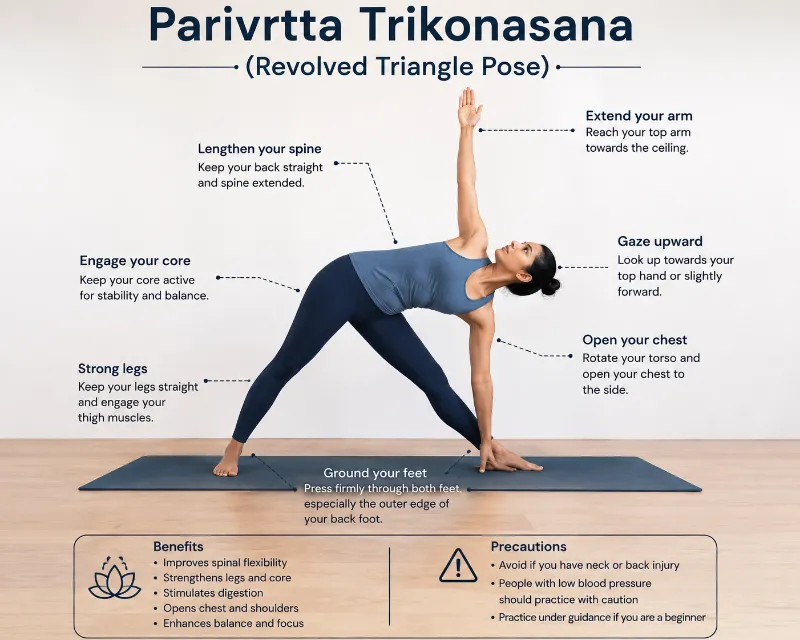
Starting at the top of the mat, place your feet hip-width apart. With your front toes pointing straight forward and your back toes out at a 45-degree angle, step your left foot back approximately a meter. So that you feel comfortable and strong, grind down through both heels.
Lengthen and reach out
Breathe in and extend your arms like wings, then release the breath as you extend your right arm forward, extending your back over your front leg. With your left arm extended toward the heavens, place your right hand on your shin, a yoga block, or the ground.
Softly revolve your heart
To locate even more length in your spine, take a deep inhale. Gently turn your torso to the right as you release the breath, starting from your belly button rather than just your shoulders. Your left hand can be placed on a block on the inside or outside of your foot, or it can be brought over to your right shin.
Expand and look up
If it seems comfortable for your neck, gently look over your right shoulder or up toward your upper thumb. To assist you in keeping balanced and supported, bring your navel in nearer your spine while maintaining strong, active legs.
Breathe into the twist
Take five to ten deep, nourishing breaths here. You could decide to utilize additional props, such as a chair or bolster, to support your weight in order to extend the duration of this “Yin Yoga”-inspired pose. With each exhale, feel the energy flow through your fingertips.
Release with care
Exhale to gradually relax your torso back to center after taking a final breath to lengthen. To maintain things balanced, press into your feet to stand again, pause to observe how you feel, and then repeat the process on the opposite side.
Preparatory Poses
- The non-rotating triangle that warms the hamstrings and lateral hip before adding the twist is called Trikonasana (5 breaths per side).
- The full standing Parivrtta requires a warmed thoracic rotation range, which is achieved by performing Ardha Matsyendrasana on both sides.
- Paschimottanasana (2 minutes): This pose warms the hamstrings on both sides prior to the demand of asymmetric standing.
Key Alignment Cues
Hips Square
- The key to this position is to keep your hips square while rotating your upper body, which is incredibly challenging. Because of this, it’s a good idea to use a block under your hand and to check your hips midway to make sure they are still level and directed forward. Check out our Closed vs. Open Hips explainer if you’re unsure about the meaning of “hips square.”
Lengthen Before You Twist
2. Prior to rotating your upper body, extend your spine completely for your own benefit. That way, you’ll find a lot more space.
Stack Your Shoulders
3. From your elevated hand to your placed palm, visualize a straight line. Use a block beneath your chest if you are unable to open it wide enough with your hand on the ground.
Beginner Tips for Parivrtta Trikonasana
- To keep your hips square and fully open your chest, place a block under your bottom hand at any height.
- As an alternative, place your bottom hand inside rather than outside your front foot. Here, a block is also an option.
- For more stability, extend your stance by shifting your feet to the sides of the mat.
- Maintain a microbend in the knee to prevent locking your front leg.
Alignment Tips
Keep your hips straight to the front of the mat and visualise bringing the outer right hip back.
Engage both legs and press onto the feet for stability.
Maintain a long spine; prevent rounding or collapsing.
If you cannot reach the floor without turning your hips, place a block beneath your lower hand.
Simple and Effective Training Suggestions
- Pull your outer hips towards the midline.
- Twist from the spine, not the arm.
- Press down to lift and rotate.
- Imagine your spine extending out from the crown of your head.
- Let each inhale lengthen you, and each exhale deepen the twist.
Contraindications
- Spinal Injuries or Herniated Discs: Avoid deep twisting and seek guidance.
- Hamstring Injuries: Use shorter stances and props.
- Pregnancy: Avoid closed twists and employ open versions.
- Challenges with Vertigo or Balance: Practice using wall support.
- Low Back Pain: Keep the twist soft and the hips steady.
Modifications & Variations of Parivrtta Trikonasana
- Use a Block: Place a block beneath the bottom hand to improve alignment.
- Shorten the stance. If you feel imbalanced or have tense hamstrings,
- Keep the top hand on the hip. Instead of reaching up, focus on spinal alignment.
- Wall Support: Practice near a wall to improve stability and alignment.
Variations
Revolved Triangle with Bind: For advanced practitioners, bind the arms around the front leg.
Chair Variation: Do the twist while seated to access the spinal rotation without balancing issues.
Knee Slightly Bent: Soften your front knee slightly to protect strained hamstrings.
Revolved Triangle with Twist Strap: Use a yoga strap between the hands to provide shoulder support.
Common Mistakes to Avoid
- Letting hips rotate open: Keep them square to isolate the twist in the spine.
- Rounding the back: Prioritise length and use props to avoid collapsing.
- Locking the front knee: Maintain a tiny bend to protect the joint.
- Over-Twisting the Neck: The gaze can remain neutral or downward.
- Losing Grounding: Engage both feet evenly and root through your legs.
When to Avoid or Modify Parivrtta Trikonasana?
- Pregnancy (particularly in the second and third trimesters): Replace with open twist alternatives.
- SI Joint or Lower Back Issues: Practice cautiously or skip the twist.
- Balance or Vision? For support, use a chair or wall. To prevent hamstring strain, shorten your stance with blocks.
- Recent abdominal or spine surgery: Avoid, unless cleared by a professional.
Why Practice Parivrtta Trikonasana?
Parivrtta Trikonasana provides an excellent balance of strength, flexibility, and mental clarity. It tests your balance and concentration while cleansing internal organs with its deep twist. As a posture that combines breath, alignment, and grounded strength, it’s a cornerstone of intermediate yoga practice—and a stepping stone to deeper awareness on and off the mat.
Explore More Yoga Poses
If this position appealed to you, you might also enjoy:
- How to Do Tadasana Pose | Mountain Pose
- How to Do Virabhadrasana III Pose | Warrior 3 Pose
- How to Perform a Handstand in Adho Mukha Vrksasana Pose
Curious About Yoga Teacher Training?
In our 200-hour yoga teacher training, you will learn 108 poses, as well as yoga philosophy, breathwork, meditation, anatomy, and the self-assurance to instruct.
Being the most adaptable person in the room is not required. You don’t have to have years of experience. All you have to do is be inquisitive and eager to start. This course meets you where you are, whether your goal is to become a professional teacher, improve your own practice, or just learn more about yourself.
FAQs
What Is the Difference Between Triangle Pose and Parivrtta Trikonasana (Revolved Triangle Pose)?
In Triangle Pose, you take a longer stance, twist your chest away from your front leg, and keep your hips open.
With the Revolved Triangle, you take a shorter stance, twist your chest toward your front leg, and place your hips in a closed, or square, position.
Revolved Triangle’s lower body is more like Pyramid Pose than Triangle Pose.
Is Parivrtta Trikonasana beginner-friendly?
Although it’s more of an intermediate pose, beginners can attempt it with a block for support.
Who should avoid Parivrtta Trikonasana?
Full Parivrtta Trikonasana includes intense spinal rotation. Avoid this position if you’ve been told not to perform this kind of movement due to pain or injury.
How long should I hold Parivrtta Trikonasana?
Hold each side for five to eight breaths. The base and rotation are established in the first two to three breaths, and each exhale deepens the thoracic opening in the subsequent breaths. Always practice both sides for the same amount of time.
Who should not do Parivrtta Trikonasana?
The complete standing expression should be avoided by those who have severe hamstring tears, acute lumbar disk herniation, or serious balance issues. Similar thoracic rotation advantages can be obtained from the seated Ardha Matsyendrasana without the standing balance and hamstring flexibility requirements.
How Can You Improve Hamstring Flexibility for Parivrtta Trikonasana?
The necessary hamstring length is gradually developed with daily Paschimottanasana, Janu Sirsasana, and Supta Padangusthasana. Practice Trikonasana concurrently every day to increase awareness of the wide-legged stance. After persistent practice, the whole Parivrtta expression usually becomes ready in 6 to 10 weeks.
References:
- Umel, A. U. (2025, August 15). How to do revolved triangle (Parivrtta trikonasana). Liforme. https://liforme.com/blogs/blog/revolved-triangle-parivrtta-trikonasana?srsltid=AfmBOoppFjrfFgqzZ7PoynCMhx_TGXLLsksv88px573Gglz1fCY45Agp
- Carla, E. A. (2026, March 3). How to do parivrtta trikonasana pose | Revolved triangle pose. Merrymaker Sisters | MerryBody Online Studio: Unlimited Yoga, Pilates and Meditation. https://themerrymakersisters.com/how-to-do-parivrtta-trikonasana-pose/
- Yoga Journal. (2025, March 22). Revolved triangle pose. https://www.yogajournal.com/poses/revolved-triangle-pose-2/