Trikonasana (Triangle Pose)
Introduction
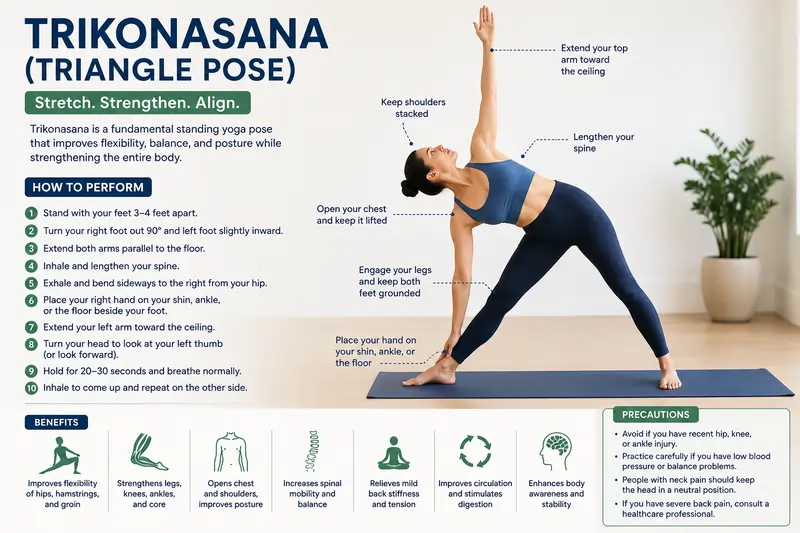
Trikonasana, also known as the Triangle, is a standing yoga pose that calls on balance, strength, and flexibility. You are supposed to spread your legs apart and extend your arms during Trikonasana. Moreover, you rotate one foot at a 90-degree angle. Now, bend your upper body toward the front foot so that one arm reaches forward as though it touches the ground, while the other hand stretches toward the sky.
There may or may not be a distinction between utthita trikonasana and trikonasana depending on your yoga studio or school. However, there are differences between the two terminologies, especially concerning the position of the hands and the torso. While trikonasana and parsvakonasana are similar, trikonasana is done with straight legs, but parsvakonasana maintains the lead leg at a 90-degree angle.
Trikonasana is a series of asanas used in Satyananda yoga. These asanas are done in a series and consist of either four or five poses. Many yoga instructors’ favourite pose is the triangle pose, which they frequently incorporate into their classes.
How to Perform Trikonasana?
Take a straight stance. Your feet should be comfortably spaced between 31/2 to 4 feet apart.
Make your left foot 15 degrees inward and your right foot 90 degrees outward.
Now line up the centre of your left foot arch with the centre of your right heel.
Make sure that both of your feet are in contact with the ground and that your body’s weight is distributed equally between them.
Take a deep breath and, as you release it, bend your body to the right, downward from the hips while maintaining a straight waist. This will allow your right hand to descend toward the floor and your left hand to rise into the air. Keep both arms in a straight line.
Rest your right hand on your shin, ankle, or the floor outside your right foot, whichever is possible without distorting the sides of your waist. In alignment with the tops of your shoulders, extend your left arm toward the ceiling. Keep your head in a neutral position or turn it to the left, eyes staring softly at the left palm.
Ensure that your body is twisted sideways and not backwards or forward. Pelvis and chest are wide open.
Stretch as much as you can while remaining steady. Continue inhaling deeply and slowly. The body should become more relaxed with each exhalation. Simply focus on your body and your breath.
Rise, lower your arms to your sides, and straighten your feet as you take a breath.
On the opposite side, repeat the process.
Duration
- Hold each side for 20–30 seconds.
- Repeat 2–3 times on each side.
Tips:
Instead of attempting to reach the floor, concentrate on stretching both sides of your torso. The alignment is more crucial than the depth of your hand.
Trikonasana Benefits
If you practice trikonasana yoga regularly, you will gain the following five benefits.
- Strengthens the legs, knees, ankles, arms, and chest.
- Stretches and opens up the hips, groins, hamstrings, calves, shoulders, chest, and spine.
- Promotes mental and bodily equilibrium.
- Helps improve digestion.
- Reduces anxiety, stress, back pain, and sciatica.
Things to Keep in Mind
The Triangle posture may appear simple to practice, but without proper direction, it is possible to achieve incorrect alignment and breath control. So, look at the following strategies to complete the Trikonasana successfully:
Engage your muscles:
Many people claim they can’t feel anything in their bodies when doing the Triangle stance. This happens because they aren’t engaging their core, legs, or shoulders. Make sure to strengthen your quadriceps, glutes, abdomen, and shoulders.
Don’t lock your joints.
Beginners are frequently ignorant of the distinction between engaging and locking the joint. As a result, individuals may have joint soreness during practice. So, keep your muscles stiff yet actively retain a tiny bend in your knees and arms.
Be aware of your bending motion.
The triangle stance is a sideways hinge, not a forward bend. Also, avoid curving the spine when you bend to the side; this might create lower back pain.
Tips for practising Trikonasana
Before performing the asana, ensure that you have completed a thorough warm-up exercise for your entire body.
Bend forward softly and gently so that you don’t lose your equilibrium.
Preparatory poses
- Katichakrasana
- Konasana
- Vrikshasana (Tree Pose)
Counter poses
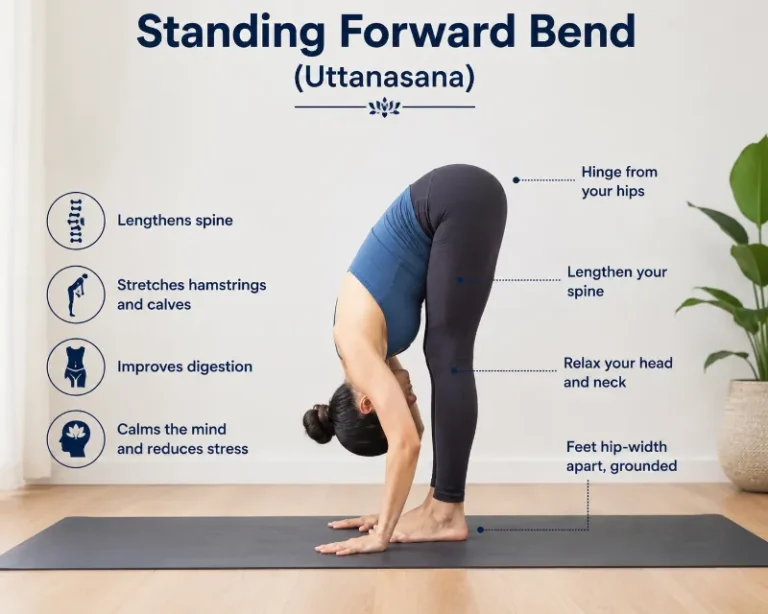
- Uttanasana (Standing Forward Bend)
- Viparita Virabhadrasana (Reverse Warrior)
- Paschimottanasana (Seated Forward Bend)
- Anjaneyasana (High Lunge)
Follow-up poses
Variations
There are techniques to make Extended Triangle Pose more accessible if you can’t get comfortable in the conventional version:
Block-based Extended Triangle Pose
If you can’t get to the floor without bending or rounding your back, place a block beneath your shoulder, inside your front ankle. You can change the block’s height to a level that suits you.
Chair-based Extended Triangle Pose
For greater stability and improved balance, place your bottom hand on the chair seat instead of your shin or the ground. Alternatively, turn the chair over and place your hand on its back instead of its seat.
Sitting in a chair, extend the triangle pose
Take a seat close to the chair’s edge. Gently extend one leg to the side after straightening your knee. Bring that side hand to your shin or thigh after rotating that thigh externally so your knee faces the ceiling. Use your other arm to reach up. If it is comfortable for your neck, you can look up at your fingers.
When to Avoid Performing Trikonasana?
Avoid this posture if you have a migraine, diarrhoea, low or high blood pressure, or neck and back injuries. Those with high blood pressure may perform this stance, but without elevating their hand overhead, as this may increase their blood pressure.
Common Mistakes:
Taking a position that is either too short or too long.
Applying force to your front hand. Your wrist and shoulder may become strained if you place too much weight on your front hand. Instead, to distribute the load more evenly, push hard with both feet.
To get to the ground, round your back. This error frequently occurs when a person’s body does not fit the stance or when they are not yet flexible enough to do the full Triangle posture. Avoid rounding your back to force the posture if you find yourself in either of these circumstances.
Excessive enlargement of the hips. The Triangle Pose may lead some people to overstretch their hips despite its hip-opening benefits.
Anatomy
The front leg hamstrings and the gluteal maximus are the main focus of Trikonasana and receive a strong stretch. Additionally, the position extends the gastrocnemius and soleus muscles in the back leg as well as the upper-side abdomen and back muscles.
Observe how the front-leg hamstrings are stretched more when the upper-side back curvature is straightened. This is due to the fact that using the quadratus lumborum muscle on the upper side causes the pelvis to tilt slightly forward, raising the ischial tuberosities. The relationship between the movement of the hamstring muscles and the upward rotation of the trunk is evident.
The knees are straightened by using the quadriceps. The front of the pelvis opens when the buttocks contract. As the rear hip moves externally, the front of the pelvis likewise expands. By trying to drag the back foot away from the front without really moving, you can engage the quadriceps and gluteal muscles of the back leg. The force of this action is transferred to the back of the knee on the rear leg, opening this area, as the foot is immobile and stays fixed on the mat.
When the body turns up, the front knee tends to turn inward. To counteract this inclination, keep the knee facing forward by externally rotating the hip. To generate a circular force up the leg, press the ball of the foot into the ground. This exemplifies the idea of creating stability by co-activating muscles.
With the lower hand fixed on the ground or knee, the chest can be opened with leverage. Proprioceptive awareness of the space arm is produced when the upper side of the shoulder and the upper arm are engaged. The head is rotated to face upward by the cervical spine.
FAQs
What is Trikonasana and its benefits?
Trikonasana, sometimes called the Triangle Pose, is a fundamental yoga pose with many advantages for both mental and physical well-being. By strengthening the core muscles and stretching the legs, hips, and spine, this pose improves flexibility.
Who should not do Trikonasana?
This pose should be avoided by students who have injuries to their necks, knees, shoulders, or ankles. Runners and athletes with hamstring or ankle issues should avoid this stance and instead rest the muscles. This pose should be avoided by those who have had hip, knee, or spinal surgery.
What is Trikonasana also known as?
Asana means “posture,” kona means “angle” or “corner,” and tri means “three” in Sanskrit. Trikonasana, which translates to “three corners,” is also referred to as Triangle Pose in English.
Can Trikonasana reduce belly fat?
It helps you lose extra fat and gives your entire body a good stretch. Belly fat can be readily reduced by using the modified Trikonasana exercise.
What are the mistakes in Trikonasana?
Bending forward is a typical error in Trikonasana. Your shoulders and hips are no longer in alignment when you lean forward. You miss the entire side body stretch as a result. Instead, pretend your back is against a wall, maintain your chest wide, and stack your shoulders.
References:
- Yoga Journal. (2026, March 9). Extended triangle pose. https://www.yogajournal.com/poses/extended-triangle-pose/
- Dr.Nidhiphysio. (2024, October 21). Trikonasana (Triangle Pose): Health Benefits,steps,Types & variations. Mobile Physiotherapy Clinic. https://mobilephysiotherapyclinic.in/trikonasana-yoga-pose/

5 Comments