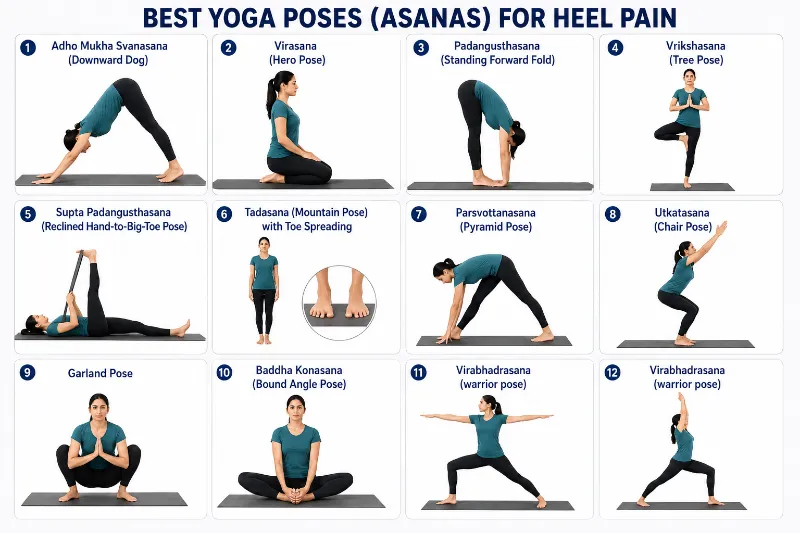
11 Best Yoga Poses for Heel Pain
Introduction
Heel pain is not limited to the morning. It restricts how far you can walk, how long you can stand, and how confidently you can go about your day. Choosing to ignore the sore heel might alter your gait over time and lead to secondary issues with your lower back, knees, and hips.
The strategy is effective because it addresses the root causes, which include reduced ankle mobility that stresses the heel with each step, weak foot muscles that cannot support the arch, and a tight calf that pulls the plantar fascia taut.
Can Yoga Really Help with Heel Pain?
Yes, three standard procedures are used in yoga for heel pain:
Stretching the calf and posterior chain: By releasing the gastrocnemius and soleus, downward dog and standing forward folds directly lessen the tension that causes the plantar fascia to become taut.
Intrinsic foot strengthening: Toe-spreading movements and Tree Pose develop the tiny foot muscles that support the arch and lessen fascial strain.
Ankle mobility improvement: One of the main risk factors for plantar fasciitis is restricted ankle dorsiflexion. This range of motion is restored with Achilles-focused poses and supine calf stretches.
Daily calf stretches and intrinsic foot strengthening are the foundations of a yoga practice for heel pain, and research consistently supports them as first-line conservative therapy for plantar fasciitis. Additionally, yoga fosters conscious body awareness, which enables you to identify and manage tension before it becomes painful.
Benefits of Yoga for Heel Pain
Strengthens the Internal Foot Muscles:
Inadequate arch support and elevated fascial loading are caused by weak intrinsic foot muscles. This intrinsic foot strength is developed by yoga postures that challenge single-leg balance, widen the toes, and engage the arch. These poses target the anatomical weakness that underlies persistent heel discomfort.
Reduces the Anxiety of Chronic Pain:
Movement anxiety based on chronic heel pain results in compensatory habits that lead to secondary issues because of the fear of that painful first step. As pain lessens and natural gait is restored, yoga’s mindful movement method aids in reestablishing confident, relaxed foot contact with the ground.
Supports Whole-Body Structural Health:
Rarely does heel pain go undetected. Plantar fasciitis-related gait alterations frequently result in tension throughout the entire posterior chain, including the hamstrings, lower back, and calves. For complete structural relief, a regular practice of yoga for heel pain combined with yoga for the spine treats this link from foot to spine.
Best Yoga Poses (Asanas) for Heel Pain
Adho Mukha Svanasana (Downward Dog)
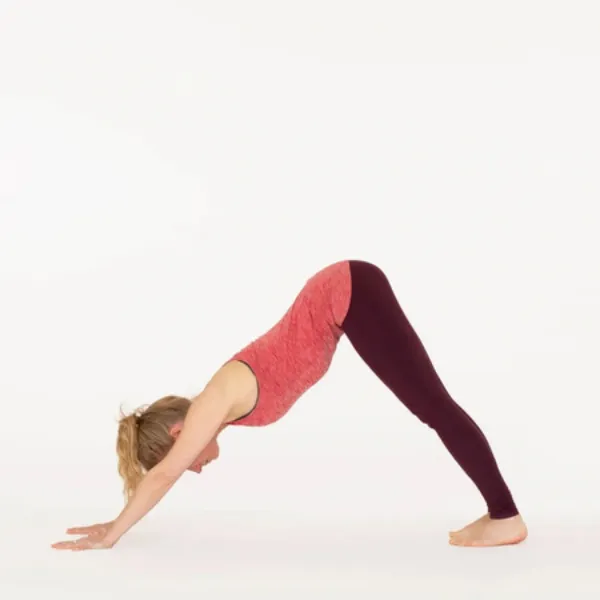
- The most comprehensive single yoga posture for heel pain is Adho Mukha Svanasana, which simultaneously stretches the plantar fascia, Achilles tendon, gastrocnemius, and soleus muscles.
- Hold with alternating heel slides for ten breaths.
- For optimal results, practice three to five times a day.
How it helps: reduces the tension that causes this condition of discomfort by releasing the complete posterior chain from the heel to the sit bones.
Virasana (Hero Pose)
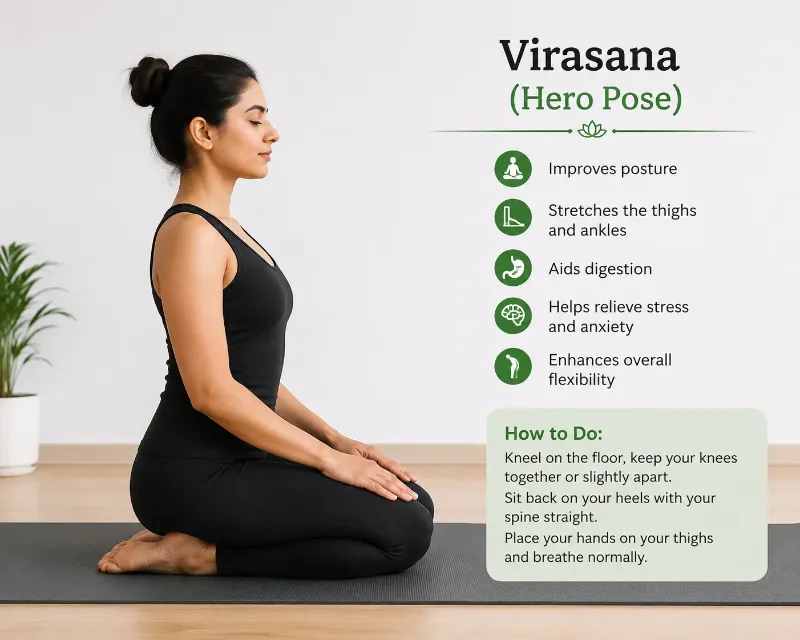
- The plantar fascia is directly stretched when performing Virasana while sitting on one’s heels with the toes tucked under and pressing into the floor with bodyweight.
- Hold for 30 to 60 seconds, three times.
- Within two weeks of daily practice, this is the most direct plantar fascia stretch offered in yoga and may significantly reduce heel discomfort.
How it helps: targets the inflammatory tissue at its origin by directly stretching the plantar fascia, not only the surrounding muscles.
Padangusthasana (Standing Forward Fold)
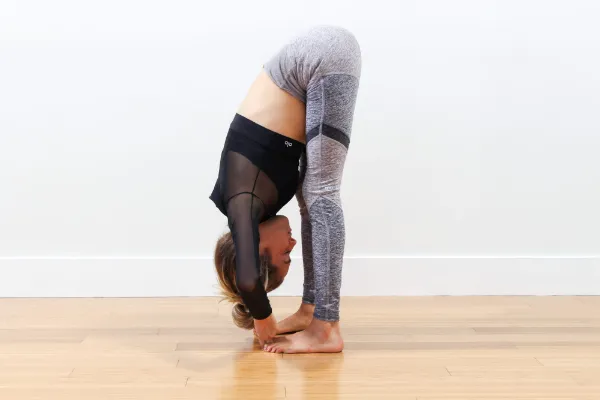
- The calf-Achilles-plantar fascia chain that causes heel pain is released by the standing forward fold, which produces a complete posterior chain stretch from the heel through the entire leg.
- Hold for ten deep breaths.
- If your hamstrings are extremely tight, try bending your knees gently.
How it helps: When heel discomfort spreads to the hamstrings and lower back in addition to the calf, this is one of the best yoga poses.
Vrikshasana (Tree Pose)
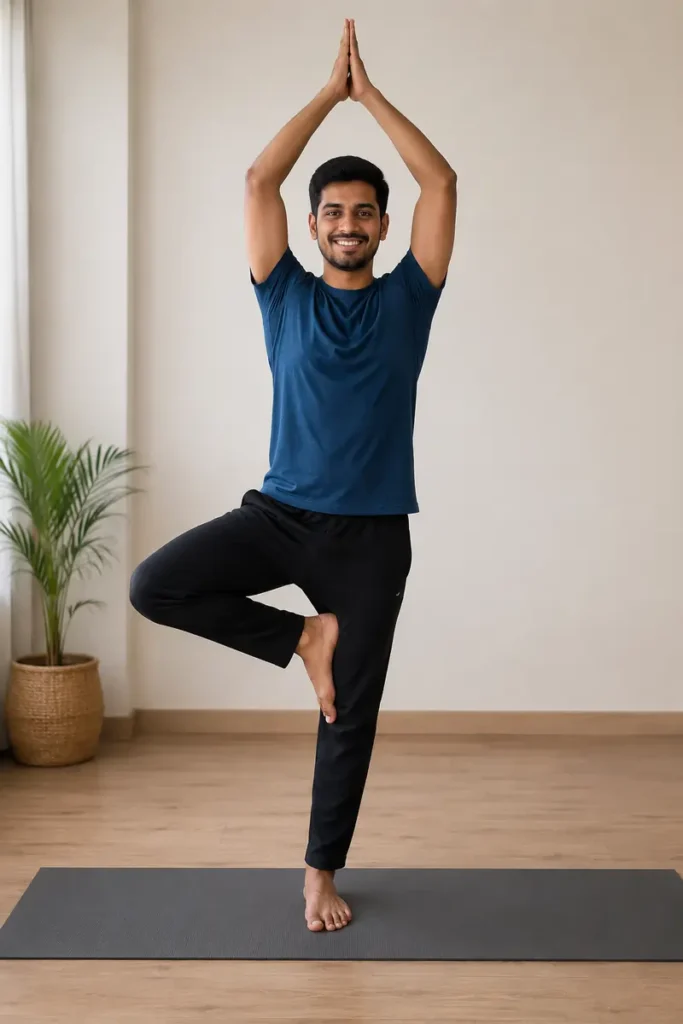
- The most useful intrinsic foot-strengthening yoga exercise is Vrikshasana, which tests the standing foot’s intrinsic muscles to maintain the arch under single-leg pressure.
- Hold for 30 seconds on each side, increasing to 60 seconds.
- Practicing tree pose every day strengthens the feet and keeps plantar fasciitis from coming back.
How it helps: It is essential for preventing long-term heel discomfort since it treats the structural weakness rather than just the symptoms.
Supta Padangusthasana (Reclined Hand-to-Big-Toe Pose)
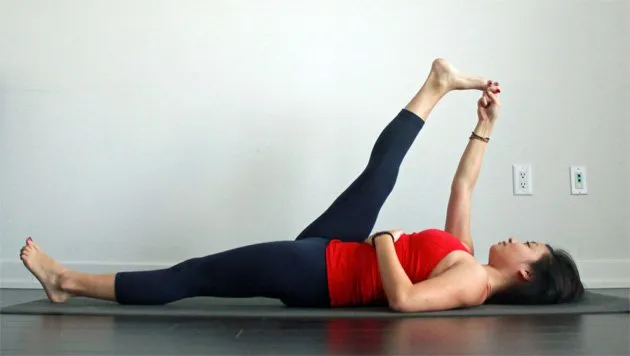
- Raise one leg while lying on your back and use a strap to hold the foot.
- To mobilize the ankle, flex and extend the foot ten times.
- Then, maintain maximum dorsiflexion for ten breaths.
- This supine stretch is wonderful for your morning routine before getting out of bed since it allows you to practice yoga for heel pain without having to bear weight.
How it helps: The safest choice during acute flare-ups is to stretch the calf and Achilles in a non-weight-bearing position.
Tadasana (Mountain Pose) with Toe Spreading
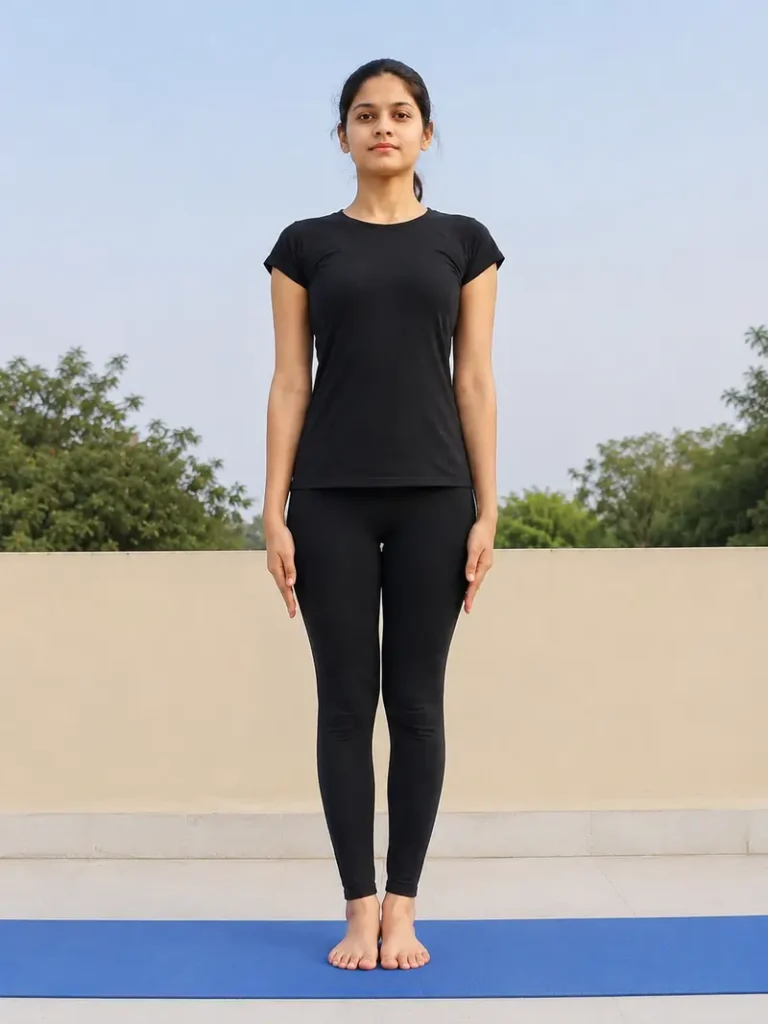
- Spread all ten toes as wide as you can while standing in Tadasana, pressing each toe into the floor separately.
- Ten times, hold the spread for ten seconds, then let go.
- The foot intrinsic muscles that have been latent due to years of wearing shoes are reactivated by this easy workout.
How it helps: it treats one of the underlying anatomical reasons for plantar fasciitis by retraining the foot muscles involved in arch support.
Parsvottanasana (Pyramid Pose)
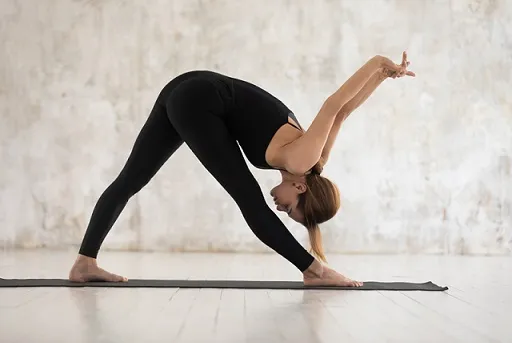
- Fold over the front leg with one foot front and one back, driving the rear heel firmly into the ground.
- This produces a strong Achilles and calf stretch on the back leg.
- Hold ten breaths on each side.
How it helps: targets the deeper calf muscle, the soleus, better than the downward dog; this is significant since soleus tightness is frequently disregarded when treating heel discomfort.
Utkatasana (Chair Pose)
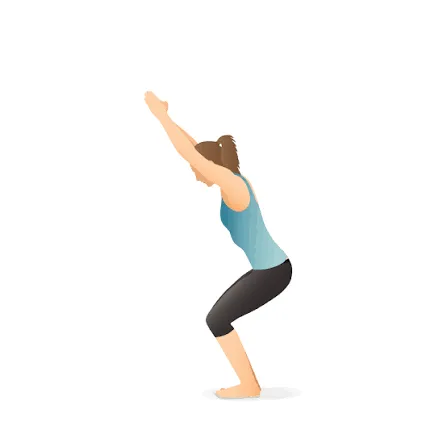
- Place your feet hip-width apart as you stand. Press your big toes and the outside border of your feet into the ground while spreading your toes apart.
- Take a breath and lift both arms over your head, palms facing one another. Maintain a straight elbow position.
- Bend your knees and gently descend as if you were going to sit in a chair as you release your breath. Maintain your whole weight concentrated over your heels and your chest up.
- Hold for a few breaths.
- Relax.
Garland Pose
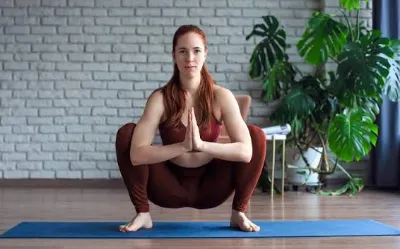
- Garland posture increases flexibility and strength in the vital muscles that support your arch by stretching the calves and ankles.
- The Garland pose involves squatting on the floor with your feet close together, your thighs apart, and your heels flat on the ground.
- Lean forward till your body is between your thighs as you release the breath.
- Now, softly press your elbows on your inner knees while bringing your hands together.
- After 30 seconds of holding this posture, gradually let go.
Baddha Konasana (Bound Angle Pose)
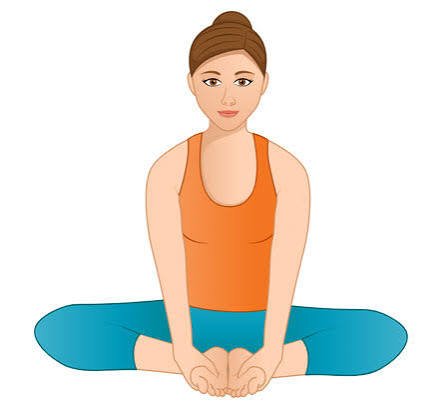
- For those whose feet are tired and sore from prolonged standing, this position is ideal. It stretches the hips, thighs, and calves in addition to the feet.
- Sit down and straighten your back to do the Bound Angle Pose.
- The soles of your feet should then come into contact with your pelvis when you bend your knees.
- You can use your hands to support your feet. Press your knees softly toward the floor after using your hands to draw your feet as close to your body as you can.
- Hold for one to three minutes, then let go and do it again. You may make this posture more challenging as you become used to it by gradually fluttering your knees up and down like a butterfly.
Virabhadrasana (warrior pose)
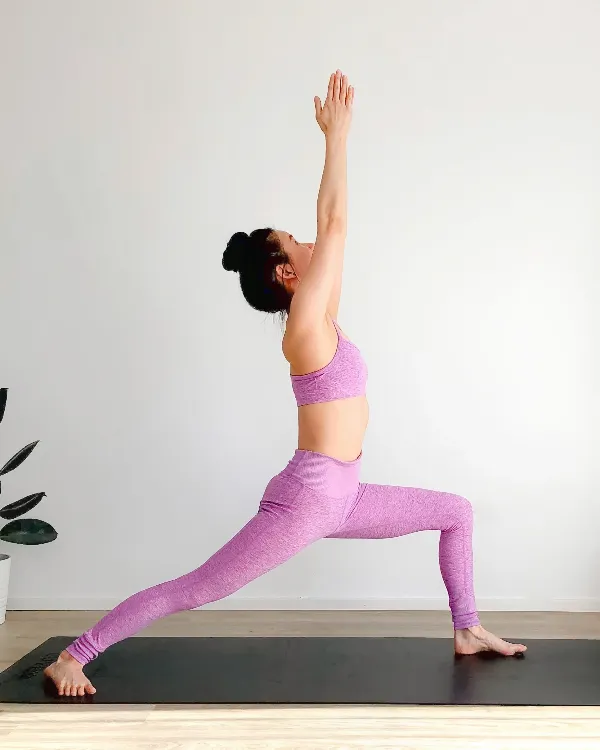
This position improves our body’s balance while toning and strengthening our arms, legs, and lower back. The steps to do Virabhadrasana are as follows:
- A minimum of three to four feet should separate your legs while you stand tall.
- Both arms should be raised and extended to shoulder height.
- Turn the left foot in at 15 degrees and the right foot out at 90 degrees.
- Take a deep breath and maintain this position.
- Exhale and lower your hands.
- On the left side, repeat this position.
Precautions:
People with plantar heel pain may find that yoga increases their range of motion and flexibility, especially if they stretch their calves and plantar fascia gently. Exercises should be adjusted based on the level of discomfort and the underlying reason for heel pain, too.
Stretching should not be forced. Avoid pulling the foot or heel into painful regions when performing yoga poses.
If the pain gets much worse, stop. Heel pain that is intense, stabbing, or getting worse should be stopped, but mild stretching discomfort is possible.
Persistent heel pain should not be ignored. Plantar fasciitis is not usually the source of heel pain. Persistent or unusual pain should be addressed by a healthcare professional because identical symptoms can be caused by other illnesses.
FAQs:
How to stop heel pain quickly?
Rest your foot and place an ice pack or a cold water bottle under your arch for 15 to 20 minutes to rapidly relieve heel pain. Before getting up, take an over-the-counter anti-inflammatory medication like ibuprofen and stretch your calves and feet gently.
What are 5 common causes of heel pain?
Heel pain is frequently caused by the following five factors:
Inflammation of the tissue band on the bottom of the foot is known as plantar fasciitis.
Overuse or inflammation of the tendon that connects the calf to the heel is known as Achilles tendonitis.
Heel spurs, which are calcium deposits on the heel bone
Inflammation of the fluid-filled sac behind the heel is known as bursitis.
Small breaks in the heel bone caused by persistent stress are known as stress fractures.
Is heel pain due to uric acid?
Heel pain is less common than big toe pain; however, it can occasionally be caused by gout caused by excessive uric acid. But the majority of heel pain is caused by mechanical problems like tendinitis or plantar fasciitis and is unrelated to uric acid.
Should I keep walking with heel pain?
If you have severe heel pain, you should reduce or stop taking long walks. Walking through the pain may result in more microscopic tears in the tissue, exacerbating the damage and delaying its healing. For your feet, rest and care are safer options.
Can heel pain be fixed?
It is possible to cure heel pain, and the majority of patients recover completely with basic home remedies like rest, ice, and supportive shoes. Plantar fasciitis, an inflammation of the tissue along the bottom of the foot, is the most frequent cause.
References:
- Höök, K., Caramiaux, B., Erkut, C., Forlizzi, J., Hajinejad, N., Haller, M., Hummels, C., Isbister, K., Jonsson, M., Khut, G., Loke, L., Lottridge, D., Marti, P., Melcer, E., Müller, F., Petersen, M., Schiphorst, T., Segura, E., Ståhl, A., . . . Tobiasson, H. (2018). Embracing first-person perspectives in Soma-based design. Informatics, 5(1), 8. https://doi.org/10.3390/informatics5010008
- Tick, H., Nielsen, A., Pelletier, K. R., Bonakdar, R., Simmons, S., Glick, R., Ratner, E., Lemmon, R. L., Wayne, P., & Zador, V. (2018). Evidence-Based Nonpharmacologic Strategies for Comprehensive Pain Care. EXPLORE, 14(3), 177–211. https://doi.org/10.1016/j.explore.2018.02.001
- Martin, R. L., Davenport, T. E., Reischl, S. F., McPoil, T. G., Matheson, J. W., Wukich, D. K., McDonough, C. M., Altman, R. D., Beattie, P., Cornwall, M., Davis, I., DeWitt, J., Elliott, J., Irrgang, J. J., Kaplan, S., Paulseth, S., Torburn, L., Zachazewski, J., & Godges, J. J. (2014). Heel Pain—Plantar Fasciitis: Revision 2014. Journal of Orthopaedic and Sports Physical Therapy, 44(11), A1–A33. https://doi.org/10.2519/jospt.2014.0303