Urdhva Dhanurasana (Wheel Pose)
Key Highlights
The highest backbend in yoga is Urdhva Dhanurasana, also known as Wheel Pose. This fully arched supine pose offers heart-opening energy, thyroid stimulation, full-body strength, and extensive anterior chain flexibility. It requires methodical preparation, boosts mood, and cultivates courage. Through gradual backbend sequencing, it is appropriate for intermediate practitioners.
- Setu Bandhasana and Ustrasana prepare for what is known as yoga’s highest backbend.
- puts strain on the glutes, quadriceps, spine extensors, triceps, and shoulder stabilizers.
- In particular, full neck extension improves circulation to the parathyroid and thyroid glands.
- Practitioners characterize head-below-heart vulnerability as truly transforming.
- The reproductive organs are also reported to be stimulated by pelvic extension during the complete backbend.
- Needs to be prepared methodically using Bhujangasana, Ardha Chakrasana, and Setu Bandhasana.
What is Urdhva Dhanurasana?
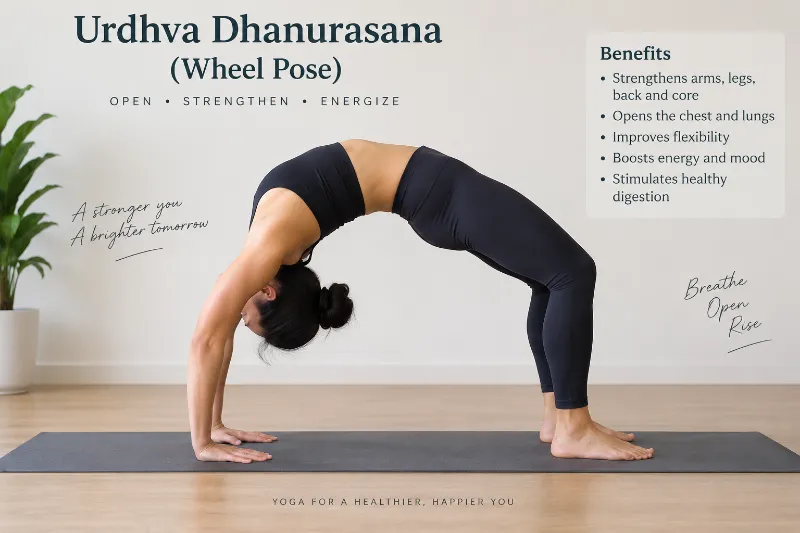
Urdhva Dhanurasana, sometimes called Wheel Pose or Upward Bow Pose in English, is derived from the Sanskrit words Urdhva (upward), Dhanu (bow), and Asana (posture). With the hands and feet on the ground, the hips raised, the arms and legs fully extended, and the spine completely backbent, the body forms an upward-arching bow that resembles a tight bow.
One of the hardest and most rewarding yoga poses is Urdhva Dhanurasana, which calls for the concurrent development of full-body strength, hip flexor lengthening, shoulder opening, and spinal flexibility. All previous backbend preparations, such as Setu Bandhasana, Bhujangasana, Ustrasana, and Ardha Chakrasana, culminate in this apex backbend.
Urdhva Dhanurasana is taught at Habuild using a meticulously planned progression that guarantees the safe and methodical development of shoulder, hip flexor, and spinal flexibility prior to attempting the full wheel.
Muscles Worked
Urdhva Dhanurasana activates several major muscle groups, including:
- Arms and shoulders
- Upper and lower back
- Abdominal muscles
- Glutes
- Hamstrings
- Quadriceps
- Hip flexors
- Chest muscles
Urdhva Dhanurasana Benefits
Physical Benefits
Develops Full-Body Anterior Chain Flexibility
The deepest anterior body stretch in yoga is called Urdhva Dhanurasana, which simultaneously lengthens the anterior deltoids, hip flexors, abdominals, intercostals, pectorals, and entire anterior spine. The basis of advanced yoga flexibility is this thorough openness.
Builds Full-Body Strength
The triceps, shoulder stabilizers, spinal extensors, glutes, and quads must all be exceptionally strong in order to press into the full wheel pose while bearing a heavy load.
Stimulates the Thyroid and Endocrine System
While the entire anterior body expansion stimulates the endocrine system generally, promoting thyroid health and hormonal balance, the full anterior neck extension boosts circulation to the thyroid and parathyroid glands.
Opens the Heart and Stimulates the Chest and Pelvic Region
The full chest opening increases intercostal flexibility, activates the heart chakra area, and enlarges the thoracic cavity. The reproductive organs are stimulated concurrently by the pelvic extension.
Mental Benefits
Produces Euphoria and Elevates Mood
One of yoga’s most potent mood-enhancing poses is Urdhva Dhanurasana, whose complete chest-open, anterior-expanded position is neurologically linked to self-assurance, vitality, and emotional openness.
Develops Courage and Overcomes the Fear of Backbending
The completely arched position’s vulnerability—head below the heart, spine fully extended—requires a level of mental and physical bravery that practitioners frequently characterize as transforming.
How to Do Step-by-Step Instructions
Key Principles
Essential Ideas: Three non-negotiable criteria are: lead with the chest because the lift starts from the thoracic spine, not the lumbar; press through the hands evenly because unequal hand pressure creates an asymmetric shoulder load; and warm up thoroughly—at least ten to fifteen minutes of progressive backbend preparation.
Step 1: Supine Starting Position
With your knees bent, your feet flat on the mat, hip-width apart, and your heels near your sitting bones, lie on your back. Let the spine settle and place your arms next to your body.
Step 2: Place the Hands Beside the Ears
With the fingers pointed toward the shoulders and the elbows pointing up, place the hands next to the ears. Verify that the hands are equally spaced and shoulder-width apart.
Step 3: First Press — Crown to Floor
Press through the hands and feet to raise the hips as you exhale, briefly resting the crown of your head on the ground. This is the alignment checkpoint for shoulder opening and hand position.
Step 4: Full Press Into Wheel Pose
Press firmly through the arms on the subsequent exhale, straightening the elbows and raising the head entirely off the ground. The entire spine curves into the shape of a full wheel.
Step 5: Engage the Lower Body and Breathe
Draw the inner thighs closer to one another while using the glutes to push the hips forward and upward. Short, steady breaths should be taken into the rear of your body.
Step 6: Come Down Safely
One vertebra at a time, drop the head and spine to the mat after tucking the chin into the chest and softly bending the elbows. Spend 30 to 60 seconds resting in Apanasana (knees to chest).
Breathing
The posterior ribcage extends when you inhale into your rear body. At first, short, steady breaths work better than extended ones. The most frequent mistake that causes dizziness in Urdhva Dhanurasana is to hold your breath.
Progressive Preparation Sequence
Before attempting Wheel Pose, several preliminary positions must be achieved.
- Setu Bandhasana (Bridge Pose, 3 rounds): This pose develops the supine backbend mechanics and activates the posterior chain.
- Bhujangasana (Cobra Pose, 5 breaths): Promotes posterior chain activation and spinal extension awareness.
- Ustrasana (Camel Pose, five breaths): This pose opens the thoracic extension and hip flexors needed for the full wheel.
- The direct step in between camel and full Urdhva Dhanurasana is called supported half-wheel (hands on blocks).
Variations
Variation 1: Supported Wheel with Blocks — Beginner Preparation
People with low shoulder flexibility can perform the press-up more easily because yoga blocks under the hands lessen the amount of shoulder extension needed.
Variation 2: Full Urdhva Dhanurasana — Standard
The standard objective for intermediate practitioners with well-established backbend preparation is the full expression outlined in the steps.
Variation 3: One-Legged Urdhva Dhanurasana — Advanced
One leg lifts toward the ceiling from the complete wheel, resulting in a deeper hip flexor stretch on the side with the grounded leg and a unilateral strengthening demand.
Urdhva Dhanurasana Step-by-Step Guide.
- Step 1: Spread your arms out beside you while keeping your back flat on the mat. Bend your knees so that your legs are the same width as your hips and your soles are parallel to the ground. Bring your heels as near to your buttocks as you can while you’re in this posture.
- Step 2: Raise your arms over your head and flex your elbows so that your hands are flat on the ground on either side of your head. Make sure the fingers are stretched out and resting under the shoulders, with the palms pointing downward.
- Step 3: At this stage, concentrate on each of your limbs. Dispel whatever opposition you come across. Make a conscious effort to remain present. Prior to moving on to the next steps, pay attention to any resistance or strain in your limb. Once everyone is relaxed, take a deep, steady breath and raise your elbows toward the ceiling.
- Step 4: Raise your hips toward the ceiling while keeping your feet firmly on the ground. The arms and legs should be parallel to one another. Take a deep breath and place your palms firmly on the ground to raise off your shoulders.
- Step 5: With your crown just barely touching the mat, allow your inner arms and thighs to pull closer to one another. In this position, take a deep inhale, raise your entire body, and concentrate on creating a curve with your spine. Your neck should be at ease and supported by gravity.
- Step 6: Take deep breaths and hold the position for no more than a minute. Then, reset and repeat up to ten times if necessary. Lift your head off the ground and bring it closer to your chest to reset. Slowly bend your arms and knees before lowering your back to the floor.
Common Mistakes to Avoid
Attempting the Full Pose Without Adequate Preparation
Without a comprehensive backbend warm-up, Urdhva Dhanurasana puts a great deal of strain on the lumbar spine and shoulder joints. The entire stance is safe and accessible because of the preliminary sequence, which is not optional.
Elbows Splaying Outward
Splaying the elbows puts rotational force on the wrist and lateral elbow joint; therefore, the elbows must stay parallel and shoulder-width throughout the press.
Using the Lumbar Spine Instead of the Thoracic Spine
The thoracic spine and chest, not a lower back arch, are where the lift begins. While a lumbar-led wheel compresses the posterior disk, a thoracic-led wheel is safe and helpful.
Who Should Practise?
Practitioners Ready for Advanced Backbends
Any practitioner who has easily established Setu Bandhasana, Ustrasana, and Ardha Chakrasana will naturally reach Urdhva Dhanurasana.
Those Seeking Hormonal and Thyroid Support
Urdhva Dhanurasana is one of the most effective yoga poses for promoting thyroid health and hormonal balance in physically fit practitioners because of its extensive endocrine stimulation.
Is Urdhva Dhanurasana Good for Beginners?
For beginners working toward the whole wheel over three to six months of methodical practice, the entire preparatory sequence is both appropriate and beneficial, though not as an immediate beginning stance.
Make Urdhva Dhanurasana a Part of Your Practice
The full anterior body arc of Urdhva Dhanurasana, the pinnacle of yoga’s backbend curriculum, offers the most extensive flexibility, strength, endocrine activation, and heart-opening feeling of any single yoga pose.
With the whole preparatory sequence, thoracic-led lift technique, and safe exit instructions, professional teaching for the most efficient way to build toward Urdhva Dhanurasana.
FAQs
How is Urdhva Dhanurasana different from Chakrasana?
The entire supine wheel backbend with arms and legs completely extended is essentially the same position. Ashtanga and Iyengar yoga traditions utilize the Sanskrit name Urdhva Dhanurasana, whereas Hatha yoga traditions more frequently use the name Chakrasana. The benefits, preparation, and physical posture are the same.
“How should the body be prepared before practicing Urdhva Dhanurasana?
The most important requirement is shoulder flexibility. The wrists will sustain compensatory load in the complete wheel if you are unable to comfortably raise both arms upwards and place the palms flat on the floor while lying on your back. Before trying the complete press, develop shoulder openness using Ustrasana, Setu Bandhasana, and targeted shoulder stretches.
What causes the elbows to move away from the body during Urdhva Dhanurasana?
Insufficient shoulder flexibility for the necessary arm position is indicated by elbow splaying. Throughout the press, the elbows must be parallel to one another and shoulder-width apart. Before moving on to the entire wheel, keep preparing your shoulders if they splay despite your best efforts. The necessary shoulder range is decreased, and proper elbow alignment is made possible by using blocks under the hands.
Can Urdhva Dhanurasana boost mood and energy?
Yes, it has the most potent mood-enhancing effect of all the yoga poses. A consistent and instantaneous transition from low or contracted emotional states to energized and open ones is produced by the full anterior body expansion, sympathetic nervous system activation, and heart-opening quality. Within seconds of reaching the complete position, practitioners sense this.
Who should avoid Urdhva Dhanurasana?
The entire wheel should not be used by anyone with carpal tunnel syndrome, shoulder injuries, uncontrolled hypertension, spinal disk issues, or recent wrist injuries. The standing backbend, or Ardha Chakrasana, is still doable for the majority of people and offers significant benefits for spinal extension without the same difficulties.
What is a suitable weekly practice routine for Urdhva Dhanurasana?
Two to three times a week, always following a thorough warm-up that includes at least ten to fifteen minutes of preparation for advanced backbends. The whole wheel benefits from rest days in between sessions for wrist and shoulder recuperation, in contrast to milder postures. Bridge Pose and Ardha Chakrasana can be done every day as part of the preparation routine.
What should I do immediately after Urdhva Dhanurasana?
As soon as you land, spend 30 to 60 seconds in Apanasana, with your knees brought to your chest. After the vigorous extension, the lumbar spine is slowly decompressed. After releasing the lower back with Child’s Pose, reestablish spinal neutrality with Paschimottanasana or a light forward fold before standing.
References
- Yogateket. (n.d.). Urdhva Dhanurasana: Upward Bow ( Full Wheel) Pose – YOGATEKET. Yogateket. https://yogateket.com/blog/urdhva-dhanurasana-upward-bow-pose
- Zehra, S. (2026g, August 11). Urdhva Dhanurasana: Wheel Pose Steps & Benefits | Habuild. Habuild Blogs. https://habuild.in/habitology/asana-mudra/urdhva-dhanurasana/
- Yoga Journal. (2025ab, March 22). Wheel Pose | Upward-Facing Bow Pose. https://www.yogajournal.com/poses/upward-bow-or-wheel-pose/
One Comment