
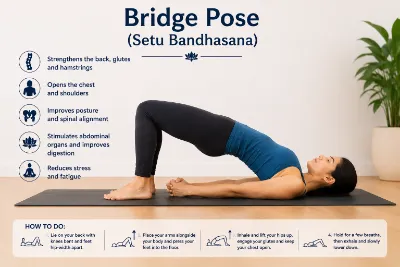
Setu Bandhasana (Bridge Pose)
What is Setu Bandhasana (Bridge Pose)?
Setu Bandhasana, also known as Bridge Pose, is a gentle yoga posture that strengthens the back, glutes, and legs while improving spinal flexibility.
The hips lift from this position, creating a bridge-like bend through the spine. Bridge Pose opens the chest and hip flexors, strengthens the glutes and back, and relieves stiffness caused by prolonged sitting when practised properly.
The Bridge Pose, a pose often introduced early in yoga practice, makes deeper backbends such as Wheel Pose and Camel Pose possible. With consistent practice, it becomes a dependable tool for building lower body strength, improving spinal health, and improving posture.
Setu Bandhasana: Overview and Meaning of Bridge Pose
- As the hips are raised and the feet and shoulders grounded in the ground, the Bridge Pose (Setu Bandhasana) resembles a bridge. Though a simple appearance, it teaches an important movement pattern: how to open the chest, support the spine, and extend the hips without compressing the lower back.
- The Sanskrit word, is the word setu (bridge), bandha (lock or bind), and asana (pose). The act of “binding” the body into a steady, bridge-like form. is defined in the name taken together. It is able to use both the shorter, more common modern name Setu Bandhasana and the longer name Setu Bandhasana Sarvangasana, as is used in some traditional lineages. Both refer to the same posture.
- Bridge Pose is closely associated with the development of modern yoga, particularly as supine poses became popular in the 20th century. Its versatility makes it easy to include in therapeutic sessions, gentle classes, restorative practices, and strengthening tasks. In various traditions, it is also taught as a pose to prepare for the Shoulder Stand (Sarvangasana).
- From an anatomical perspective, Bridge Pose combines muscle strength with a deep, gentle stretch. While the glutes, hamstrings, and spinal extensors actively raise and support the hips, the deep core and inner thighs support the pelvis and knees. The front body, shoulders, chest, and hip flexors all lengthen as the spine is. When these muscles work together, the pose is therapeutic and strengthening as the pose feels open and supportive rather than constricted.
At a Glance
- Sanskrit Name: सेतु बन्धासन (Setu Bandhasana)
- Also Known As: Setu Bandha Sarvangasana
- Pronunciation: SAY-too bahn-DAHS-uh-nuh
- English Name: Bridge Pose
- Pose Type: Supine backbend/hip lift
- Level: Beginner → Intermediate
- Hold Time: 30–60 seconds (5–10 breaths)
- Supported bridge pose: 3–5 minutes
- Main Benefits: Hip flexor stretch, chest opening, groin and back strength, and posture support
- Body Focus: Hip flexors, chest, hamstrings, glutes, & spinal extensors
Muscle Work During Bridge Pose:
- Arm and Shoulder Muscles
- Chest Muscles
- Upper and Lower Back Muscles
- Core Muscles
- Hip Muscles
- Pelvic Muscle
- Gluteal Muscle
- Psoas Muscle
- Quadricep Muscle
Setu Bandhasana (Bridge Pose) Video
Benefits of Setu Bandhasana (Bridge Pose)
Bridge pose is a rare combination of strength, openness, and nervous system support. By engaging the glutes, spine, chest, and hips at the same time, this pose is considered one of the most practical and therapeutic backbends in yoga.
Physical Benefits
- Strengthens the glutes and back muscles: Bridge Pose strengthens the posterior-chain strength needed for posture, lifting, and daily movement, strongly activating the glutes and spinal muscles.
- Reduces lower back pain: Bridge Pose helps reduce lower back strain, which is frequently caused by long sitting, by strengthening the hips and stretching tight hip flexors.
- Improves posture: By opening up the chest and strengthening the upper and lower back, rounded shoulders and forward slouching can be reduced.
- Hip flexors and front thighs stretch by lifts of the hips, and relaxes chronically tight hip flexors, which helps keep the pelvis and spine from being out of alignment.
- Expands the chest and shoulders: In pressing the arms and shoulders into the mat, the chest expands, improving breathing and reducing stiffness in the upper body.
- Supports spinal mobility: Bridge Pose creates a gentle, supported extension of the spine, which is helpful for keeping spinal mobility without excessive compression.
- Improves circulation: The pose improves venous return and improves overall blood flow by raising the hips slightly above the heart.
Mental & Nervous System Benefits
- Reduces stress and tension: The nervous system can be calmed, and tension can be released through grounding through the feet and opening through the chest.
- Boosts energy without overstimulation: Bridge Pose is gently energetic, making it useful when you feel sluggish but don’t want an intense practice.
- Enhances mind-body awareness: Proprioception and body awareness improve; breath, leg strength, and spinal movement are well coordinated.
- Supports better sleep (supported version): Practised as a supported bridge pose, it has a soothing effect that can help unwind the body before bedtime.
Digestive & Hormonal Benefits
- Stimulates digestive organs: When practised mindfully, a gentle lift and stretch of the abdomen may support digestion to lower mild bloating.
- Supports thyroid function: When the neck position is comfortable and neutral, Bridge Pose, with the chest open and the throat gently extended, can help stimulate the thyroid region.
Functional & Everyday Benefits:
- Addresses the adverse effects of prolonged sitting: Two of the most common problems for sedentary lifestyles, weak glutes and tight hips, are addressed directly in Bridge Pose.
- Builds a foundation for deeper backbends: By teaching controlled hip lift and spinal support, it safely prepares the body for poses like Wheel Pose and Camel Pose.
- Accessible for all levels: The Bridge Pose easily adapts to beginners, seniors, and recovery-focused practices because it can be practised actively or as a supported bridge pose.
- Book an appointment for a free one-on-one session with a qualified Indian yoga teacher today and feel the benefits of the Bridge Pose!
How to Do Setu Bandhasana(Bridge Pose): Step-by-Step Guide
Bridge Pose may appear simple, but to preserve the lower back and properly activate the glutes, proper setup and sequencing are essential. While practised mindfully, it builds into a powerful yet manageable backbend that opens the front body and builds strength.
Part 1: Preparing for the Pose
Check in with your body for a moment before practising Bridge Pose:
- You’re ready to practice if you can bend your knees and lie on your back without discomfort in your knees or back.
- Props You May Need
Yoga mat with adequate cushioning
Yoga block (recommended for lower back support or supported bridge)
Folded blanket (optional, under shoulders for neck comfort)
Warm-Up (Recommended)
Before performing Bridge Pose, warm up legs, hips, and spine for 5- 8 minutes:
- Knee-to-Chest Pose (Apanasana) – 30–60 seconds
- Supine Spinal Twist – 30 seconds each side
- Cat–Cow Pose – 8–10 rounds
- Pelvic tilts – 1 minute
- In warm-up for the hips and spine, these movements raise stability and support the Bridge Pose.
Part 2: A Step-by-Step Guide
- Lie flat on your knees with your feet hip-width apart on the mat, then lie on your back.
- When your arms rest along your body, walk the heels in until your fingertips can lightly touch them.
- Ensure that your feet are parallel and facing forward. Knees stack over ankles. Press your upper arms and shoulders down on the mat with your palms facing down.
- To support the spine, gently draw the lower ribs toward the mat and lightly engage the inner thighs and glutes.
- Lift the hips slowly as you exhale, starting at the tailbone & lifting the spine from the mat vertebra by vertebra. Lift until the thighs are roughly parallel to the floor.
- To broaden the chest, roll the shoulders slightly underneath. You may press the arms down and keep the palms flat or interlace fingers under the body for a gentler version.
- Hold a steady breathing rate, gently engaging the glutes and keeping your knees steady.
- Beginners: 20–30 seconds, 2–3 rounds
- Intermediate: 30–45 seconds, 3–5 rounds
- A block under the sacrum for three to five minutes is a restorative (supported bridge).
- Exhale and slowly lower the spine back down, first the upper back and end at the tailbone. To neutralise the spine, hold a few breaths while hugging the knees into the chest.
Common Alignment Tips & Mistakes
- Lift only as high as you can; maintaining glute support is less important than height.
- Knees should stay hip-width and not splay outward
- Press equal pressure on both feet, especially the inner edges.
- Most of the work should be done by the legs and glutes, and the lower back.
- Never turn the head while in Bridge Pose
- Over time, Bridge Pose supports lower-body strength and spinal health as it becomes stronger, more comfortable, and more restorative with consistent practice.
Setu Bandhasana Variations
Bridge Pose is highly adaptable, whether you’re practising or restorative, building yourself, or recovering from fatigue. With these modifications, you can increase intensity while preserving safe alignment.
Beginner-Friendly Modifications
Supported Bridge Pose (Most Recommended)
- Gently relaxes the hip flexors and chest while gently calming the nervous system.
- Place a yoga block (low, medium, or high height) under the sacrum.
- Don’t use the muscles; allow the hips to rest fully on the block.
- Keep your palms palm up; keep your arms at your sides
- Hold for 2–5 minutes with slow, steady breathing.
Low Bridge (Half Lift)
- Release tension from your lower back while strengthening your glutes and back.
- Lift hips only halfway instead of fully.
- Keep ribs soft and core lightly engaged.
- Maintain knees hip-width apart, keeping them stable.
- Hold 20–30 seconds, repeat 2–3 times.
Strap-Supported Bridge
- Improves knee alignment and inner-thigh engagement.
- Just above the knees, loop a strap around the thighs.
- As you rise, gently lift the thighs outward into the strap.
- Keep feet grounded and parallel.
- Hold 30–45 seconds with calm breathing.
- Intermediate & Strength-Building Variations
One-Legged Bridge Pose
- Intensely strengthens the glutes and stabilises the pelvis.
- Lift the hips into Bridge Pose.
- Keeping the hips level, extend one leg.
- Press firmly through the grounded foot.
- Hold 15–30 seconds per side.
Bridge Pose on Toes
- Strengthens calves and improves balance awareness.
- Lift heels off the mat from Bridge Pose.
- Keep hips steady and knees aligned.
- Engage glutes to support the lift.
- Hold 10–20 seconds.
Dynamic Bridge (Pulses)
- Builds endurance and glute activation.
- Lift the hips, then lower them 2–3 inches.
- Breathe slowly with your pulse (inhale lift, exhale lower).
- Perform 10–20 controlled repetitions.
- Restorative & Accessibility Options
Bolster-Supported Bridge
- Provides deep relaxation and chest opening without effort.
- Place a bolster lengthwise under the spine.
- Knees bent, feet grounded.
- Arms relaxed, eyes closed.
- Stay for 3–5 minutes.
Setu Bandhasana (Bridge Pose): Precautions & Contraindications
Although Bridge Pose is generally safe and suitable for a beginner, it requires awareness and proper setup because it places load on the neck, knees, and lower back. To practice safely, use guidelines listed below.
Do Not Practice Bridge Pose If You Have:
- Acute or severe neck injury (severe stiffness, recent whiplash, cervical disc issues).
- Recent spinal surgery or uncontrolled back injury
- Severe knee injury (meniscus tears, advanced arthritis)
- Advanced spine osteoporosis (compression fracture risk)
- Severe shoulder injury affecting weight-bearing capacity
- If any of the above apply, choose Bridge Pose or neutral or fully supported alternatives.
Practice With Caution & Modifications If You Have:
- Mild Lower Back Sensitivity: Use a block after the sacrum for support, emphasise glute engagement on spinal arching, and lift the hips only to a comfortable height. If you feel sharp discomfort, compression, or pinching, immediately get out of the pose.
- Neck Sensitivity: Avoid turning the head or interlacing the fingers if doing so would add pressure; keep the neck completely neutral, and place a folded blanket under the shoulders rather than the head.
- Knee pain: Keep your feet slightly wider than your hips, avoid prolonged static holds that could cause knee strain, and add cushioning underneath the mat if necessary.
- Pregnancy: With medical approval, a supported Bridge Pose may be practised briefly during the first trimester. After 12- 14 weeks, avoid long, supine backbends, create significant modifications, or skip the pose entirely. Comfort and steady breathing should always come next. Read this blog for a complete guide on prenatal yoga!
- Menstruation: Many practitioners may carry on as usual, although they opt for a supported or lower bridge on days when the flow is very strong. If the pose causes you discomfort, pressure, or fatigue, skip it.
Essential Safety Guidelines
- Warm up the spine before lifting the hips
- Do not line your knees over the ankles; keep them falling outward.
- Do not rotate your head after lifting your hips into the pose.
- Breathe steadily; stop if breath becomes strained
- Use props freely—support is intelligent, not a shortcut
- Quality of alignment matters more than height
Stop Immediately If You Experience:
- Neck pain, dizziness, or tingling
- Sharp or shooting lower back pain
- Pressure or discomfort in the cervical spine
- Difficulty breathing
- Hug knees to the chest, lower the hips slowly, and then rest. See a healthcare professional if symptoms don’t go.
- Book a free one-on-one session with an expert Indian yoga coach to ensure safe and effective practice!
Setu Bandhasana: Related Yoga Poses
Cobra Pose (Bhujangasana)
- Gently backbend and strengthen the chest and back.
- Lie prone with palms under shoulders.
- Inhale and lift your chest using back strength.
- Keep elbows close and pelvis grounded.
- Hold for 3–5 breaths.
- strength a the front body and opens it for more intricate backbends.
- Kneel with thighs perpendicular to the floor.
- Place hands on lower back or heels.
- Lift the chest and press the hips forward.
- Hold for 5–8 breaths.
Wheel Pose (Urdhva Dhanurasana)
- A more advanced backbend that builds on the strength gained in Bridge Pose.
- Lie your hands beside your ears as Lie on your back.
- To lift the body, press through the palms and feet.
- Straighten arms as chest opens.
- Hold briefly, then lower with control.
- Strengthens the back while opening the chest and hip flexors.
- Lie on your belly and bend both knees.
- Hold ankles or feet with hands.
- Inhale and lift chest and thighs.
- Hold for 4–6 breaths.
FAQs
What is Setu Bandhasana and its benefits?
Setu Bandhasana, also known as Bridge Pose, is a potent yoga pose with numerous physical, mental, and emotional advantages. This position strengthens flexibility, encourages mental clarity, and strengthens the back and core, making it a great complement to any yoga practice.
What are the disadvantages of the Setu Bandhasana?
May worsen issues with the neck and lower back: If the position is performed incorrectly, the neck and lower back may get strained.
Avoid if You Have Knee Issues: Bridge Pose can place stress on the knees, making it unsuitable for those with existing knee conditions.
What Setu Bandhasana mistakes are more common?
It’s typical to see the hips sagging toward the floor in Bridge Pose. This is particularly true for people who have tight low back muscles and hip flexors. By concentrating on using the core, pressing the feet into the ground, and flattening the back, this mistake can be avoided.
Does setu bandhasana reduce belly fat?
A randomised controlled trial found that a 12-week yoga program that included setu bandhasana helped women with excess belly fat lose belly fat, build stronger muscles, and even reduce stress. It targets the glutes while strengthening and extending the muscles in the neck, chest, back, and spine.
How much time does it take to do setu bandhasana?
Once they’re in, hold for 30 seconds; tell them to let in their breath and let their foot drop to the ground. They can then use their left leg for the same time. Once you’re in Bridge Pose, thrust your tailbone up toward the pubis and lift your heels off the floor.
Is setu bandhasana suitable for beginners?
You can adjust it by placing a yoga block beneath your sacrum for extra support, and even beginners can do it.
Can back pain be relaxed in setu bandhasana?
Indeed, by enhancing spinal alignment and strengthening the back muscles, it can reduce back pain when done properly.
References:
- Allen, W. (2026a, February 18). Setu Bandhasana. https://myyogateacher.com/yoga-asana/setu-bandha-sarvangasana
- Dr.Nidhiphysio. (2024). Setu Bandhasana (Bridge Pose): Benefits, How to do?- Variation. Mobile Physiotherapy Clinic. https://mobilephysiotherapyclinic.in/setu-bandhasana-bridge-pose-yoga/
- Captcha Verification | Tummee.com. (n.d.-b). https://www.tummee.com/yoga-poses/setu-bandhasana
- Yoga Journal. (2021, November 10). Bridge pose. https://www.yogajournal.com/poses/bridge-pose/
2 Comments