Vrschikasana (Scorpion Pose)
What is Vrschikasana?
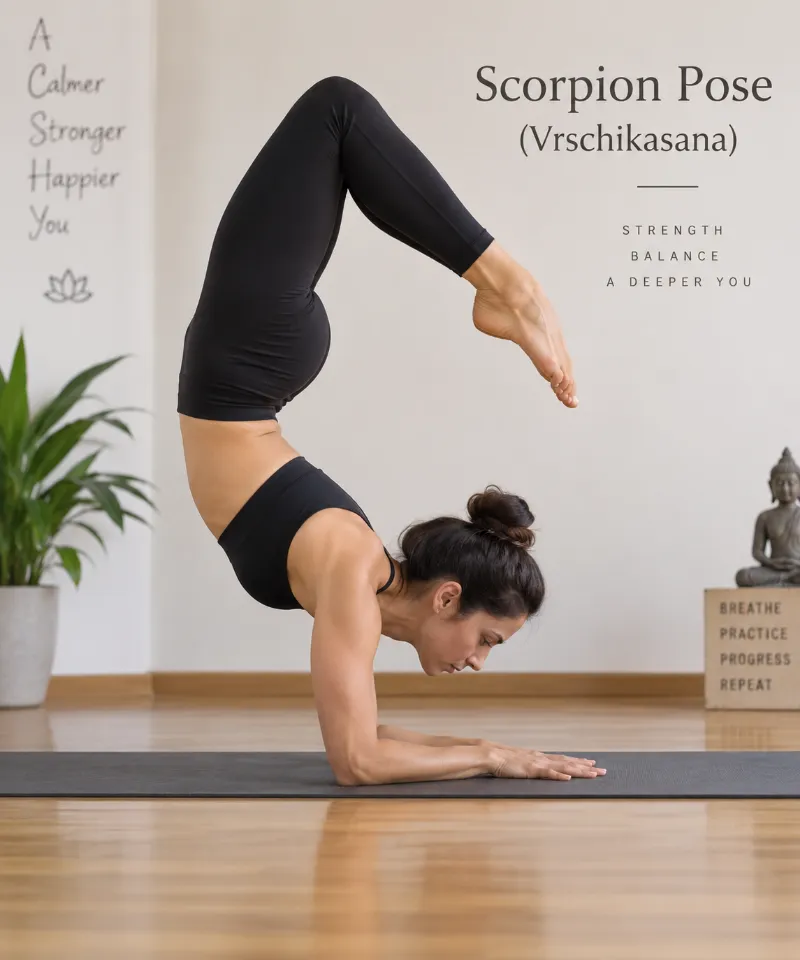
Vrschikasana means “Scorpion Pose” and is pronounced vrish-chi-kah-sa-na. The posture is called “vrschika” in Sanskrit, which means “scorpion,” since it resembles a scorpion’s tail, with the feet curved forward toward the head and the body in forearm balance.
One of the most difficult poses in modern yoga is scorpion pose, which combines the deep backbend of urdhva dhanurasana (wheel pose) with the power and balance of pincha mayurasana (forearm balance). For many dedicated practitioners, it is an aspirational pose that can be found in intermediate-to-advanced hatha and advanced ashtanga sequences.
A more approachable (but still difficult) variation is the half scorpion stance, in which the legs stay straight instead of entirely curling toward the head. Established forearm balance and substantial backbend mobility are necessary for even half scorpions.
Muscles Involved
- Shoulders and arms
- Core and abdominal muscles
- Back muscles
- Hip flexors
- Glutes and legs
Key Highlights
- Blends the deep backbend of Wheel Pose with the forearm balance of Pincha Mayurasana.
- Named because the curled feet that resemble the tail of a scorpion that arches toward the head.
- Although the half version maintains straighter legs, mastery of strong forearm balance is still necessary.
- It specifically calls for years of foundation; wheel stance and forearm balance must be strong first.
- held with continuous cervical spine awareness for only three to five breaths, even at the advanced level.
- It is not suitable for unattended practice and calls for skilled training with sufficient spotting.
Vrschikasana Benefits
Builds Full-Body Strength in the Shoulders, Arms, and Back
The triceps, shoulders, and upper back muscles must be used to their full potential in order to support the complete body on the forearms. Because Vrischikasana demands full-body control and balance in three-dimensional space, regular practice can greatly increase strength in these muscle groups, frequently in ways that typical gym exercises cannot.
Improves Spinal Flexibility and Posture
Scorpion Pose’s deep backbend strengthens the muscles supporting the spine while stretching the entire front body, including the hip flexors, chest, and abdomen. Maintaining good posture while sitting and standing can be facilitated by striking a balance between strength and flexibility.
Stimulates the Nervous System and Endocrine Glands
Vrischikasana is an inversion that enhances blood flow to the brain and key endocrine glands like the pituitary and pineal glands while reversing blood circulation patterns. This is thought to improve hormonal balance, encourage vigor, and activate the central nervous system, according to traditional yoga theory.
Enhances Focus and Reduces Anxiety
It takes total mental focus to stay balanced during such a complicated inversion. The mind becomes completely focused on the here and now, leaving little space for worry or distracting ideas. After practice, this produces a type of moving meditation that is frequently linked to advanced yoga inversions, which helps release endorphins and foster a pleasant mood.
Supports Core Strength and Fat Burning
The core muscles, which include the hips and abdominals, must be continuously used to stabilize the body during Scorpion Pose. This prolonged engagement promotes general calorie burning and body control while toning the waist and belly.
How to Do Vrschikasana Step-by-Step Instructions
Key Principles
Without years of foundation, don’t try this pose. Forearm balance, or pincha mayurasana, needs to be solid first. Wheel posture has to be reachable. Even so, strive for a scorpion while receiving professional training and sufficient spotting.
Step 1: Starting Position
Start in dolphin pose with your forearms shoulder-width apart and parallel.
Step 2: Establish Pincha Mayurasana
Reach a vertical forearm balance by kicking up. To establish stability, hold for a few breaths.
Step 3: Begin the Backbend
Open the chest by gradually extending the upper back. The head rises to look ahead.
Step 4: Bend the Knees
Bend your knees and let your feet drop gently and deliberately toward your head after your upper back has opened.
Step 5: Final Position and Hold
The feet tuck in close to the head. Just hold for three to five breaths. Continue to pay attention to your cervical spine.
Step 6: How to Come Out of Vrschikasana
Return the legs to a vertical position slowly. Lower one leg at a time to release pincha mayurasana. To release the spine, take a few deep breaths while in child’s posture.
Breathing in Vrschikasana
Slow, controlled. Holding the breath in this position is dangerous. If you can’t breathe normally, the pose is too deep to exit immediately.
Preparatory Poses Before Vrschikasana
- Pincha Mayurasana (Forearm Balance) The non-negotiable foundation.
- Urdhva Dhanurasana (Wheel Pose) Builds the backbend capacity.
- Bhujangasana (Cobra) Develops gentle backbend tolerance.
- Ardha Pincha Mayurasana (Dolphin) Builds shoulder strength.
Variations of Vrschikasana
Variation 1: Half Scorpion Pose (Intermediate)
Maintain forearm balance with knees bent at 90 degrees. The feet hover in space rather than curling toward the head. Significantly safer and more accessible.
Variation 2: Wall-Supported Scorpion (Practice Safety)
Practise the pose with the wall behind you so the feet can rest against it for support. Build the shape safely.
Variation 3: Full Scorpion (Advanced Qualified Instruction Only)
The complete pose with the feet touching the head. Years of dedicated work required. Only practise under qualified, in-person guidance.
Step-by-Step Guide to Practicing Vrschikasana
Important Note
When you try the pose for the first time, have an instructor or spotter present to help you. It is very advised to use a wall behind you until you are comfortable with control and balance.
Step 1: Start from Forearm Stand
Start kneeling on the mat with your elbows shoulder-width apart and your forearms parallel to each other. Firmly plant your forearms and palms on the ground. Shift your weight firmly into your shoulders and raise your hips into an inverted “V” posture.
Step 2: Move the Hips Beyond the Shoulders
Actively drive the hips forward and upward to move just over the shoulder line while maintaining forearm balance. Before beginning the backbend, this shift must be completed; failing to do so frequently results in a loss of balance.
Step 3: Gradually Arch the Spine
Bend the spine gradually once the hips pass the shoulders. Make a controlled “C” form through the body by extending the pelvis away from the head. Never jump or push the backbend; instead, all movements should be gentle and deliberate.
Step 4: Separate the Knees
Gently separate the knees while maintaining contact between the big toes as the backbend deepens. This enhances general balance and aids in more evenly distributing bodily weight.
Step 5: Complete the Scorpion Shape
Elevate the eyes upward as though reaching for the feet while relaxing the feet toward the head. This gives the position its iconic scorpion-tail form. The posture should be held for roughly 30 seconds by beginners, then progressively extended over time.
Step 6: Exit the Pose Safely
Avoid abruptly losing your stance. Return the legs to Pincha Mayurasana slowly at first, then descend to the floor with caution. Afterward, rest in Dolphin Pose to relieve shoulder and spinal strain.
Common Mistakes to Avoid in Vrschikasana
- The first error is trying without mastering forearm balance. Falls result when attempting scorpion without stable pincha mayurasana. Correct: Before approaching a scorpion, master forearm balance for at least six months.
- Error 2: Making the backbend. Correction: Start by developing wheel posture mobility independently.
- The third error is to compress the cervical spine. Correction: Instead of allowing the head to fall back, actively raise it.
- Error 4: Prolonged holding. Correction: even at the advanced level, a maximum of 3–5 breaths.
- Error 5: Practicing without guidance or recognition. Correction: Never by yourself; always under qualified, in-person supervision.
Who Should Practice Vrschikasana?
Advanced Yoga Practitioners
It takes years of regular practice. Wheel position and pincha mayurasana need to be solid first.
Those with Established Inversion and Backbend Practice
Both prerequisites are essential.
Is Half Scorpion Pose Good for Beginners?
No, even the half version needs to be practiced for one to two years in order to have established forearm balance. Before attempting any scorpion variation, beginners should concentrate on developing toward dolphin stance and then forearm balance. Instead, begin with our beginner’s yoga guide.
Precautions
As an advanced pose, Vrschikasana should be learned under the supervision of a qualified yoga instructor. If you have wrist, shoulder, neck, spinal, or other relevant diseases, or if you have trouble with inversions, stay away from it or get professional advice. Never try to balance or backbend.
Conclusion
Vrischikasana illustrates that yoga is a practice of strength, discipline, patience, and body awareness rather than just flexibility or relaxation. The real physical and mental shift occurs during the process of developing basic strength and control; mastering Scorpion Pose takes more than a few weeks.
The use of appropriate clothing and equipment is another aspect of practicing safely and successfully that is sometimes disregarded. Advanced inversions may be made much more stable and distraction-free with the use of supportive sportswear, a good yoga mat, and the appropriate accessories.
Before starting the path to achieving one of yoga’s most famous positions, carefully prepare yourself both mentally and physically.
FAQs
What is Vrschikasana?
With the feet curled toward the head, Scorpion performs a sophisticated inverted backbend on the forearms. One of the hardest postures in yoga.
Is Half Vrschikasanafor Beginners?
Don’t. Establishing forearm balance, usually over 1-2 years of regular practice, is necessary even for the half version.
What Are the Benefits of Vrschikasana?
Strong arms, shoulders, and core; ability to perform deep backbends; balance and body awareness; and mental toughness. Over years of patient care, the benefits increase.
How Long Does it Take to Learn Vrschikasana?
Time. Before safely approaching even half a scorpion, the majority of practitioners require two to four years of steady basic work.
Can I Practise Vrschikasana at Home Alone?
Don’t. Always provide in-person, skilled coaching with appropriate spotting. Self-practice poses an excessive risk to the cervical spine.
References
- Zehra, S. (2026h, August 11). Scorpion Pose (Vrschikasana): Steps, Benefits & Safety Guide. Habuild Blogs. https://habuild.in/habitology/asana-mudra/scorpion-pose-vrschikasana/
- Yoga Journal. (2024b, August 30). Step-by-Step Guide to Scorpion Pose. https://www.yogajournal.com/poses/vrischika-in-pincha-mayurasana/
- Dowling, G. (2023, December 21). How to do Scorpion Pose – Omstars. Omstars. https://omstars.com/blog/pose-tutorials/how-to-do-scorpion-pose/