Ardha Pincha Mayurasana (Dolphin Pose)
What is the Ardha Pincha Mayurasana (Dolphin Pose)?
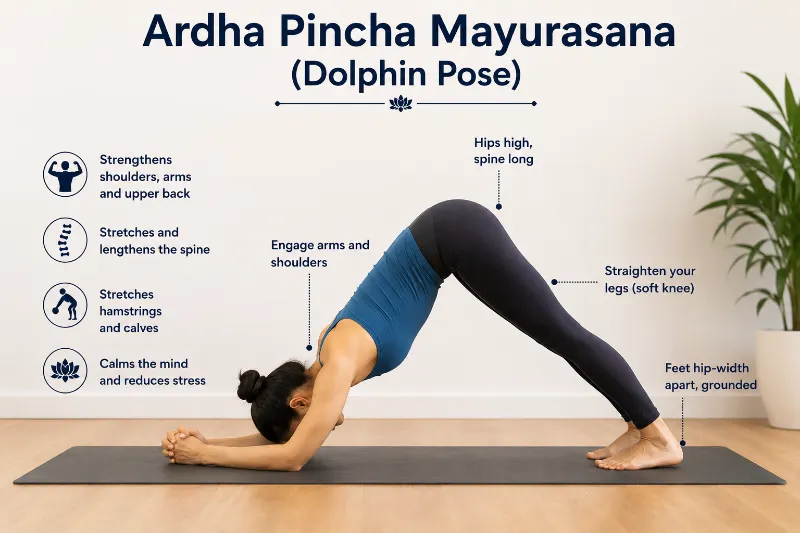
Ardha Pincha Mayurasana, commonly known as Dolphin Pose, is a yoga posture that strengthens the shoulders, arms, core, and upper back while improving flexibility and stability. It is also a useful preparatory pose for more advanced inversions and helps promote better posture and body awareness.
- The many lovely qualities of a dolphin are embodied in the dolphin posture, known as Ardha Pincha Mayurasana in Sanskrit. It increases hamstring flexibility, opens up, stretches, and strengthens the upper body, and is a terrific way to prepare for challenging inversions like a headstand. With practice, your arms and core will get stronger, and your shoulders and spine will have more range of motion. Your hips and thighs will also get more flexible and toned.
- Placing your heel on the mat or applying weight to your forearms may be challenging for you. But with practice, you’ll make significant progress and be able to achieve this. As you attempt the pose, pay attention to your breathing and the sensations in your arms, legs, and back.
How to Prepare for Ardha Pincha Mayurasana (Dolphin Pose)?
Hip flexibility
If your hips are more flexible, it will be easier for you to achieve the posture. The stance will be more comfortable, and you’ll be able to maintain it for longer. To increase hip flexibility, regularly practice lunges, triangle poses, and simple hip openers like garland stance, cobbler’s pose, and pigeon pose.
Arm strength
Developing arm strength is crucial because your arms and shoulders bear half of your body weight. Regularly practice poses including the downward-facing dog, thread the needle, seated eagle pose, puppy pose, cow face pose (Gomukhasana), and push-ups.
Core strength
You’ll be able to maintain the pose longer if you gain strength. This can be achieved by practising a few poses on a regular basis, such as the triangle position, the warrior series, the boat pose, and the plank.
Get into the posture?
- Come onto your fours. Put your shoulders exactly above your wrists, your knees exactly below your hips, and your forearms on the ground. Firmly plant your forearms and palms on the ground.
- As you slowly raise your knees off the ground, take a breath and release it gently. It’s okay if the heels are raised off the ground first. You will be able to place them entirely on the mat with practice.
- Pull the sit bones in the direction of the ceiling. Continue pressing the forearms into the mat. Keep the shoulder blades firm.
- If you can, straighten your knees, but make sure your back doesn’t curve.
- Stay here for a few deep breaths.
Getting out of the posture
To release the posture, take a deep breath and gently lower your knees onto the mat.
Spend a few minutes in the child’s position by relaxing your arms and extending them forward.
What are the benefits of Pincha Mayurasana?
By increasing blood flow to the brain, the pose instantly calms the mind, reducing tension and moderate sadness. The shoulders, spine, hamstrings, calves, and arches are all stretched and made more flexible by it.
Additionally, it fortifies the arms and legs. It is beneficial for women going through menopause because it reduces common symptoms and monthly discomfort. It helps with flat feet, asthma, high blood pressure, and sciatica in addition to improving digestion. Additionally, it helps with exhaustion, headaches, and back discomfort.
Pincha Mayurasana Variations
Easy variation
If you’re just starting, you can use the wall to develop wall support while standing. Move away from the wall by a minimum of two feet. Make a half-forward fold by hingeing at your hips. Stretch your arms forward and rest your hands and forearms on the wall.
Props like a strap are also an option. Create a loop around your upper arms with a strap. Make adjustments until you are able to push outward against the strap’s tension without expanding your arms beyond your shoulders. On the mat before you, place a block. Your head will rest on the block, with your hands on either side of it.
Advance variation
When you’re prepared, you can try the Pincha Mayurasana with a teacher’s supervision. To ensure proper practice and prevent injuries, we recommend practising this in a live session.
Advice for Beginners for the Pincha Mayurasana
- Warm up your arms and practice opening your shoulders before attempting the pose.
- By raising the elbows and forcefully pressing the wrists into the floor, you can expand your shoulders. You can also place your forearms on the ground and press your palms together. Either lock your fingers together or keep your hands squeezed together.
- Bend your knees slightly till your spine is flexible enough to practice without curving if straightening your legs causes your upper back to curve.
Practice tips for the Pincha Mayurasana
You can raise from the hips to more evenly distribute weight between the elbows and feet in order to deepen the position.
Keep your chest from lowering itself to the ground. To keep your back straight, instead, pull the ribs.
Avoid placing your heels on the ground by walking your feet closer to your hands.
Shvasa tips for Pincha Mayurasana
Lifting the heels at first is very acceptable. Don’t press them into the ground too quickly. Focus more on maintaining a straight back.
Always take guidance from an experienced and certified teacher to practice safely.
At a Glance
- Sanskrit Name: अर्धपिंचमयूरासन (Ardha Pincha Mayurasana)
- Pronunciation: ARD-hah PINCH-ah my-yer-AHS-anna
- English Names: Dolphin Pose, Half Feathered Peacock Pose
- Posture Types: Strengthening posture, light inversion, and arm balance preparation
- Difficulty Level: Intermediate (beginner-friendly with modifications)
- Duration: 30 seconds – 2 minutes
- The main advantages include inversion preparation, hamstring stretching, shoulder strength, and core stability.
- Preparatory For: Forearm Stand (Pincha Mayurasana), Headstand (Sirsasana)
Alignment Checkpoints
- Keep the elbows shoulder-width apart
- Forearms should be pressing down evenly
- Shoulders must be lifted away from the ears
- The core should be gently engaged
- Hips must be lifted up and back
- Knees can be bent if needed
- The head and neck must be relaxed
- Breath should be steady and smooth
- Regular practice of the Dolphin Pose helps develop the shoulder strength, control, and self-assurance necessary for more difficult inversions.
Pincha Mayurasana Contraindications
Dolphin Pose is a powerful inversion that puts a lot of strain on the arms, shoulders, and core. To prevent strain, especially in the shoulders, neck, and hamstrings, it is crucial to practice with the right alignment and preparation.
Avoid Pincha Mayurasana If You Have
- Shoulder injury or recent shoulder surgery: Strong shoulder stability and arm weight bearing are necessary for this pose.
- Incorrect head positioning can put more strain on the cervical spine in cases of neck injuries or persistent neck pain.
- Severe wrist injury: The position is still stabilised by the forearms and wrists, despite being less taxing than Downward Dog.
- Uncontrolled hypertension: The head’s pressure may briefly rise as a result of the little inversion.
- Inversions may raise intraocular pressure in cases of detached retina or severe eye diseases.
- The symptoms of a recent head injury or concussion may worsen while one is inverted.
- Abdominal engagement and the inverted position are usually avoided during the second or third trimester of pregnancy.
- Weight bearing through the upper body may raise the risk of fracture if you have severe osteoporosis.
Practice with Caution & Modifications
- Mild High Blood Pressure: Hold for shorter periods of time, keep the head higher than usual, and prevent walking with your feet too close. If you feel pressure in your brain, leave right away.
- Shoulder Tightness or Weakness: Instead of forcing the position, use blocks beneath the forearms, clasp the hands rather than keeping the palms flat, and progressively increase strength.
- Tight Hamstrings: Avoid walking your feet too close to your elbows and keep your knees wide-bent. Prioritise shoulder engagement over leg flexibility.
- For migraines or headaches, practice carefully and for shorter periods of time. If you already have a headache, avoid the posture.
- Menstruation: Some practitioners decide not to perform inversions on days with strong flow. Pay attention to your body and adjust or abandon the pose if it causes discomfort.
- Recent Shoulder Injury (Healed): Start with wall-supported or modified versions and resume practice only after receiving medical clearance.
General Safety Guidelines
Always:
- Warm up the shoulders thoroughly before practising.
- Engage the core to support the spine.
- Keep elbows shoulder-width apart for stability.
- Maintain smooth, steady breathing.
- Rest in Child’s Pose between rounds.
Avoid:
- Practising without a proper warm-up.
- Forcing the shoulders or hamstrings deeper than comfortable.
- Holding the breath or straining.
- Continuing if sharp pain appears.
- Practising immediately after eating (wait 2–3 hours).
When to Consult a Healthcare Provider
Seek professional advice before practising the dolphin pose if you have:
- Shoulder, neck, or wrist injuries
- Cardiovascular or blood pressure conditions
- Eye conditions such as glaucoma
- Osteoporosis or bone-density concerns
- Recent surgeries affecting the upper body
- Pregnancy or postpartum recovery
- Strength can be developed gradually while lowering the chance of injury by practising the Dolphin Pose with patience and correct technique.
Pincha Mayurasana: Related Yoga Poses
By stretching the leg muscles and strengthening the upper body, these poses enhance the Dolphin Pose.
Forearm Stand (Pincha Mayurasana)
- Builds on the Dolphin Pose by doing a full inversion using the same forearm basis, which strengthens the shoulders, core, and balance.
- With your elbows shoulder-width apart and your forearms firmly planted, begin in the dolphin stance.
- To stack the hips higher over the shoulders, move the feet closer to the elbows.
- Gently hop or carefully raise both legs after raising one.
- After maintaining a steady balance with your forearms, descend gradually and settle into Child’s Pose.
2. Adds balance, core control, and full-body awareness to many of the inversion techniques used in Dolphin Pose.
- Put your forearms on the floor and interlace your fingers while kneeling on the mat.
- Raise the legs, then carefully position the head’s crown in the hands.
- Until the hips stack over the shoulders, walk the feet inward.
Gently raise the legs slowly, maintain a steady grip, and then carefully lower them.
Supported Headstand (Salamba Sirsasana)
3. Builds the strength and self-assurance required for a full headstand while providing a more supported way to experiment with inversion.
- Place your forearms on the mat with your fingers entwined and your elbows shoulder-width apart.
- Support the crown of the head with the palms and forearms as you gently place it on the ground.
- Until the body feels light and stable, raise the hips and walk the feet inward.
- Gently raise your legs upwards, keep them there for a few breaths, and then slowly drop them.
FAQs
What is the Ardha Pincha Mayurasana good for?
Dolphin Pose opens the chest, stretches the hamstrings, and strengthens the shoulders, arms, and core. It is frequently used to get the body ready for inversions like the headstand and forearm stand.
How long should you hold the Ardha Pincha Mayurasana?
Intermediate practitioners can hold the Dolphin Pose for one to two minutes, while beginners can hold it for thirty seconds to a minute. Depending on their comfort and strength, advanced practitioners can remain for up to three minutes.
Ardha Pincha Mayurasana vs Downward-Facing Dog: What’s the difference?
Dolphin Pose promotes shoulder and core activation by using the forearms. Beginners can perform Downward-Facing Dog more easily because it is practised on the hands with straight arms.
Make an appointment for a free one-on-one session with a trained coach to learn both positions!
Is the Ardha Pincha Mayurasana good for shoulder strength?
True. One of the best yoga poses for strengthening and stabilising the shoulder is dolphin pose. For safe inversion practice, it improves the upper back and rotator cuff muscles.
Can beginners practice the Ardha Pincha Mayurasana?
Yes, with a few modifications, beginners may perform the Dolphin Pose. The pose can be made more accessible while maintaining shoulder strength by practising against a wall, keeping the knees bent, or placing blocks under the forearms.
References:
- Allen, W. (2026c, March 20). Ardha Pincha Mayurasana. https://myyogateacher.com/yoga-asana/dolphin-pose-ardha-pincha-mayurasana
- Half feathered peacock pose Yoga(Ardha Pincha Mayurasana)| Yoga sequences, benefits, variations, and Sanskrit pronunciation | Tummee.com. (n.d.). Tummee.com. https://www.tummee.com/yoga-poses/ardha-pincha-mayurasana
- Shvasa Editorial Team. (2023, April 20). How to practice dolphin pose? https://www.shvasa.com/yoga-blog/how-to-practice-dolphin-pose


One Comment