Ustrasana (Camel Pose)
What is Ustrasana (Camel Pose)?
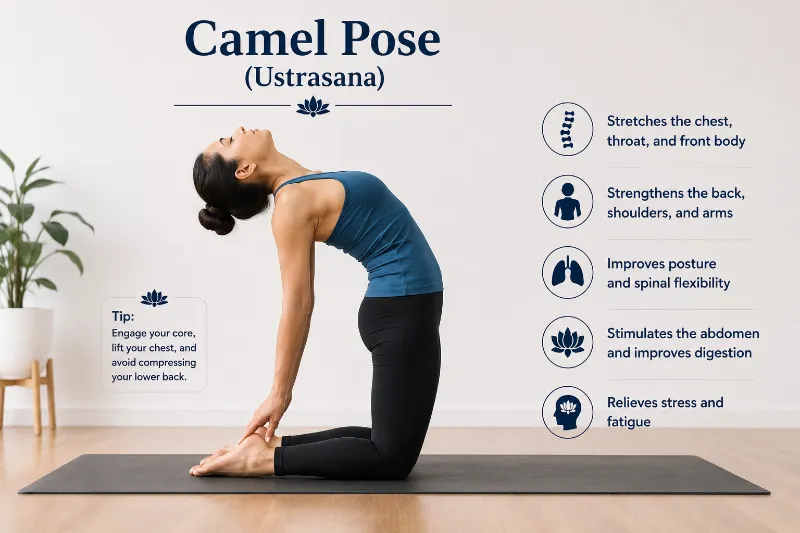
Camel Pose (Ustrasana) is a kneeling backbend that opens the front of the body, including the chest, shoulders, hip flexors, and thighs, in addition to strengthening the muscles that support the spine.
When practised with steady breath and proper alignment, the pose counters the rounded posture from prolonged sitting, improves spinal mobility, and creates a lifted, expansive feeling from the chest and rib cage. Regular practice can enhance posture, build confidence in backbending, and support overall spinal health over time.
Camel Pose: Overview and Meaning of Ustrasana
The name Ustrasana comes from the Sanskrit words ustra, meaning “camel,” and asana, meaning “pose.”The posture, which resembles a camel’s curled back, with the spine arching and the chest lifting, is reflected in the name. Backbends tend to be linked with courage and openness in yoga because they stretch the front of the body, which often stretches under stress.
Camel Pose expands the chest, improves spinal flexibility, and helps counter the effects of poor posture caused by long hours of sitting. Ustrasana is now a popular practice in Hatha, Vinyasa, and Iyengar yoga. It is often taught with obvious modifications so that practitioners can increase their strength and range of motion without having to force the pose.
Camel Pose creates a deep opening through the front of the body and strengthens the back. The quadriceps, hip flexors, abdomen, and chest—areas that often get tight from sitting— are the focus of the primary stretches. The upper back, glutes, and back muscles operate together to support the spine and raise the chest.
At a Glance
- Sanskrit Name: उष्ट्रासन (Ustrasana)
- Pronunciation: oosh-TRAH-suh-nuh
- English Name: Camel Pose
- Pose Type: Kneeling backbend/heart opener
- Level: Intermediate (beginner modifications available)
- Duration: 30–60 seconds (5–10 breaths)
- Main Benefits: improves posture, supports chest opening, stretches the quadriceps and hip flexors, and may stimulate the thyroid.
- Body Focus: Chest, shoulders, hip flexors, quads, spine
Muscles work during Ustrasana (Camel Pose):
- Abdominal muscles
- Back muscles
- Neck muscles
- Hip flexors
- Quadriceps
Benefits of Ustrasana (Camel Pose)
Benefits of Camel Pose go far beyond flexibility. Ustrasana can be both physically and emotionally therapeutic when practised with proper alignment and modifications.
Physical Benefits of Ustrasana
- Improves posture and spinal alignment: Over time, Camel Pose improves the natural curves in the spine by strengthening the back muscles and opening the chest to prevent slouching.
- Strengthens the back muscles: By stretching the backbend, the glute, erector spinae, and upper back muscles contract, creating strength that shields the spine during regular activities.
- Deeply stretches quadriceps and hip flexors: Ustrasana relieves tightness caused by prolonged sitting, which often contributes to lower back discomfort, by opening the front of the hips and thighs.
- Opens the chest and shoulders: The pose expands upper-body mobility and counteracts rounded shoulders, improving the rib cage and stretching the chest and front shoulders.
- Enhances spinal flexibility: Extending the cervical, thoracic, and lumbar areas of the spine, camel pose helps reduce stiffness and improve spinal mobility.
- Encourages deeper, more efficient breathing and increases lung capacity, which can be especially helpful for people with shallow breathing habits.
- Thyroid gland stimulation: Softly raising the throat region can promote metabolic and hormonal balance by stimulating thyroid function when done safely.
- Aids in digestion: With the stretch and compression of the abdomen, the digestive organs are stimulated, helping with constipation and bloating.
Mental & Emotional Benefits
- Reduces stress and tension: Camel pose is a heart-opening backbend and releases tension in the hips, shoulders, and chest. This calms the nervous system after the pose.
- Boosts energy and alertness: Ustrasana, when done carefully, can help fight exhaustion and mental dullness. Backbends are inherently energising.
- Builds confidence and emotional resilience: It requires presence and trust to open the front body. Regular Camel Pose practice can help to cultivate confidence and the ability to stay steady in stress.
- Encourages emotional release: Emotional tension is often stored in the hips and chest. A sense of emotional release or lightness can lead to stretching these areas.
Energetic & Subtle Benefits
- Activates the Heart Chakra (Anahata): Opening the chest brings feelings of openness, compassion, and emotional equilibrium.
- Stimulates the Throat Chakra (Vishuddha): The pose is linked with enhanced communication and self-expression when the throat opens gently.
- Energises the neurological system: Camel Pose is beneficial earlier in the day or when energy levels are low, as it has an elevating and waking impact.
Therapeutic Applications (Supportive, Not Medical)
When practised with adequate instruction and adaptations, Camel Pose may support:
- Postural imbalances and a rounded upper back
- Mild, non-acute back discomfort
- Tight hip flexors and thighs
- Digestive sluggishness
- Low energy and mental fatigue
- Stress-related tension
- Camel Pose may not be suitable for everyone and should be modified or avoided based on individual health conditions. The Precautions section contains comprehensive safety guidelines.
- To reap the benefits of Camel Pose, schedule a free one-on-one session with a professional Indian yoga teacher today!
Step-by-Step Guide
The true value of Camel Pose comes from strong leg and core engagement, smooth breathing, and a controlled backbend. Alignment is always more important than depth. Ustrasana is safe and effective when practised mindfully and slowly.
Part 1: Preparing for the Pose
Before You Begin
The neck, hip flexors, knees, and spine are all heavily strained during Camel Pose; thus, preparation is crucial.
- Practice without eating (at least three to four hours after meals).
- For padding, place a folded blanket or towel beneath your knees.
- Before trying deep backbends, warm up your hips and spine.
- Instead of reaching for the heels, try to keep your hands on your lower back if you experience neck or lower back sensitivity.
- Recommended warm-up poses
- Cat–Cow: Mobilises the spine
- Cobra or Sphinx: Introduces gentle back extension
- Low Lunge: Opens hip flexors and thighs
- Bridge Pose: Activates glutes and back muscles
How to Do Ustrasana (Camel Pose)
- Kneel on your mat, hip-width apart, thighs perpendicular to the floor. Firmly push down on the tops of your feet and shins. With your hands on your hips, inhale deeply two or three times.
- Press your shins down and mildly activate your quads and glutes. Draw your lower tummy in to stabilise your spine.
- Inhale and push your chest up, pulling your shoulder blades down and together.
- Begin by gently arching your upper back while maintaining a forward hip position. Avoid compressing your lower back—think chest up and forward, not head back first.
- Return your hands to your heels one at a time. If your heels feel far away, keep your hands on your lower back or place yoga blocks beside you to rest your hands.
- Lift your chest higher by pressing your hands into the heels or blocks. Continue to drive the hips forward and stretch the front of the body.
- If your neck is healthy and relaxed, you can gently let your head sink back. If not, glance up or forward while keeping your chin slightly tucked.
- Hold for 20-60 seconds, inhaling slowly. Each exhale relieves needless strain, and each breath lifts the chest.
- Return your hands to your hips. Engage your core and slowly pull your torso upright, starting with the chest. Take a few deep breaths while in Child’s Pose to help you relax and straighten your spine.
Common Alignment Mistakes (and Fixes)
- Instead of allowing your hips to wander rearward, aggressively press them forward over your knees.
- Overcompressing the lower back: Engage the glutes lightly and stretch the tailbone.
- Instead of forcing your head back, keep your neck neutral until you’re completely comfortable.
- Knee discomfort: Increase the padding or reduce the depth.
- Holding the breath: To ensure safety, keep your breath slow and steady.
- Always rest in Child’s Pose between rounds.
Progress Ustrasana (Camel Pose):
- Salamba Bhujangasana (Sphinx Pose): A mild backbend when you raise your chest while lying on your stomach with your forearms resting on the floor.
- Bhujangasana (Cobra Pose): This gentle backbend opens the front of the body while encouraging a smooth and comfortable arch through the spine.
- Salabhasana (Locust Pose): A backbending, prone position in which you lie on your stomach, raise your lower legs off the ground, and raise your arms straight behind you.
- Anjaneyasana (Low Lunge Pose): A position that enables you to raise your arms in the air and bend backwards.
Ustrasana Variations
Camel Pose can be altered for all levels of practice, from beginners establishing confidence to advanced practitioners exploring deeper back bends.
Beginner-Friendly Modifications
Hands on Lower Back (Foundational Modification)
- Increases back strength and chest openness without severe spinal compression.
- Place both hands securely on your lower back, resting them over the sacrum for support.
- Lift the chest and thrust the hips forward over the knees.
- Instead of bending deeply, try to stretch your spine.
- Hold 20–30 seconds with steady breathing.
Camel Pose with Yoga Blocks
- Makes the full pose accessible without forcing flexibility.
- Place bricks at their tallest points beside your heels.
- Instead of reaching for your heels, return your hands to the blocks.
- Press down through blocks to lift the chest.
- Gradually lower block height as flexibility improves.
Tucked-Toes Camel Pose
- reduces strain and shortens the distance to the heels.
- Tuck toes under so heels lift naturally.
- Reach your hands back to your heels for minimal spinal demand.
- Keep thighs vertical and hips pressing forward.
- The ideal transition between the supported and full Camel Poses.
Wall-Supported Camel Pose
- Prevents hips from drifting backwards and improves alignment awareness.
- Kneel 6–8 inches away from a wall.
- As you bend back, press your hips lightly on the wall.
- Place your hands on your lower back or blocks.
- Excellent for learning correct hip placement.
Intermediate Variations
One-Arm Camel Pose
- Improves balance, core control, and asymmetrical strength.
- While in the full Camel Pose, gently lift one hand away from its heel.
- Extend the arm upward or overhead.
- Keep hips square and chest lifted.
- Hold 10–20 seconds, then switch sides.
Wide-Knee Camel Pose
- Adds stability and reduces lower-back intensity.
- Widen your knees and feet to the mat’s edges.
- Press hips forward while lifting chest.
- Reach for heels or blocks.
- Helpful for practitioners with hip or balance limitations.
Advanced Variations
Deep Camel (Laghu Vajrasana Preparation)
- Increases spinal flexibility and back strength significantly.
- Walk your hands up your calves, toward your knees, from full Camel pose.
- Keep hips strongly forward and chest lifted.
- Only attempt with a well-warmed spine.
- Best practised under teacher supervision.
Camel to Wheel Transition
- Builds strength, coordination, and advanced spinal mobility.
- From Camel Pose, lift arms overhead.
- Carefully lower into Wheel Pose.
- Reverse the movement back to Camel.
- Advanced flow requires control and experience.
Ustrasana (Camel Pose): Precautions & Contraindications
When practised correctly, Camel Pose is a powerful backbend that benefits the spine, but it is not suitable for every body type or circumstance. Practising safely means understanding when to modify the pose, proceed with caution, or avoid it altogether.
Do Not Practice Camel Pose If You Have
- Severe or acute lower back pain, herniated discs, or spinal injuries: Deep spinal extension can aggravate disc problems and increase nerve compression.
- Neck injuries or chronic cervical spine problems: Dropping the head back causes stress on the neck and may aggravate pre-existing disorders.
- Uncontrolled hypertension or hypotension: Backbends and head position adjustments can make you feel lightheaded or faint.
- If you have recently had surgery on your back, abdomen, knees, or neck, wait at least 6 months and receive medical permission before doing Camel Pose.
- Severe osteoporosis: Deep backbends raise the risk of spinal compression or fracture.
- Kneeling backbends and abdominal stretches are not recommended during pregnancy (second and third trimesters).
- Choose gentler alternatives such as Bridge Pose, Sphinx Pose, or Cat-Cow if any of the above situations apply.
General Safety Guidelines
- Always warm up with easy backbends before moving on to Camel Pose.
- Spinal length and control are more important than range; never push depth.
- Distinguish between pain and a sharp sensation; pinching or sharp pain is a signal to stop.
- Maintain steady breathing.
- Blocks and blankets are tools, not crutches, so feel free to use props.
- Build intensity gradually over weeks, not days.
When to Stop Immediately
Exit the pose and rest if you experience:
- Sharp pain in the knees, neck, or lower back
Dizziness, nausea, or breathlessness
Tingling or shooting sensations
Loss of balance or pressure in the head
Sit back into Child’s Pose for several breaths. If symptoms persist, consult a healthcare provider. - Schedule a free one-on-one session with a skilled Indian yoga instructor to guarantee a secure and productive practice!
Camel Pose (Ustrasana): Related Yoga Poses
- Strengthens the spine and deepens front-body opening.
- Lie on your belly and bend both knees.
- To raise your chest and thighs, hold your ankles and take a breath.
- Keep knees hip-width apart.
- Hold 3–5 breaths.
Wheel Pose (Urdhva Dhanurasana)
- Creates a complete spinal backbend, building on Camel Pose.
- Place your palms next to your ears while lying on your back and bending your legs.
- Press hands and feet to lift the body.
- Keep your chest open and breathe steadily.
- Hold briefly, then release slowly.
Child’s Pose (Balasana)
- Neutralises the spine after intense backbending.
- Kneel and sit the hips back toward heels.
- Fold torso forward, arms relaxed.
- Rest your forehead on the mat.
- Breathe deeply for 5–10 breaths.
Downward-Facing Dog (Adho Mukha Svanasana)
- Rebalances the body following backbends and decompresses the spine.
- Start in Tabletop and lift your hips up.
- Keep spine long and knees soft.
- Press hands firmly into the mat.
- Hold for 5–10 breaths.
FAQs
What is the meaning of Ustrasana?
The camel position’s significance originates from its amazing backbend, which opens the chest and extends the front of the body, representing the opening of the heart and the releasing of emotion. The camel is among the most powerful representations of strength, endurance, and determination.
Why is Ustrasana so difficult?
Camel Pose takes a great deal of confidence and trust. It can feel risky to lean back into something without being able to see or know what’s behind us. We have faith that our shoulder blades and upper back will hold the backbend and that we won’t fall.
Who should avoid Ustrasana?
This pose should be done if you have any pain or injury in your ankles, knees, calves, thighs, back, shoulders, or neck. Whether people’s blood pressure is high or low, people should take precautions.
What are the benefits of Ustrasana?
Lessens thigh fat.
Strengthens and stretches the back and shoulders.
Enhances excretion and digestion by increasing the size of the abdomen.
Enhances posture.
Improves breathing by opening the chest.
Reduces lower back pain.
Which disease does Ustrasana treat?
It is particularly helpful for respiratory conditions including asthma, anxiety, moderate spinal diseases, and digestive disorders.
References:
- Yoga Journal. (2025a, January 27). Camel Pose: The complete guide. https://www.yogajournal.com/poses/library/camel-pose-the-complete-guide/
- Dr.Manasvi Patel. (2025). Ustrasana (Camel Pose) – How to Perform, Muscle Work. Physiotherapy Treatment and Exercises at Home. https://homephysiotherapyexercises.com/ustrasana-camel-pose/
- Allen, W. (2026a, February 18). Ustrasana. https://myyogateacher.com/yoga-asana/ustrasana
- Camel Pose Yoga(Ustrasana)| Yoga sequences, benefits, variations, and Sanskrit pronunciation | Tummee.com. (n.d.). Tummee.com. https://www.tummee.com/yoga-poses/ustrasana

9 Comments