Evening Yoga Routine for Relaxation
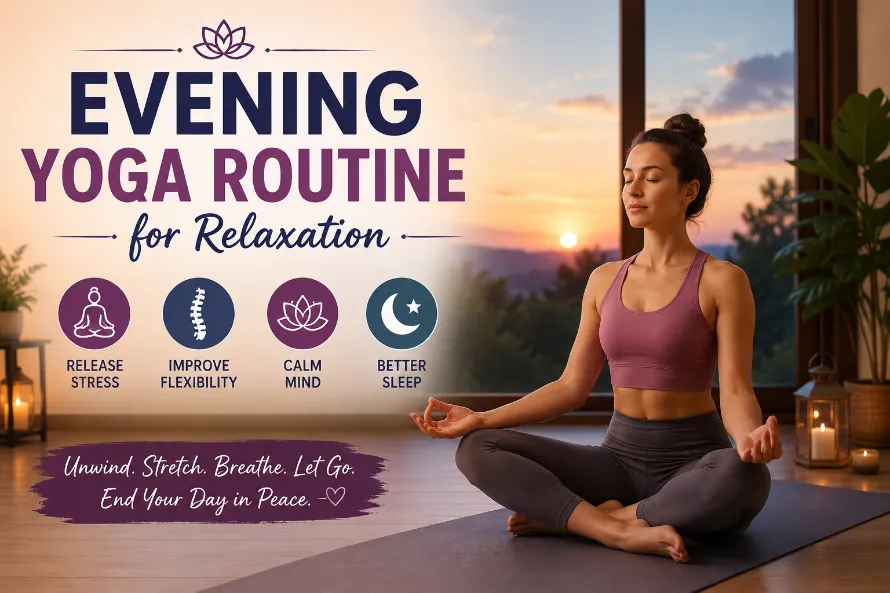
An evening yoga routine can help relax the body, calm the mind, and release tension after a busy day. Gentle yoga poses combined with slow, deep breathing can promote relaxation and prepare you for a peaceful night’s sleep.
Although there are many well-established health advantages of yoga, sleep is one area in which it excels. You feel calmer, more at ease, and less nervous after doing some yoga in the evening. Meditation, breathing techniques, relaxation, and soothing physical movements are all part of a successful nighttime yoga class.
This simple routine is suitable for beginners and can be practiced at home with minimal equipment.
Is it Preferable to do yoga in the evening?
The ideal time of day for yoga practice has long been a topic of discussion among practitioners. There are advantages to doing yoga in the morning or at night. Deep relaxation, introspection, and letting go of the day’s stress and worries are all excellent during the evening.
Before going to bed, stretching and deep breathing can help ease tension and nervous thoughts that might interfere with a restful night’s sleep.
What are the benefits of evening yoga?
In addition to enhancing vascular health and boosting energy flow throughout the body, daily yoga practice activates the parasympathetic nervous system, which manages rest-and-digest (as opposed to fight-or-flight) reactions. You can get a good night’s sleep and wake up feeling rejuvenated if you have a good bedtime routine that helps you find calm before you snooze.
If you want to really benefit from yoga, like with any workout, it’s crucial to practice it correctly. You will become more aware of the changes in your life and body as you practice more frequently.
Benefits
- Reduces sleeplessness
- Regular yoga practice might help you control your insomnia problems. You could be able to fall asleep more quickly, stay asleep longer, and return to sleep after waking up in the middle of the night.
- Yoga and other mind-body treatments are useful in treating insomnia and improving sleep, according to research from 2019. In addition to yoga, those who engaged in tai chi, qigong, and meditation reported better sleep patterns.
- To build on these results, further thorough research is required.
- Loss of weight
- Regular yoga practice is linked to both good sleep and weight loss. Practicing yoga before bed may improve your sleep quality, which is beneficial for both weight loss and maintenance. Being more aware of your food habits might also be beneficial.
- Promotes relaxation
- The relaxation response is a state of calm that yoga may help you achieve. The fight-or-flight reaction is the reverse of this. You may be able to de-stress and lessen your level of arousal by performing relaxing yoga positions.
- Both your blood pressure and levels of the stress hormone cortisol may drop as a result. Stress-related issues, including weight gain, anxiety, and sleeplessness, may be lessened with a regimen.
Best yoga poses for evening
- Supta Padangusthasana (Reclining Hand to Big Toe Pose)
- Supta Matsyendrasana (Reclined Twist Pose)
- Balasana (Child’s Pose)
- Vajrasana Garudasana (Hero Pose with Eagle Arms)
- Vajrasana Paschima Namaskarasana (Hero Pose with Reverse Arm)
- Gomukhasana (Hero Pose with Cow Face Arms)
- Adho Mukha Svanasana (Downward-Facing Dog Pose)
- Utthan Pristhasana (Lizard Pose)
- Kapotasana (Pigeone pose )
- Janu Sirsasana (Head-to-Knee Pose)
- Ardha Matsyendrasana (Half Lord of the Fishes Pose)
- Corpse Pose (Savasana)
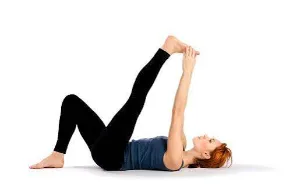
Supta Padangusthasana (Reclining Hand to Big Toe Pose)
How to do
- Inhale deeply, release the breath, and rest on your back. Here, contract your core muscles such that the navel is attempting to reach the tailbone.
- Avoid bending or rotating your right leg when you lift it. Just maintain your toes pointed and the raised leg straight.
- In a straight resting position, place the left arm on the left side. Next, reach your right foot’s toes with your right arm extended overhead.
- Breathe in, straighten your leg, keep your pelvis stable, and keep your left leg level on the floor.
- Repeat this stance on the opposite side after holding it for ten to thirty seconds on each side.
Supta Matsyendrasana(Reclined Twist Pose)
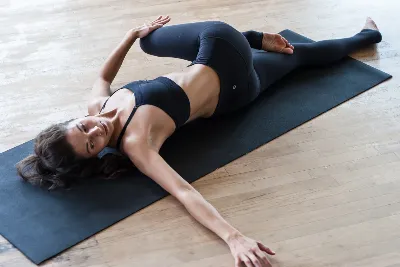
How to do
- Close your eyes and take a few deep breaths to relax while lying comfortably on your back with your legs outstretched, arms outstretched in a T shape, and palms facing up.
- To relieve your lower back, bend your knees and gently pull them toward your chest while swaying slightly from side to side.
- With both shoulders firmly planted on the mat, extend your arms back out to shoulder height, palms up or down for comfort.
- With both knees stacked or slightly apart, slowly drop them to the right side as you exhale. Don’t force the twist; instead, let gravity lead them down.
- Lying comfortably on your back with your arms extended in a T shape, your legs outstretched, and your palms facing up, close your eyes and take a few deep breaths to relax.
- Sway slightly from side to side as you bend your knees and gently bring them toward your chest to ease your lower back.
- Stretch your arms back out to shoulder height, palms up or down for comfort, while keeping both shoulders firmly planted on the mat.
- As you exhale, carefully lower both knees to the right side while keeping them stacked or slightly apart. Allow gravity to carry them down instead of forcing the twist.
Balasana(Child’S Pose)
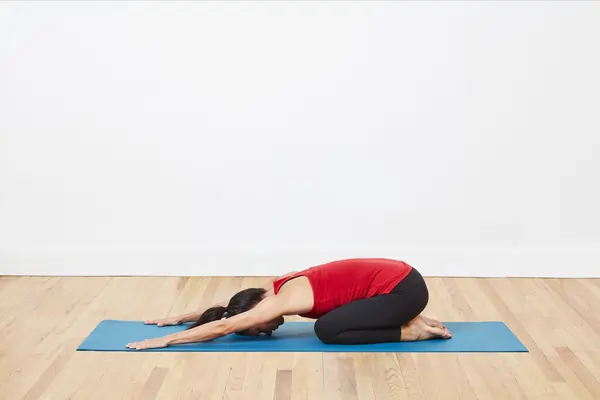
How to do
- Align your wrists beneath your shoulders and place your legs hip-width apart. To ensure that the tops of your feet lie gently on the mat, point your toes straight back.
- Keep your knees apart and allow your big toes to gently contact. As you fold forward, this makes room for your chest and abdomen.
- Breathe out slowly and shift your hips in the direction of your heels. Pay attention to your thighs and knees and just go as far as is comfortable.
- Place your face on the mat or a cushion and let your chest naturally drop between or over your thighs.
- Put your arms in this position
- Extended version: To stretch your spine, extend your arms forward, palms down.
- Restorative version: For more profound relaxation, place your arms next to your body with your palms facing up.
- Let your shoulders drop away from your ears, and your chest relax in the direction of the mat.
- Breathe in to extend your sides and back; breathe out to relieve tension. Depending on how comfortable you are, stay for 30 seconds to several minutes.
- Maintaining a long spine, steadily raise your body upright while walking your hands back toward your knees.
Vajrasana Garudasana (Hero Pose with Eagle Arm)
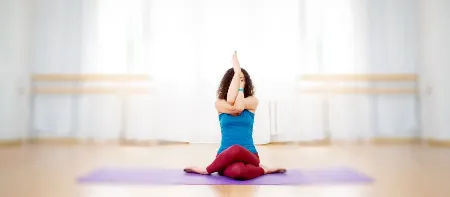
How to do
- Take a Tadasana stance.
- Lift your right knee and raise your right foot off the ground while bending both knees slightly and shifting your weight to your left foot.
- Cross your right leg as far up your left leg as you can.
- Wrap your right foot behind your left leg or ankle if you can. For now, skip this step and just cross your thighs if you are unable to hook your foot.
- As close to your chest as you can, cross your right arm beneath your left.
- Bring your hands closer to one another. Hold them there or, if you can, wrap your wrists and forearms to bring your palms together.
- Press your palms together if they are already together. Push your elbows together if your hands are apart.
- Move your shoulder blades down your back and spread out over your collarbones.
- Look either down at the ground or forward. You can discover balance and attention by looking through your hands when they are in the prayer posture.
- Extend your spine to a lofty position. Slide your shoulders down your back.
- Here, you may bring your right elbow to your right knee and further bend your knees.
Vajrasana Paschima Namaskarasana (Hero Pose with Reverse Arm)
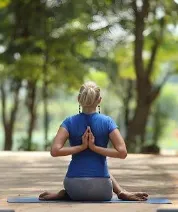
How to do
- Start in the stance of Tadasana.
- Bend your knees slightly and let your shoulders drop.
- With your fingertips pointing downward, bring your arms behind your back and connect the palms.
- Bring your fingertips upward and bend them inward toward your spine as you inhale.
- Make sure the hands are firmly pushed against one another, and the legs are still slightly bent.
- Hold the pose for a few breaths.
- Turn your fingertips slowly downward as you release the breath.
- Return to Tadasana gradually after bringing the arms to the side of the body.
Gomukhasana (Hero Pose with Cow-Face Arms)
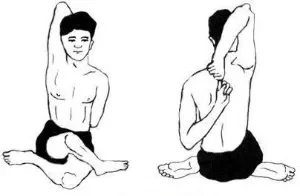
How to do
- Sitting firmly in the middle of your yoga mat, ensure that your head, neck, and spine are all balanced.
- Start by assuming the Seated Staff Pose. Maintain a straight line with your legs extended.
- From your knees, bend both of your legs. Now place your right thigh on top of your left thigh after moving your right leg over it.
- Now place your feet on opposing sides, equally spaced from the hips, and stack your knees on top of each other.
- For a few seconds, concentrate on taking deep breaths. Take a deep breath, raise your right arm, bend it at the elbow, and place your right hand behind your back.
- Now extend your left arm behind your back from the side of your left oblique, bending it from your elbow.
- Breathe out, then inhale deeply once more while holding hands.
- Hold your breath for a few seconds while straightening your spine, interlocking both hands, opening your chest, engaging your pelvis, and closing both eyes.
- Breathe out and carefully unclasp your hands behind your back.
- Take a breath, remove your legs from the stacked position, exhale once more, and return to the staff position.
Adho Mukha Svanasana (Downward-Facing Dog Pose)
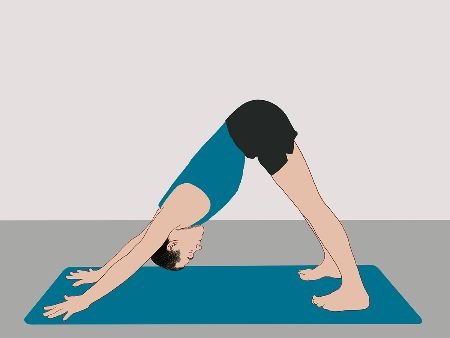
How to do
- With your knees behind your hips and your wrists beneath your shoulders, drop to your hands and knees. Press evenly through your hands while spreading your fingers wide.
- Instead of locking your elbows, maintain a gentle bend. To stabilize the shoulders and expand the upper back, gently twist the upper arms outward so that the biceps face slightly forward.
- As you exhale, tuck your toes under and raise your knees off the mat. To create an inverted V, raise and lower your hips. At first, keep your knees bent.
- Focus on building length from the wrists through the hips while pressing the floor away with your hands. Avoid collapsing the shoulders as you softly bring the chest toward the thighs.
- If your hamstrings feel tight, keep your knees bent to maintain correct alignment. Maintain a long spine while progressively straightening the legs if flexibility permits. Heels do not have to come into contact with the ground.
- Avoid flaring the ribs by softly drawing the lower abdomen in. In addition to protecting the lower back, this core support maintains the pose’s equilibrium.
- With the neck relaxed, let the head rest freely between the arms. Don’t try to stare ahead; instead, focus on the navel or thighs.
Utthan Pristhasana (Lizard Pose)
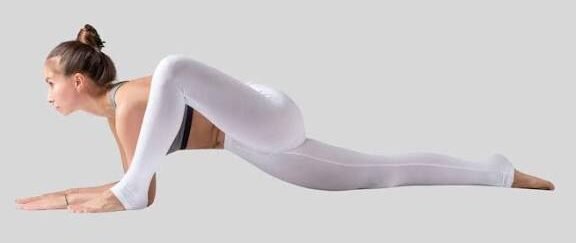
How to do
- Start in Dog Pose, facing downward.
- Place your right foot outside of your right hand on the front of your mat.
- Align your right knee over your ankle by bending it.
- Lower your forearms onto blocks or the mat. Keep your forearms horizontal and your elbows beneath your shoulders.
- To maintain the straight extension of your left leg, push into your left heel.
- Embrace your right knee in the direction of your right shoulder.
- To stretch your spine and expand your chest, press onto your hands and forearms.
- Return to Downward Facing Dog and repeat the position on the opposite side after five to ten breaths.
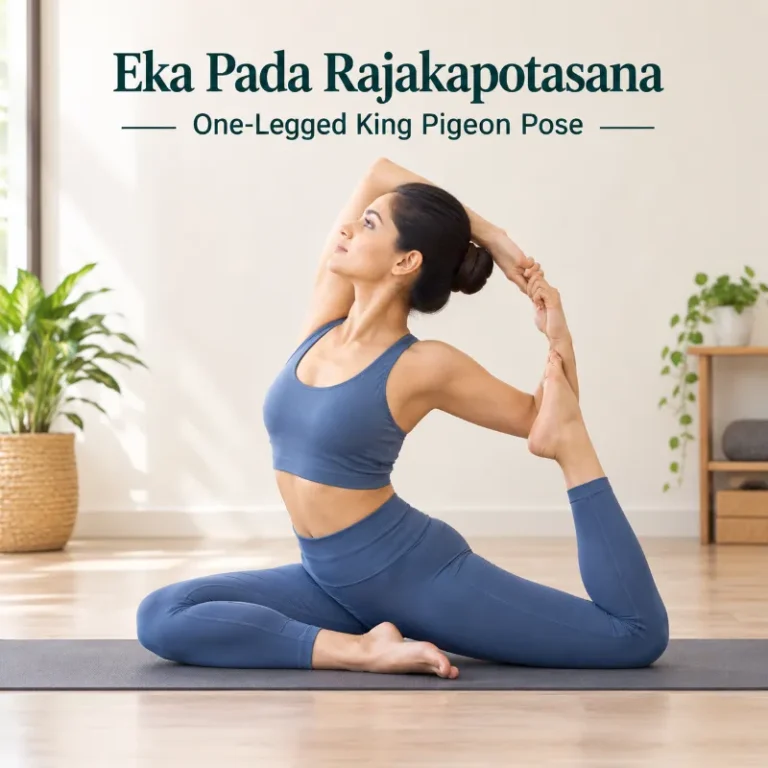
Kapotasana (Pigeon Pose)
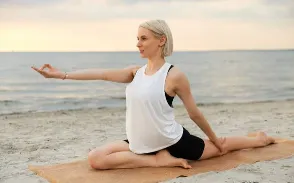
How to do
- Pose like a diamond to begin.
- Stretch your arms out gently and firmly ground them.
- Straighten your legs and raise your knees to adopt a downward-facing dog position.
- Follow steps 2 through 13 of method 1.
- Return to the downward dog position to release the posture, then repeat with the leg forward on the other side.
Janu Sirsasana (Head-to-Knee Pose)
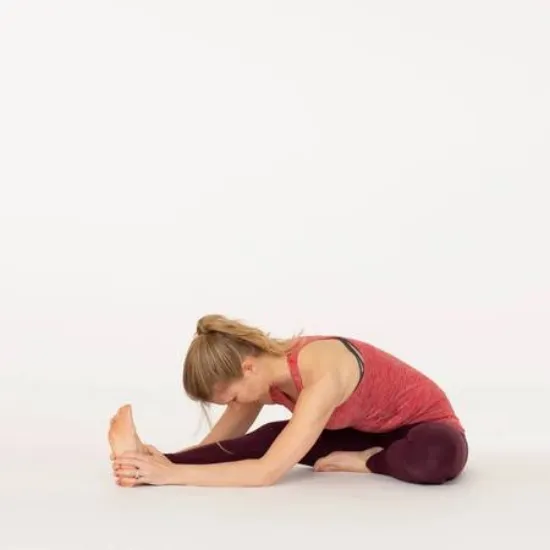
How to do
- Come to sit with both legs out in front of you in Staff Pose (Dandasana).
- Draw your left heel in the direction of your groin while bending your left knee. Your left knee stretches out to the left as you do this. Maintain a flexed left foot.
- When you forward fold, turn your upper body slightly to the right so that your torso is directly over your right leg.
- Extend your back and raise your arms above your head while taking a breath.
- Tip your pelvis forward to rotate into a forward bend over your extended right leg as you exhale.
- Hold onto your right leg or foot for additional traction or move your hands to either side of it after you’ve reached your maximum extension.
- Take a few deep breaths while in your forward fold, then sit up straight again.
- With your left leg outstretched, repeat the position.
Ardha Matsyendrasana (Half Lord Of the Fishes Pose)
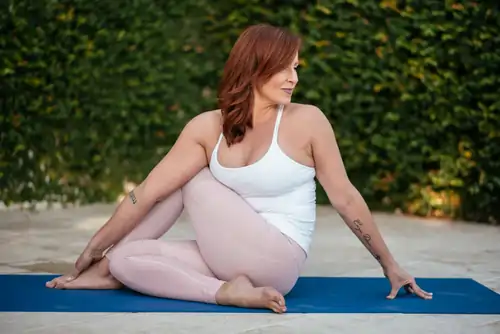
How to do
- With your feet together and your spine upright, sit with your legs straight out in front of you.
- Place the heel of your left foot next to your right hip while bending your left leg.
- Cover your left knee with your right leg.
- Put your right hand behind your lower back and your left hand on your right knee.
- Look over your right shoulder while twisting your waist, shoulders, and neck in this order to the right.
- Maintain a straight spine.
- Maintain the position while taking deep, long breaths.
- Release your right hand first, then your waist, then your chest, and finally your neck as you exhale.
- Continue on the opposite side.
Corpse Pose (Savasana)
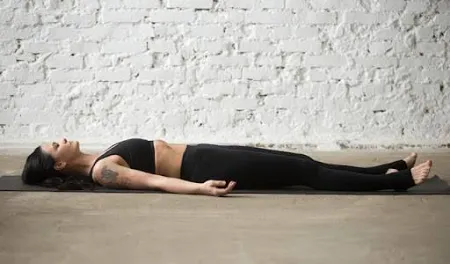
How to do
- With your arms near your body and palms facing up, lie flat on your back with your legs together but not touching.
- Breathe slowly and deeply through your nose while keeping your eyelids slightly closed and your facial muscles relaxed.
- Pay attention to every part of your body, starting at the top of your head and working your way down to your feet. Consciously relax each area before moving on to the next.
- Stay in the shava-asana for at least three to five minutes. Breathe a little more deeply and quickly if you start to feel drowsy during the shava-asana.
Tips for Starting an Evening Yoga Routine
Maintain a regular nighttime regimen. You may tell your body that it’s time to wind down and get ready for slumber by doing yoga and going to bed at the same time every night.
For extra comfort, use supports like bolsters or blankets. According to Dr. Marek, “supporting your body with soft props can help you relax more fully into each pose, making your nighttime yoga routine more enjoyable.”
Include deep breathing exercises throughout every stretch. Your body and mind may be calmed by combining moderate motions with focused breathing, which can help you sleep better.
Pay attention to how the motions feel rather than how they seem.. Instead of striving for “perfect” form, Dr. Marek advises, “Allow each pose to feel comfortable and supportive for you, and trust what feels best.”
Why Evening Yoga Supports Better Sleep
Although yoga is frequently thought of as an energetic activity, it may also be used as a natural sedative. Your body needs cues that it’s okay to unwind as the day comes to an end. Evening yoga practices help you transition from the sympathetic “fight or flight” state to the parasympathetic “rest and digest” mode, which allows you to recuperate and fall asleep.
Here’s how:
- Heart rate decreases when breathing slows.
- Tension dissipates as muscles become softer.
- Stress reduces when the mind calms.
- Resetting the nervous system leads to deeper sleep.
For this reason, many yoga practitioners utilize yoga to improve their quality of sleep, especially if they have trouble with racing thoughts or physical stiffness at the end of the day. In addition to lowering anxiety and promoting melatonin synthesis, evening practice aids in establishing a nighttime restorative cycle for the body.
Preparing Your Space for Evening Practice
Establishing a place that conveys serenity and comfort is beneficial before beginning your nighttime yoga practices. You may not be aware of how much your surroundings affect your neurological system.
Dim Your Lighting
Swap harsh overhead lights for:
- Warm lamps
- Candles
- Salt lamps
- Soft fairy lights
- This cues your circadian rhythm to begin winding down.
Remove Stimulation
Turn off notifications, silence your phone, and step away from screens. Reducing blue light before your practice will help your bedtime go more smoothly because it delays melatonin.
Build a Personal Sanctuary
Use elements that soothe your senses:
- Blankets
- Bolsters and cushions
- Gentle essential oils (lavender, chamomile, vetiver)
- Soft music or nature sounds
- Repeat this setup nightly to create a comforting ritual your body recognizes.
Basic Evening Yoga Practices
Yoga in the evening doesn’t have to be lengthy or difficult. It only has to be deliberate, gradual, and gentle with the body.
Pranayama, or gentle breathing
Make a connection to your breath first. Breathing exercises help you relax and control your nervous system.
Try these methods for deep rest
- Inhale 4, hold 7, and exhale 8 to create the 4-7-8 breath.
- Inhale 4, exhale 6–8 for an extended exhale
- Box Breathing: 4-4-4-4 sequence
- Observe how the abdomen, jaw, and shoulders relax with each inhalation.
Poses of Yin or Support
Longer-held positions encourage fascia release and profound relaxation. Try holding for two to four minutes:
- Butterfly reclined with pillows
- Legs up the wall to reduce blood flow
- Supported child’s grounding position
- This is the point at which you start doing restorative evening yoga.
Short Yoga Nidra or Body Scan
To finish your yoga practice before bed, lie down and move your awareness from head to toe. This lessens mental loops before sleep and promotes physical surrender. Five minutes may have a profound impact.
Improving Your Yoga Practices in the Evening
By adding little, nutritious habits, you may enhance your experience.
Drink a Relaxing Tea
Select calming concoctions like tulsi, lavender, chamomile, or mint. To maintain awareness, take a leisurely sip and take a breath between each bite.
Take a warm bath or shower.
Warm water softens energy, eases tense muscles, and amplifies the benefits of your forthcoming nighttime yoga practices.
An Easy 20-Minute Yoga Practice in the Evening
Try this accessible flow if you’re unsure where to begin:
- Breathe deeply in your abdomen for two minutes.
- Stretch your neck and shoulders for one minute.
- Cat-cow + mild twists for two minutes
- Fold forward and stretch while seated for four minutes.
- Legs-up-the-wall for eight minutes
- Body scan meditation for three minutes
Feel the slow change as you repeat this every night.
FAQs
How soon will doing yoga in the evenings show results?
Within the first week of regular practice, many people report better quality sleep. Benefits from stress reduction frequently start to show themselves much sooner, sometimes after only one session. However, it usually takes four to eight weeks of consistent practice to see the biggest improvements in anxiety levels and general wellness. Smytten offers a range of wellness products that can enhance your evening routine and promote relaxation.
Does doing yoga in the evening require any particular equipment?
Not at all! Bolsters, blocks, and blankets are examples of props that might improve your technique, but you can start with simple, commonplace objects. Rolled towels, pillows, and cushions are ideal. For easy evening poses, a carpeted floor or even your bed can be used instead of a yoga mat.
If I’m a total beginner, can I do yoga in the evening?
Of course! Because the poses are typically more approachable and gentle, evening yoga is really ideal for beginners. Start with basic breathing exercises and stretches for five to ten minutes. Just pay attention to your body and avoid pushing yourself into any uncomfortable postures; you don’t need any prior expertise.
What happens if I fall asleep when practicing yoga at night?
It’s not always a terrible thing to nod off during practice because it indicates that your body is genuinely at ease! For safety considerations, however, make an effort to remain awake for the majority of positions.
References
- (n.d.). Evening Yoga: A Complete Guide • Yoga Basics: Yoga Poses, Meditation, History, Philosophy & More. Yoga Basics. https://www.yogabasics.com/tag/evening-yoga/
- Day. (2025). Evening Yoga Rituals That Support Deep Rest. VIKASA. https://vikasa.com/2025/11/19/evening-yoga-rituals-for-deep-rest/
- Smytten. (2026). Evening Gentle Yoga Stress FAQ: Your Questions Answered. Smytten. https://smytten.com/blogs/wellness/evening-gentle-yoga-stress-faq-your-questions-answered?srsltid=AfmBOoqg6NXVacEZBny8mxyFsFXY6GwC-cjAGCOdcphwUrhRR7jLAkPL