Janu Sirsasana (Head-to-Knee Pose)
What is Janu Sirsasana (Head-to-Knee Pose)?
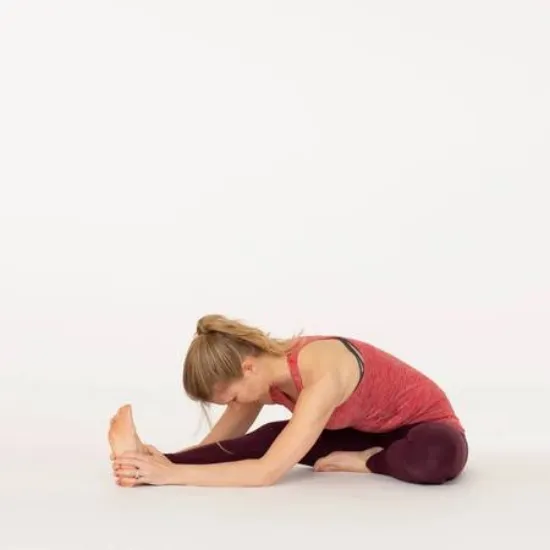
Janu Sirsasana, also known as Head-to-Knee Pose, is a forward-facing sitting position that involves slight hip opening and hamstring stretching. This pose, which is pronounced JAH-new shear-SHAHS-uh-nuh, is commonly employed in Hatha, Yin, and Ashtanga yoga to improve hip and leg flexibility and foster mental and physical peace.
Head-to-Knee Pose: Overview and Meaning of Janu Sirsasana
The head-to-knee posture is derived from the Sanskrit terms janu (knee), sirsa or shirsha (head), and asana (stance). The general orientation of the fold, where the torso moves in the direction of the extended leg, is described by the name. Instead of bringing the head to the knee, the emphasis in practice is on keeping the spine long and folding in a controlled, comfortable way.
With roots in traditional Hatha yoga, Janu Sirsasana gained popularity through modern systems such as Ashtanga Yoga, whose variations A, B, and C are part of the Primary Series. It is currently frequently used in Hatha, Yin, and restorative yoga because of its adaptability and calming properties. It prepares the body for deeper forward folds in strong sequences, although it is often maintained longer in slower practices to encourage flexibility, relaxation, and recuperation.
From an anatomical perspective, Head-to-Knee Pose combines hip opening, spinal lengthening, and hamstring stretching. The extended leg gets a deep stretch through the back of the thigh while the bent leg opens the inner thigh and groin. The torso folds forward, stretching the spine, and the body settles into a supported, asymmetrical position. This combination highlights the differences between the two sides of the body while making the position efficient and approachable.
At a Glance
- English Name: Head-to-Knee Pose
- Sanskrit Name: Janu Sirsasana
- Pronunciation: JAH-new shear-SHAHS-uh-nuh
- Pose Types: Hip opener, hamstring stretch, and seated forward fold
- Level: Beginner to Intermediate
- Duration: 1–5 minutes per side
- Ideal Time: After a warm-up or hip-opening, in the evening, or during sitting sequences.
- fitness. Main Benefits: stretches the hamstrings, opens the hips and groin, lengthens the spine, and soothes the neurological system.
- Chakras: Root (Muladhara), Sacral (Svadhisthana), Solar Plexus (Manipura)
Muscle Work During Janu Sirsasana:
- Neck Muscles
- Lower Back Muscle
- Core Muscle
- Gluteus Muscle
- Hamstring Muscle
- Hip Muscle
Janu Sirsasana (Head-to-Knee Pose) Video
How to Perform?
- Begin by sitting in Dandasana.
- Allow the heel of the right foot to contact the perineum as the left leg remains extended forward.
- Inhale and lift your hands overhead.
- Exhale while bending forward and gripping your left toe.
- Bend your trunk forward with another exhale and extend your head to your left knee.
- Maintain this stance for 30-60 seconds, inhaling deeply.
- After a few moments of relaxation, repeat the step with the left leg bent.
Benefits of Head-to-Knee Pose (Janu Sirsasana)
Head-to-Knee Pose encourages the body to relax and calm down while combining hip opening, spinal lengthening, and hamstring stretching. It is a very effective seated forward fold.
Physical Benefits
The stomach, hips, legs, and spine are all balanced in this pose.
- Stretches the hamstrings and improves flexibility: The extended leg receives a deep stretch across the back of the thigh, improving overall mobility.
- Opens the hips and groin: By making room via the inner thigh and hip, the bent leg promotes greater range of motion.
- Lengthens the spine and relieves tension in the lower back: A supported forward fold can assist in lessening back body stress.
- Encourages digestion: Gently pressing on the abdomen may help encourage digestion.
- Relieves tense muscles: When done carefully, it can help release tension in the legs, hips, and lower back.
Mental and Emotional Benefits
Janu Sirsasana has a relaxing effect by nature, just as many forward folds.
- Calms the Nervous System: The body is encouraged to settle down, unwind, and release tension by the gradual forward fold.
- Lessens mental exhaustion and stress: Promotes a more relaxed and grounded state.
- Enhances internal awareness and focus: Promotes turning away from outside distractions.
- Develops body awareness and patience: The pose’s asymmetry draws attention to side variances, encouraging attentive practice.
Energetic and Holistic Benefits
The Head-to-Knee Pose in traditional yoga is linked to inward meditation and grounding.
- Encourages stability and grounding: The sitting base and front fold create the appearance of solidity and rootedness.
- Encourages relaxation and release: Hip and groin openings are often linked to releasing stored tension.
- Activates the abdominal centre: Balance and internal awareness are supported by light compression.
- Encourages pratyahara, or internal focus, which lessens sensory overload and aids in turning attention inward.
- This posture should be done carefully if you have hamstring strains, knee pain, or lower back problems because it involves forward folding and knee rotation.
Do you wish to take full use of guided forward folds’ benefits? Make an appointment for a complimentary one-on-one session with a qualified Indian yoga instructor right now.
How to Perform Head-to-Knee Pose (Janu Sirsasana): Complete Step-by-Step Guide
By using this thorough tutorial, you may perform Head-to-Knee Pose with better alignment and less strain. The objective is to stretch the spine and fold in a way that your body can sustain pleasantly rather than forcing depth.
Part 1: Preparing for the Pose
Make sure your hips and hamstrings are supported so you can practice comfortably. Sit on a folded blanket if you’re having lower back ache. If reaching the foot strains your posture, keep a strap nearby. The pose can be made better with a little warm-up with mild hip openers and hamstring stretches.
Part 2: Step-by-Step Guide to Practicing Head-to-Knee Pose
- With both legs outstretched, begin in Staff Pose (Dandasana). If necessary, sit on a folded blanket to maintain an erect spine.
- Position the foot’s sole against your inner left thigh while bending your right knee. Don’t push the knee down; instead, let it naturally relax.
- Gently flex the foot as you turn your torso toward the outstretched leg. Keep the leg active without locking the knee.
- Breathe in, extend your spine, and reach up to make room in your torso.
- As you exhale and turn forward from the hips, lead with the chest. Put your hands on a foot, ankle, shin, or strap.
- When you can keep your spine straight and your breathing calm, pause. Soften the shoulders, neck, and face. Hold for:
- Beginners: 30–60 seconds
- Intermediate: 1–3 minutes
- Restorative/Yin: 3–5 minutes
- Take a breath and slowly raise your torso to emerge. Return to Staff Pose and straighten the bent leg before switching sides.
Common Mistakes and Alignment Tips
- The lower back is strained, and effectiveness is decreased when the spine is rounded.
- Advice: Take a seat on a blanket and lead with your chest.
- Knee joint strain can result from forcing the bent knee down.
- Advice: Support the knee or let it rest naturally.
- Locking the extended leg can stress the knee.
- Advice: Maintain an active leg with a little tenderness.
- When you pull with your arms, your neck and shoulders become tense.
- Advice: Instead of using force, use your hands or the strap for support.
- Collapsing the chest: Limits breath and spinal length.
- Tip: Think of folding forward, not downward.
- When done patiently and with assistance, Head-to-Knee Pose is a slow, therapeutic forward fold that improves flexibility and encourages mental and physical calm.
Janu Sirsasana Variations
For varying degrees of comfort, hip mobility, and flexibility, the Head-to-Knee Pose can be modified. Some adjustments make the position more beginner-friendly, while others deepen the hip opening or add a twist through the side body.
Beginner Modifications
Elevated Hips
- Makes the posture safer and more comfortable for hamstrings and tight hips by facilitating the pelvis’ easier forward tilt.
- Position yourself in Staff Pose on one or two folded blankets.
- Press the foot up on the inner thigh while bending one knee.
- Fold forward over the outstretched leg and expand your spine.
- Stay lifted through the chest as you breathe.
Strap Around the Extended Foot
- keeps your spine lengthy without requiring you to strain to reach your foot.
- A yoga strap should be looped around the ball of the outstretched foot.
- In each hand, grasp one end of the strap.
- Exhale to fold forward and inhale to stretch the spine.
- Instead of pulling hard, use the strap for support.
Micro-Bend in the Extended Knee
- When the back of the leg feels really tight, it protects the knee joint and hamstrings.
- Extend one leg forward.
- Instead of locking that knee straight, maintain a small bend.
- Lengthen the spine and fold forward.
- As long as the stance is supported, keep the gentle bend.
- Classical Variations: Janu Sirsasana A, B, and C
Janu Sirsasana A
- In its most approachable form, the traditional variation strikes a balance between forward folding, hip opening, and hamstring stretch.
- One leg should be extended while the other is bent to the side.
- Put the bent foot up against the extended leg’s inner thigh.
- Inhale to lengthen the spine.
- Exhale and fold forward over the straight leg.
Janu Sirsasana B
- modifies the bent leg’s position to deepen hip opening and groin release.
- Bring the heel beneath the same-side sitting bone by bending one knee.
- Let the body sit partially on the heel.
- Extend the opposite leg straight forward.
- Fold over the extended leg and lengthen your spine.
Janu Sirsasana C
- intensifies the seated position while adding deeper ankle, foot, and hip training.
- Tuck the toes of one foot under while bending the knee.
- If necessary, carefully sit on your heel or ball of your foot.
- Extend the opposite leg forward.
- With patience and a steady breath, fold toward the outstretched leg.
Props and Accessibility
- If the pelvis tilts back, take a seat on a folded blanket.
- If reaching the foot circles the spine, use a strap.
- If the hip feels tight or unsupported, place a blanket beneath the bent knee.
- For a more restorative variation, rest on blocks or a bolster.
- Keep the extended knee in a microbend if the hamstring feels strained.
- Gradually transition into Janu Sirsasana B and C only after the traditional pose is stable and cosy.
- Whether you’re practising Head-to-Knee Pose to develop flexibility, explore deeper classical forms, or relax your mind, these modifications make it more versatile and long-lasting.
Head-to-Knee Pose (Janu Sirsasana) Precautions & Contraindications
Although Head-to-Knee Pose is generally therapeutic and calming, it needs to be done carefully, particularly if you have lower-back, hamstring, knee, or hip discomfort. Instead of pushing the fold, the goal is continuous length and support.
Avoid the head-to-knee pose if you have:
- Acute hamstring strain or tear
- Acute knee injury or severe knee pain
- Significant disc irritation or a herniated disc, particularly if forward bending exacerbates the condition
- Severe or uncontrolled sciatic pain
- Acute lower-back injury
- Diarrhoea or significant abdominal discomfort
- Late pregnancy without appropriate modifications
Practice With Caution and Modifications in case of:
Tight hamstrings: Avoid dragging yourself farther than your breath can sustain, wrap a strap around the foot, and sit on a folded blanket.
Knee sensitivity: Use a blanket or bolster to support the bent knee rather than pressing it toward the floor.
Lower-back sensitivity: Pay more attention to the length of the spine than its depth, keep the fold smaller, and elevate the hips above normal.
Hip tightness: Give the bent knee full support and, if needed, let it stay higher.
The hip should open gradually, not by force.
Pregnancy: Adopt a wider leg stance, stay upright or supported, and refrain from compressing the abdomen. A more open or side-supported position is typically safest later in pregnancy. Read our complete prenatal yoga guide here.
If you have ankle pain in variations B or C, keep doing Janu Sirsasana A until your ankles, knees, and hips are ready for more difficult classical poses.
General Safety Guidelines
- Sit on support if your pelvis rounds backwards.
- Lengthen the spine before folding.
- Turn from the hips rather than slumping through the waist.
- Keep the bent knee supported if needed.
- Use props freely.
- Breathe naturally throughout.
- Ease out immediately if you feel any sharp or unstable sensations.
- When to Consult a Healthcare Provider
- Speak with a healthcare professional before practising if you have:
A current or recent hamstring injury.
Ongoing knee pain or instability.
Disc issues or recurring lower-back pain.
Sciatica that worsens in forward folds.
Pregnancy with pelvic or abdominal discomfort.
Any condition that causes pain or danger when folding forward when seated.
Progressing Safely
A good progression usually looks like this:
- Place a blanket underneath you and use a strap to help you begin Janu Sirsasana A.
- Add torso support for longer holds.
- Build comfort in the hips and hamstrings gradually.
- Only when A is stable and pain-free should you investigate B and C variations.
- Parivrtta Janu Sirsasana should be approached independently because it emphasises side bending over a straight fold.
- When you modify Head-to-Knee Pose to fit your physique, it becomes more therapeutic. A deeper shape attained with strain is significantly less effective than a smaller, better-supported variant.
- Schedule a free one-on-one session right now to maximise your practice!
Related Yoga Poses
By enhancing hip mobility, forward-fold depth, and hamstring flexibility, these poses enhance Janu Sirsasana.
Paschimottanasana (Seated Forward Fold)
- A symmetrical forward fold that lengthens the spine and extends the hamstrings.
- Sit with both legs extended straight in front.
- Inhale and lengthen the spine upward.
- Exhale and hinge forward from the hips.
- Hold the shins, ankles, or feet.
- Keep the chest lifted and breathe steadily.
Triang Mukhaikapada Paschimottanasana (Three-Limbed One-Legged Forward Fold)
- adds a forward fold and a deeper stretch for the knees and quadriceps.
- One leg should be outstretched
- The other leg is folded back next to the hip.
- Keep both hips grounded evenly.
- Inhale to lengthen the spine.
- Exhale and fold over the extended leg.
- Hold and breathe, then switch sides.
Kurmasana (Tortoise Pose)
3. An advanced forward fold that promotes inward focus and hip opening.
- Sit with legs extended and slightly apart.
- Slide your arms beneath your legs and bend your knees.
- Extend the legs forward while lowering the torso.
- Rest the chest and head toward the floor.
- Stay relaxed and breathe deeply.
Parivrtta Janu Sirsasana (Revolved Head-to-Knee Pose)
4. A version that uses a side bend to give the hips, ribs, and spine greater room.
- With one leg extended, the other should be bent.
- Turn slightly toward the bent leg.
- Inhale and reach the arm upward.
- Exhale and side-bend over the extended leg.
- Breathe steadily and maintain lengthy waists on both sides.
FAQs
Can beginners perform Janu Sirasana?
Yes, novices may execute Janu Sirasana, which can improve hamstring and lower back flexibility. This is a great sitting forward-bending stretch for lengthening the spine and strengthening both legs.
Who should not perform Janu Sirasana?
Pregnant women in their second and third trimesters should avoid performing Janu Sirasana owing to increased strain on the knees, core, and lower back.
Which asana should be practised after Janu Sirasana?
After Janu Sirasana, two counter-stretching yoga postures can be performed: Dandasana (Staff Pose) and Purvottanasana (Upward Plank Pose). These will help you restore your spine’s natural curvature and relax your hamstrings.
What are the benefits of Janu Sirasana?
Janu Sirasana offers several health advantages, including the following:
Toned hamstrings
Strong and toned core
Relief for back pain
Increased spine and hamstring length
Better functioning of digestive organs
Better functioning of reproductive organs
Can Janu Sirsasana relieve back pain?
Janu Sirsasana is a basic yet effective asana for reducing back discomfort. Extreme stretching of your back muscles causes suppleness in your spine.
REFERENCE
- MyYogaTeacher. (2026c, June 3). Janu Sirsasana. https://myyogateacher.com/yoga-asana/janusirsasana
- Lasater, J. H. (2026, July 15). Head-to-Knee pose shines light on your posture problems. Yoga Journal. https://www.yogajournal.com/practice/janu-sirsasana-head-to-knee-explainer/
- Head on Knee Pose Yoga(Head to knee pose)| yoga sequences, benefits, variations, and Sanskrit pronunciation | Tummee.com. (n.d.). Tummee.com. https://www.tummee.com/yoga-poses/head-to-knee-pose


5 Comments