Vasisthasana (Side Plank Pose)
Introductions
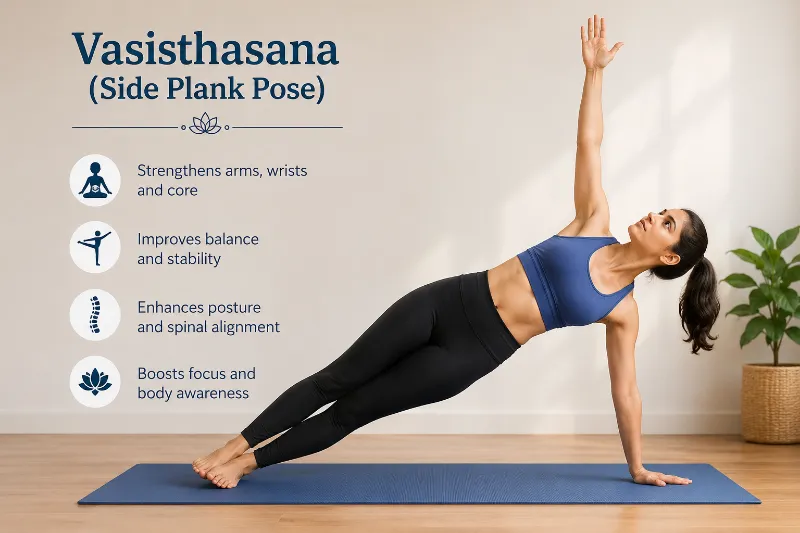
Vasisthasana, or Side Plank Pose, is a powerful yoga balancing posture. You balance your entire body on one hand and the outer edge of your foot while lifting your hips and extending your other arm toward the ceiling.
The oblique abdominal muscles, which aren’t used as much in ab exercises like crunches, can be strengthened with the Vasisthasana.
With just one arm and the side of one foot supporting you, you will hold your body upright on its side. Strong obliques are useful as core stabilisers. Beginners must build the strength and balance needed with warm-ups for the obliques and modified side planks before progressing to the full side plank. You can include side planks in your core exercise routine, Pilates, or yoga practice.
How To Do Vasisthasana (Side Plank)?
Lie on your right side, legs extended and stacked from hip to feet. The elbow of your right arm is directly under your shoulder. Ensure your head is directly in line with your spine. Your left arm can be aligned along the left side of your body.
Engage your abdominal muscles, drawing your navel toward your spine.
Lift your hips and knees from the mat while exhaling. Your torso is straight in line with no sagging or bending. Hold the position. Inhale after a few breaths and go back to where you were. The goal should be to hold for 60 seconds. Change sides and repeat
Benefits of Vasisthasana (Side Planks)
The primary muscles used are the obliques, along with the gluteus medius and gluteus maximus to stabilise the hips. Your shoulder stabilisers keep you aligned as well.
Vasisthasana doesn’t put pressure on your lower back or neck as many core exercises do. In pregnancy, the side plank is preferred, as it places less stress on the central abdominal muscles. It is a balancing exercise, and you will be building balance and coordination. This exercise can help you sustain good posture and ease of movement by building a strong core and better balance.
Vasisthasana Variations
Side Twist
You can prevent joint and/or muscle pain by gently easing into your side plank before completely loading it with your body weight. Warm-ups and adjustments are used for this.
Small side curl-ups are a good way to warm up your obliques. Start by lying on the floor with your feet flat and your knees bent. Perform a few straight-on curl-ups to get going.
When you’re ready, do the curls to one side, moving up and down slowly to get the most strengthening benefits.
Do at least five on each side.
Before you challenge your obliques, spend a few moments on your back with your knees bent and feet flat. Gently drop or roll both knees to one side and then the other several times.
If you’d like to turn this move into an oblique challenge, when you pull your legs back to the start position (feet flat on the floor), do so from your Let your legs hang like dead weight and focus entirely on your hips. Keeping your abs active and refusing to let your legs assist you is the secret to making this work.
Vasisthasana From Knees
Now take the warm-up to a slightly more difficult level by folding your legs behind you while sitting on one hip.
- Place that hand on the floor and extend the arm on the same side as the hip you are sitting on to support your body weight.
- This will give you some isometric workout for your obliques.
- Repeat on the opposite side after staying there for 20 to 30 seconds.
Single-Knee Vasisthasana
If you can’t hold the side plank position, the remedial side plank is a fine place to develop your oblique strength.
From a seated position, lower down so your weight is supported on your hip and the side of the thigh closest to the floor. This leg should be slightly bent to help facilitate safe and accurate positioning. Your weight should also be supported on the forearm on the same side.
Maintain proper alignment and form by keeping your upper hip and shoulder just above your lower ones. Engage your abs. You may place your hand on your hip or rest your upper arm by your side.
Stay in this posture for a maximum of one minute before switching. Strive to maintain proper form while performing the pose, and strive to extend each repetition by one to two seconds.
Stability Ball Vasisthasana
If you remain remedial, you can develop muscle balance and involve the muscles in your ribs more by placing a football or BOSU ball under your plank.
The ball will challenge your alignment and overall body balance. You must maintain your top hip and shoulder directly over the bottom. If you have problems doing this, widen your base of support by putting the top foot in front of the other on the floor.
Increase Intensity
In yoga, the Side Plank Pose (Vasisthasana) is taught with the supporting arm straight. It is also taught as a Pilates exercise in this manner. In addition to using more forearm muscles, this puts additional strain on the wrist. From Plank Pose, you can transition into the straight-arm version (Phalakasana). For an even harder test, you can raise both your upper arm and leg.
Common Mistakes
To get the most from side planks, avoid these errors.
Hips Sagging
- Your hips will sag, and you won’t be able to maintain a straight line if you haven’t gained enough strength.
- When this happens, it means your core is no longer holding you in place, and you are not getting the benefit of the exercise. Additionally, you could put undue tension on your back and hips.
Rolling Forward
Without enough strength and balance, you may not be able to maintain the position, and you’ll find yourself rolling forward and unable to keep your hips and legs stacked. If this happens, try to correct it, but if it’s too difficult, lower your bottom knee and maintain a straight line.
Holding Too Long
- You might only be able to maintain the side plank for a few seconds at first. As soon as you start sagging or rolling
- Forward or backwards, it is time to end the plank before you get a strain injury. Keep an eye on your form and stop as soon as you start to get tired.
- Lift your top leg for the queen of all difficulties. Both the straight-arm support position and the forearm support position can be used for this. Raising the upper leg will activate your inner thigh muscles, but it is not necessary to raise it higher than parallel to the ground. Another alternative is to raise the lower leg off the ground while keeping only your elbow or hand in contact with the higher leg’s foot.
Safety and Precautions
You should avoid side plank if you have an injury to your shoulder, arm, elbow, or ankle. Talk to your doctor or physical therapist about whether it is appropriate if you have any other injuries or conditions. Stop if you feel pain at any time.
Modifications & Variations
Avoid stacking your legs in Vasisthasana if you struggle with balance. Instead, try the “kickstand” variation. When you step your top foot forward and position it in front of your hips, far enough away from your torso, your shin should be roughly straight up and down. Turn your foot parallel to the short edge of the mat, just like you would with your other foot.
If it is still hard to balance
Place yourself in a side plank with your back against the wall after setting up in a plank next to a wall. This will support you and assist you in determining the pose’s form.
If you have wrist pain in the pose
First, check that you are in alignment. Your wrist crease or bones should be at least very slightly parallel to the top of your mat as it came to pass. If your wrist ache doesn’t go away, place a yoga wedge beneath your hand with the thick edge closest to your wrist.
If You Have Wrist Discomfort or Carpal Tunnel Syndrome
With your forearm parallel to the short edge of the mat, you can practice a side plank. You can create a fist and press it into the ground if you would rather keep your lower arm straight.
Supported Practice with a Chair, Two Mats, and a Block
Check out this fantastic modification for Vasisthasana! I adore the various ways props may be useful. Here, you arrange the chair on your mat, cover the chair with a folded-up mat for comfort and stickiness, and then cover the chair seat with a thin block (this is to support your side/underarm area).
Kneel next to the chair on your mat. Place your right arm, shoulder, and head through the chair’s back. Reach your right arm down to grasp the lower leg while bending your right hip on the chair seat. Extend your legs straight out to the side. Bend your upper leg, hold your big toe, and continue if you want to achieve the pose’s complete expression. Details are shown in the photo below.
Vasisthasana with Vrksasana
Want more options? If you’d like, you can switch it up and perform Vrikshasana (Tree Pose) with your upper leg. Insert your upper leg’s foot into your lower leg’s inner thigh. Continue raising your hips while applying pressure with your bottom foot.
With props, your options are endless
When you have access to rope walls, chairs, straps, blocks, blankets, bolsters, and more, the possibilities for changing or adjusting Vasisthasana are truly endless. To help you increase your practice in this position, I suggest experimenting with props and spending time with instructors who use props in their workshops.
Follow-up Poses
- Adho Mukha Svanasana / Downward Dog Pose
- Gomukhasana / Cow Face Pose
- Ardha Chandrasana / Half Moon Pose
- Parighasana / Gate Keeper’s Pose
Gear & Resources for This Pose
- BKS Iyengar’s Light on Yoga
- Darren Rhodes Yoga Resource Practice Manual
- Yoloha Cork Yoga Mat with plant-based foam
- Yoloha Cork Yoga Blocks
- Organic Cotton Yoga Straps
- Machine Washable Vegan Yoga Blankets
- Foam Yoga Wedge
- Folding Yoga Chair
Conclusion
Long after you’ve mastered the fundamental form, this stance still works for you. As long as you practice it, your body and mind will continue to gain strength and stability.
Furthermore, Vasisthasana simply keeps opening up new possibilities and options, just like all wonderful yoga positions. Like yoga, the possibilities of Vasisthasana are endless. Have fun playing!
FAQs
What is Vasisthasana (Side Plank Pose)?
Vasisthasana, also known as Side Plank Pose, is a balancing yoga posture that strengthens the arms, shoulders, core, and legs while improving stability and body awareness.
Why Practice Vasisthasana (Side Plank Pose)?
Vasisthasana (Side Plank Pose) helps build core strength, improves balance, strengthens the wrists and shoulders, enhances posture, and increases overall body stability.
Is Vasisthasana (Side Plank Pose) suitable for beginners?
Yes, beginners can practice Vasisthasana (Side Plank Pose) by keeping the bottom knee on the floor or using a wall for support until they develop enough strength and balance.
Which muscles does Vasisthasana (Side Plank Pose) strengthen?
Vasisthasana (Side Plank Pose) primarily strengthens the core, obliques, shoulders, wrists, arms, glutes, and legs while improving full-body coordination.
Who should avoid Vasisthasana (Side Plank Pose)?
People with wrist, shoulder, elbow, or severe back injuries should avoid Vasisthasana (Side Plank Pose) or practice it only under the guidance of a qualified yoga instructor or healthcare professional.
How long should you hold Vasisthasana (Side Plank Pose)?
Hold Vasisthasana (Side Plank Pose) for 15–30 seconds on each side while breathing steadily, and gradually increase the duration as your strength and balance improve.
References:
- Yoga Journal. (2025f, March 21). Side plank pose. https://www.yogajournal.com/poses/side-plank-pose/
- JanviMangukiya JanviMangukiya. (2026). Vasishtasana (Side Plank Pose) – Benefits, How to do? – Variations. Mobile Physiotherapy Clinic. https://mobilephysiotherapyclinic.in/vasishtasana-side-plank-pose/
- Stephen. (2023, March 31). How to do Vasisthasana – Benefits & Yoga pose tutorial. Adventure Yoga Online. https://adventureyogaonline.com/vasisthasana-benefits/
- Vasisthasana Yoga(Side plank pose)| Yoga sequences, benefits, variations, and Sanskrit pronunciation | Tummee.com. (n.d.). Tummee.com. https://www.tummee.com/yoga-poses/side-plank-pose