Agnistambhasana (Fire Log Pose)
What Is Agnistambhasana?
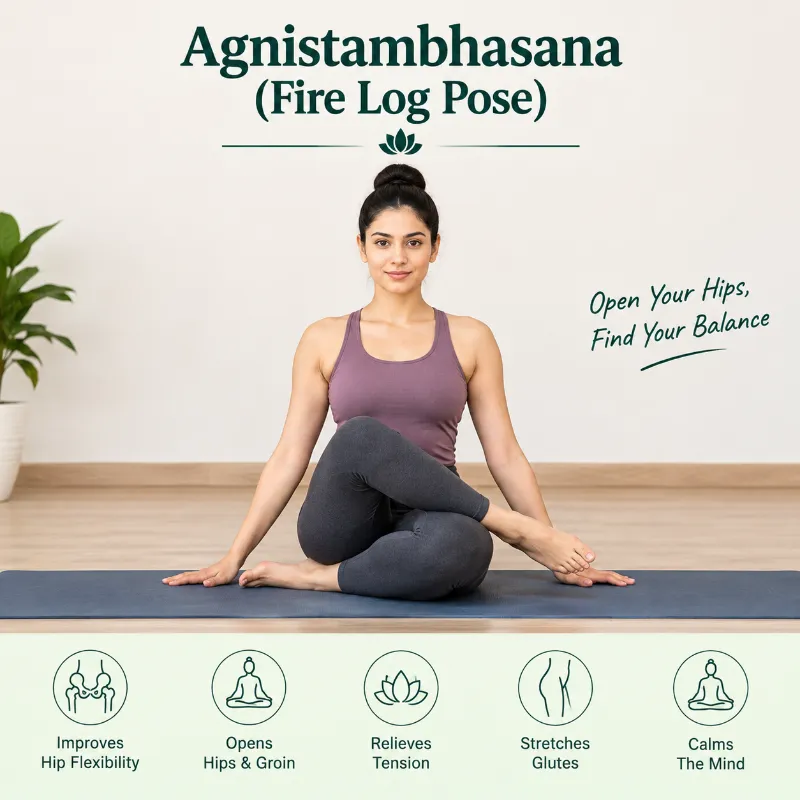
Agnistambhasana, also known as Fire Log Pose, is a seated yoga posture that gently stretches the hips, glutes, and outer thighs.
Fire Log Pose is a seated hip-opening posture in which the shins are stacked parallel, with one ankle over the opposite knee and the other ankle under the opposite knee. The legs create a shape that resembles stacked wooden logs.
The Sanskrit name Agnistambhasana comes from the words:
- Agni – fire
- Stambha – log, pillar, or support
- Asana – pose or posture
The posture is sometimes called Double Pigeon Pose because of the way the legs are positioned. However, Fire Log Pose is generally practised as a seated hip-opening variation and should not be confused with Pigeon Pose, which has a different leg and pelvic position.
The primary objective of Agnistambhasana is to encourage hip mobility while maintaining an elongated spine and controlled breathing.
Muscles Worked in Agnistambhasana
Fire Log Pose mainly works on the muscles and connective tissues surrounding the hips.
The areas involved include:
- Gluteus maximus
- Gluteus medius
- Gluteus minimus
- Piriformis muscle
- Deep external rotators of the hip
- Outer thigh muscles
- Hip joint structures
- Lower back muscles for postural support
Benefits of Agnistambhasana
Regular and mindful practice of Agnistambhasana may provide several physical and mental benefits.
- Improves Hip Flexibility
Fire Log Pose primarily targets the hips. Maintaining the stacked-leg position encourages the hips to gradually adapt to external rotation.
With consistent practice, it may help improve overall hip mobility.
- Stretches the Gluteal Muscles
The posture creates a significant stretch through the gluteal region.
This can be useful as part of a stretching routine for people who experience tightness around the hips and buttocks.
- Opens the Outer Hips
Agnistambhasana is particularly useful for working on the external rotators and surrounding muscles of the hip.
Improved hip mobility can make certain seated yoga poses more comfortable.
- Stretches the Outer Thighs
The stacked-leg position creates a stretch around the outer thighs and hip region.
The intensity of the stretch depends on individual flexibility and the alignment of the legs.
- Encourages Better Posture
Maintaining an upright spine during Fire Log Pose requires awareness of the pelvis, spine, shoulders, and head.
Practising this alignment can encourage better postural awareness.
- Prepares the Body for Deeper Hip-Opening Poses
Fire Log Pose can serve as preparation for more demanding hip-opening postures.
It can gradually develop the mobility required for poses that involve greater external rotation of the hips.
- Promotes Relaxation
Like many seated yoga postures, Agnistambhasana can be practised with slow breathing and mindful awareness.
The combination of controlled breathing and sustained stretching may help create a calm and relaxing practice.
- Supports Mindful Movement
Because the pose requires attention to alignment and sensation, it can encourage practitioners to become more aware of how their body responds to stretching.
This makes it useful in slower yoga practices.
Perform Agnistambhasana
Follow these steps to practice Fire Log Pose safely:
Step 1: Begin in a Comfortable Seated Position
- Sit on your yoga mat with your legs extended forward. Keep your spine tall and allow your shoulders to relax.
- If sitting upright feels difficult, place a folded blanket or yoga cushion underneath your hips. Elevating the hips can make it easier to maintain a neutral spine.
Step 2: Bend the Legs
- Bend your knees and bring your feet toward your body.
- Slowly place your left shin in front of you. Your left foot should remain near the right side of the mat.
Step 3: Stack the Legs
- Bend your right knee and bring your right shin over the left shin.
- Try to position the right ankle above the left knee and the right knee above the left ankle. Ideally, the shins become approximately parallel to each other.
- Do not force the legs into position. If your knees remain significantly higher than your ankles, that simply indicates that your hips need more gradual mobility work.
Step 4: Keep the Spine Upright
- Place your hands beside your hips or gently on your thighs.
- Lengthen through the crown of your head. Keep your chest open and avoid collapsing forward.
- Your pelvis should remain as neutral as possible.
Step 5: Deepen the Stretch
- If your body feels comfortable, slowly walk your hands forward and begin to fold from your hips.
- Keep the movement controlled and avoid rounding the back excessively.
- You should feel a stretch around the outer hips and gluteal muscles rather than sharp pain in the knees.
Step 6: Breathe Slowly
- Take slow, steady breaths while holding the posture.
- Stay in the pose for approximately 30 seconds to 1 minute initially. With regular practice, you may gradually increase the duration.
Step 7: Release the Pose
- Slowly walk your hands back toward your body.
- Uncross the legs carefully and extend them forward.
- Pause for a few breaths before repeating the pose with the opposite leg on top.
Breathing During Agnistambhasana
Breathing is an important part of the practice.
Once you establish the posture, inhale slowly through the nose and create length through your spine. During the exhalation, allow your body to soften without forcing the stretch.
If performing the forward fold, you can use each inhalation to lengthen the spine and each exhalation to relax slightly deeper into the position.
Never hold your breath to increase the intensity of the pose.
Modifications for Beginners
Beginners do not need to immediately create a perfect Fire Log Pose.
Several modifications can make the posture more accessible.
Use a Cushion Under the Hips
- Sit on a folded blanket, bolster, or firm cushion.
- This can help tilt the pelvis forward and make it easier to maintain an upright spine.
Place a Block Under the Knee
- If the upper knee does not comfortably move toward the lower ankle, place a yoga block or folded blanket underneath it for support.
- The support should reduce strain rather than force the knee downward.
Keep the Legs Less Tightly Stacked
- You can begin with the top foot farther away from the opposite knee.
- As your mobility improves, gradually work toward the traditional stacked position.
Avoid the Forward Fold
- Beginners can simply remain upright instead of folding forward.
- The seated position itself can provide a useful hip-opening experience.
Agnistambhasana for Advanced Practitioners
More experienced practitioners may deepen Agnistambhasana by performing a controlled forward fold.
However, greater depth is not necessarily better.
The goal should be to maintain proper alignment while experiencing a manageable stretch.
Advanced practitioners may also incorporate the pose into longer hip-opening sequences or use it as preparation for meditation-oriented seated postures.
Precautions and Safety
Although Fire Log Pose can be beneficial, it is not appropriate for everyone in every situation.
Practice with caution if you have:
- Knee Pain or injury
- Hip injury
- Recent surgery involving the hips, knees, or lower body
- Significant joint stiffness
- Acute lower-body pain
- Severe mobility limitations
If you experience sharp pain, numbness, tingling, or significant discomfort, come out of the pose and rest.
People recovering from an injury or medical procedure should seek guidance from an appropriately qualified healthcare professional before beginning a new yoga routine.
Common Mistakes in Agnistambhasana
Practitioners often make several mistakes while attempting Agnistambhasana.
Forcing the Knees Down
- One of the most common mistakes is trying to push the knees toward the floor.
- This can place unnecessary stress on the knee joint.
- Instead, allow the knees to remain at a comfortable height.
Rounding the Back
- When hip flexibility is limited, practitioners may compensate by rounding the spine.
- Try to maintain an elongated spine and fold from the hips rather than collapsing through the chest.
Forcing the Ankles Into Position
- The stacked-leg position should develop gradually.
- Do not force your ankle or knee into an uncomfortable position simply to make the legs look perfectly stacked.
Ignoring the Pelvis
- If the pelvis tilts backwards, maintaining an upright spine can become difficult.
- Sitting on a folded blanket or cushion can help create more space for the hips and make the posture more accessible.
Comparing Both Sides
- It is normal for one hip to be more flexible than the other.
- Avoid forcing the tighter side to match the more flexible side.
Who Should Avoid Agnistambhasana?
Anyone with an acute knee or hip injury should avoid forcing this posture.
People with significant joint problems should practice only under appropriate professional guidance.
Pregnant practitioners may also need modifications depending on their stage of pregnancy, comfort, and individual circumstances.
The pose should always be adapted to the practitioner’s current physical condition rather than performed simply because it appears in a yoga routine.
How Long Should You Hold Agnistambhasana?
Beginners can start with approximately 20–30 seconds on each side.
- As flexibility and comfort improve, the posture can be held for around 1–2 minutes per side.
- There is no universal ideal duration.
- The quality of the posture and your ability to breathe comfortably are more important than holding it for a specific amount of time.
Best Poses to Practice Before Agnistambhasana
A short warm-up can make Fire Log Pose more comfortable.
Useful preparatory poses may include:
- Cat-Cow Pose
- Butterfly Pose
- Bound Angle Pose
- Easy Pose
- Figure-Four Stretch
- Child’s Pose
- Gentle seated hip stretches
A gradual warm-up is especially useful if your hips feel stiff.
Poses to Practice After Agnistambhasana
After completing Fire Log Pose, you can transition into gentle neutralising movements.
Some options include:
- Seated Forward Fold
- Gentle Twist
- Staff Pose
- Happy Baby Pose
- Supine Figure-Four Stretch
- Shavasana (Corpse Pose)
The next posture should feel comfortable rather than immediately increasing the intensity.
Tips for Practising Agnistambhasana
Keep the following tips in mind:
- Warm up before attempting the pose.
- Never force the knees toward the floor.
- Keep the spine long.
- Use props when necessary.
- Practice both sides evenly.
- Breathe slowly and naturally.
- Focus on sensation rather than appearance.
- Stop if you experience sharp or unusual pain.
- Progress gradually.
- Prioritise comfortable alignment over depth.
Conclusion
Fire Log Pose (Agnistambhasana) is a valuable seated yoga posture for developing hip mobility, stretching the gluteal and outer-hip muscles, and improving awareness of seated alignment.
Although the posture may appear straightforward, it requires patience and gradual progression.
The most important aspect of practising Fire Log Pose is not achieving perfectly stacked legs.
Instead, focus on maintaining comfortable alignment, breathing naturally, and respecting your body’s current range of motion.
Beginners can make the pose more accessible by sitting on a cushion, supporting the knees, or reducing the depth of the posture.
With consistent and mindful practice, Fire Log Pose can become a useful part of a balanced yoga routine focused on hip mobility, flexibility, and relaxation.
Always remember that yoga should be practised according to your individual abilities.
Avoid forcing your joints into a position and seek qualified professional guidance if you have an injury or medical concern.
FAQs
Is Agnistambhasana good for beginners?
Fire Log Pose can be practised by beginners with appropriate modifications. Beginners may keep the legs less tightly stacked, sit on a cushion, or support the upper knee with a block.
Why is Agnistambhasana difficult?
The pose can be challenging because it requires significant external rotation and mobility of the hips. Individual anatomy also affects how easily the legs can stack.
Should my knees touch the floor?
Don’t. You don’t have to touch the floor with your knees. Trying to force them down can create unnecessary stress on the joints.
Can Agnistambhasana improve hip flexibility?
Regular, gradual practice may help improve hip mobility and flexibility. Results vary depending on individual anatomy, consistency, and overall mobility.
Can I do Agnistambhasana every day?
If the posture feels comfortable and does not cause pain, it can be incorporated into a regular yoga routine. However, intensity should be adjusted according to your body’s response.
Should I feel Agnistambhasana in my knees?
The primary sensation should generally occur around the hips and outer glutes. Knee pain is a reason to modify or stop the posture.
Is Agnistambhasana the same as Double Pigeon?
Fire Log Pose is commonly referred to as Double Pigeon because of its stacked-leg position. The names are often used interchangeably in modern yoga instruction.
References
- Yoga Journal. (2025w, March 21). Fire log pose. https://www.yogajournal.com/poses/fire-log-pose/?scope=anon
- Yogapedia. (2023, December 21). Agnistambhasana. Yogapedia. https://www.yogapedia.com/definition/6409/agnistambhasana?utm_source=chatgpt.com