Ardha Chandrasana (Half Moon Pose)
What is Ardha Chandrasana (Half Moon Pose)?
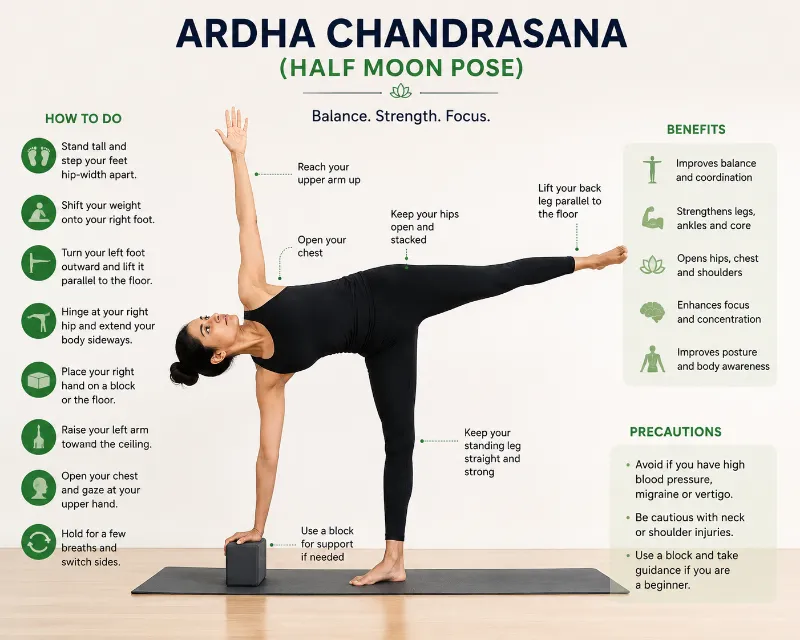
Ardha Chandrasana is also called Half Moon Pose. This contemporary intermediate Hatha yoga pose is ideal for energising your ankles, legs, and spine.
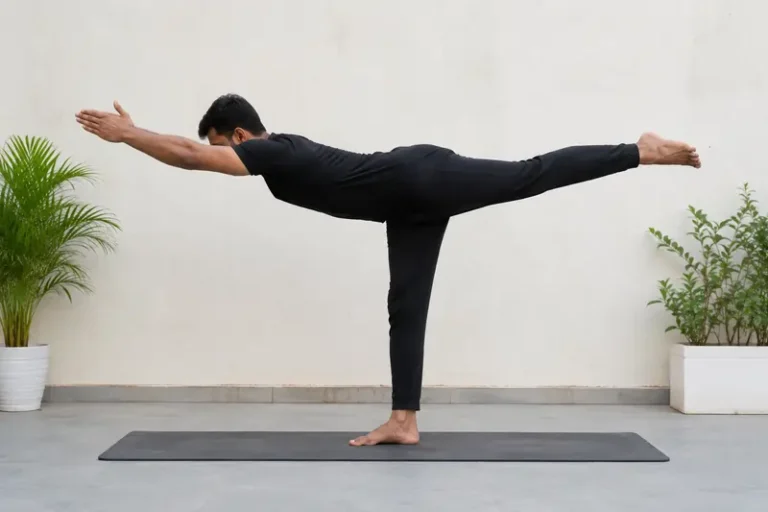
To begin, balance on one leg in Tree pose, stretch your raised leg backwards, half-bend your upper body forward, and form a T with your arms. Lastly, you will look up at the ceiling while holding the pose and keeping your body in a side stretch.
This pose is ideal for increasing flexibility in your legs and spine and strengthening your core.
Overview & Etymology
Half Moon Pose is another term for Ardha Chandrasana. This modern intermediate Hatha yoga pose is perfect for strengthening your spine, legs, and ankles.
Start by half-bending your upper body forward, stretching your elevated leg backwards, and forming a T with your arms while balancing on one leg in Tree pose. Finally, you will maintain the stance and keep your body in a side stretch while gazing up at the ceiling.
This pose is ideal for increasing flexibility in your legs and spine and strengthening your core.
According to Hindu mythology, “Chandra” was a demigod and the ruler of “Chandralok,” or “moon land.” He was linked to Lord Shiva as a brother-in-law and married the daughters of “Daksha,” the first human.
It is also said that after Lord Shiva ingested poison from the “Samudra Manthan” churning of the ocean, Lord Chandra assisted him in cooling down. In Hatha yoga, the half moon posture is a symbol of balance, wisdom, calm, and patience.
Additionally, the phases of the moon are strongly linked to menstruation and feminine energy in Hindu mythology. Ayurveda states that a woman’s menstrual cycle in harmony with the moon’s cycles is a sign of a healthy cycle.
- Sanskrit Name: अर्धचन्द्रासन
- Pronunciation: Ur-duh CHUN-draa-suh-nuh
- Pose Type: Standing Balance
- Also known as: Half-Moon Pose
- Strengthens: Spine, Hamstrings, Knees, Core, and Glutes
- Stretches: Spine, Shoulders, Hamstrings, Throat, Calves, and Glutes
Health Benefits of Ardha Chandrasana
- Lengthens the spine.
- Improves body posture.
- Increases leg and core strength.
- Enhances flexibility in the hamstrings.
- Reduces tension, stress, and anxiety.
- Increases mind and muscle coordination.
- Strengthens the musculoskeletal system.
- Increases focus and balance in the body.
- Stretches the pelvis and activates tight glutes.
- Activates the Sacral and Root Chakras.
- Improves blood circulation in the legs, back, and ankles.
When to Avoid Performing Ardha Chandrasana
- Avoid if you are pregnant.
- Avoid if you are menstruating.
- Avoid if you have chronic back pain.
- Avoid if you have inflammatory knee arthritis.
- If you’ve had surgery or an injury recently, stay away.
- Steer clear if it’s difficult to move in time with your breath.
How to do Ardha Chandrasana (Half Moon Pose)
The Half Moon stance can be difficult for some people, while it’s easy for others.
We’ve divided the primary practice into four crucial components to make it easy for everyone.
Part 1 – Preparatory Poses for Ardha Chandrasana
It’s a good idea to work your inner thighs, hamstrings, ankles, obliques, and core muscles before attempting the Half Moon position. This is how:
Utthita Trikonasana (Extended Triangle Pose):
- Maintaining a minimum four-foot spacing between both feet, step your right foot to a 90-degree angle. Maintain a 45-degree angle with your left foot facing the same direction as your right.
Take a breath, then bend over your right leg from your right hip joint. Stretch your left arm straight up to the ceiling while holding your right big toe with your fingers.
For five minutes, maintain this stance on each side. Keep your eyes on your outstretched upper arm while you feel your ankles, back, and chest muscles contract.
Parsvottanasana (Intense Side Stretch Pose):
- As you did for Triangle Pose, begin by stepping wide open to the side. To create a reverse namaste position, take a breath, rotate your shoulder internally, and bring both arms behind you.
Inhale and begin to bend your torso forward onto your extended leg once you are comfortable with your arms at your back
Feel your obliques, shoulders, tailbone, glutes, and hamstrings contract as you release the breath and place your head on your leg. Repeat the same on the other side. Inhale and begin to bend your torso forward onto your extended leg once you are comfortable with your arms at your back.
Feel your obliques, shoulders, tailbone, glutes, and hamstrings contract as you release the breath and place your head on your leg. On the opposite side, do the same.
Part 2: Step-by-Step Instructions to Perform Ardha Chandrasana
The Half Moon position can be practised by following these steps:
- Step 1: Begin in the Extended Side Angle or Parsvakonasana pose. Hold for four or five breaths.
- Step 2: Next, extend your leg behind you and move one of your hands back into alignment. Reach out with your other hand and touch the tip of your finger on the mat at the same moment.
- Step 3: Take a deep breath, get ready to balance, release it, and stand on your front leg.
- Step 4: Lift your back leg and flex your foot sideways so that it aligns with the side of your mat.
- Step 5: Plant your balance foot firmly on the mat, contract your quadriceps and core, and extend your foundational leg until your hamstrings and glutes are well stretched.
- Step 6: Make sure your fingertips on the mat are in line with your shoulder and that your arm remains in line with your elevated leg behind you. For a few breaths, maintain this position.
- Step 7: Make a sideways “T” form with your arms by looking down, taking a breath, and raising your upper arm toward the sky in alignment with your straight arm on the ground.
- Step 8: If you feel powerful while maintaining balance in this pose, push yourself by looking from the mat to the side fingertips of your raised arm.
- Step 9: Hold the Half Moon balance stance while continuing to inhale and exhale. Relax in Uttanasana after releasing yourself by going back to Parsvakonasana.
Part 3: Things to Keep in Mind
Use these posture clues to execute the Half Moon pose safely and smoothly:
Avoid rounding your spine. If you hunch down in Half Moon stance, you risk tripping and falling. Make sure to extend your spine forward, focus on the tips of your fingers for a few seconds, and then slowly move your eyes to your outstretched fingers above you.
Maintain alignment between your hips and leg: As you lift your extended leg into the air, look in the mirror to see how it lines up with your glutes. You are overextending and may experience lower back soreness after practice if your leg is elevated over the level of your glute muscle. For optimal effects, maintain a straight alignment between your lifted leg and your glute muscle.
Part 4: Relaxing Poses After Ardha Chandrasana
To release any remaining tension in your back, legs, core, and spine, try the following poses:
Uttanasana (Standing Forward Bend)
- With the inner edges of your feet together, begin in mountain pose. Place your feet hip-width apart and place both hands on your waist. Take a breath, raise and lower your shoulders, and begin to bend forward.
As you bend forward, maintain an active core and glutes. Keep your hamstrings from being overextended as you fully bend forward and press your face into your knees.
Hold this position for five to ten deep breaths until your spine, shoulders, and legs are relaxed and comfortable.
Prasarita Padottanasana (Wide-Legged Standing Forward Bend)
- This Extended Wide-Leg Forward Bend will release any remaining tension in your ankles, neck, inner thighs, and spine.
With your hands on your waist and your toes parallel to one another, assume a wide-legged position. Breathe in and softly bend your neck backwards to extend your spine. Your back and chest muscles will begin to open up.
Breathe out now as you bend forward and align your chest with the floor. When you get to the ground, put your hands between your legs and look through them to fully relax your neck.
For five to ten deep breaths, hold this position.
Breath Awareness:
- Inhale: Just before entering the posture, while using your leg and core muscles.
- Breathe out as you lift your extended leg behind you.
- Holding the position on one leg, inhale and exhale.
- Beginners should perform Ardha Chandrasana for 15 to 30 seconds on each side.
- Advanced Performance Time: Perform Ardha Chandrasana for 30 to 90 seconds on each side.
Key Principles
A vertical line should be formed from the floor to the hip by the standing foot, lower hand (or block), and extended hip. The chest completely turns to face the side wall rather than the ground. The heel is actively reached by the outstretched leg. Until the balance is established, it is highly advised to use a block beneath the lower hand.
Common Mistakes
- Locking the standing knee
- Allowing the lifted leg to drop too low
- Rotating the body too aggressively
- Putting excessive weight on the supporting hand
- Holding the breath
- Trying to look upward before establishing balance
Ardha Chandrasana Variations to Consider
Depending on where you are in your yoga journey, select a Half Moon position variation that you would like to try:
Half Moon Pose on Floor Variation
- This version is intended for novices who are still honing their core strength. Put yourself in a tabletop position, lift your right leg straight off the mat, and slightly contract your core.
Next, lift your right arm off the mat, turn your chest up, and reach straight up to the ceiling. To make a sideways “T,” make sure both arms are in line.
After a few minutes of holding this pose on each side, gradually strengthen your core for the major pose.
Ardha Chandra Chapasana (Sugarcane Pose)
- To do this variant, begin by extending your raised leg straight to the ceiling while in the standard Half Moon stance. As much as you can, try to straighten your elevated leg.
Next, extend the muscles in your chest and turn your upper body such that your arms form a sideways “T.” Look at your upper arm, bend your outstretched leg, and grasp your foot with your hands at the point where your shin and foot connect.
Work on your back, core, and legs simultaneously by holding this semi-standing Bow pose-like structure for a few seconds on each side.
Parivrtta Ardha Chandrasana (Revolved Half Moon Pose)
- Because you will be balancing on alternate arms and legs, this posture is referred to as a difficult variation.
With your right arm raised in the air in a “T” shape and your left arm touching the floor, balance on your right foot and extend your left leg parallel to the ground. This is the version of the Revolved Half Moon.
FAQs
What is Ardha Chandrasana good for?
Ardha Chandrasana is good for improving postural imbalance. It improves your lower body’s flexibility and strength while strengthening your legs and core muscles.
Can beginners perform Ardha Chandrasana?
Ardha Chandrasana is a standing balance pose that demands a great deal of stability, core strength, and awareness to perform. Before beginning Ardha Chandrasana, beginners should focus, strengthen their core, and stabilise their leg muscles.
Which yoga poses can help prepare the body for Ardha Chandrasana?
Some great poses to prepare for Ardha Chandrasana include Triangle Pose, Sun Salutation, Warrior Pose, and Intense Side Stretch Pose. Your knees, spine, ankles, calves, inner thighs, hamstrings, and obliques will all be activated by each of these poses.
What are the benefits of Ardha Chandrasana?
The benefits of Ardha Chandrasana are:
It improves core balance.
It enhances leg muscle strength.
helps to ease the symptoms of mild back or neck pain.
Both the small and large intestines perform better as a result.
It lengthens the spine, engages the glutes, and opens the chest.
What are the different variations in Ardha Chandrasana?
Variations of Ardha Chandrasana include Bound Revolved Half Moon Pose, Sugarcane Pose, Assisted Half Moon Pose on the Floor, and Revolved Half Moon Pose.
What is Parivrtta Ardha Chandrasana?
An intermediate form of the main Ardha Chandrasana stance is called Parivrtta Ardha Chandrasana, or Revolved Half Moon stance.
The Parivrtta Ardha Chandrasana involves balancing your upper body on one leg, twisting your torso to the side, and looking up.
References
- Allen, W. (2025a, August 26). Ardha Chandrasana. https://myyogateacher.com/yoga-asana/ardha-chandrasana
- Zehra, S. (2026b, August 11). Ardha Chandrasana (Half Moon Pose): Steps, Benefits & Precautions. Habuild Blogs. https://habuild.in/habitology/asana-mudra/ardha-chandrasana/
- Yoga Journal. (2025i, February 25). Half moon pose. https://www.yogajournal.com/poses/half-moon-pose-3/
One Comment