Utthita Hasta Padangusthasana (Extended Hand-to-Big-Toe Pose)
What is Utthita Padangusthasana?
Extended Hand-to-Big-Toe Pose, or Utthita Hasta Padangusthasana, is a standing balance pose that integrates strength, flexibility, and concentration. In Hatha, Vinyasa, and Ashtanga yoga, this pose—pronounced oo-TEE-tah HAH-stah pah-dahn-goo-STAH-suh-nuh—is frequently used to enhance balance, stretch the hamstrings, and strengthen the legs and core.
Overview and Meaning
Utthita Hasta Padangusthasana, which is derived from the Sanskrit terms utthita (extended), hasta (hand), pada (foot), angustha (big toe), and asana (position), is translated as Extended Hand-to-Big-Toe position. The primary movement of the pose—holding the big toe while extending the raised leg—is reflected in the name. In actual practice, the posture is typically approached gradually, starting with a bent knee, moving the leg forward, and finally opening it to the side.
Utthita Hasta Padangusthasana is regarded as a contemporary yoga pose that gained popularity due to 20th-century teaching methods. It was popularized by instructors like Krishnamacharya and his pupils, such as B.K.S. Iyengar and Pattabhi Jois, after being influenced by physical culture and then transformed into yoga. It is currently widely used in Hatha, Vinyasa, and Ashtanga yoga as a standing balancing pose that improves strength, flexibility, and focus.
From an anatomical perspective, this pose is a single-leg balancing pose that calls for complete body synchronization. The standing leg builds strength and stability, while the lifted leg works the hamstrings and hip flexors. The spine stays long to prevent collapse, while the core keeps the torso erect. Side-opening variations put additional strain on the inner thighs and hips, combining control, mobility, and balance.
At a Glance
- Sanskrit Name: उत्थित हस्त पादाङ्गुष्ठासन
- Oo-TEE-tah HAH-stah pah-dahn-goo-STAH-suh-nuh is the pronunciation.
- Extended Hand-to-Big-Toe Pose is its English name.
- Pose Types: Hip opener, hamstring stretch, and standing balance
- Level: Intermediate to Advanced
- Duration: 20–60 seconds per side
- Ideal Time: In the middle of a practice when the body is warm.
- Principal Advantages: enhances balance, opens the hips, strengthens the standing leg, stretches the hamstrings, increases focus, and stabilizes the core.
- Chakras: Root (Muladhara), Sacral (Svadhisthana)
- Props Needed: Yoga strap, wall, optional block
Benefits of Utthita Hasta Padangusthasana
Utthita Hasta Padangusthasana is a dynamic standing balance exercise that simultaneously increases focus, strength, and flexibility. It teaches the body to remain stable under pressure by extending one leg while grounding via the other.
Physical Benefits
The legs, hips, core, and spine are all worked together in this pose.
- Enhances stability and balance by strengthening the hip, ankle, and foot stabilizers and increasing general coordination.
- Increases flexibility and stretches the hamstrings: Particularly in the forward version, the elevated leg is deeply stretched.
- Strengthens the legs and core: The standing leg builds strength while the core sustains the pelvis and spine.
- Opens the inner thighs and hips: The side version improves hip and groin mobility.
- Enhances body control and posture: Maintaining an upright spine helps with alignment and full-body coordination.
Mental and Emotional Benefits
Balance poses naturally build focus and awareness.
- Enhances focus: It requires constant focus and a fixed stare (drishti).
- Increases stability and self-assurance: Improving your balance increases your faith in your body.
- Encourages persistent effort and the ability to get back up after losing one’s balance, which strengthens resilience and patience.
- Promotes awareness of the present moment: Aids in focusing attention entirely on the body and breath.
Energetic and Holistic Benefits
This position symbolizes grounding with controlled expansion in classical yoga.
- Supports stability and grounding: The standing leg establishes a solid, firm platform.
- Promotes openness and mobility: Through the hips, the raised leg fosters freedom.
- Strengthens one-pointed concentration and fosters focused awareness, or dharana.
- Develops inner steadiness: Mental clarity and serenity are supported by physical balance.
- This posture should be done carefully if you have ankle instability, hamstring issues, or hip limitations because it requires balance and hamstring flexibility.
Do you want professional assistance to increase your flexibility and balance? Make an appointment for a complimentary one-on-one practice with a qualified Indian yoga instructor right now.
How can you practice Utthita Hasta Padangusthasana (Extended Hand-to-Big-Toe Pose) correctly? A step-by-step guide
You may practice Utthita Hasta Padangusthasana with improved balance, control, and alignment by following this step-by-step guide. The objective is to remain steady, upright, and aware of your breath rather than to raise the leg as high as you can.
Part 1: Preparing for the Pose
If your hamstrings are tight, keep a strap close by for comfortable practice, and if your balance is difficult, utilize a wall for support. A quick warm-up that includes hamstring stretches and standing balancing will help prime the body and increase stability.
Part 2: Step-by-Step Instructions
- With both feet firmly planted and your spine elevated, begin in Tadasana (Mountain Pose). Keep your eyes fixed on a fixed location.
- Place more weight on your left foot. Maintain a raised chest while using the standing leg.
- Draw your right knee toward your chest while bending it. To find your balance, pause here.
- Use a strap around the foot or your fingers to grasp the big toe.
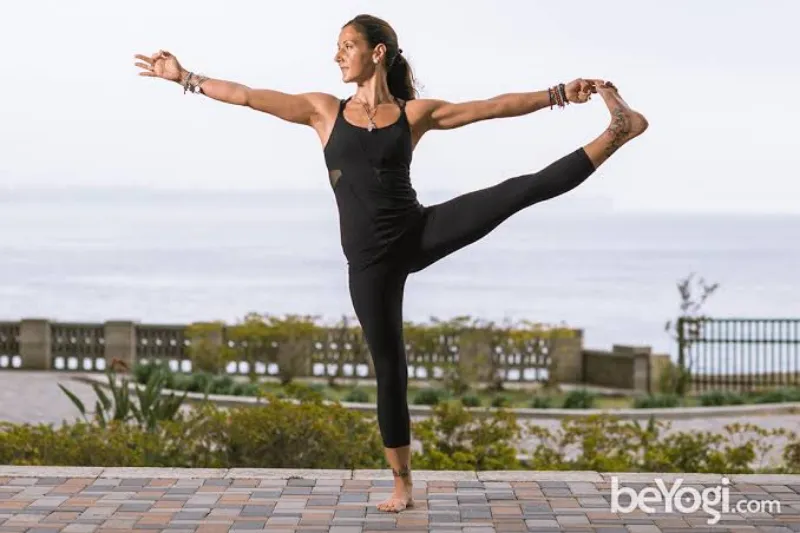
- While maintaining an erect posture, extend your right leg as far forward as you can during an inhale. This is Utthita Hasta Padangusthasana A.
- Use your left hand on your hip or stretch it laterally for balance. For a few breaths, hold.
- For the side version, maintain an upright body while gradually extending the leg to the side. For balance, extend the opposing arm. This is Utthita Hasta Padangusthasana B. Return to Tadasana after bringing the leg back to the center and bending the knee. Continue on the opposite side.
- Hold for:
- Beginners: 15–30 seconds
- Intermediate: 30–45 seconds
- Advanced: 45–60 seconds
Common Mistakes and Alignment Tips
- Lower back strain occurs when the spine is rounded to reach the foot.
- Advice: Keep your torso upright and use a strap.
- Standing knee locking: Decreases stability
- Advice: Maintain a slightly soft, active leg.
- Excessive backward leaning: Disturbs alignment
- Advice: Put your posture first rather than your leg height.
- Balance is impacted when the lifted leg’s hip is raised.
- Advice: Maintain level and controlled hips
- Straightening the leg may cause hamstring strain.
- Utthita Hasta Padangusthasana is a potent position for improving balance, flexibility, and mental focus when done patiently and with the right support.
Utthita Hasta Padangusthasana Variations
You can modify Utthita Hasta Padangusthasana in a variety of ways based on your hip mobility, hamstring flexibility, and balance. The safest course of action for the majority of practitioners is to progressively build the position with assistance before attempting the full expression.
Beginner Modifications
Utthita Hasta Padangusthasana With a Yoga Strap
- Helps you straighten the raised leg without losing your balance or rounding your spine.
- Wrap a strap around the raised foot’s ball.
- Use the same-side hand to hold the strap.
- Maintain an erect spine and a stable standing leg.
- Only extend your leg as far as you can without losing control.
Bent-Knee Variation
- Enhances core control and balance without demanding complete hamstring flexibility.
- Shift your weight to one foot while standing in Tadasana.
- Bring the opposing knee up to the chest.
- Hold the knee or shin rather than the toe.
- Remain straight and take steady breaths.
Wall Support
- Lessens the difficulty of balance so you may concentrate on leg motion and alignment.
- Place your free hand lightly on a wall while standing next to it.
- Put weight on the leg that is standing.
- With or without a strap, raise and extend the leg on the other side.
- As you balance, work on maintaining a tall spine.
Intermediate Variations
Utthita Hasta Padangusthasana A
- Increases core stability, hamstring flexibility, and balance when the leg is extended forward.
- Raise the opposing knee while standing on one leg.
- Hold a strap or the big toe.
- Maintaining an upright torso, extend the leg forward.
- Hold your gaze steadily for a few breaths.
Utthita Hasta Padangusthasana B
- Deepens the balance challenge and adds hip opening and inner-thigh stretch.
- Start variant A by extending your leg forward.
- Extend the raised leg slowly to the side.
- To counterbalance, extend the opposing arm outward.
- Maintain a raised chest and a powerful standing leg.
Advanced Variations
Parivrtta Utthita Hasta Padangusthasana
- Integrates spine rotation, hamstring flexibility, and balance into a single advanced posture.
- Stretch the other leg forward while standing on one leg.
- Reach the foot or strap that is raised with the other hand.
- Turn your body to face the raised leg.
- With a steady breath, extend the free arm back and hold.
Baddha Utthita Hasta Padangusthasana
- strengthens the hamstrings and shoulders with a bound variation behind the torso:
- Stabilize the standing leg while extending the raised leg.
- If you have the arm, wrap it around or behind the foot to bind it.
- Maintain an open chest and a tall back.
- Hold as long as the stance doesn’t hurt and stays steady.
Supta Utthita Hasta Padangusthasana
- Eliminates the issue of balance, allowing you to focus more intently on leg motion and flexibility.
- Stretch one leg out on the ground while lying on your back.
- Hold the foot or strap while lifting the other leg.
- Straighten the raised leg either a little forward or toward the ceiling.
- Maintain a long waist on both sides and grounded shoulders.
Props and Accessibility
- If you have tight hamstrings, start with a yoga strap.
- Until balancing feels more secure, practice next to a wall.
- If the leg rounds the spine when it is straightened, keep the raised knee bent.
- For a supported version, place a chair or block beneath the elevated foot.
- Before proceeding to version B, work with variation A.
- For later practice stages, save the bound and rotated versions.
- While you are still developing the balance and flexibility needed for the full posture, these variants make the Extended Hand-to-Big-Toe posture considerably safer and more attainable.
Utthita Hasta Padangusthasana Precautions & Contraindications
The difficult standing balance pose Utthita Hasta Padangusthasana incorporates hip opening, hamstring stretching, and single-leg stability. The position should be approached gradually and never forced because it requires both balance and flexibility at the same time.
Avoid Utthita Hasta Padangusthasana If You Have
- Acute knee or ankle damage
- Severe strain or recent hamstring tear
- Severe vertigo or balance problems
- Recent ankle, knee, or hip surgery
- Sciatica or severe lower back pain that gets worse when you elevate your legs
- Any circumstance that renders unsupported single-leg balancing dangerous
Practice With Caution and Modifications
- Tight hamstrings: If necessary, keep the knee bent and start using a strap. Avoid making the leg straight.
- Balance challenges: Until the standing leg feels more comfortable, practice with one hand on a stable surface or at the wall.
- Lower-back sensitivity: To compensate for restricted hamstring flexibility, maintain an upright posture, use your core, and refrain from bending backward.
- For persistent ankle instability, use wall support and concentrate more on strengthening your standing legs than your height.
- Hypermobility: Maintain a flexible and supple standing knee. Just because the range is available doesn’t mean you should hang in the joints.
- During pregnancy, prevent overstretching, use wall support, and put comfort and balance over depth.
General Safety Guidelines
- Prior to practice, fully warm up.
- If reaching the toe throws off your posture, use a strap.
- Maintain an active but unlocked standing knee.
- Keep your spine upright.
- When learning, practice next to a wall.
- Throughout, breathe steadily.
- If you experience severe pain or lose control, lower the leg right away.
When to Consult a Healthcare Provider
Prior to practice, see a medical expert if you have:
- A recent or ongoing hamstring injury
- Hip, knee, or ankle instability
- Dizziness or severe balance problems
- Persistent lower back discomfort
- Pregnancy-related pain or changes in balance
- History of fractures or falls
Progressing Safely
A steady progression often looks like this:
- Start with wall-supported standing versions of Supta Padangusthasana.
- Practice with a bent knee and a strap.
- Prior to attempting variant B, have confidence in variation A.
- Only when the standing leg, core, and breath remain steady can you explore higher forms.
- Respecting the process makes this posture safer and more successful. Repetition, support, and patience are the best ways to increase balance and flexibility rather than pushing the complete shape too quickly.
- Schedule a free one-on-one session right now to maximize your practice!
Related Yoga Poses
By enhancing balance, hip stability, and hamstring flexibility, these poses enhance Utthita Hasta Padangusthasana.
Warrior III (Virabhadrasana III)
- Strengthens the standing leg and core, resulting in good balance and full-body stability.
- To begin, stand up and shift your weight to one leg.
- Raise the back leg while bending forward at the hips.
- From head to heel, maintain a straight body.
- You can either keep your hands on your hips or extend your arms forward.
- Stay calm and take a breath.
Half Moon Pose (Ardha Chandrasana)
- Enhances balance, broadens the hips, and fortifies the standing leg.
- Start in Triangle Pose or a standing stance.
- Put one hand on a block or the floor.
- Raising the back leg parallel to the floor is the goal.
- Stack the hips and open your chest.
- Raise the upper arm and grasp it.
Standing Splits (Urdhva Prasarita Eka Padasana)
- Increases hamstring flexibility while testing control and balance.
- Start by folding forward.
- Put your weight on one foot.
- Behind you, raise the opposing leg.
- Maintain a firm and grounded standing leg.
- While keeping your balance, fold forward.
FAQs
What are the benefits of Utthita Hasta Padangusthasana?
Stretching the hamstrings, opening the hips, strengthening the standing leg, developing core stability, and sharpening focus are all benefits of this pose. Additionally, it helps with body awareness and gets the body ready for more difficult standing balances.
Can beginners do Utthita Hasta Padangusthasana?
With little adjustments, beginners can move toward the posture. The position can be made considerably more accessible while developing the strength and flexibility required for the full version by using a strap, bent knee, wall support, or even putting the foot on a chair.
What variations of Utthita Hasta Padangusthasana are there?
A (leg front), B (leg sideways), rotated variations, bound versions, and supported or reclining forms like Supta Utthita Hasta Padangusthasana are typical variations. These variants assist practitioners in working on various combinations of control, flexibility, and balance.
What factors may prevent you from fully extending your leg while performing this yoga pose?
Tight hamstrings are the most typical cause. Additionally, many compensate by leaning back or rounding their spines, which weakens the pose. The easiest approach to advance safely is frequently to use a strap and maintain an erect body while keeping the leg bent.
How long should you hold Utthita Hasta Padangusthasana?
Intermediate practitioners can hold for 30–45 seconds, expert practitioners for 45–60 seconds, and beginners for 15–30 seconds on each side. Long hold times are typically less important than alignment quality and steadiness.
How do Utthita Hasta Padangusthasana and Supta Padangusthasana differ in their practice, technique, and benefits?
Supta Padangusthasana is done on the back, whereas Utthita Hasta Padangusthasana is a standing balance variation. The supine variation eliminates the difficulty with balance and is frequently used to get the hips and hamstrings ready for the standing pose.
References
- MyYogaTeacher. (2026e, June 3). Utthita padangusthasana. https://myyogateacher.com/yoga-asana/utthita-padangusthasana
- Zehra, S. (2026n, August 11). Utthita Hasta Padangusthasana (Extended Big Toe Pose): Steps, Benefits & Precautions. Habuild Blogs. https://habuild.in/habitology/asana-mudra/utthita-hasta-padangusthasana/
- Yoga Journal. (2025, March 14). Extended Hand-to-Big-Toe pose. https://www.yogajournal.com/poses/extended-hand-to-big-toe-pose/