Supta Padangusthasana (Reclining Hand to Big Toe Pose)
What is Supta Padangusthasana?
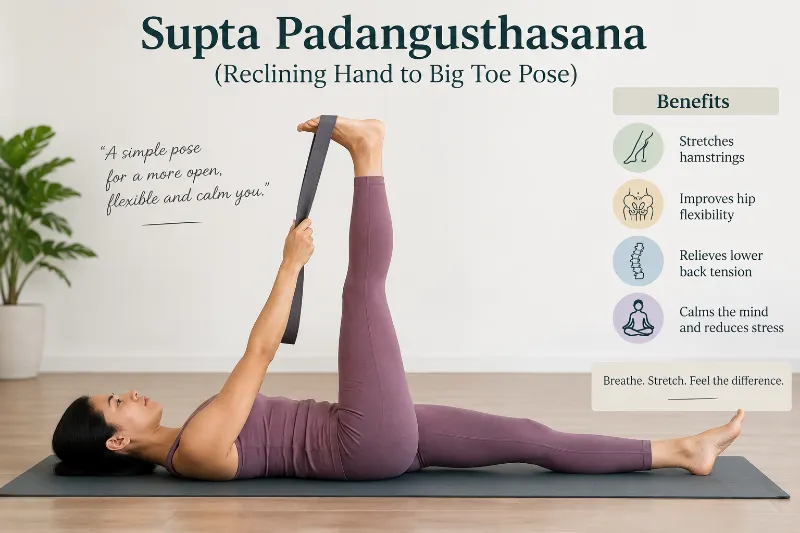
Supta Padangusthasana, also known as the Reclining Hand to Big Toe Pose, is a beginner-to-intermediate yoga pose that helps relax the neck, low back, and spine. The practitioner concentrates on opening and stretching the calf, gluteal, and hamstring muscles.
For those with tense leg and back muscles, this pose is a fantastic stretch. To sense awareness penetrating your entire body, begin by stretching one leg straight in the air, gripping the big toe with the fingers locked, and bringing the leg close to your forehead.
Overview & Etymology
A few Sanskrit terms are combined to form the name Supta Padangusthasana: “Supta” means “reclining,” “Pada” means “foot,” “Angustha” means “big toe,” and “Asana” means “posture.”
Since the Reclining Hand to Big Toe Pose is a contemporary yoga pose, no old Hatha yoga scriptures include a thorough description of this posture technique.
But because it was included in the main series of Ashtanga Vinyasa Yoga by K. Pattabhi Jois and K. Pattabhi Jois, it gained popularity during the 20th century.
- Sanskrit Name: सुप्त पादाङ्गुष्ठासन
- Pronunciation: SOOP-tah pahd-ahng-goosh-TAHS-uh-nuh
- Pose Type: Restorative Reclining Stretch
- Also known as: Supine Hand to Toe Pose
- Inner thighs, hip flexors, glutes, groin, hamstrings, and knees are strengthened.
- Stretches for the inner thighs, calves, glutes, groin, hip flexors, and hamstrings
Muscles Involved
Supta Padangusthasana primarily works and stretches the:
- Hamstrings
- Calf muscles
- Hip flexors
- Inner thighs (adductors)
- Quadriceps
- Core muscles
Health Benefits of Supta Padangusthasana
- Improves flexibility.
- Soothes sciatic pain.
- Aids in aligning the pelvis.
- Enhances reproductive health.
- Stretches the overall leg muscles.
- Improves digestive system function.
- Activates the root and sacral chakra.
- Reduces mild symptoms of back pain.
- Alleviates knee discomfort and mild arthritic symptoms.
- Makes the muscles in the arms, shoulders, and legs longer and stronger.
How to do Supta Padangusthasana (Reclining Hand to Big Toe Pose)
We have separated the Supta Padangusthasana practice into four simple sections. Warm-ups, basic posture techniques, alignment cues, and calming poses are some of them.
Let’s take a closer look at each segment:
Part 1 – Preparatory Poses for Supta Padangusthasana
To get ready for Supta Padangusthasana, warm up your back, hamstrings, pelvis, and glutes. The preparatory steps are as follows:
Apanasana Variation (Single-Leg Knees to Chest Pose)
- Bend one leg and pull the knee near to your chest while lying on the yoga mat on your back.
Put your arms over the knee, give them a firm hug, and lock your forearms by grasping the elbows on the other side.
This pose is perfect for gently stimulating blood flow to your lower back, pelvis, and inner thighs. For two to three minutes, hold this stance on both sides.
Sucirandhrasana (Eye the Needle Pose)
- Simply raise and bend your legs into the air while lying on your back. With the ankle of your right leg resting slightly below the knee of your left leg, cross it over the other.
As you begin to slowly draw the leg closer to your chest, grasp the muscles of your left thigh with your palms and interlock your fingers. Feel the deep stretching of your glute muscles as you draw the leg closer.
You should feel your glutes opening up after doing this on either side for a few minutes.
Part 2: Step-by-Step Instructions to Supta Padangusthasana
The reclining hand-to-big-toe pose can be practiced by following these steps:
- Step 1: Inhale deeply, release it, and then lie on your back. Here, contract your core muscles to make your navel strive to reach your tailbone.
- Step 2: Raise your right leg without bending or twisting it. Just keep your toes pointed and your raised leg straight.
- Step 3: Put the left arm in a straight resting position on the left side. Next, reach the toes of your right foot by extending your right arm overhead.
- Step 4: Take a breath, flex your leg straight, keep your left leg flat on the ground, and stabilize your pelvis.
- Step 5: Repeat the stance on the opposite side after holding it for ten to thirty seconds on each side.
Breath Awareness:
- Inhale while using your leg and core muscles.
- When you’re prepared to break the stance, exhale.
- Breathe in and out both before entering the pose and while maintaining the stretch for a long time.
- Beginner’s Performance Duration: Hold the big toe stance while reclining for 30 to 90 seconds on each side.
- Advanced Performance Time: Perform the big toe stance while reclining for two to five minutes on each side.
Part 3: Things to Keep in Mind
Remember these posture clues when performing Supta Padangusthasana:
- Engage your legs and core muscles: If you don’t fully extend your leg and engage the quad muscle, you won’t be able to feel any stretch in your glutes or back of your legs.
- Additionally, you won’t be able to raise and maintain the leg in the air for an extended period of time if your core is not properly engaged.
- Stabilize the lower leg: Use your left arm to support your lower leg if it begins to rise as you extend your right leg in the reclining hand-to-big-toe stance.
Make sure your left leg is not lifting off the mat when you place your left arm over your right front thigh..
Part 4: Relaxing Poses After Supta Padangusthasana
To reduce any stress in your lower back, pelvis, or legs, try these soothing poses:
Supta Baddha Konasana (Reclining Bound Angle Pose)
- Start by stepping your heels in the direction of your pelvis while resting on your back. Take a breath, then spread your knees till the bottoms of your feet make contact in Namaste.
Breathe out and lower your knees toward the floor. If you find this too strenuous, place yoga blocks under each knee and a bolster beneath your spine. Your lower body, pelvis, and spine can all be gently relaxed with this pose.
- The entire body will be restored with this stance. Maintain the Reclining Bound Angle Pose while spreading your legs straight on the mat and placing your hands sideways toward the ceiling.
Shut your eyes and concentrate on your breathing. As you take each breath, deliberately relax your entire body. Hold this stance for as long as it feels good.
Supta Padangusthasana Variations to Consider
Try these different postures if you wish to modify your Supta Padangusthasana practice:
Supta Padangusthasana Extension With Bent Leg:
- We have a solution if you have persistent problems with your inactive leg lifting.
Just put the foot near your pelvis and bend the inactive leg. By doing this, you’ll be able to stabilize and prevent the opposite leg from lifting excessively.
Additionally, this position is ideal for novices because it lessens the intensity of the leg stretch.
Supta Padangusthasana Holding the Hamstring:
- Straighten the inactive leg and place it on the ground to further challenge your lower body.
However, grasp the thighs of the active leg rather than the toes with your palms. For novices who first struggle to hold their feet with their palms, this pose variant is great.
After two to three minutes of holding this variation on each side, move your hands upward and closer to the foot as you get more flexible.
Supta Padangusthasana on the Side:
- Try this more difficult variation once you feel strong enough to execute the Supta Padangusthasana with your legs straight in the air.
In the straight-leg Supta Padangusthasana stance, take four to five deep breaths, release them, and then rotate the active leg out to the side.
While keeping the other leg and core firmly planted on the mat, place the active leg on the side.
Precautions
Don’t pull hard on the big toe or push the leg upward. Individuals who have recently had a hamstring, hip, lower back, or knee injury should only practice under qualified medical supervision. Rather than grabbing for the toe, you can use a yoga strap.
Common Mistakes
- Lifting the opposite leg off the floor
- Rounding or straining the lower back
- Pulling the raised leg too aggressively
- Locking the knee
- Holding the breath
- Turning the hips rather than maintaining their stability
When to Avoid Performing Supta Padangusthasana
- Avoid post-cesarean delivery.
- Avoid during shoulder or knee joint injury.
- Avoid if lying down on the back is painful.
- Steer clear of injuries to the hamstrings, quadriceps, or glutes.
Preparatory Poses
You can prepare with:
- Supta Pavanamuktasana (Wind-Relieving Pose)
- Ananda Balasana (Happy Baby Pose)
- Adho Mukha Svanasana (Downward-Facing Dog)
- Gentle hamstring stretches
FAQs
What is Supta Padangusthasana good for?
Supta Padangusthasana improves blood circulation in the legs, opens the glutes for deep hip-opening postures, and increases lower body flexibility.
Can beginners perform Supta Padangusthasana?
Supta Padangusthasana is a yoga pose suitable for beginners and intermediates. Therefore, a beginner may do this pose effectively, but before beginning the main posture, be sure to warm up your lower body.
What are the different preparatory poses in Supta Padangusthasana?
A variety of preparatory poses, including the Baby Cradle pose, Eye of the Needle pose, and Knees to Chest pose with single-leg variation, are utilized to stimulate your lower body and stretch your tight glutes before performing Supta Padangusthasana.
What are the benefits of Supta Padangusthasana?
The Supta Padangusthasana has the following important health benefits:
Stretches the spine.
Boosts abdominal organ health.
Increases overall blood circulation.
Relieves mild lower back pain symptoms.
Increases lower body flexibility and strength.
What are the different variations in Supta Padangusthasana pose?
Try variants such as Supta Padangusthasana grasping the hamstring or Supta Padangusthasana extension with a bowed leg to ease your primary practice.
On the other hand, try the advanced version of Supta Padangusthasana, which involves stretching your leg on the side, if you feel even stronger.
What is Supta Hasta Padangusthasana?
Supta Padangusthasana is also known as Supta Hasta Padangusthasana. Thus, in English, both of them are called Reclining Hand to Big Toe Pose.
References
- Allen, W. (2025r, August 26). Supta Padangusthasana. https://myyogateacher.com/yoga-asana/supta-padangusthasana
- Yoga Journal. (2025, March 21). Reclining Hand-to-Big-Toe pose i. https://www.yogajournal.com/poses/reclining-big-toe-pose/