Ardha Uttanasana (Half Forward Fold)
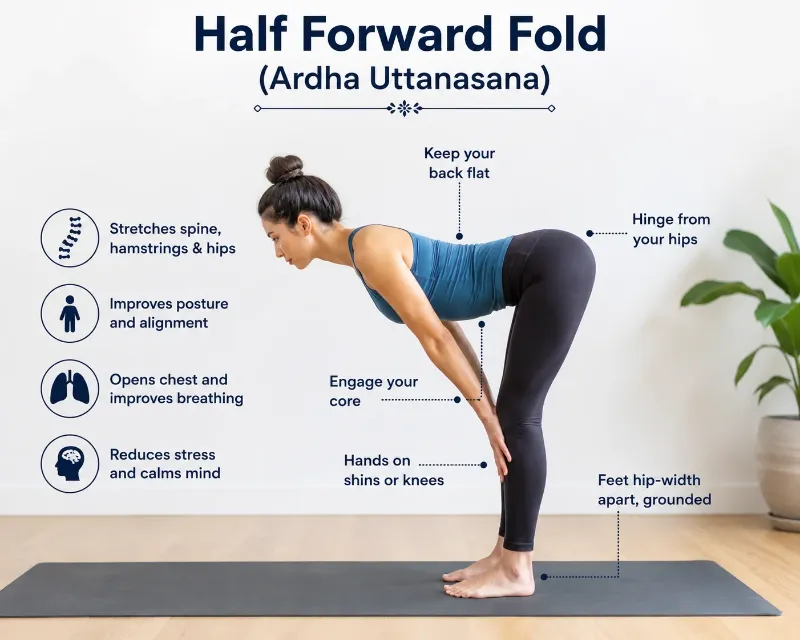
The half forward fold, also known as Ardha Uttanasana, develops the hip-hinge movement pattern necessary for safe yoga and all daily bending, strengthens the spinal extensors, and offers a dynamic hamstring stretch. It is an important transitional pose in Surya Namaskara that merits careful consideration as a stand-alone therapeutic pose. Appropriate for all levels of fitness.
What is Ardha Uttanasana?
The Sanskrit terms ‘Ardha’ (half), ‘Ut’ (intense), ‘Tan’ (to stretch), and ‘Asana’ (posture) are the starting points of Ardha Uttanasana, often known in English as Half Forward Fold, Half Standing Forward Bend, or Standing Half Lift. With the back flat, the spine parallel to the floor, and the hands, shins, or blocks on the ground, the body rises to the halfway point of the full forward fold. With the back flat, the spine parallel to the floor, and the hands, shins, or blocks on the ground, the body rises to the halfway point of the full forward fold.
Every round of Surya Namaskara includes Ardha Uttanasana, one of the most popular yoga poses. Notwithstanding its transitional function, it improves the hip-hinge movement pattern, actively strengthens the spinal extensors, offers a load-bearing hamstring stretch, and increases the postural awareness that separates a safe yoga practice from one that builds up disk stress.
Every Surya Namaskara session at Habuild includes explicit instruction in hip-hinge mechanics, spinal neutrality, and active back-extensor engagement, giving Ardha Uttanasana the same meticulous alignment training as any single pose.
Muscles Work During Ardha Uttanasana:
- Middle Back Muscles
- Hamstring Muscle
Preparatory Pose:
- Balasana (Child Pose)
- Dandasana (Staff Pose)
- Ardha Bhekasana (Half Frog Pose)
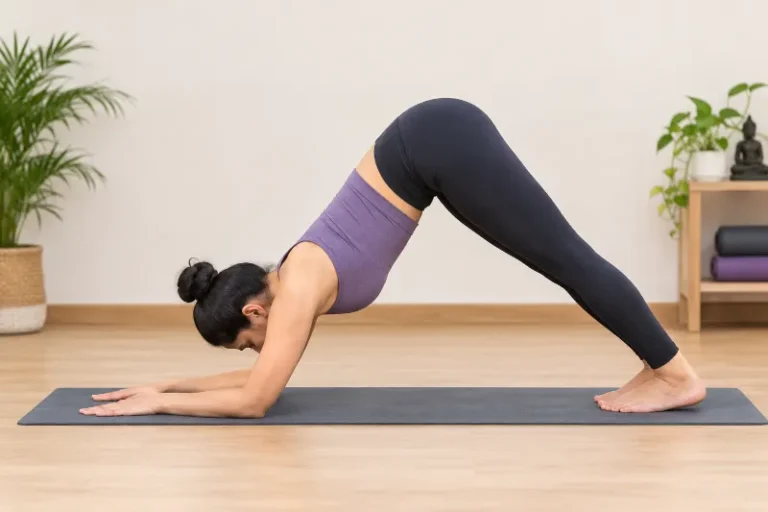
- Adho Mukha Savasana (Downward Facing Dog Pose)
Benefits
Physical Benefits
Strengthens the Spinal Extensors and Prevents Back Pain
The erector spinae, multifidus, and thoracic extensors must be continuously engaged against gravity to actively maintain a flat, horizontal spine. This builds the posterior chain strength, which is the principal defence against long-term lower back problems.
Provides an Active Hamstring Stretch
In contrast to the full forward fold’s passive hamstring stretch, Ardha Uttanasana offers an active hamstring stretch in which the back extensors concurrently work to maintain position while the hamstrings elongate under gravity strain. This results in longer-lasting and more useful flexibility gains.
Develops Hip-Hinge Movement Pattern
The fundamental movement pattern of safe yoga and daily movement is the hip hinge required by Ardha Uttanasana, which involves folding and rising from the hip joint rather than the lumbar vertebrae.
Stimulates Digestive Organs
The abdominal extension and shift in intra-abdominal pressure stimulate the digestive organs and promote mesenteric circulation within the Surya Namaskara sequence.
Mental Benefits
Develops Mindful Transition Awareness
Ardha Uttanasana is the most commonly practised mindlessly. The entire Surya Namaskara is transformed from mechanical movement into true movement by paying intentional attention to the pose—feeling the spine stretch, the hamstrings contract, and the breath flow.
How to Do Ardha Uttanasana — Step-by-Step
Key Principles
Key Principles: Three principles: hinge from the hips, not the waist; maintain spinal neutrality – neither hyperextended nor rounded, but parallel to the floor; and actively activate the back extensors –This is an active back-strengthening posture rather than a passive hinge.
Step 1: Begin in Uttanasana
Start in Uttanasana (full forward fold), knees bent as necessary, hands on the floor or shins. This is where the half lift will begin.
Step 2: Inhale and Lift the Torso Halfway
Press your fingertips into the ground as you inhale, then raise your torso halfway, bringing your spine closer to the floor.
Step 3: Hands to Floor, Shins, or Blocks
Put the fingertips on blocks, the shins, or the floor next to the feet, depending on the height that permits a truly flat back. To get to the floor, never compromise your spinal neutrality.
Step 4: Retract the Shoulder Blades
To open the chest forward and widen the collarbones, draw the shoulder blades downward and nearer one another. The eyes are fixed on the ground just ahead of the feet.
Step 5: Engage the Quadriceps
To protect the knees and intensify the active hamstring stretch, actively contract the quadriceps; the standing leg should feel powerful and active rather than inert.
Step 6: Hold or Transition
Hold for 2–5 breath cycles for standalone practice. Use it as the intentional inhale transition for Surya Namaskara, then release it to step back into a lunge or fold back into Uttanasana.
Breathing
In Surya Namaskara, Ardha Uttanasana is always an inhalation pose since the pose calls for the expansion of the chest and stretching of the spine that the inhale produces. When practising alone, inhale into your back body, causing your posterior ribs to expand.
Preparatory Poses
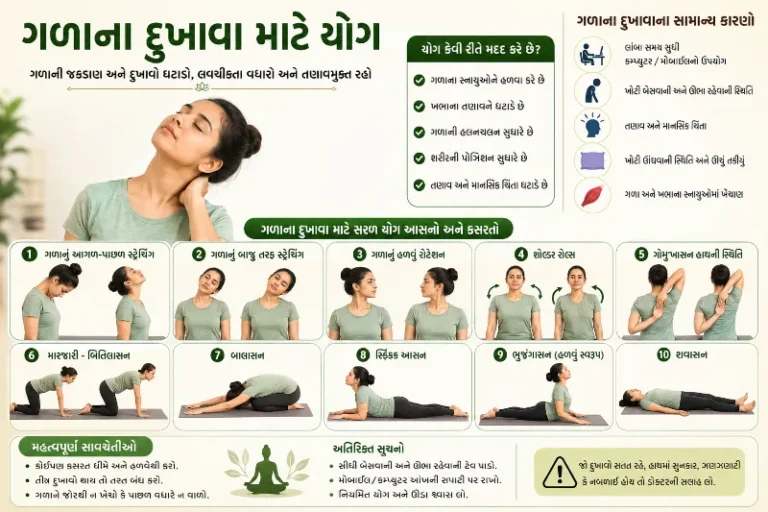
The Cat-Cow pose, Marjariasana-Bitilasana, warms the spinal extensors and creates awareness of spinal neutrality.
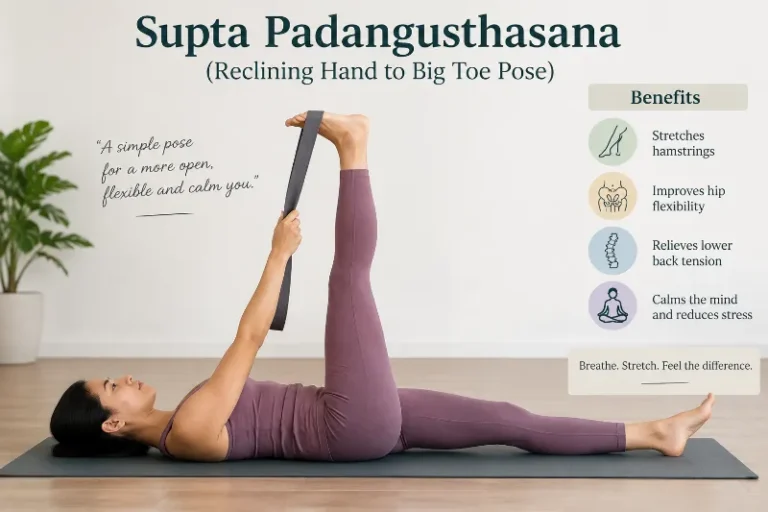
Bridge Pose, or Setu Bandhasana, activates the posterior chain in the supine position prior to the standing requirement.
Variations
Variation 1: Hands on Shins — Beginner
The back can stay flat for practitioners with tight hamstrings if they place their hands on their shins instead of the floor. The goal is always to have a flat back.
Variation 2: Fingertips on Blocks — Standard Modification
No matter how flexible your hamstrings are, you can perform a flat-back Ardha Uttanasana by raising the floor to meet your hands with blocks at the right height.
Variation 3: Arms Extending Forward — Advanced
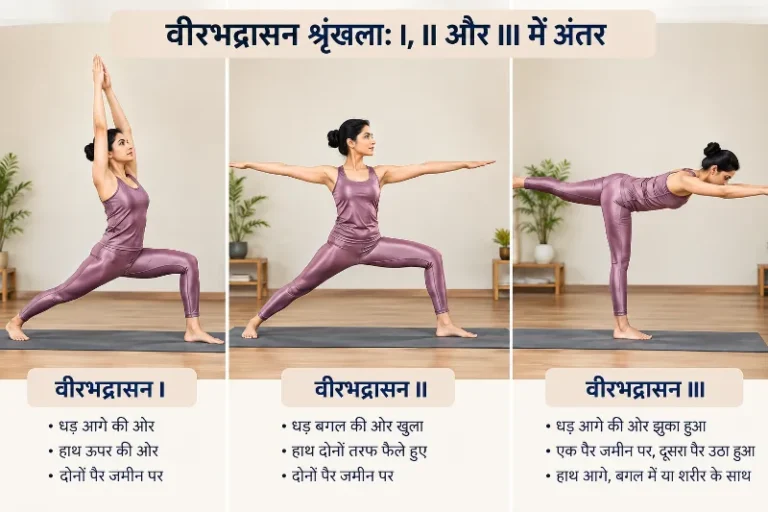
Ardha Uttanasana and Virabhadrasana 3 are connected by an extended lever and increased posterior chain engagement created by extending the arms forward alongside the ears.
Common Mistakes to Avoid
Rounding the Back to Touch the Floor
Always use blocks. In Ardha Uttanasana, a flat back is the posture’s overall therapeutic point; a rounded back emphasises the lumbar disk.
Rushing Through as a Transition
Whether the sequence increases disk stress or develops functional spinal strength depends on the quality of each Ardha Uttanasana in each Surya Namaskara cycle.
Looking Forward Aggressively
Instead of looking forward, the eyes are fixed on the ground in front of them. A strong forward gaze compresses the neck and shortens the posterior cervical muscles.
Make Ardha Uttanasana a Part of Your Practice
The quality and safety of the forward-fold aspect of the entire practice are determined by the intentional performance of Ardha Uttanasana in every Surya Namaskara transition, making it the most popular and often overlooked pose in yoga.
Every intentional Ardha Uttanasana develops the posterior chain strength and hip-hinge awareness that safeguard the spine in all yoga and everyday movement, whether it is through the use of blocks to preserve a flat back or the complete floor-touch with perfect spinal neutrality.
Advice for beginners
Ensure that your feet are hip-width apart and parallel to one another. Ground down via each foot’s four corners as you divide the weight equally between the feet. To establish a solid base for the position, firmly press into the earth. Be careful not to lock your knees. You can start by placing your hands on blocks while bending your knees. Lengthening the spine should continue to be the major goal.
Shvasa tips
As you bend forward at the hips, give priority to stretching your spine. To keep your back straight and stretched throughout the position, picture making space between each vertebra.
If you feel tightness in your lower back or hamstrings, bend your knees slightly. You can benefit from the stretch while maintaining appropriate alignment by softening your knees to help relieve any strain.
Always remember to practice as little as possible and safely. Your stability and flexibility will gradually increase, making it easier for you to practice.
Lower back flexibility
Both the half-standing forward fold and general spinal health benefit from increased lower back flexibility. Flexibility in this area can be improved by incorporating positions like standing forward fold, cobra pose, locust pose, and camel pose into your practice.
The lower back can also be loosened and prepared for deeper stretches with dynamic movements like those found in Paschimottanasana, where you travel forward and backward multiple times before settling into the position.
FORWARD BEND & BACKBEND
Half Forward Ardha Uttanasana Fold is a standing pose that can appear contradictory because it is both a forward bend and a backbend. It extends the spine back into a “backbend” after rotating the hips forward into a “forward bend.” In Bitilasana/Cow, you will also notice this somewhat peculiar double bend characteristic, in which your spine coils back toward the back of your hips while your hips rotate forward and downward. The entire back works against gravity to elevate the weight of the upper body and the heavy head in Ardha Uttanasana/Half Forward Fold, which is a very strong pose for the spine.
Because of our usual posture and the way we move throughout the day without being conscious of the curves of our spine, the back is prone to weakening. The vital component of the vertebrae, which contains the spinal cord of the peripheral nervous system, is shielded from gravity by the muscles of the spine. By strengthening the back, Ardha Uttanasana/Half Forward Fold is a particularly helpful pose to incorporate into any sequence to help offset extended durations of sitting or standing and improve everyday posture.
The hip joint and spine move in unison. When the pelvis is tilted forward in an upright position, the neck’s curvature increases, the mid-back’s curve decreases, and the lower spine’s curve increases. When you tilt your pelvis back, the opposite happens: the neck becomes less curved, the mid-back becomes more curved, and the lower spine becomes less curved.
This interaction between the hip and spine is developed in Ardha Uttanasana/Half Forward Fold, which is an excellent pose to see how one influences the other. Freer, more fluid mobility throughout the day is made possible by a strong back and effective communication between the hip joint and the spine.
FAQs
What Are the Steps for Practising Gomukhasana (Cow Face Pose)?
As part of the Sun Salutation sequence, you are likely familiar with the Ardha Uttanasana (Standing Half Forward Bend) pose. It’s the one that comes after Standing Forward Bend, or Uttanasana. It might also have been referred to as Half Lift or Halfway Lift by a teacher.
Who should avoid Ardha Uttanasana?
Injury and Surgery: People who have lower back or hamstring injuries should not perform Ardha Uttanasana. Avoid this pose if you have joint pain or an abdominal hernia. When the lower back hurts, one should avoid this pose or perform the stretch while bending their knees.
What are common mistakes in Ardha Uttanasana?
Typical Errors to Avoid When Rounding the Back: Instead of folding deeply, concentrate on stretching the spine.
Looking Up Too Much: To prevent compression, keep the neck in alignment with the spine.
Putting your hands on your knees might cause joint strain; instead, place them on your thighs or shins.
Knee overextension: Maintain a microbend to protect your joints.
What are the disadvantages of Uttanasana?
Students who have migraines, vertigo, or high blood pressure should avoid this stance since it causes a blood rush to the brain. Because this posture causes the spine to stretch deeply, students with spinal conditions such as herniated discs, advanced cervical and lumbar spondylitis, scoliosis, and kyphosis should avoid it.
Is Ardha Uttanasana good for back pain?
The standing forward fold is one of the best poses for avoiding backbends. Under the supervision of a qualified yoga instructor, the pose can help ease stiffness in the back when done correctly.
Is Ardha Uttanasana good for balance?
Ardha Uttanasana reduces stress and improves flexibility by extending the hamstrings, calves, and spine. By fortifying the lower back, core, and leg muscles, it also enhances stability and balance.
What props can help with Ardha Uttanasana?
This version requires two yoga blocks (if you want to fold further), a chair (to hold onto for support and to help you lengthen your spine), and some free wall space (to help you locate the verticality in your legs).
References:
- Yoga Journal. (2025f, March 21). Standing half forward bend. https://www.yogajournal.com/poses/standing-half-forward-bend/
- Captcha Verification | Tummee.com. (n.d.). https://www.tummee.com/yoga-poses/half-standing-forward-bend
- Ardha Uttanasana (Standing Half Forward Bend): Steps, Benefits, Precautions – Fitsri Yoga. https://www.fitsri.com/poses/ardha-uttanasana