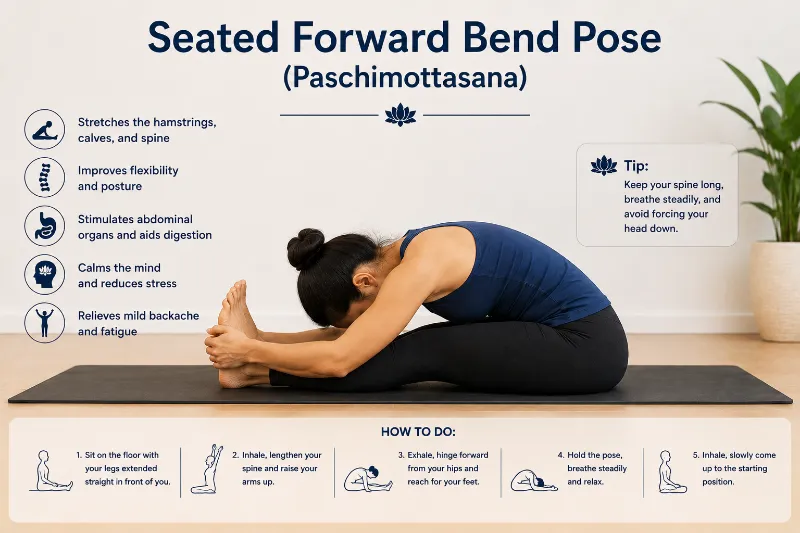
Paschimottasana (Seated Forward Bend Pose)
What is Paschimottasana?
The Seated Forward Bend pose (Paschimottanasana) is a relaxing yoga practice that promotes flexibility and relaxation while stretching the lower back, hamstrings, and spine. Through deep forward folding, it improves mindfulness, helps reduce tension, and improves digestion.
Three Sanskrit words make up the term “Paschimottanasana”: Paschima, which means “west,” but in this case it refers to the rear of the body; Uttana, which denotes “stretching”; and asana, which means “position.” For beginners, Paschimottanasana is a challenging forward bend form that bends from the waist and extends the entire back. It eases upper body tension and stress while also calming the mind.is a simple yoga stance that many practitioners overlook, particularly beginners who are ignorant of its benefits or disregard it since it’s so simple.
Your entire back, neck, shoulders, back of the leg, and arms extend as you lengthen and lower your upper body to the floor. Consequently, it improves physical flexibility and encourages relaxation of the lower back and hamstrings.
Muscle Work During :
- Neck Muscles
- Back Muscles
- Core Muscles
- Gluteus Muscle
- Hamstring Muscle
- Hip Muscle
How to Perform Paschimottasana?
- Similar to Staff Pose, start the Seated Forward Fold Paschimottasana while seated with your legs extended in front of you.
- Make sure your thighs are in neutral rotation, and your sit bones are directly on the mat as you remove the fleshy areas from behind your buttocks.
- Sitting on the front edge of your sit bones, slightly bend forward. This facilitates the forward tilt of the pelvis to a neutral position.
- Breathe out and begin to tilt forward at the hips. Ideally, you should hinge at a 45-degree angle while raising your arms overhead.
- Put your hands on your legs in the same position that they came from, which is normally right under your knees.
- To maintain the little backbend, take a breath and raise the sternum (chest bone) once more. Additionally, you could shift your sit bones back a little.
- Fold forward over your thighs after exhaling. Stretch your hands forward. You’ll be able to take care of your feet eventually.
- Flatten your back by connecting your lower ribs to your thighs, even if this means bending your knees.
Preparatory Pose:
- Staff Pose (Dandasana)
- Head to Knee Pose (Janu Sirsasana)
- Bound Angle Pose (Baddha Konasana)
- Child’s Pose (Balasana)
Benefits of Paschimottanasana (Seated Forward Bend)
Paschimottanasana offers benefits that go far beyond flexibility. It is regarded as one of the most holistic seated postures in yoga since it simultaneously affects the muscles, spine, neurological system, and internal organs. It promotes both physical comfort and mental clarity when practised with correct alignment and calm breathing.
Physical Benefits
- Deep hamstring stretch: Lengthens the hamstrings, which frequently get taut as a result of extended sitting, driving, and restricted movement.
- Stretches the entire back body by focusing on the upper back, spine, calves, and backs of the knees in a single, cohesive motion.
- Enhances spinal flexibility: Promotes controlled forward flexion while preserving the length and mobility of the spine.
- Relieves lower back tension: When used with bent knees, gentle traction helps lessen compression in the lumbar spine.
- Promotes better posture by easing posterior-chain tightness, which can cause slouching and drag the pelvis out of alignment.
- Enhances hip mobility by teaching a safe hip hinge pattern that shields the lower back when moving around on a regular basis.
Digestive & Organ Health Benefits
- Activates digestive organs: The intestines, pancreas, liver, and kidneys are all gently compressed.
- Encourages good digestion by igniting the digestive fire (agni), which may lessen bloating and slow digestion.
- Relieves constipation: Forward folding promotes evacuation and downward-moving energy.
- Supports metabolic function: Maintaining metabolic equilibrium is aided by regular stimulation of the abdominal organs.
- Helps with pelvic circulation: Enhances blood flow to the pelvic area and lower abdomen.
Mental & Nervous System Benefits
- Reduces tension and anxiety by triggering the parasympathetic “rest-and-digest” response, which calms the neurological system.
- Lessens mental exhaustion: Inward concentration and regular breathing assist in reducing mental overload.
- Promotes emotional release: Traditionally, forward folds have been connected to surrender and letting go.
- Enhances mindfulness and concentration: Maintaining the stance mindfully develops present-moment awareness.
- Promotes improved sleep: Practising in the evening can assist the body and mind in getting ready for sleep.
Energetic & Therapeutic Benefits
- Apana Vayu is balanced by downward-moving energy, which promotes stability, elimination, and grounding.
- Promotes inward energy flow: Assists in focusing attention on internal awareness rather than external stimulus.
- Prepares the body for meditation: Because it has a relaxing effect, it is traditionally done before sitting meditation.
- Supports conditions connected to stress: When used cautiously, it may alleviate moderate anxiety, exhaustion, and discomfort caused by tension.
- The best way to experience these advantages is to practice the pose with the right alignment and adjustments.
- To practice the posture under the instruction of an expert, schedule a free one-on-one session.
Paschimottanasana Variations
From total beginners to highly skilled practitioners, Paschimottanasana can be modified for every level of flexibility. These variations enable you to practice securely, focus on particular advantages, and advance gradually—without imposing depth.
Beginner & Supportive Modifications
Paschimottanasana with Bent Knees
1. Permits a secure forward fold while protecting the hamstrings and lower back.
- Bend your knees generously while sitting in Staff Pose.
- Fold forward, resting the torso toward the thighs.
- Hold shins, ankles, or use a strap.
- Focus on spinal length, not straight legs.
Paschimottanasana with Strap
- Makes the pose accessible when hamstrings are tight.
- Put a strap around your feet’s balls.
- Hold the strap ends with arms relaxed.
- Inhale to lengthen the spine.
- Exhale to hinge forward without pulling.
Elevated Hips (Blanket Support)
- Reduces strain and enhances alignment by tilting the pelvis forward.
- Sit on a folded blanket or cushion.
- Extend legs forward in Staff Pose.
- Lift the spine on inhale.
- Fold forward on exhale.
Supported Paschimottanasana (Bolster)
- Deeply calming, restorative version for stress relief.
- Place a bolster lengthwise over the legs.
- Fold forward and place your torso on the bolster.
- Let arms relax by the sides.
- Hold for several minutes with slow breathing.
Intermediate Variations
Wide-Legged Seated Forward Fold (Upavistha Konasana)
- Lessens spinal compression while stretching the inner thighs and hamstrings.
- Sit with legs wide apart.
- Lengthen the spine on the inhale.
- Fold forward between the legs.
- Rest hands on floor or blocks.
Advanced Variations
Ardha Baddha Padma Paschimottanasana
- Combines hip opening with deep forward folding.
- Bend one leg into half lotus.
- Hold the lotus foot by binding the arm behind the back.
- Fold forward over the extended leg.
- Switch sides carefully.
Urdhva Paschimottanasana
- Stretches hamstrings without spinal compression.
- Lie on your back and lift both legs upward.
- Hold feet or use a strap.
- Keep legs straight or slightly bent.
- Breathe steadily while lengthening.
Paschimottanasana with Arm Bind
- Adds shoulder opening to the forward fold.
- Fold forward in Paschimottanasana.
- Reach arms around the legs.
- Clasp hands behind the calves.
- Maintain gentle spinal length.
Other Variations
Ardha Paschimottanasana (Half Forward Bend)
- Strengthens the posture and gets the body ready for more profound folding.
- Sit upright with legs extended.
- Hinge forward halfway with a long spine.
- Place hands on shins or floor.
- Maintain length without collapsing.
One-Leg Seated Forward Fold (Janu Sirsasana)
- Targets one hamstring at a time, improving symmetry.
- Bend one knee such that the sole touches the inner thigh.
- Inhale to lengthen the spine.
- Exhale and fold over the straight leg.
- Switch sides after holding.
Paschimottanasana: Step-by-Step Guide
Paschimottanasana may appear straightforward, but proper technique is crucial.
Part 1: Preparing for the Pose
Keep a folded blanket and yoga strap close at hand if your lower back rounds quickly or your hamstrings are tense. The fold is more supportive and pleasant when practised on an empty stomach, two to three hours after meals.
Warm-Up Poses for Paschimottanasana
- Marjaryasana-Bitilasana, also known as Cat-Cow Pose, warms the spine gently and gets it ready for forward flexion.
Child’s Pose (Balasana): This pose soothes the nervous system and gently stretches the spine before folding. - Baddha Konasana, also known as Bound Angle Pose, releases tension in the seated forward fold by opening the hips and inner thighs.
Paschimottanasana: Step-by-Step Guide
- Take a seat on the mat. Flex your feet.
- Keep your legs out in front of you.
- Extend your spine upward, and ground your sitting bones uniformly.
- To create alignment, place your hands next to your hips and take two to three slow breaths.
- Inhale and sweep your arms overhead. Make room between the hips and ribs and cut into the chest.
- Maintain a lofty back and relaxed shoulders that are away from the ears.
- Breathe out and fold forward from the hips rather than the waist. Instead of using your head, lead with your chest.
- To maintain a long and supported spine, bend your knees as much as necessary.
- Hold wherever you can without strain:
- Feet or ankles
- Shins
- A yoga strap looped around the feet
- Avoid pulling yourself forward. The fold originates from the hips; the arms help only slightly.
- With each inhale, lengthen the spine. Only if the body permits, soften a little further with each breath.
- Let the head, neck, and shoulders relax. Keep the breath slow and steady.
- Stay in the pose for:
- Beginners: 30–60 seconds
- Intermediate: 1–3 minutes
- Advanced: 3–5 minutes
- There should be sensation, not pain. If your hamstrings or lower back feel tense, ease out.
- Engage the core gently. Inhale, starting with the chest, to raise the torso back up.
- Lower the arms and return to Staff Pose. Pause for 2–3 breaths before moving on.
Key Alignment Cues
- Bend the knees if the spine rounds
- Fold from the hips, not the lower back
- Chest moves toward thighs, not head to knees
- Keep your shoulders relaxed and breath steady
- Use props without hesitation
Beginner’s Tips:
- Don’t force your body to go beyond its limits. Go as far as your flexibility permits.
- To strengthen the stretch, you can also ask your teacher or partner to apply pressure on your back.
- For added comfort, tuck a folded blanket beneath your hips.
- Your upper body can be supported and any discomfort relieved by placing a bolster lengthwise on your legs.
- Practice this position three to four hours after eating since it puts pressure on your abdomen.
Precautions & contraindications:
- This position should not be performed if you have a slipped disk, spondylitis, hernia, hypertension, or any other cardiovascular condition.
- This pose strains the pelvic and abdominal area; therefore, pregnant women should avoid doing it. The fetus’s health suffers as a result.
- Do not try this asana if you have recently had surgery or an injury to any part of your arms, legs, back, or pelvis.
Common Mistakes:
Don’t let your knees turn out; instead, keep them in alignment. If this happens, the tension is brought closer to your joints, and your hamstrings are less stretched.
As long as you can maintain the position, keep your back straight. This will enable you to breathe deeply.
FAQs
What is Paschimottanasana and its benefits?
By encouraging blood circulation in the lower back, shoulders, spine, belly, and pelvis, this forward-bending stretch while seated enhances organ function in these muscle areas.
How to perform the Paschimottanasana Pose?
The following steps can be used to achieve Paschimottanasana Pose: Start by assuming the Staff Pose.
Inhale deeply, then lift your arms above your head.
Take a deep breath and close your eyes.
Lean forward with your legs, vertebra by vertebra.
As you descend till your head is on your knees, let out a deep breath.
Hold your arms out in front of you until your body is completely at ease.
What is Ardha Baddha Padma Paschimottanasana?
Ardha Baddha Padma. A more difficult variation of the straight-leg front bend is called Paschimottanasana, or Half Bound Lotus front Fold. By applying pressure to the abdominal organs, this Paschimottanasana variation further enhances digestive function.
Can a beginner accomplish the Paschimottanasana?
Yes, novices can use the Seated Forward Bend Pose as a warm-up and relaxation technique to gradually increase their hamstring and lower back flexibility.
Paschimottanasana may heal what kinds of diseases?
Regular practice of Paschimottanasana can help alleviate erectile dysfunction, depression, high blood pressure, diabetes, PCOD, and PCOS.
References:
- Allen, W. (2025c, August 26). Paschimottanasana. https://myyogateacher.com/yoga-asana/paschimottanasana
- Seated Forward Bend Pose (Paschimottanasana): How to Do, Benefits & Precautions – Fitsri Yoga. https://www.fitsri.com/poses/seated-forward-bend
- Seated Forward Bend Pose Yoga Pose (Paschimottasana). Tummee. https://www.tummee.com/yoga-poses/Paschimottasana
- insideyoga.org. (2024b, March 27). Paschimottanasana – insideyoga.org. https://insideyoga.org/asana-library/paschimottanasana/
- Ryt, A. P. (2021, May 24). How to do a seated forward bend (Paschimottanasana) in yoga. Verywell Fit. https://www.verywellfit.com/seated-forward-bend-paschimottanasana-3567101


One Comment