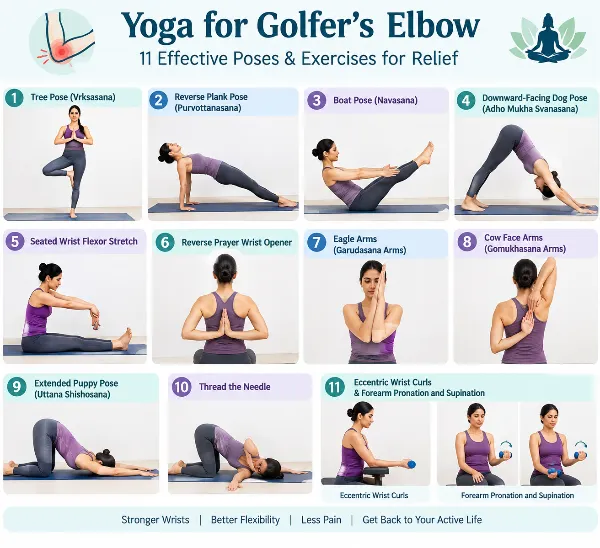
Yoga for Golfer’s Elbow
Introduction
Pain and inflammation on the inside of the elbow are the hallmarks of golfer’s elbow, also known as medial epicondylitis. Despite its name, anybody can get this ailment as a result of repeated hand, wrist, or arm motions.
Golfer’s elbow can be effectively managed and relieved with yoga, a comprehensive practice that combines movement and awareness. Yoga provides a route to healing and prevention by emphasizing mild stretches, strengthening activities, and correct posture.
Understanding Golfer’s Elbow
When the tendons that connect to the inner elbow are stretched or abused, golfer’s elbow develops. Pain, stiffness, and soreness are among the symptoms, which are frequently made worse by holding or lifting items. Typing, hard lifting, and golf club swinging are examples of repetitive activities that are frequently the cause.
Incorporating yoga into your routine can help with pain relief, increase mobility, and prevent recurrent flare-ups, even if rest and avoiding stressful activities are crucial for healing.
Common Causes And Risk Factors
You may stop your golfer’s elbow from coming back by knowing what caused it. When the flexor tendons are loaded more quickly than they can adjust, an injury occurs. This is typically caused by vigorous grasping, repeated wrist flexion, or abrupt increases in activity.
Climbing, throwing sports, weight training with an improper wrist posture, racket sports with a powerful topspin forehand, and manual trades involving hammering or screwing are common offenders. Inadequate warm-ups or recovery time increase the risk, and tendons lose stiffness and blood flow after the mid-thirties; thus, age also plays a role.
Understanding your unique pattern allows you to change the troublesome action while the tendon heals, which frequently makes the difference between a quick recovery and a long-term issue.
How to Prevent Golfer’s Elbow
The best ways for athletes to prevent injuries include stretching, flexibility exercises, and a thorough warm-up. In addition to greatly lowering your risk of injury, adhering to these exercise routines can enhance your performance. The following exercises can help prevent golfer’s elbow by reducing the tension on joints and muscles.
- Light-Weight Forearm Rotations
- Wrist Curls and Extensions
- Planks
How Yoga Helps
Strength, flexibility, and awareness are all improved by yoga. It aims to treat golfer’s elbow by:
- Stretching the Wrists and Forearms: Light stretches help release tension in the affected area.
- Strengthening Supporting Muscles: Increasing arm, shoulder, and core strength reduces elbow strain.
- Promoting Circulation: Healing is supported by dynamic motions that promote blood flow.
- Promoting Mindfulness: You can prevent actions that worsen the situation by concentrating on bodily awareness.
Precautions Before You Begin
Patience, not force, is how tendon injuries respond. Work in a pain range of around 0 to 3 out of 10; a slight aching or tension that goes away fast is fine, but acute, radiating, or worsening pain should be avoided.
Because they put a lot of strain on the flexor tendons, stay away from full weight-bearing poses like the plank, chaturanga, downward dog, and arm balances until your grip strength recovers.
Start by warming your forearms, proceed carefully, and end any position that causes problems to persist until the next day. See a doctor before proceeding if you experience tingling, numbness, or severe weakness, as these may indicate nerve involvement.
Yoga Poses And Stretches For Golfer’s Elbow
Repeat this two to three times on each side while holding each stretch for 20 to 30 seconds on a warm forearm. Throughout, maintain a steady breathing pattern and relaxed shoulders.
Tree Pose (Vrksasana)
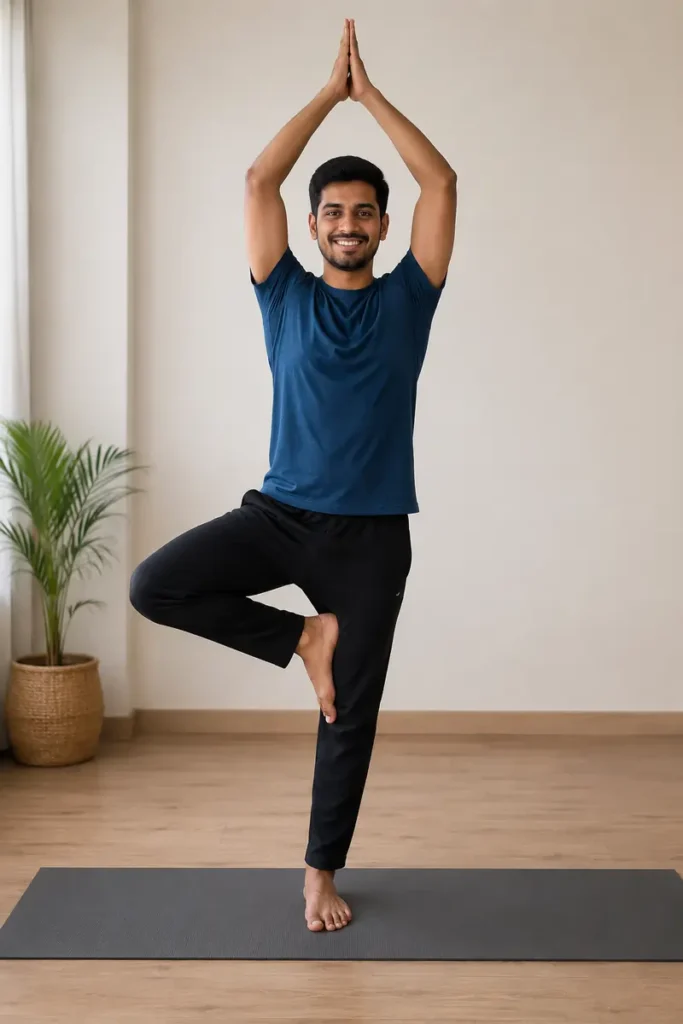
One of the best yoga postures for golfers who want to increase their attention and balance is tree pose. Along with stretching your spine, improving your posture, and expanding your shoulders and chest, you’ll gain stability and core strength. Increase the duration of the position gradually while maintaining mental awareness and breath awareness.
- Put your feet together and your arms at your sides; stand straight.
- Keep your posture stable while shifting your weight to your left leg.
- Place the sole of your right foot against your inner left thigh or calf while bending your right knee. Don’t put it right on the knee.
- Place your palms on your chest in a praying stance.
- Maintain a tall spine and engage your core. Keep your eyes fixed on whatever is in front of you.
- Raise your hands over your head, keeping your palms together, if it feels comfortable.
- Breathe deeply and gently for 20 to 30 seconds while maintaining the stance.
- Lower your right leg and arms gently, then repeat on the other side.
Reverse Plank Pose (Purvottanasana)
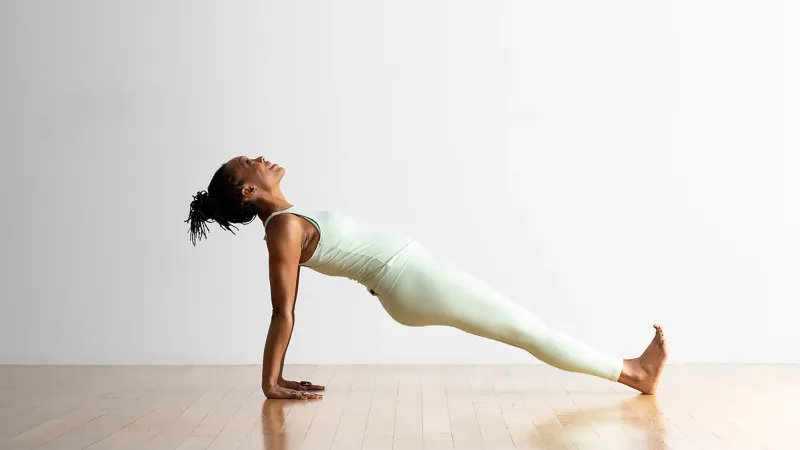
- The majority of golfers have wrist tightness, especially after holding different clubs all day. Additionally, you overstretch your upper back and tighten your chest by bending over your clubs as you get ready to swing. The reverse plank pose is one of the finest yoga poses for golfers because of these typical postural and ergonomic problems. Stretching your wrists, chest, neck, hip flexors, quadriceps, and ankles is quite beneficial. Additionally, it strengthens your shoulders.
- Put your legs out in front of you and take a seat on the ground.
- With your fingers pointing toward your feet, place your palms on the ground behind your hips.
- Firmly plant your heels and palms on the floor.
- Lift your hips and contract your core.
- Maintaining a straight torso from head to heels, extend your arms and legs as far as is comfortable.
- Maintain an open chest and keep your shoulders far from your ears.
- Look straight ahead or upward while maintaining a neutral neck position.
- Maintain the posture for 15 to 30 seconds while breathing normally.
- Relax as you slowly return your hips to the floor.
Boat Pose (Navasana)
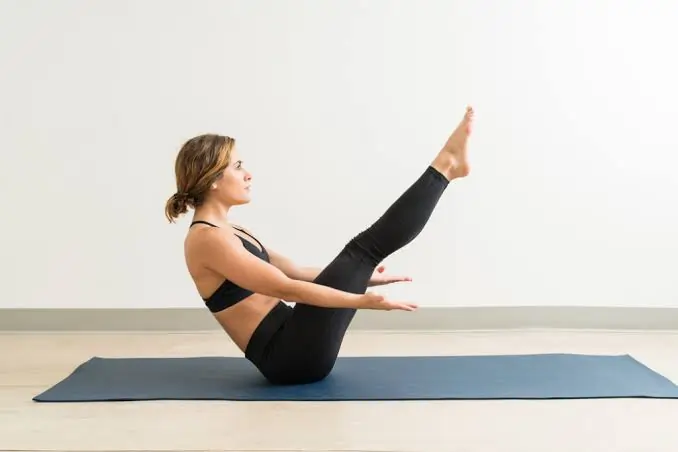
For golfers, yoga works best when it improves the qualities you need to play the game, such as having a strong core. Boat pose is a static, isometric hold that improves your abs, quadriceps, hip flexors, and spinal stabilizers while requiring extreme core control. In addition to promoting proper posture and the synergistic support and control from the lower back and lower abs, maintaining a straight back and shoulders will aid in developing core strength and balance. For golfers, yoga works best when it enhances the qualities you need to play the game, such as having a strong core.
- Put your legs out in front of you and take a seat on the floor.
- Put your feet on the ground and bend your knees.
- Maintaining a straight spine, tilt your torso gently back.
- Lift your feet off the ground by using your core muscles.
- If necessary, keep your knees bent while extending your legs upward until they are about at a 45–60° angle.
- With your hands facing inward, extend your arms forward and parallel to the floor.
- Maintain a long spine, relaxed shoulders, and an elevated chest.
- Maintain the posture while breathing normally for ten to thirty seconds.
- Return to a sitting position by slowly lowering your feet.
- Do this two or three times.
Downward-Facing Dog Pose (Adho Mukha Svanasana)
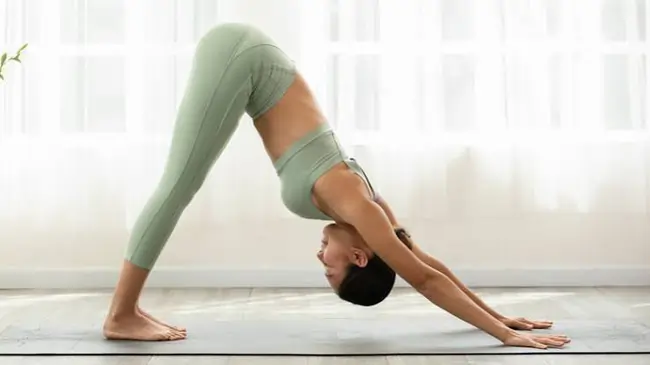
Your shoulders, glutes, calves, core, hamstrings, and back are all worked in the Downward-Facing Dog position. To make the position stronger, squeeze your quadriceps.
- Take a tabletop posture and begin on your hands and knees.
- Spread your fingers and place your hands shoulder-width apart.
- Raise your knees off the ground and tuck your toes beneath.
- Make an inverted “V” shape by pushing your hips upward and backward.
- Lengthen your spine and maintain a straight arm position.
- Don’t push your heels down; instead, softly press them toward the floor.
- Look down at your knees or feet while maintaining a calm head position between your arms.
- Breathe gently and slowly while holding the stance for 20 to 30 seconds.
- Bend your knees and slowly return them to the floor to relax.
Seated Wrist Flexor Stretch
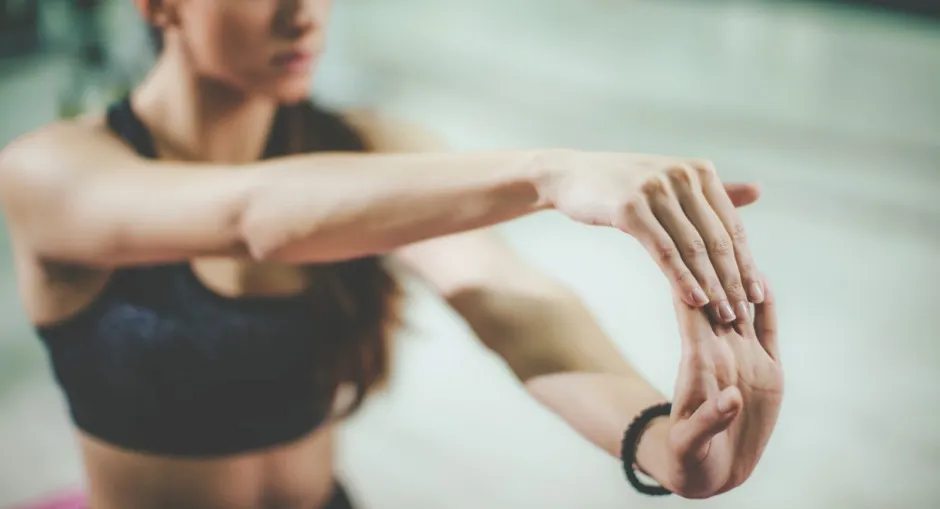
- Put one arm out in front of you, palm up, at shoulder height.
- Stretch your inner forearm by using the opposite hand to gently pull the fingers and palm down toward the floor.
- This causes the flexor tendons that cause golfer’s elbow to extend immediately.
- Maintain a straight but unlocked elbow and release it as soon as the sensation becomes acute.
Reverse Prayer Wrist Opener
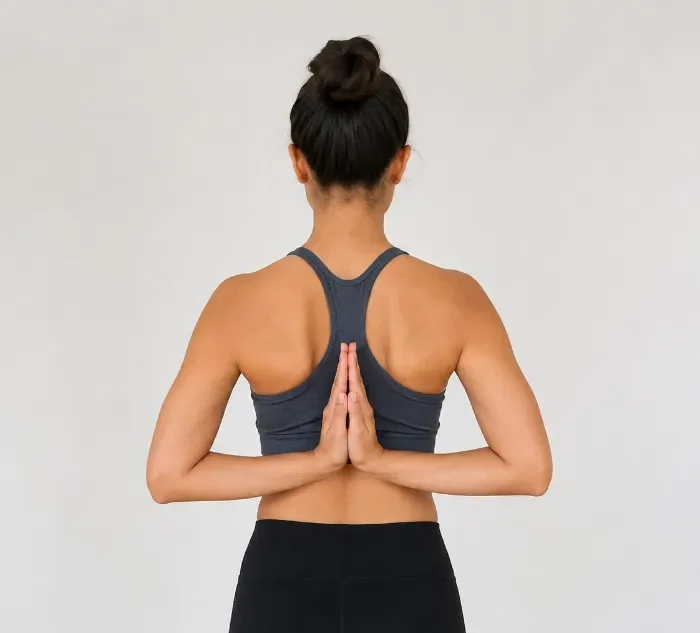
- With your fingers pointing up, place your palms together in front of your chest while sitting upright.
- Then, slightly lower your hands until you feel a stretch over your inner wrists and forearms.
- This mild bilateral stretch relieves chronic flexor tightness without putting undue effort on the elbow and is a more compassionate substitute for reverse prayer behind the back.
Eagle Arms (Garudasana Arms)
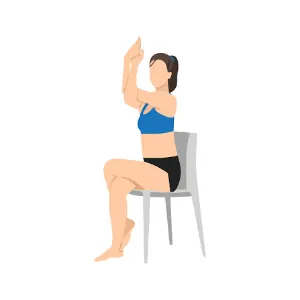
- After crossing one arm under the other at the elbows, wind the forearms until the palms or backs of the hands come into contact.
- Raise the elbows and extend the hands away from the face.
- This position relieves the postural tension that overworks the forearms by decompressing the shoulders and upper back.
- Holding opposing shoulders is a simple solution if wrapping the wrists causes elbow pain.
Cow Face Arms (Gomukhasana Arms)
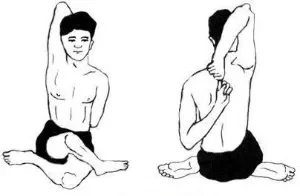
- Pull the other arm up and behind to meet it with a strap if the hands do not attach. Raise one arm high and bend the elbow to slide the hand down the back.
- Without straining the flexor tendons, this allows the elbow to move across a comfortable range while opening the shoulders and chest.
Extended Puppy Pose (Uttana Shishosana)
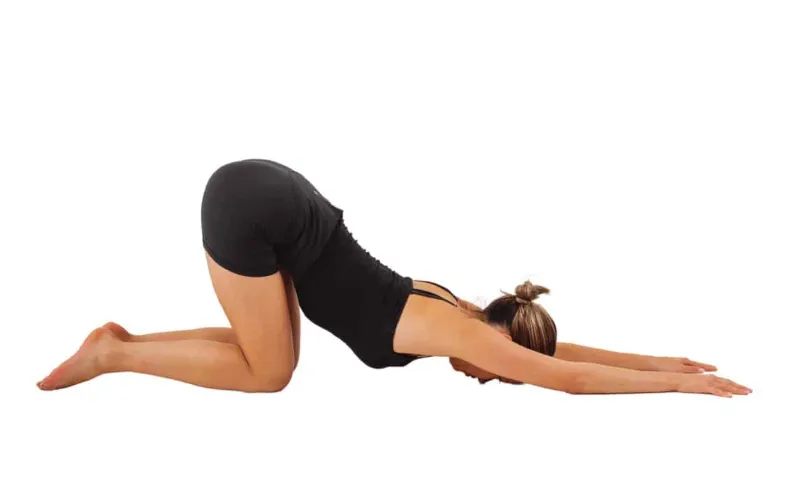
- Keeping the hips above the knees, melt the chest toward the floor while walking the hands forward on all fours.
- To reduce a tight grip, gently rest your forearms or raise your hands.
- This puts less strain on the wrists and elbows while releasing the shoulders and upper back.
Thread the Needle
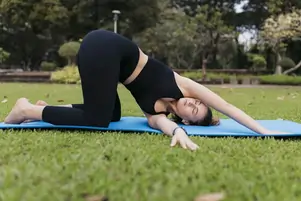
- Place one arm under the body while on all fours, resting the shoulder and side of the head on the mat.
- This healing twist improves the mechanics supporting a healthy elbow by opening the shoulder and upper back.
- Don’t put any weight on the damaged forearm.
Eccentric Wrist Curls
- Place your forearm palm up on your thigh while first bearing a very small amount of weight or nothing at all.
- Curl the wrist up with the other hand, then use only the injured side to gradually drop it down over a period of three to five seconds.
- One of the most proven methods for regaining tendon strength is eccentric loading.
- Over several weeks, progressively increase the load.
Forearm Pronation and Supination
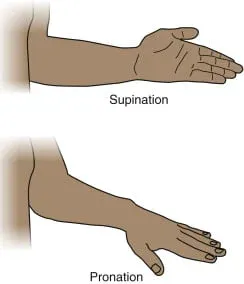
- Rotate the palm gently up and then down, as if you were spinning a doorknob, while keeping the elbow tucked to your side and bent at a 90-degree angle.
- This softly loads the tendons through their normal range and recovers the rotational mobility that golfer’s elbow frequently takes away.
- Keep your shoulder motionless and move freely.
A Simple 10-Minute Daily Sequence
To warm the tissue, start with a minute of moderate fist opening and closing and simple wrist circles. To release the flexors, perform the sitting wrist flexor stretch and reverse prayer opener. Next, release the shoulders with cow face arms and eagle arms.
Finish with two rounds of eccentric wrist curls and pronation-supination on the affected side, then conclude by shaking out the hands. Add Extended Puppy Pose for the upper back. This program, when performed once or twice a day, gradually strengthens the tendon while maintaining tissue mobility.
FAQs:
Can yoga help with golfer’s elbow?
By gently extending the forearm flexors and improving joint circulation, a focused yoga and mobility sequence can help ease golfer’s elbow (medial epicondylitis).
What is the fastest way to heal a golfer’s elbow?
Combining early, progressive physical therapy, focused loading exercises, and rapid relative rest and activity modification is the quickest strategy to treat golfer’s elbow.
What triggers golfers’ elbows?
Repetitive overuse and strain of the forearm tendons and muscles that govern your wrist and fingers can result in golfer’s elbow.
Why won’t my golfer’s elbow go away?
Standard rest alone is frequently insufficient to treat golfer’s elbow because the tendon develops disordered fibers and failed repair (tendinopathy) rather than only temporary inflammation.
Should I ice or heat golfer’s elbow?
For fresh or acute golfer’s elbow pain (during the first 72 hours or following a flare-up), use ice; for persistent, chronic stiffness, apply heat before performing forearm stretches.
What are some good physio exercises for golfers’ elbows?
In order to relieve pain and restore forearm strength, physiotherapy for golfer’s elbow (medial epicondylitis) uses gradual tendon loading, mild stretching, and soft tissue care.
References:
- Zen Mat Yoga. (2026, August 26). Ease Golfer’s Elbow Pain with Targeted Yoga Poses and Mindful Movement for Strength and Flexibility Relief — Zen Mat Yoga Studio. Zen Mat Yoga Studio. https://www.zenmatyogastudio.com/blog/swing-back-to-comfort-yoga-for-golfers-elbow-relief
- Yacep, C. S. E. 5., & Yacep, C. S. E. 5. (2026, July 1). Yoga for Golfer’s Elbow: Poses to Ease the Pain. Yogajala. https://yogajala.com/yoga-for-golfers-elbow/
- Sayer, A., & Sayer, A. (2026, March 24). Yoga for golfers: 8 poses to boost your game. Yogajala. https://yogajala.com/yoga-for-golfers-8-poses/
- Master the Safe Swing: How to Prevent Golfer’s Elbow. (2025, May 30). University of Rochester Medicine. https://www.urmc.rochester.edu/news/story/master-the-safe-swing-how-to-prevent-golfer-s-elbow