Karnapidasana (Ear Pressure Pose)
What is Karnapidasana?
The pronunciation of Karnapidasana is kar-nah-pee-DAHS-ana, which means “ear pressure pose” (Karna = ear, Pida = pressure, Asana = position). As the spine folds deeply in the inverted posture, the knees descend beside the ears and gently press against them, creating a physical reality that gives rise to the pose’s name.
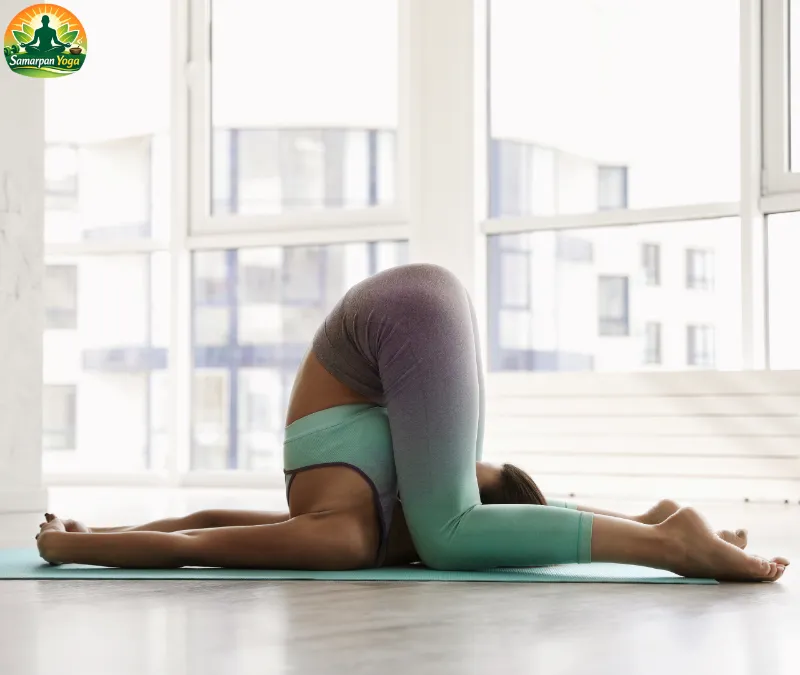
Karnapidasana is a yoga pose in which the practitioner starts in Halasana (toes on the floor behind the head), bends the knees, and then lowers them to the floor next to the ears. The bent-knee position’s abdominal compression offers an extra digestive stimulus, and the spine deepens its flexion beyond what the straight-leg plow does.
Karnapidasana is taught at Habuild as part of the Sarvangasana-Halasana sequence for shoulder inversion and spinal flexion.
Key Highlights
- Halasana’s spinal flexion is further deepened by lowering the knees next to the ears.
- Is held for the same amount of time and comes right after Halasana in the Ashtanga Primary Series.
- Creates a natural sensory-withdrawal state known as Pratyahara by physically muffling outside noises.
- Keeps the same throat lock from Jalandhara Bandha that provides Halasana its thyroid-beneficial effects.
- Beyond straight-leg Halasana, bent-knee abdominal compression enhances the intestinal massage.
- The knees’ physical pressure on the ears is the reason behind the name.
- Compared to the straight-leg plow stance, Karnapidasana, also known as the Ear Pressure stance, is a deep forward-folding form of Halasana in which the knees bend and fall beside the ears, producing a stronger abdominal compression, deeper hamstring and shoulder stretch, and more severe spinal flexion. Karnapidasana is held for the same amount of time after Halasana in the Ashtanga Primary Series.
Karnapidasana Benefits
Physical Benefits
Deeply Flexes the Spine and Decompresses the Vertebrae
One of the deepest spinal flexion poses in yoga is created by Karnapidasana; the bent-knee inverted stance results in more posterior chain lengthening and vertebral decompression than Halasana alone.
Stimulates the Thyroid and Abdominal Organs
Similar to Halasana, Karnapidasana stimulates the thyroid by cervical compression while maintaining the Jalandhara Bandha throat lock. The massage of the digestive organs is enhanced by the extra compression of the abdomen caused by the bent legs.
Stretches the Posterior Shoulders and Upper Back
The thoracic and shoulder tension that builds up from desk work and screen use is released by the deep posterior shoulder and upper back stretch produced by the inverted shoulder position and the forward-folding weight of the knees.
Supports Digestive Health
Karnapidasana is useful for constipation and digestive stasis because of the deep abdominal compression of the knees-beside-ears position, which immediately massages the ascending and descending colon and provides great digestive stimulation.
Mental and Emotional Benefits
Produces Deep Inward Calm and Pratyahara
A natural pratyahara (sensory withdrawal) and the deep internal quiet that the pose is particularly prized for in meditation sequences are produced by the knees being positioned next to the ears, which physically lowers external sound input.
Calms the Nervous System and Relieves Stress
Karnapidasana is one of the best postures for acute stress release and nervous system soothing because it combines deep forward fold, inversion, and abdominal compression to create a potent parasympathetic response.
How to Do Karnapidasana — Step-by-Step Instructions
Key Principles
It is necessary to enter Karnapidasana from Halasana; it is never tried directly. Instead of the neck, the shoulders are used to distribute the weight. The head remains still the entire time. It is advised that all practitioners wear blankets beneath their shoulders. Exit needs to be controlled and slow.
Put your feet on the floor behind your head, your arms flat or clasped, and your chin to your chest to fully establish Halasana.
Breathe out and pull both knees toward the floor on either side of your head.
Lower the knees till they are on the floor next to your ears. Behind the head, the shins might lie on the ground.
Step 1: Begin in Halasana
Put your feet on the floor behind your head, your arms flat or clasped, and your chin to your chest to fully establish Halasana.
Step 2: Bend Both Knees
Breathe out and pull both knees toward the floor on either side of your head.
Step 3: Lower the Knees to the Floor
Lower the knees till they are on the floor next to your ears. Behind the head, the shins might lie on the ground.
Step 4: Adjust the Arm Position
The arms can be wrapped over the shins or left flat on the ground for support after the hands are released from the Halasana clasp.
Step 5: Hold Steadily and Breathe
Hold for five to ten breaths, taking steady, slow breaths while compressing your chest. The head does not move at all.
Step 6: Return Through Halasana and Exit
Return to Halasana by extending your knees, and then slowly unroll your spine back to the floor, vertebra by vertebra. In Savasana, lie.
Breathing in Karnapidasana
Because of the constraint of the knees, the chest has less room to expand during Karnapidasana breathing. Inhale deeply into the ribcage’s sides. Don’t hold your breath. The pose’s relaxing effect is enhanced by the slow, constricted breathing.
Preparatory Poses Before Karnapidasana
- Sarvangasana (shoulderstand, 3 minutes) is a crucial prerequisite for the neck and shoulder position.
- The direct preparation and entering point for Karnapidasana is Halasana (Plow Pose, 1 minute).
- Folded blankets beneath the shoulders: Prior to doing any inversion technique, always employ shoulder support.
- Prior to the inverted deep fold, the hamstrings and posterior chain are opened with the Paschimottanasana (Seated Forward Fold, 3 minutes).
Variations of Karnapidasana
Variation 1: Karnapidasana with Knees Hovering — Beginner
To preserve the benefit of spinal flexion without forcing the entire knee-to-floor expression, bring the knees toward the ears but let them hover over the floor if they are uncomfortable.
Variation 2: Standard Karnapidasana — Intermediate
knees on the ground next to the ears in a complete expression. the typical stance in the Ashtanga sequence after Halasana.
Variation 3: Karnapidasana with Padmasana Legs — Advanced
Before or during Karnapidasana, fold the legs into Padmasana (Lotus), which adds the hip opening of the crossed-leg pose to the deep inversion while altering the quality of posterior stretch and abdominal compression.
Common Mistakes to Avoid in Karnapidasana
- The spinal flexion gradually increases from the straight-leg plow to the bent-knee expression when entering directly without first performing Halasana (Karnapidasana must be performed from established Halasana).
- The entire body weight is supported by the neck through the shoulders; blankets beneath the shoulders distribute the weight appropriately and shield the cervical vertebrae.
- It is risky to turn the cervical spine under compression while in this position. The head must stay still.
- Coming out too quickly: Always depart by slowly unrolling the spine after extending the knees back to Halasana. Avoid rolling straight from Karnapidasana to sitting.
- Forcing the knees to the floor: Hover the knees and let the posture develop gradually if the hamstrings or spinal flexibility prevents the knees from reaching the floor.
Who Should Practise Karnapidasana?
Those Managing Thyroid and Digestive Health
Karnapidasana is one of the most focused therapeutic poses for these disorders because it combines thyroid stimulation through Jalandhara Bandha with digestive organ compression through the knee-beside-ear posture.
Practitioners Developing an Advanced Inversion Practice
As the next step in the traditional shoulderstand series, Karnapidasana readily follows any inversion sequence based on Sarvangasana and Halasana.
Is Karnapidasana Good for Beginners?
Karnapidasana is intermediate in complexity and necessitates an established Halasana practice. Before trying the bent-knee descent, beginners should become proficient in Halasana using shoulder blankets. The safe transition from Halasana to Karnapidasana is guided by the live instructors at Habuild.
Make Karnapidasana a Part of Your Practice
The deepest pose in the shoulderstand-plow family is Karnapidasana, which combines the thyroid stimulation of Halasana with deeper abdominal compression, more intense spinal flexion, and the special sensory withdrawal that the ear-pressure position produces.
It offers one of yoga’s most thorough therapeutic inversion practices when performed as part of the whole Sarvangasana-Halasana-Karnapidasana sequence.
This inversion sequence with live direction and proper prop support is part of Habuild’s daily workouts. There is just a 14-day free trial for the first seven days.
Begin your free 14-day yoga journey right now with Habuild!
Precautions
Karnapidasana should not be pressured because it is an advanced pose. If you have glaucoma, uncontrolled hypertension, neck or spinal issues, or other illnesses that make inversions inappropriate, avoid them or seek professional advice.
Generally speaking, pregnant people should avoid this stance unless a certified physician specifically advises them to do so.
It’s important to disperse the weight through the upper back and shoulders rather than straight onto the neck. It should be taught by a qualified yoga instructor to beginners.
FAQs
What is Karnapidasana?
The Ear Pressure Pose, or Karnapidasana, is a profound yoga inversion in which the knees are placed on the floor next to the ears and the legs are folded over the head. Thyroid stimulation, deep spinal flexion, abdominal compression, and natural sensory withdrawal are all combined in this Halasana bent-knee sequence.
What are the karnapidasana benefits?
Deep spinal flexion and vertebral decompression, thyroid and parathyroid stimulation through Jalandhara Bandha, compression and stimulation of digestive organs, release of the upper back and posterior shoulder, profound nervous system calming, and natural pratyahara through the ear-pressure sensory withdrawal are the main advantages of karnapidasana.
How to do Karnapidasana?
Place blankets beneath your shoulders to establish Halasana. Breathe out and lower both knees to the floor next to your ears by bending them. Wrap your shins or lay your arms flat. Hold five to ten breaths. Back to Halasana, extend your knees. Unroll the spine slowly to the ground.
Is Karnapidasana safe for beginners?
A precondition for Karnapidasana is established Halasana. The inversion sequence should be developed gradually by beginners: Sarvangasana, Halasana, and Karnapidasana, all with appropriate shoulder support. This advancement is guided carefully by Habuild’s live educators.
How is Karnapidasana different from Halasana?
With the toes on the ground behind the head, the legs are straight in the pose of halasana. Karnapidasana’s distinctive ear-pressure sensory withdrawal, stronger abdominal compression, deeper spinal flexion, and more powerful posterior shoulder stretch are all produced by the knees bending and descending next to the ears.
References
- Zehra, S. (2026f, August 11). Karnapidasana (Ear Pressure Pose): Steps, Benefits & Precautions. Habuild Blogs. https://habuild.in/habitology/asana-mudra/karnapidasana/
- School, H. Y. V. (2025, July 16). 11 Excellent benefits of Karnapidasana – Ear Pressure pose. Hariom Yoga Vidya School. https://hariomyogavidyaschool.com/blog/karnapidasana/
- Yoga, P. (n.d.). What is Karnapidasna Yoga? All the Benefits of Ear Pose. Pratham Yoga. https://www.prathamyoga.com/blog/meaning-of-karnapidasana-yoga-benefits