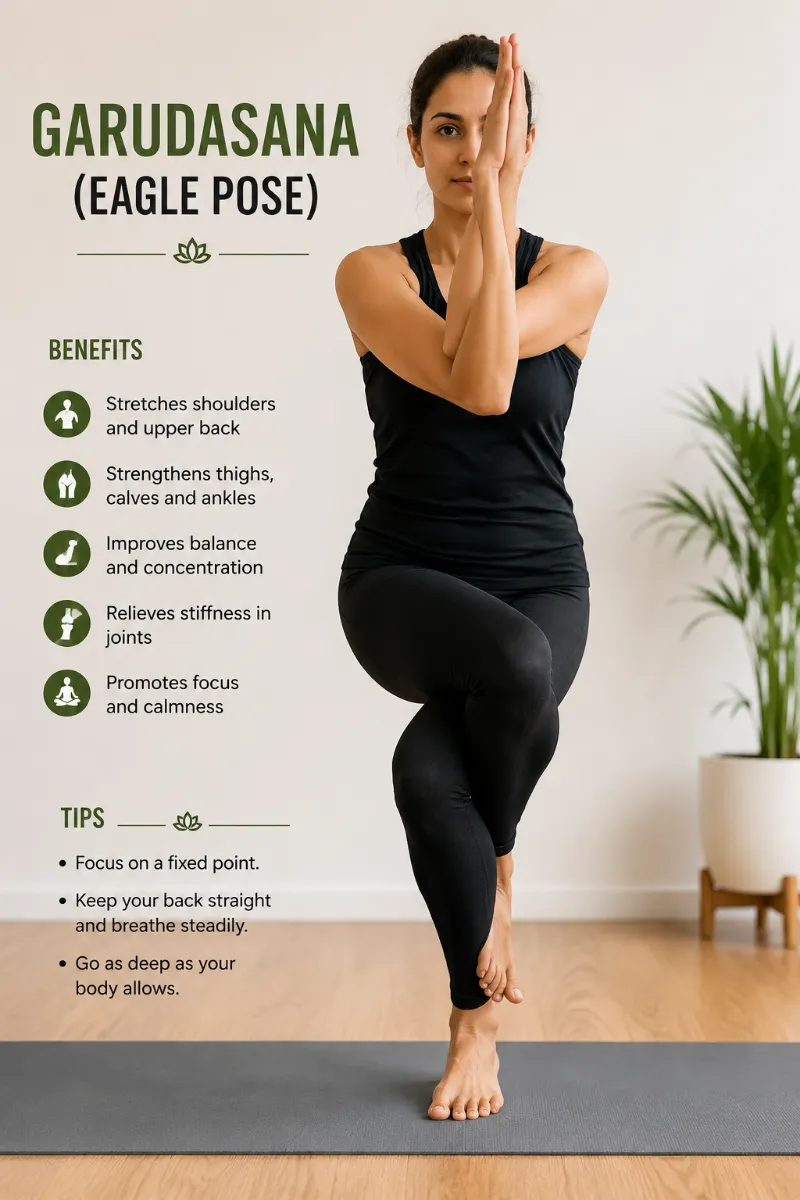
Garudasana (Eagle Pose)
What is Garudasana (Eagle Pose)?
Eagle Pose, also known as Garudasana, is a standing yoga pose with twisted arms and legs. One leg at a time is balanced in this standing position.
Eagles are regarded as powerful, highly focused birds. In a similar vein, balancing your entire body on one leg in this position also calls for a great deal of mental awareness and core strength.
Your ankles, thighs, glutes, knees, core, arms, shoulders, and back will all begin to burn the longer you maintain this stance.
Overview & Etymology
Sanskrit terms are combined to form the name Garudasana. “Asana” denotes seat or posture, while “Garuda” indicates an eagle.
Hindu mythology describes Garuda as the friend of people, the monarch of all birds, and the enemy of snakes.
He is the Vaahan (vehicle) of Lord Vishnu, the highest Hindu deity. Lord Vishnu can be carried through the skies by this king of all birds without ever landing.
There are two well-known texts in Hinduism that are dedicated to Garuda. Garudopanishad is the second, and the Garuda Purana is the first.
The book Garudopanishad discusses charms and mantras that can cure poisoning. Conversely, the Garuda Purana, one of the eighteen Mahapurans, covers a wide range of subjects, including yoga theory, karma, cosmology, and soteriology.
In contrast, Garuda is frequently depicted in Buddhist folk art, and eagles are regarded as a mythological species in Buddhist culture.
In Tibetan Buddhist culture, the eagle is one of the Four Dignities in animals, representing a Bodhisattva (a monk attaining Nirvana).
- Sanskrit Name: गरुडासन
- Pronunciation: gah-roo-DAH-sah-nuh
- Pose Type: Standing Balance Pose
- Also known as: Eagle Pose
- Strengthens: Knees, Ankle, and Calves
- Stretches: Glutes, Shoulder, Thighs, and Upper Back
Muscles Worked
Garudasana engages and stretches several muscle groups, including:
- Quadriceps
- Hamstrings
- Calves
- Glutes
- Hip muscles
- Core muscles
- Shoulders
- Upper back
- Forearms and wrists
Health Benefits of Garudasana
- Improves posture.
- Enhances flexibility in the body.
- Strengthens the knee and elbows.
- Stimulates abdominal organ function.
- Increases awareness and mental focus.
- Strengthens the core and lengthens the legs.
- Enhances blood flow in the arms, legs, and glutes.
- Burns extra fat in the arms, abdomen, glutes, and legs.
- Activates the vertebrae and improves nervous system function.
When to Avoid Performing Garudasana
Avoid if you have any injuries.
- Avoid if you have a severe surgery.
- Avoid if you have chronic lower back pain.
- If you have inflammatory elbow or knee arthritis, stay away.
- Steer clear if you are uncomfortable in your abdomen or pelvis.
- Steer clear if you have back discomfort, aching feet, or are pregnant.
How to do Garudasana (Eagle Pose)
It can be intimidating to perform Eagle Pose. Because of this, the entire practice has been divided into several stages, including a warm-up, alignment cues, relaxation, and steps to enter the primary position.
We’ve also included some simple adjustments and entertaining variants for beginners and intermediate yogis to attempt throughout their Garudasana practice. Now let’s get going!
Part 1 – Preparatory Poses for Garudasana
Your arms, glutes, calves, knees, and spine are the primary muscles you need to use for Eagle Pose. To warm up all the required body parts, try these preliminary poses:
- This basic standing yoga pose, also called Samasthiti, is performed for mild foot, spine, leg, and core activation.
With your feet parallel to one another and slightly hip-distance apart, take a straight position in the middle of the mat. With both palms facing forward, keep both arms at ease next to your torso. Breathe deeply and mindfully while maintaining this position for two to five minutes.
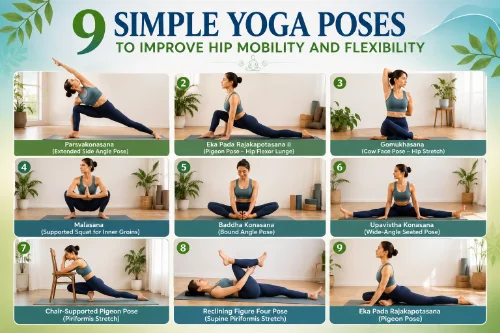
Gomukhasana (Cow Face Pose)
- The leg shape in this seated cross-legged yoga pose resembles a cow’s face. It helps to extend your spine and is a great hip opener. To begin, sit up straight and cross your legs so that your knees are on top of each other.
Flex one arm up from the shoulder and the other from below on the side of your oblique to reach your arms behind. Put your fingers behind your back and extend your spine to open your chest. After two to three minutes of holding this stance, switch up where your arms and legs are placed.
- This is the basic yoga pose needed to reach Eagle Pose. Start by taking a deep breath, keeping both legs close, and standing in Mountain Pose.
Breathe out now while bending your knees and pulling your glutes back. Hold this position for five to ten deep breaths while raising your arms overhead. Your lower body’s blood flow will rise if you continue doing this for five to ten rounds.
Part 2: Step-by-Step Instructions to Perform Garudasana
To do Garudasana, also known as Eagle position, follow these steps:
- Step 1: Take a few deep breaths while standing erect in Tadasana, being careful to relax your body.
- Step 2: Take a deep breath, put both hands on your waist, and contract your core. Raise your right foot off the mat and bend your knees slightly.
- Step 3: To fully lock your legs, curl your right foot over your left calf muscle and wrap your right leg around your left leg.
- Step 4: Breathe out and descend your glutes toward the floor as if you were performing a narrow squat.
- Step 5: Raise both arms to chest level and bend them from the elbows when you are comfortable.
- Step 6: Interlock your arms by clasping both hands together while continuing to breathe lightly. Wrap your left elbow across your right forearm.
- Step 7: For the next five to ten deep breaths, maintain this shape by concentrating on your breath and your gaze.
- Step 8: Breathe out as you unlock your arms and legs. Repeat the process on the opposite side after standing upright to allow your blood to return.
Breath Awareness:
- Breathe in when you lift one foot off the mat and contract your core.
- Exhale: When you eventually release the stance and descend after interlocking.
- Beginners should perform Eagle Pose for five to ten deep breaths on each side.
- Performance Duration for Advanced: Hold Eagle Pose for 60 to 90 seconds on each side.
Part 3: Things to Keep in Mind
For the safe performance of Eagle Pose, the following alignment cues are crucial:
Engage the core: You are more likely to become unbalanced and sustain an injury if your core muscles are weak. When balancing your complete body on one leg, make sure your core muscles are extremely tense.
Engage your ankles, lower back, shoulders, and arms after your core strength has established a solid foundation. You can maintain the stance longer if you do this.
Concentrate: Eagles are thought to have four to eight times superior vision than humans, in addition to having the clearest eyesight of all animals.
This is due to the fact that eagles are extremely focused, and in order to keep your posture and balance, you must imitate their level of acute concentration.
The ideal way to execute any balancing yoga stance is with a focused Drishti (Gaze).
If, for some reason, you are unable to fix your sight on the tips of your thumbs during Eagle Pose, try focusing on a single spot and staying there until the exercise is finished.
Part 4: Relaxing Poses After Garudasana
After Eagle Pose, perform the counteryoga positions listed below to maintain the flow of energy and relieve any residual muscle tension.
Uttanasana (Standing Forward Bend Pose)
- Your spine will require some care following an extended practice of Eagle Pose. Begin by reaching for your toes and slowly bending your upper body from the torso.
This is a full-body stretch, but your hamstrings and lower back will counterstretch, giving you a calming sense of release. For one to two minutes, maintain this stance. This forward bend revitalises your head, arms, and shoulders by allowing blood to flow back into them.
Prasarita Padottanasana (Wide-Legged Standing Forward Bend)
- Expand your legs to a distance greater than hip-width apart and execute the same bending motion as the forward bend pose.
Hold this stance for a few minutes with your hands on the floor and take deep breaths. Your legs, neck, and mid-back will all become even more relaxed as a result.
- To release any remaining tension in your ankles, tailbone, thighs, knees, and pelvic floor, perform this deep yogi squat. Pull your glutes close to the floor in a deep squat while continuing to exhale from the wide-legged pose.
Make sure your thighs are pointing out with the resistance of your arms as you hold your arms close to your chest in prayer position. Hold this position while taking deep breaths until your entire body is at ease.
Garudasana Variations to Consider
Check out these variants of Eagle Pose for yogis of all skill levels:
Reclining Eagle Crunch:
- For those looking to train their abs, this dynamic routine is a great way to improve your core. To begin, lie on your back on the yoga mat and make the eagle shape with your arms and legs. Try performing crunches with your abs in this eagle formation while using your core muscles.
Take a deep breath and expand your abs. Now maintain your body in this position for two seconds, exhale as you rise, and meet your elbows with your knees as you crunch. Ten repetitions of these should be done for two rounds on each side.
Eagle Pose Low Squat:
- To get a burn in your glutes, try squatting low in Eagle Pose. Focus your gaze, begin with the basic Garudasana pose, and gradually lower your pelvis to the floor.
Hold this version for a few seconds on each side, stabilising your body with a rounded back and an engaged core.
Common Mistakes
Avoid these common errors while practising Eagle Pose:
- Looking around: Keep your gaze fixed on one point.
- Rounding the entire back: Keep the spine as upright as comfortably possible.
- Forcing the legs or arms to wrap completely: Use only the range of motion that feels comfortable.
- Holding your breath: Continue slow, steady breathing.
- Collapsing into the standing knee: Keep the standing leg active and controlled.
Beginner Modification
If wrapping the legs completely is difficult, simply cross one thigh over the other without trying to hook the foot behind the calf. Similarly, if the palms cannot touch, keep the backs of the hands or forearms together.
Until your balance gets better, you can also practice next to a chair or wall.
Precautions
Practice carefully if you have a knee, ankle, hip, shoulder, wrist, or elbow injury. Avoid forcing the joints into the wrapped position. A trained yoga instructor can help beginners learn the pose gradually.
Quick Tip
The goal of Garudasana is not to wrap the arms and legs as tightly as possible. Focus instead on maintaining balance, comfortable alignment, steady breathing, and controlled movement.
FAQs
What are the benefits of Garudasana?
Some significant health advantages of Garudasana are as follows:
Enhances concentration.
Stretches the entire body.
Tones the legs and shoulders.
Strengthens the core and knees.
Increases body balance and awareness.
Improves flexibility and mobility in the body.
Can beginners perform the Garudasana pose?
The Garudasana stance is difficult for beginners to execute; thus, they should avoid doing it. It could be challenging to cross-form while balancing all limbs on one leg. It is preferable to start with standing body balance yoga poses (like chair pose) and some arm and leg mobility exercises. The main Eagle Pose can then be achieved gradually.
What is the meaning of Garudasana?
Garuda, which means eagle, and Asana, which means stance, posture, or seat, combine to form the Sanskrit term Garudasana.
How does Garudasana benefit the legs?
The body is balanced on one leg at a time during Garudasana. This strengthens your quads, glutes, and legs. Your thighs’ tone will gradually improve with consistent work. An excellent pose for increasing the range of motion in your knee and ankle joints is Garudasana.
Who should not perform Garudasana?
Garudasana should be avoided if you are a beginner, have arthritis in your knees or elbows, are in the final trimester of pregnancy, have persistent back discomfort, or have a serious injury to your pelvis or spine.
References
- Allen, W. (2025d, August 26). Garudasana. https://myyogateacher.com/yoga-asana/garudasana
- Yoga Journal. (2025ab, March 24). Eagle pose. https://www.yogajournal.com/poses/eagle-pose/
- Dr.Kruti Sorathiya. (2024). Garudasana (Eagle Pose) – Health Benefits, Steps, Precaution. Mobile Physiotherapy Clinic. https://mobilephysiotherapyclinic.in/garudasana-eagle-yoga-pose/
- Eagle pose, step by step. (2016, March 14). https://yogainternational.com/article/view/eagle-pose-step-by-step/?srsltid=AfmBOoo5QWBxVILzEeYgV-Xx04ophzUgz-kzT9-jchjSRQWgPir3qzaY