Navasana (Boat Pose)
What is Navasana (Boat Pose)?
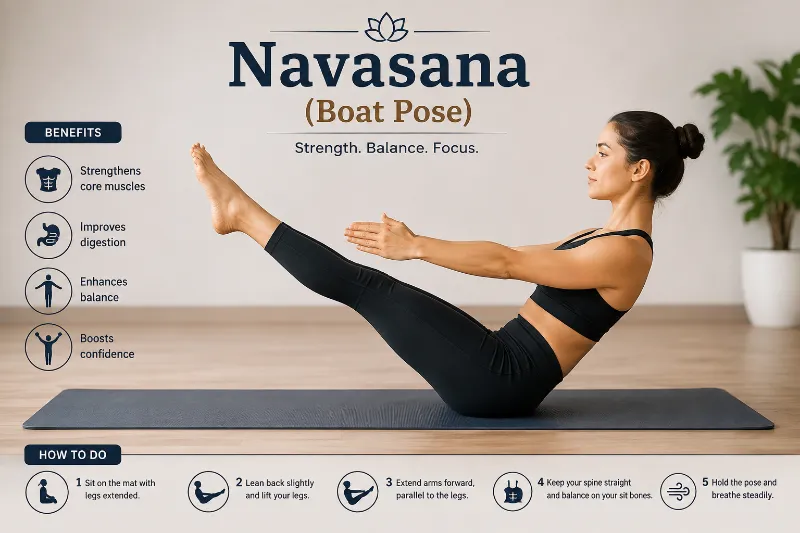
Boat Pose, also known as Navasana, is a sitting yoga pose that calls for core strength to keep the body in a “V” form. Over time, it enhances core strength, balance, endurance, and mental clarity.
Navasana is also a popular pose in many yoga systems, such as the main series of Ashtanga yoga, because of its advantages for the body and mind. From the more difficult Full Boat Pose to the more beginner-friendly Half Boat Pose, there are several versions of this pose.
Overview & Etymology
- The Sanskrit words Nava, which means “boat,” and Asana, which means “posture” or “seat,” are combined to form the name Navasana or Naukasana.
- Hindu mythology makes several allusions to the use of boats. One of them tells the story of “Manu,” the first human on Earth. The narrative describes the events of a great flood (Pralaya), during which Manu attached his canoe to the horn of a large fish (the fish was Lord Vishnu’s avatar) and transported all the Scriptures, Vedas, plants, and animals to a safe location at the summit of Mount Meru.
- Nauksana and Purna Nauksana were the first yoga poses established in the 19th century by Sritattvanidhi.
- Sanskrit Name: नावासन
- Pronunciation: NAUK-AAHS-uh-nuh
- Pose Type: Seated.
- Also referred to as: Paripurna Navasana (Full Boat Pose) or Boat Pose
- Strengthens: Core, Spine, Glutes, and Mental Consciousness
- Stretches: None
Muscles Worked
- Rectus abdominis
- Transverse abdominis
- Erector spinae
- Quadriceps
- Hip flexors
- Hamstrings
- Upper back and neck muscles
- Biceps
- Triceps Brachii
Health Benefits of Navasana
- Improves core strength.
- Increases mental consciousness.
- Strengthens the abdominal muscles.
- Reduces neck, back, and spine pain.
- Aids in weight loss around the abdomen.
- Lengthens and strengthens spine tissues.
- Improves digestion and enhances metabolism.
- Activates chakra healing with improved hormonal balance.
When to Avoid Performing Navasana?
- Avoid if you are pregnant.
- Avoid during menstruation.
- Avoid if you have abdominal cramps.
- If you’ve recently had surgery or an injury, stay away.
- Steer clear if you have serious conditions including asthma, high blood pressure, or heart issues.
What is One leg boat pose (Eka pada Naukasana)?
- Avoid having a large and tight lower abdomen. Instead, keep it flat and hard. As you inhale, flex your heels or point your toes. Hold the position for 10 to twenty seconds, then gradually increase it to a minute.
- A simple sitting pose that works the abdominal muscles is called eka pada savasana. Asana means “position” or “posture,” pada means “foot” or “leg,” nava means “boat,” and eka means “one.” The name comes from these Sanskrit terms.
- A “V”-shaped body structure that balances on the buttocks with the arms straight and the legs up characterises eka pada savasana, a pre-savasana position and a shortened variant of savasana. The eka pada form is a one-footed, knee-bent reminder on the ground. The bent knee falls to the side in another leg form. For a deeper stretch, the grounded leg raises straight, much like in the hook stance.
- Navasana is an important part of the main sequence of Ashtanga yoga and is considered vital in other yoga systems due to its mental and physical advantages. The Eka Pada form is renowned for enhancing concentration and focus in addition to fortifying the core. The Eka Pada form is renowned for enhancing focus and attention in addition to fortifying the core. Physical Treatment
- Because the asana focuses on the centre of the body, it is frequently thot of as a way to initiate the Manipura (solar plexus) chakra. The Manipura chakra is opened by the eka pada navasana exercise, giving the yogi a sense of strength, vitality, and self-acceptance. Yogis with a healthy Manipura chakra are more stimulated and self-aware.
How to do Navasana (Boat Pose)?
- Your core muscles, particularly your hip flexors, abdominals, and lower back, can be strengthened with navasana. By continuously contracting your abs and paying attention to your breathing, this experience can also help you achieve mental and physical equilibrium.
- Here are the four stages to begin practising Boat Pose.
Part 1 – Preparatory Poses for Navasana
A strong core is necessary for most Navasana poses. However, you can begin with basic activation exercises for the lower body muscles, hip flexors, and abdomen if your core muscles are not properly balanced. The list of stances to prepare for the boat pose is as follows:
Surya Namaskar (Sun Salutations)
- To warm up your body and release any tense muscles, start your practice with a few Surya Namaskar rounds.
Make sure your breathing and body movement are synchronised when performing Sun Salutations. Pay attention to your body’s expansion while you practice for around six rounds on each side. Allow yourself to sink deeply into each stretch. After six rounds, get into Tadasana and relax.
Brahmacharyasana Variation (L-Sit Variation)
2. Stretch your legs while sitting in Dandasana and pointing your toes forward. Now raise one leg slowly and keep it there for ten seconds. Make sure to fully engage your core when lifting the leg.
Do this three to five more times on each side, then repeat on the opposite leg. When you balance in the boat pose, this form of the L-Sit pose strengthens the muscles surrounding your core.
Brahmacharyasana (L-Sit Pose)
3. Lift both legs off the ground and balance the L shape with your arms once your core has been activated and if you feel even more powerful.
For novices in particular, this posture will further strengthen the arms and core and assist in building a stronger foundation for the Full Boat pose, which also requires arm strength.
Part 2: Step-by-Step Instructions to Perform Navasana
Here are the steps for practising Boat Pose:
- Step 1: Take a seat in the centre of the mat with your arms at your sides, and your legs outstretched.
- Step 2: You can offer more support to your lower back by placing a block behind it if it hurts.
- Step 3: Transfer your weight to the back of your sitting bones while maintaining a regular breathing pattern and avoiding rolling onto your tailbone. This is where core strength is useful.
- Step 4: Ensure that your back and head are positioned in a straight line yet tilted. Maintain a taut core and extended legs with pointed toes.
- Step 5: Arrange your arms such that they resemble the waves the boat would float over. Make sure the direction of your fingers and feet are the same.
- Step 6: Take a deep breath, lean slightly back, raise your legs off the mat, and stretch your arms until they are parallel to the mat. In complete boat stance, if you can, try to straighten both legs.
- Step 7: After a few seconds of holding your breath in this posture, drop your legs onto the mat and let out a deep breath.
Breath Awareness:
- As you enter the posture, breathe normally.
- Take a deep breath, raise your legs, and contract your core.
- While lowering your legs, exhale twice as much as you inhaled.
- If you can sustain this pose for a longer period of time, remember to breathe deeply during the extended hold.
- Beginners should perform the boat stance for 30 to 60 seconds.
- Duration of Advanced Performance: Maintain the boat stance for one to five minutes.
Part 3: Things to Keep in Mind
If you’ve never struck boat posture before, bear in mind some of the following:
- Fix your gaze: It’s natural to find it difficult to balance in Boat Pose during the first few tries. Learn to focus your sight on a single, fixed area in front of you to get into this position more quickly. For a longer balance, you can also close your eyes and concentrate on your third eye area, which is located in the centre of your eyebrows.
- Engage the muscles: Loose muscles and inadequate activation of the muscle groups necessary for balancing may be the cause of your inability to maintain your equilibrium. As a result, make sure your legs are pointed and tight, as well as your arms and core (lower back, hip flexors, and abdomen).
Part 4: Relaxing Poses After Navasana
You may experience severe pressure throughout your entire core or perhaps strong vibrations throughout your lower body after performing the boat position. After practising Navasana, it’s crucial to do the following relaxation poses:
Paschimottanasana (Seated Forward Bend Pose):
- After practising Boat Pose, take a seated staff pose by lowering your legs to the floor. Now bend your body forward onto your legs, arch your back, and place your forehead here for a few deep exhales.
Breathe deeply and let go of all the extra tension in your lower back, spine, core, and legs as you unwind in this pose. For a minute or two, maintain this position.
Adho Mukha Svanasana (Downward Facing Dog Pose):
- Although it is a counterpose, this position is extremely similar to the Full Boat position. Particularly after a lengthy practice of Full Boat Pose, it is beneficial to further relax your arms and legs in this pose.
Stretch the position by simply placing all four limbs on the ground and flexing your arms and calves. Take a minute or two to stay here. You can flex your arms more to open your back and chest muscles, or you can stroll with your legs.
Pawanmuktasana (Wind-Releasing Pose):
3. Hold both legs with your arms while bending your knees to your chest. With a little movement, you can even rock on your back here.
In order to improve digestive system function, this pose will help you relax your hip flexors and spine while further compressing your abdomen.
Navasana Variations to Consider
Remember that every yoga pose has distinct strengths and skills for each learner. Therefore, it’s beneficial to investigate Navasana varieties so that students can select the interpretation that best suits their needs. Find your ideal variation of Boat Pose by looking at the list below:
Half Boat Pose:
- Bend your knees and progressively work your way into the main posture over time with repetition if you still need to strengthen your legs.
By holding onto this bent knee variant, you may reduce the strain on your core while progressively strengthening your quadriceps and hamstrings.
Revolved Heron Pose Variation:
- For people who wish to strengthen their hip and leg flexors, this is an intermediate-level variant. Maintaining balance while training your hip flexors is made simple by engagement and concentrating on using just one leg at a time.
You can raise the other leg slightly off the mat for a powerful burn in the lower abdomen once you feel more comfortable supporting this position on one leg.
Hollow Boat Pose:
- Only yoga practitioners who have already achieved a significant level of core strength are eligible for this advanced variant. Hardcore strength in the lower back, hip flexors, neck, and entire abdomen is required to hold this position for even a few minutes.
During this form of boat stance, every muscle is stiff and active. Additionally, people who want to reduce fat around their waist and front thighs should definitely try this stance.
FAQS
How do I practice a Navasana pose?
The steps to perform a Navasana stance are as follows:
Begin in a seated position.
With both feet on the floor, maintain a bent knee position.
As you raise your feet off the floor, take a breath and contract your core muscles.
Balance on your tailbone.
Once you feel comfortable balancing, straighten both legs.
Hold both hands out in front of you for a short while.
Finally, breathe deeply and return your feet to the floor.
What are the benefits of Navasana?
The benefits of Navasana include the following:
Improves digestion.
Burns fat around the waist and thighs.
Stretches, lengthens, and strengthens the core muscles.
Increases mind and body connection.
Can a beginner perform Boat Pose?
It is not recommended to execute Boat Pose without any core strength if you are a beginner. To make balancing more comfortable and perfect, beginners might start with a few core-strengthening exercises.
What is Ardha Navasana?
Ardha Navasana is Half Boat Pose. Here, you maintain your knees bent and both arms extended in front of you to balance your body in a semi-V configuration. Intermediate-level yoga practitioners with some degree of core strength are best suited for this pose.
What is the Navasana position?
Navasana or Naukasnana is a seated core-balance pose. It has been called Boat Pose because of its boat-like look. This posture keeps your hip flexors, abdomen, and ribs extremely active and facilitates the gradual development of greater core strength. You will build more strength for related balance asanas by practising the Navasana position more frequently.
References:
- Allen, W. (2025c, August 26). Navasana. https://myyogateacher.com/yoga-asana/navasana
- Dr.Kruti Sorathiya. (2024). Naukasana: Health Benefits, How to do?- Variations. Mobile Physiotherapy Clinic. https://mobilephysiotherapyclinic.in/naukasana-yoga-pose/
- Yoga Journal. (2025o, March 21). Boat pose. https://www.yogajournal.com/poses/full-boat-pose-2/