Prasarita Padottanasana (Wide-Legged Forward Fold)
What is Prasarita Padottanasana (Wide-Legged Forward Bend)?
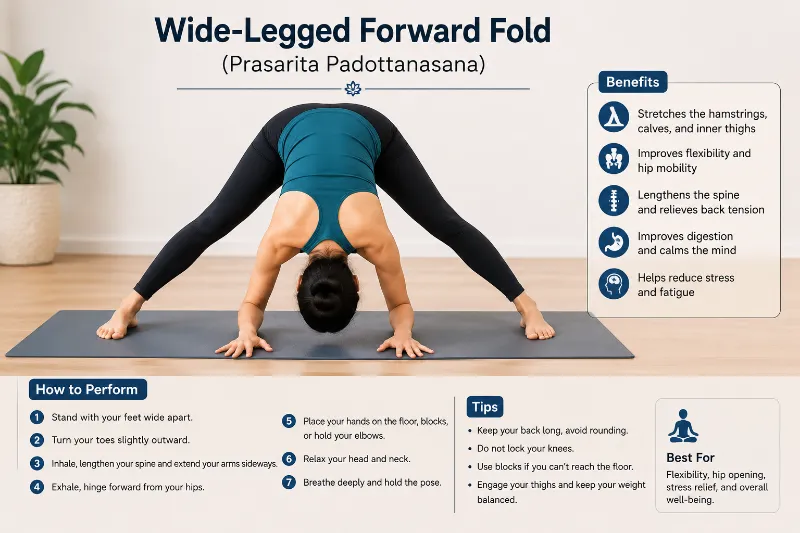
Prasarita Padottanasana is a standing yoga pose that involves a wide-legged stance and a forward fold. It gently stretches the hamstrings, calves, hips, and lower back while helping improve flexibility, balance, and circulation.
- The arm positioning varies to change the emphasis from support to strength or shoulder opening, while the leg position stays the same in the four traditional forms (A, B, C, and D). With the right alignment and the assistance of yoga blocks when necessary, this position is both beginner-friendly and challenging for more experienced practitioners.
- Overview and Significance of Wide-Legged Forward Bend in Prasarita Padottanasana
- Uttana means “intense stretch,” asana means “pose,” pada means “foot/leg,” and prasarita means “spread out.” Prasarita Padottanasana is characterised by a deep forward fold, the posture’s distinguishing motion, and a wide-legged stance.
- Prasarita Padottanasana is closely linked to contemporary, structured yoga traditions, particularly those that arrange standing poses into distinct versions. Because it increases lower-body mobility while remaining steady and approachable, it is frequently taught in Hatha, Iyengar-style alignment classes, and Vinyasa. It is also frequently practised in Ashtanga as a sequence of four forms (A, B, C, and D). These days, it’s particularly important for relieving hamstring and hip tension brought on by extended sitting and a lack of movement variation.
- The hamstrings and inner thighs (adductors) are the main muscles stretched in this position; the wide stance distinguishes the inner-thigh opening from narrow forward folds. In order to support the fold and safeguard the lower back, the quadriceps and core remain slightly active, and gravity aids in decompression and spinal lengthening. Additionally, depending on the variation, the upper back and shoulders may be used more (particularly in Variation C, with the bind).
At a Glance
- Sanskrit Name: प्रसारितपादोत्तानासन (Prasarita Padottanasana)
- Pronunciation: pruh-SAH-ree-tah pah-doh-tahn-AH-suh-nuh
- English Name: Wide-Legged Forward Bend (also: Wide-Legged Forward Fold)
- Variations: A, B, C, D
- Pose Type: Standing forward fold / mild inversion
- Level: Beginner to Intermediate (props make it beginner-friendly)
- Hold Time: 5–10 breaths (30–60 seconds)
- Primary Areas: Hamstrings, inner thighs (adductors), hips, spine, calves
- Hip and hamstring opening, spinal decompression, and the soothing inversion effect are the main advantages.
Benefits of Prasarita Padottanasana
Deep lower-body stretching, spinal release, and soothing inversion effects are all combined in Prasarita Padottanasana. Many practitioners find that the wide stance is steady and accessible while stretching areas, particularly the inner thighs, that narrow forward folds are unable to completely access.
Physical Benefits
- Lengthens Inner Thighs and Hamstrings: The wide-leg stance simultaneously stretches the adductors, or inner thighs, and the hamstrings. This dual stretch promotes better hip mechanics and increases lower-body flexibility overall.
- Decompresses the Spine: Gravity helps extend the spine when the torso bends forward. When done correctly, this can help ease minor tension and stiffness in the upper and lower back.
- Strengthens Legs and Core: The core stabilises the fold, and the quadriceps contract to support straight legs. This keeps the lower back from collapsing and increases flexibility and balanced strength.
- Enhances Hip Mobility: The broad stance expands the hip joints’ range of motion. Over time, this enhances regular movement patterns like bending and squatting and encourages deeper sitting positions.
- Benefits of Mild Inversion: Circulation patterns change somewhat when the head is below the heart, which may ease tension and soothe the nervous system. The position is grounding and centring for many practitioners.
- Reduces Tension in the Shoulders and Back: The posture can reduce tension in the shoulders and back when performed with spinal length rather than rounding. The shoulder bind enhances the benefits of chest and shoulder opening in variations such as Prasarita Padottanasana C.
Mental & Emotional Benefits
- Calms the Nervous System: Stress and mental tension are reduced by the forward-fold posture and slight inversion, which trigger the parasympathetic response.
- Enhances Clarity and Focus: Maintaining the stance for a few breaths promotes prolonged concentration and mental stillness.
- Promotes Surrender: Unlike backbends, forward folds place greater emphasis on release than on effort.
Therapeutic Applications
Prasarita Padottanasana may support the following:
- Tight hamstrings and inner thighs
- Mild lower back tension (non-acute)
- Hip stiffness from prolonged sitting
- Stress, anxiety, and mental fatigue
- Athletic recovery (runners, cyclists, field sports)
- Although there are several advantages to a wide-legged forward bend, each situation calls for unique modifications. Maintaining the pose’s safety and efficacy requires practising with correct alignment and using blocks when necessary.
Schedule a free one-on-one session right now for the best practice!
Prasarita Padottanasana: Complete Practice Guide
Part 1: Preparing for the Pose
- Before practising Prasarita Padottanasana:
- Make sure you have 4 to 5 feet of lateral room.
- To prevent foot slippage, practice on a non-slip mat.
- If your hands can’t reach the floor comfortably, keep one or two yoga blocks close by.
- Instead of pushing for maximum depth, start with a half-fold (flat back) if your hamstrings are extremely tight.
Warm-Up (Essential)
- Warm up for at least 8–10 minutes before practising:
- Mountain Pose (Tadasana): 5–10 breaths
Standing Forward Bend (Uttanasana): 30 seconds
Low Lunge (Anjaneyasana): 30 seconds each side
Butterfly Pose (Baddha Konasana): 60 seconds
Gentle wide-leg shifts side to side: 10 reps
This gets the hips, inner thighs, and hamstrings ready for a safe fold.
Part 2: Prasarita Padottanasana: Step-by-Step Instructions
- Stand tall in Mountain Pose. Step your feet wide apart (about 4–4.5 feet). To make the outer edges of your feet almost parallel, turn your toes slightly inward. Press equally through both feet while engaging your thighs.
- Your hands should be on your hips. Expand your collarbones and lengthen your spine upward.
- Breathe in to raise the chest. Breathe out and maintain your back long as you fold forward from the hips. Instead of using your head, lead with your chest.
- Put your hands beneath your shoulders on the ground. Put them on yoga blocks at any height that maintains a long spine if they can’t reach comfortably.
- To achieve a flat back, take a breath and extend your spine forward. Maintain an even weight distribution across your feet and keep your legs moving.
- Let your torso drop as you expel the breath. If it is comfortable, move your hands back a little. The head’s crown may go to the floor, but it should never be forced.
- Take 5–10 breaths (30–60 seconds) to stay. Maintain equal weight on both feet, contract your quads, and, if necessary, maintain a gentle microbend.
- Return your hands to the hips. Breathe in and raise your torso with a long back. Return to Mountain Pose by stepping your feet together.
Prasarita Padottanasana Variations
All four versions have the same beginning point: You should have strong, active legs, turn your toes slightly inward, and place your feet four to five feet apart. Bend forward from the hips, keeping your spine long.
Prasarita Padottanasana A (Foundational Version)
Focus: Hands on the ground, supported front fold.
- Inhale to stretch your spine from your broad stance.
- Breathe out and bend forward, putting your hands on the floor (or on blocks) shoulder-width apart.
- If you can, bend your elbows and walk your hands a little back between your feet.
- Keep your legs moving and your weight balanced in your heels as you let the crown of your head drop toward the floor.
Prasarita Padottanasana B (Hands on Hips)
Focus: Spinal control without arm support and hamstring strength.
- Before folding, firmly place your hands on your hips.
- Take a breath to extend and raise your chest.
- Keeping your hands on your hips, exhale and fold forward.
- When your torso is parallel or deeper, pause, then take a breath to raise yourself back up with a flat, firm back.
Prasarita Padottanasana C (Arms Bound Behind)
Focus: Shoulder and chest opening with forward fold.
- Hold a strap or intertwine your fingers behind your back.
- Take a breath to raise the sternum and expand the chest.
- Let your arms rise above your head as you exhale and fold forward.
- As you extend your arms toward the floor in front of you, maintain a relaxed posture and strong legs.
Prasarita Padottanasana D (Big Toe Grip)
Focus: Deeper hamstring stretch with a yogi toe lock.
- Reach your thumb and first two fingers to grasp your big toes as you fold forward.
- Take a breath to slightly extend your spine.
- Breathe out and extend your elbows to bring your torso closer to your legs.
- As the head’s crown descends, maintain a centred weight and solid legs.
Parivrtta Prasarita Padottanasana (Revolved Variation)
Focus: Adds spinal rotation to the wide-legged forward fold.
- Fold forward from your wide-leg position and place your right hand beneath your chest on the ground or a block.
- Take a breath, open your chest, and raise your left arm toward the ceiling.
- Maintain equal weight distribution through both feet and strong legs.
- Hold for five to eight breaths, then carefully transfer sides.
Ardha Prasarita Padottanasana (Half Variation – Beginner Friendly)
Focus: To strengthen and safeguard the spine, perform a flat-back half-fold.
- With a long, flat back, hinge forward halfway from your wide stance.
- Put your hands on your thighs, hips, or beneath your shoulders on yoga blocks.
- To stabilise your legs, contract your core and apply solid pressure through your feet.
- Maintaining spinal length, hold for five to ten breaths before straightening up.
- While increasingly testing shoulder mobility and spinal control, practising all four classical versions (A, B, C, and D) develops a comprehensive lower-body flexibility system.
Precautions & Contraindications
While many practitioners can perform Prasarita Padottanasana, focused practice is essential, especially if you have hamstring problems, spinal conditions, or blood pressure concerns.
- Avoid Prasarita Padottanasana If You Have:
- Acute inner-thigh or hamstring tear: Recent strains may be made worse by deep forward folding. Await complete recovery and medical clearance.
- Severe herniation or acute lumbar disk injury: During flare-ups, forward flexion under gravity may raise disk pressure.
- Avoid deep folds until symptoms completely subside if you have severe lower back inflammation or nerve discomfort.
- Uncontrolled hypertension: Pressure levels may be momentarily impacted by the little inversion (head below the heart).
- Head-down stance may raise cranial or ocular pressure if you have glaucoma or severe headaches.
Practice Gently or with Modifications in Case of:
- Tight Hamstrings or Recent Strain: To ease the strain on the tendons, place yoga blocks beneath your hands, bend your knees gently, and work your quads. Don’t force depth.
- Practice Ardha Prasarita Padottanasana (half-fold with flat back) if you have a sensitive lower back. Put your spinal length ahead of how far you fold, and take a steady breath to stand up.
- Knee Hypermobility: To avoid joint locking, keep your knees in a micro-bend and use your thigh muscles.
- Neck Sensitivity: Avoid allowing the head to hang loosely by keeping it neutral. The crown of the head should not be forced to the ground.
- Pregnancy (Second & Third Trimester): Practice only the half-fold variation with a wider stance and hands on blocks. Avoid deep abdominal compression and seek medical clearance.
General Safety Guidelines
- Lengthen the spine before folding.
- Never bounce in the stretch.
- Keep weight evenly distributed across both feet.
- Instead of slumping onto the hamstrings, use your legs.
- Exit slowly with core engagement.
- When necessary, use props to support alignment rather than weakness.
When to Consult a Healthcare Provider
Before starting yoga, consult a specialist if you have been diagnosed with a spinal problem, hamstring avulsion injuries, uncontrolled blood pressure, glaucoma, or persistent back, hip, or knee pain.
Exit Strategy
- If you feel a painful tug in your hamstrings, tingling down your legs, dizziness, or excruciating lower back pain, instantly bend your knees, put your hands on your thighs, contract your core, and slowly stand back. Stay in Tadasana until you are completely stable.
- Practice gradually and pay attention to your body. For individualised alignment advice based on your flexibility and medical history, schedule a free one-on-one session with a qualified Indian yoga instructor.
Prasarita Padottanasana: Related Poses
Seated Wide-Leg Forward Bend (Upavistha Konasana)
- Calms the nervous system and increases hamstring and inner thigh flexibility.
- Flex your feet while sitting on the mat with your legs wide apart.
- To extend the spine upright, inhale.
- Breathe out and bend forward from the hips, maintaining a long back.
- Hold your hands for five to ten breaths on the ground or on blocks.
Head-to-Knee Pose (Janu Sirsasana)
2. Stretches one hamstring at a time while gently decompressing the lower back.
- With one leg outstretched and the other foot pressed against the inner thigh, take a seat.
- Inhale to lift and lengthen the spine.
- Exhale and fold forward over the extended leg.
- Hold for 5–10 breaths, then switch sides.
Seated Forward Bend (Paschimottanasana)
3. Encourages profound relaxation and lengthens the entire back.
- Extend both legs straight in front of you while you sit.
- Take a breath, raise your arms, and extend your spine.
- Breathe out, then bend forward from the hips and grasp for the feet.
- Hold with a long spine for five to ten breaths.
4. A complete inversion that improves balance and concentration while strengthening the shoulders and core.
- Interlace your fingers and place your forearms on the mat with your elbows shoulder-width apart.
- Lightly place the head’s crown between your hands on the ground.
- Elevate your hips and carefully elevate your legs above your head.
- After maintaining a steady grip, slowly descend and rest in Child’s Pose.
FAQs
What is Prasarita Padottanasana?
Wide-Legged Forward Bend, also known as Prasarita Padottanasana, is a standing forward fold in which the torso bends toward the floor and the feet are spaced four to five feet apart. It has four traditional versions (A, B, C, and D) with varying arm positions. The pose provides minor inversion advantages while stretching the inner thighs and hamstrings.
What Are the Differences Between Prasarita Padottanasana A, B, C, and D?
The same wide-leg posture is used in all four variants. The hands are on the floor in Variation A, remain on the hips in Variation B, clasp behind the back in Variation C, and grasp the big toes with the fingers in Variation D. While keeping the lower-body stretch, each variation modifies the involvement of the arms and shoulders.
Can beginners practice Prasarita Padottanasana?
Definitely, beginners can perform Ardha (half) Prasarita Padottanasana with a flat back using blocks beneath the hands. Compared to narrow forward folds, a broad stance frequently offers greater stability.
Schedule a free one-on-one session right now for the best beginner-friendly practice!
What are the benefits of Prasarita Padottanasana?
Through its gentle inversion, Prasarita Padottanasana opens the hips, lengthens the hamstrings and inner thighs, decompresses the spine, and soothes the nervous system. Additionally, it enhances posture, balance, and leg strength.
Is Prasarita Padottanasana good for tight hamstrings?
Sure. Compared to tight forward folds, the wide stance makes the stretch more accessible by distributing it throughout the inner thighs and hamstrings. Progress can be made safely and gradually by using yoga blocks and maintaining a small knee bend.
What Is the Ideal Foot Distance for Prasarita Padottanasana?
The majority of practitioners set their feet four to five feet apart. A wider stance may be necessary for taller people. Maintaining stability and preventing lower back or groin strain are crucial.
References:
- Allen, W. (2026a, February 26). Prasarita Padottanasana. https://myyogateacher.com/yoga-asana/prasarita-padottanasana
- Yoga Journal. (2025c, February 25). Wide-Legged Standing Forward Bend. https://www.yogajournal.com/poses/wide-legged-forward-bend/
- Wide-legged forward fold Pose Flow Yoga(Prasarita Padottanasana Vinyasa)| Yoga sequences, benefits, variations, and Sanskrit Pronunciation | Tummee.com. (n.d.). Tummee.com. https://www.tummee.com/yoga-poses/wide-legged-forward-fold-pose-flow