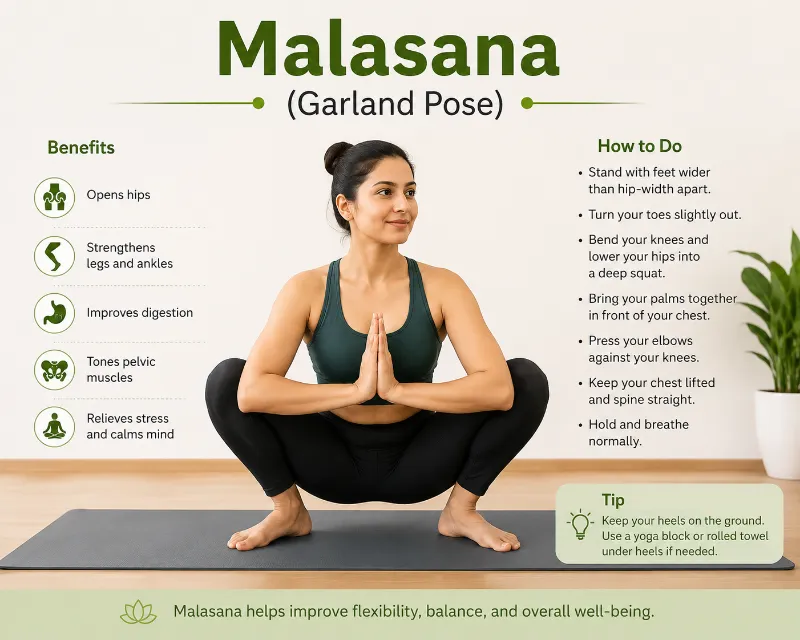
Malasana (Garland Pose)
What is Malasana (Garland Pose)?
Malasana, also known as Garland Pose, is a deep squat yoga pose that increases leg and ankle mobility, reduces tension in the lower back, and relaxes tight hips.
Regular practice of this mild, beginner-friendly pose can support improved posture, ease stiffness from extended sitting, and even make you feel more at ease and rooted.
Malasana: Overview and Meaning of Garland Pose
- Malasana, also known as Garland Pose, is a deep squat with roots in India’s ancient yogic and cultural traditions. It is comparable to the natural resting position used for eating, cooking, gardening, getting rid of waste, and even getting ready to give birth in traditional Indian living.
- It produces a sensation of equilibrium and serenity by focusing the mind and stabilising the body. It is frequently performed before pranayama or meditation. It activates the Muladhara (Root) Chakra, which promotes emotions of stability, security, and awareness. Malasana is a spiritual symbol of humility and submission. The circular shape of the position, like a garland, symbolises unity, continuity, and the inherent rhythm of existence.
- Anatomically, Malasana improves the glutes, quadriceps, calves, and deep hip rotators while also strengthening the hip flexors, groin, lower back, and ankles—areas that are frequently stiffened by extended sitting. The position, which gently activates the pelvic floor and core for balance and support, includes ankle dorsiflexion, hip and knee flexion, and modest spinal elongation.
- Frequent Malasana practice improves mobility, balance, digestion, and nervous system serenity while restoring the body’s natural alignment and connection to breath.
At a Glance
- Sanskrit Name: मलासन / मालासन
- Pronunciation: MAH-lah-sah-nah
- Pose Type: Deep squat / hip-opener
- Also Known As: Garland Pose, Yoga Squat
- Strengthens: Glutes, thighs, calves, pelvic floor, core?
- Stretches: Hips, ankles, groin, lower
Benefits of Malasana
The Garland Pose, also referred to as the yoga squat, is more than just a deep stretch. This traditional pose helps with digestion, strengthens the lower body, supports the mind and breath, and promotes pelvic and reproductive health.
Let’s explore the many benefits of the Malasana squat, grouped by category:
Physical Benefits of Malasana
- Builds strength in the quadriceps, calves, and glutes, strengthening the lower body.
- Deeply opens the hips: The groin, hip flexors, and deep hip rotators are stretched in this position.
- Increases ankle flexibility: Squatting promotes ankle dorsiflexion, which enhances gait and balance.
- Promotes pelvic health: The posture enhances tone and circulation in the pelvic area by naturally activating the pelvic floor muscles. This is especially helpful for postpartum recovery.
- Compresses the lower belly gently to promote digestion and may alleviate constipation or bloating symptoms.
- Reduces lower back pain: Malasana aids in reversing compression brought on by bad posture or a desk job.
- Strengthens your balance and coordination over time by increasing proprioception, or your awareness of your body’s location in space.
Reproductive & Women’s Health Benefits
- Malasana naturally opens the pelvic outlet, giving the hips and sacrum more room and flexibility, which prepares the body for childbirth.
- Tones the pelvic floor: The alignment of the reproductive organs, bowel movements, and bladder health are all supported by mild activation of the pelvic base muscles.
- Promotes menstrual health: Frequent practice may lessen pelvic congestion and help control the menstrual cycle.
- Reduces discomfort during pregnancy: Malasana can assist expecting mothers in reducing strain in their hips and lower back, increasing circulation and lowering oedema.
Emotional and Spiritual Benefits
- Encourages stability and grounding: Malasana relieves restlessness and anxiety by making you feel centred and rooted in the soil.
- Promotes emotional release: The deep hip opening makes room for relaxation and ease by encouraging the body to release tension and emotions that have been retained.
- Activates the Root Chakra (Muladhara): This energy centre is stimulated by the pose, which promotes emotional resilience, safety, and balance.
- Develops spiritual connection: Regular Malasana practice can help you feel more present and remind you of your connection to life’s natural rhythms.
How to Do Malasana (Garland Pose): Step-by-Step Guide
Part 1: Preparing for Malasana
Before attempting Malasana, warm up your spine, hips, and ankles. You may enhance mobility, lessen strain, and sink deeper into the squat with good alignment by performing these mild preparation postures.
Ankle Circles
- Stiff ankles can be loosened and made ready for deep dorsiflexion with a gentle ankle movement.
- Stand tall and lift one foot.
- Roll your ankle ten times in each direction in gentle circles.
- Switch sides.
Hip Circles
- Tension in the hip sockets and groin can be released using hip circles.
- Stand with feet hip-width apart, hands on hips.
- Make wide, slow circles with the hips.
- Repeat 5–8 times in each direction.
Leg Swings
- These mobilise the hip flexors and hamstrings.
- Stand near a wall for balance.
- Swing one leg forward and back like a pendulum.
- Repeat 10 times per leg.
- The lower back and spine are prepared for upright posture by this little twist.
- Sit cross-legged.
- Inhale and lengthen the spine.
- Exhale, twist gently to one side.
- Hold for 3–5 breaths.
- Switch sides.
Butterfly Pose (Baddha Konasana)
- The hips and inner thighs are gently opened in this pose.
- Sit with soles of feet together, knees wide.
- Flap your knees gently up and down while holding your feet.
- Hold for 30–60 seconds with relaxed breath.
Part 2: Step-by-Step Instructions for Malasana
- Turn your toes at a 45-degree angle, place your feet slightly wider than hip-width, and let your arms hang freely by your sides. Take several deep breaths to centre yourself and prepare for the squat.
- As you exhale, slowly bend your knees and descend your hips toward a squat, distributing your weight equally over both feet while maintaining a raised chest and a tall spine.
- Track in line with your toes and bring your hips as near to your heels as is comfortable while letting your thighs naturally split.
- Maintain a neutral spine without rounding your lower back, and keep your heels grounded with a rolled blanket or block if necessary.
- In Anjali Mudra, bring your palms together at your heart, then insert your elbows into your knees and gently push them apart while pulling them inward on your
- Raise your chest while maintaining your shoulders as you extend your spine upward from the base to the head.
- Maintain a calm, steady gaze while using your core and pelvic floor muscles to support the position.
- If you’re a novice, stay in the posture for 30 to 60 seconds; if you’re an intermediate practitioner, stay in it for 1 to 2 minutes; if you’re an advanced practitioner, stay in it for up to 3 to 5 minutes.
- To emerge, support yourself with your hands on the ground, take a breath, and gently press into your feet to stand up.
- To reset your body and mind, go back to Tadasana (Mountain Pose) and take two to three deep breaths.
Part 3: Tips for Proper Alignment and Safety
- Keep your heels down. If necessary, place a rolled blanket, block, or wedge beneath the heels.
- Avoid bending your knees inward. Always keep an eye on your toes.
- For improved balance and lower back support, activate your pelvic floor and core.
- If your hips are uncomfortable lowering to the heels, support them by sitting on a yoga block.
- You can use the wall behind you or in front of you to gain balance.
- Avoid hunching forward. Keep chest lifted and back elongated.
- Cool Down: After Malasana, cool down in:
- Supine Twist
Malasana Variations
Beginners can perform Garland Pose (Malasana), but expert practitioners will find it challenging. With the aid of props, adjustments, and inventive transitions, you can modify this deep squat to suit your body and gradually improve your technique.
Beginner Modifications
Supported Malasana
- Gradually increases strength, relieves hip and knee pressure, and promotes improved posture.
- Under your sitting bones, place a cushion, bolster, or yoga block.
- Take a deep breath, relax here, and change the height as necessary.
- Hold 2–3 minutes comfortably.
Wall-Assisted Malasana
- makes the posture more stable by lowering ankle and core strain.
- Use the wall for balance as you lower yourself into Malasana while standing with your back slightly touching a wall.
- Keep chest lifted and knees aligned with toes.
- Hold and breathe steadily.
Heels-Elevated Malasana
- relieves pressure on the ankles, maintaining the height of the spine.
- If your heels rise off the floor, place a yoga wedge or rolled blanket beneath them.
- Maintain a long spine and outward-tracking knees as you squat into Malasana.
- Breathe steadily and hold.
Intermediate Variations
Malasana with Twist
- opens the chest, facilitates digestion, and enhances spinal movement.
- From Malasana, gently twist your spine while placing one hand on the floor and raising the opposing arm toward the ceiling.
- Hold 30–45 seconds on each side, breathing slowly.
Dynamic Malasana
- Builds leg strength, warms up joints, and enhances breath-coordination.
- Breathe in to raise and out to descend into a squat as you transition between standing and squatting.
- Repeat 8–12 times with mindful breathing.
Malasana Flow
- Increases range of motion, coordination, and body heat.
- Move in a flowing sequence from Mountain Pose? Malasana? Forward Fold? Mountain Pose.
- Link movement with breath for a continuous flow.
Advanced Variations
Malasana on Tip Toes
- Strengthens calves, challenges core stability, and improves balance.
- Lift your heels off the mat while balancing on the balls of your feet in Malasana.
- Hold for a few breaths while keeping the chest raised and using your core.
Malasana with Side Bend
- promotes hip flexibility, tones the obliques, and deepens lateral stretch.
- Lean to one side from Malasana, place your hand on the ground beside your foot, and stretch the other side.
- Hold 30 seconds, then switch sides.
Malasana (Garland Pose): Precautions and Contraindications
Although Garland Pose, or Malasana, has numerous psychological and physical advantages, it’s crucial to approach the pose consciously and adjust or avoid it in specific situations. Here are some pointers for safe behaviour.
Avoid Malasana if you have:
- Acute Knee Injuries: The deep pressure Malasana places on the knees may worsen discomfort, inflammation, or instability in injured or healing joints.
- Severe Ankle Injuries: The squat calls for a significant amount of ankle dorsiflexion. Avoid deep squats without permission if your ankle is healing from a fracture, sprain, or surgery.
- Recent Hip or Pelvis Surgery: The pelvic area is deeply engaged and stretched in this pose. Implant misalignment or healing tissue tension can result from practising too soon after surgery.
- Severe Lower Back Injury: Deep hip flexion can worsen lumbar instability, sacroiliac joint dysfunction, and herniated disks, among other spinal disorders.
- Advanced Pregnancy Complications: Although malasana is frequently beneficial throughout pregnancy, it should be avoided in high-risk pregnancies, placenta previa, or if a healthcare professional advises against deep squatting.
- Severe Varicose Veins: People with vascular issues may find that prolonged squatting restricts blood flow and increases venous pressure in the legs.
Practice with Caution in case of:
- Pregnancy (All Trimesters): Malasana is usually regarded as safe and helpful for expanding the pelvis during pregnancy, particularly in the third trimester. But always keep an eye on your comfort level, don’t hold for too long, and use props for assistance.
- Knee Osteoarthritis: Malasana can put a lot of pressure on the knees. Avoid pushing the depth; instead, use a yoga block or bolster for support.
- High Blood Pressure: Prolonged squatting may raise intra-abdominal pressure or result in blood pooling. Avoid holding your breath, and keep the hold light and short.
- Balance Disorders: If you’re worried about your stability during descending or maintaining the squat, use a chair or wall for support.
- Restricted Ankle Mobility: The position is made more accessible and less taxing by using props like a wedge or wrapped blanket beneath the heels.
Safety Tips for Malasana
- Go slowly: To reduce tension, let your body open gently without forcing depth.
- Utilise props: For comfort and alignment, raise your heels, sit on a block, or utilise wall support.
- Take note of your body: If you have back pain, knee pain, vertigo, or hip pinching, stop immediately.
- Warm up first: Mobilise hips, ankles, and spine before practising.
- Gradually increase hold time and depth, beginning at around 30 seconds each week.
- Seek advice: A trained teacher can guarantee safe practice and make recommendations for changes.
- For individualised assistance on Garland Pose, schedule a free one-on-one session right now!
Malasana (Garland Pose): Related Poses
These poses enhance the hip-opening and grounding advantages of Malasana while providing fresh approaches to lower body strength and stretch:
Butterfly Pose (Baddha Konasana)
- In order to prepare the body for deeper squats, this seated position softly expands the hips and inner thighs.
- Sit with your legs extended.
- Bring the soles of your feet together as you bend your knees.
- Let your knees fall toward the ground while holding your feet with your hands.
- Breathe deeply for 30 to 60 seconds while maintaining a tall spine.
Pigeon Pose (Eka Pada Rajakapotasana)
- This deep hip opener relieves stress from extended sitting by focusing on the glutes and outer hips.
- Start in the downward dog or plank position.
- Extend your left leg behind you while bringing your right knee forward toward your right wrist.
- Square your hips forward and lengthen your spine.
- Hold for 30–60 seconds and switch sides.
- By strengthening the legs and stretching the hip flexors, this pose helps with squat balance.
- Lunge forward with your right foot while maintaining your left knee on the mat.
- While maintaining an elevated chest, sink your hips.
- Stretch your arms above your head or maintain them on your front leg.
- After 20 to 30 seconds of holding, switch to the opposite side.
FAQs
What is Malasana good for?
Garland Pose, also known as Malasana, is great for increasing ankle flexibility, strengthening the legs, and expanding the hips. Additionally, it promotes pelvic health, stimulates the digestive system, and helps reduce stiffness brought on by extended sitting or sedentary lifestyles.
Can beginners do Malasana?
Yes! When practised with the appropriate adjustments, malasana is suitable for beginners. Use a wall for balance, a rolled blanket beneath your heels, or a yoga block or cushion beneath your hips.
Is Malasana safe during pregnancy?
In most cases, yes. By expanding the pelvis and relieving tension in the lower back and hips, Malasana can help the body become ready for childbirth. But it’s advisable to see your physician first, and props should always be used for safety and support.
What are the benefits of the Malasana squat?
The Malasana squat opens the hips deeply while strengthening the thighs, calves, and glutes. It is good for core stability and reproductive health since it increases ankle mobility, promotes digestion, and involves the pelvic floor.
How is Malasana different from a regular squat?
Malasana is a static, grounding yoga pose as opposed to gym-style squats that emphasise strength and repetition. It is frequently practised with hands in the prayer position (Anjali Mudra) and focused quiet, emphasising mobility, breath, and hip opening.
Is Malasana good for constipation?
Yes, Malasana (Garland Pose) helps relieve moderate constipation because it increases bowel movement, stimulates digestion, and softly massages the abdominal organs.
References:
- Allen, W. (2026e, February 27). Malasana. https://myyogateacher.com/yoga-asana/malasana
- Malasana (Garland Pose) history | Tummee.com. (n.d.). Tummee.com. https://www.tummee.com/yoga-poses/garland-pose/history
- Yoga Journal. (2025, March 21). Malasana (Garland pose or squat). https://www.yogajournal.com/poses/garland-pose/

4 Comments