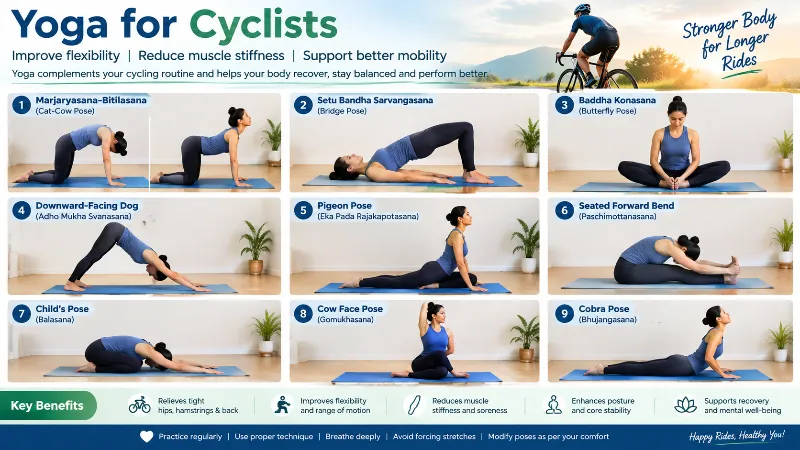
Yoga for Cyclists
Introduction
When it comes to better performance, you could prioritize power, speed, and endurance. However, your performance can also be changed by your strength, mobility, and mental toughness. Try yoga for bikers to address all three of those factors.
In many forms of yoga, a series of poses is combined with your breath to create a potent mind-body practice. Yoga adds a mindful component that might help you better handle lengthy or challenging rides through deep, fluid breathing and meditation. And that’s only the start of the advantages.
Here are some facts regarding yoga for cyclists, how incorporating it into your routine might improve your rides, and the ideal starting sequence.
The Benefits of Yoga for Cyclists
Strength: Yoga can help you develop some of the strength you need for the road because it incorporates features like balance and shoulder and core stability. (However, this doesn’t mean that you should forgo conventional strength training.) You’ll perform a lot of isometric exercises, which can strengthen your core and, according to studies, even lower blood pressure.
Mobility: Yoga’s flexibility component helps bikers increase their range of motion, which is extremely advantageous. For instance, hip-opening exercises like the crescent lunge and pigeon pose can enhance pedaling mechanics and increase bike mobility.
Research indicates that yoga can also enhance spinal flexion, which reduces pain in the lower back.
Recovery: Stretching may aid in the body’s recovery from riding, but yoga may have even greater ability to ease mental stress. It creates a sense of peace since it pushes you to be in the now and take deep breaths.
According to research, yoga can even help reduce work-related stress, which may reduce mental fatigue and eventually improve performance.
Improved flexibility: Yoga is known for its capacity to increase flexibility since it includes a variety of poses that strengthen and stretch various muscle groups throughout the body. Everyone benefits from increasing flexibility, but cyclists especially need to do so because the repetitive nature of riding can cause tension in the lower back, shoulders, hamstrings, and hips. Increasing these areas’ flexibility and mobility may reduce pain and injury risk.
Enhanced balance and stability: In addition to strengthening the core and stabilizing muscles, holding and switching between various yoga positions calls for a great deal of balance and coordination. Better stability and balance on the bike may result from this. This is essential for managing different terrain and keeping control when riding.
Improved posture: When you spend a lot of time bending over on a bike with your neck outstretched, your upper body might get tired and stiff. This, along with tense lower back and leg muscles from pedaling, can lead to bad posture. Yoga can help with this in two ways: by promoting awareness of body alignment to improve posture both on and off the bike, and by strengthening and stretching the muscles to rectify imbalances.
Better breath control: Regular practice of yoga helps strengthen the diaphragm and enhance breathing technique since it emphasizes controlled and mindful breathing. This can help you manage your energy, expand your lung capacity, and improve endurance during your rides, allowing you to bike farther and faster.
Improved focus and mental resilience: Even while cycling is fun, it can be mentally and physically exhausting. Yoga combines meditation and relaxation, giving cyclists the tools they need to reduce stress, sharpen their focus, and stay upbeat while riding and competing.
Better mind-body connection: Yoga promotes a close relationship between the body and mind. Like many others, I’ve observed that I’ve become more conscious of my body’s signals, which enables me to spot possible problems early on and take action before they worsen.
How to Add Yoga to Your Schedule
You can only get the intended outcomes from yoga by consistent practice, just like you can with anything you wish to master. An hour-long yoga session would not be possible for the majority of riders on a daily basis.
However, there is a quick and easy procedure that you may simply practice on a daily basis. This sequence, which is often called a sun salutation, is essential to all branches (or styles) of yoga because it symbolizes the fundamental, full-body opening.
To learn appropriate form, watch Yanik Faylayev, a qualified yoga instructor, demonstrate the sun salutation below. A yoga mat is required.
If you’re new to yoga, it’s best to concentrate on correct alignment first, then work on your form and breathing in this sequence before moving on to other poses. Just five repetitions of the sequence each day will improve your knowledge of muscle awareness, spinal alignment, and breath control, all of which are related to your pedal stroke.
To get the most out of it, execute this sequence either before or after rides.
Best Yoga Poses for Cyclists
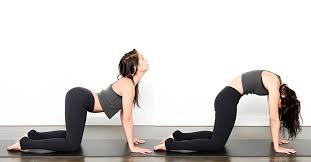
Marjaryasana-Bitilasana (Cat-Cow Pose)
Steps:
- Begin on your hands and knees with your knees hip-width apart and exactly beneath your hips, and your wrists directly under your shoulders.
- Breathe in, arch back, and lower your belly toward the mat to enter cow pose. Raise your chin to look at the ceiling. Draw your shoulders away from your ears and spread your shoulder blades wide.
- Breathe out, then round your back and draw your stomach to your spine to achieve cat pose. Allow your head to drop to the floor.
- Continue using the breath.
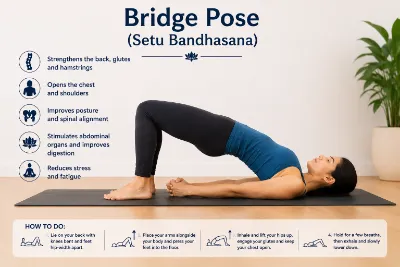
Setu Bandhasana (Bridge Pose)
Steps:
- Bend your knees and place your feet on the ground while lying face up. Arms should be extended along the sides.
- Put your feet and arms firmly on the floor. As you raise your hips toward the ceiling, release the breath. Raise and lower your shoulders. Apply equal weight to each of your feet’s four corners. Hold for a single breath.
- Breathe out as you carefully return your spine, vertebra by vertebra, to the mat.
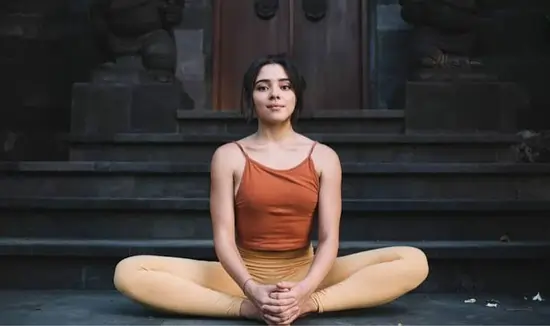
Baddha Konasana (Butterfly Pose)
Steps:
- Sit with your back extended and your chest raised.
- As you exhale, bend your knees and touch the soles of your feet. Don’t push your knees down; rather, let gravity gently bring them down.
- Hold for a few breaths.
- If you are more flexible, you can fold forward to bring your forehead to your feet or your chest to the floor, but this may be your limit.
- Relax into the pose and hold it for a few breaths.
Adho Mukha Svanasana (Downward-Facing Dog)
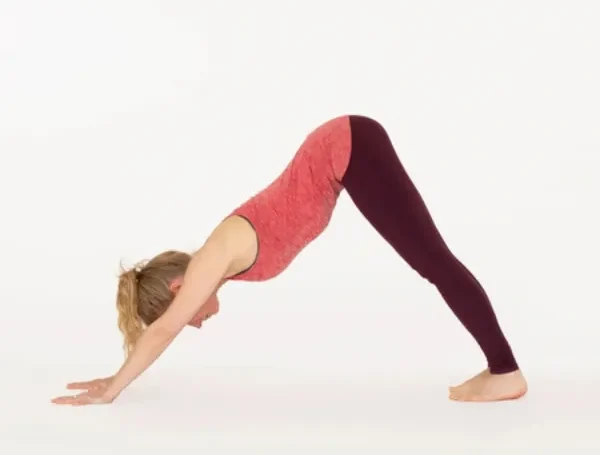
Steps:
- Get on your hands and knees, placing your knees beneath your hips and your wrists under your shoulders. Press equally through the palms while spreading your fingers wide.
- As opposed to locking the elbows, maintain a little bend. To stabilize the shoulders and widen the upper back, gently rotate the upper arms outward so that the biceps face slightly forward.
- As you exhale, tuck the toes under and raise your knees off the mat. To create an inverted V shape, raise and lower your hips. At first, keep the knees bent.
- Using your hands to push the floor away, concentrate on extending from the wrists to the hips. Without contracting the shoulders, let the chest approach the thighs softly.
- To maintain proper alignment, keep your knees bent if your hamstrings are tight. Maintain a long spine while progressively straightening the legs if flexibility permits. Heels do not have to come into contact with the ground.
- Avoid flaring the ribs by softly drawing the lower abdomen in. In addition to protecting the lower back, this core support maintains the pose’s equilibrium.
- With the neck relaxed, let the head rest freely between the arms. Don’t try to look forward; rather, focus on the navel or thighs.
- Maintain the position and take steady breaths:
- Novices: five to ten breaths
- Intermediate: ten to twenty breaths
- Advanced: a minute or three
- Every breath adds length to the spine, and every breath out lets the body settle.
- Return to Tabletop or Child’s Pose after bending the knees and lowering them softly to the mat. Before carrying on with your exercise, take a few breaths to pause.
Eka Pada Rajakapotasana (Pigeon Pose)
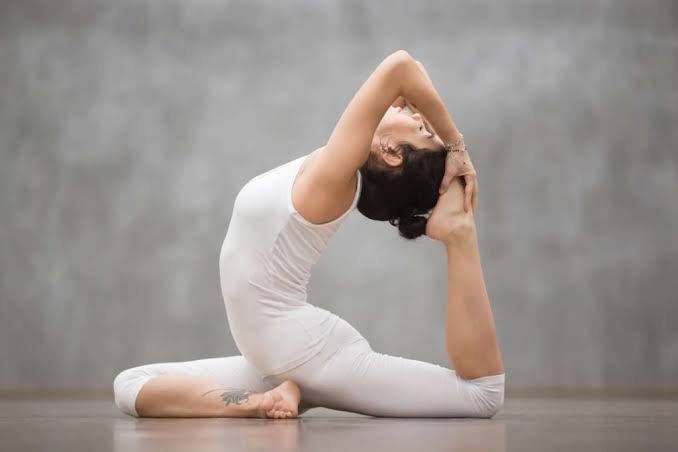
Steps:
- Take a deep breath while resting your spine and core in the Downward Facing Dog stance to begin.
- In the Downward Dog stance, take a breath, raise your right leg, release it, and bring it down between your wrists.
- Make sure your right foot is near your left wrist and your right knee is near your right wrist.
- With your heels facing the ceiling and your toes pointed, keep your left leg extended behind you. Sit comfortably on the mat with your hips square.
- As you extend your spine, contract your core, and open your chest, take another breath.
- Bend your neck backward and softly arch your lower back by exhaling. Your pelvic, tailbone, and chest muscles will become even more open as a result.
- Take a breath, bend your left leg behind you, and use your left hand to grasp the ankle till you feel comfortable.
- After you’re comfortable enough, twist your elbows toward the ceiling while holding onto your left toe with both hands. Make sure your arms are positioned above your head.
Paschimottanasana (Seated Forward Bend)
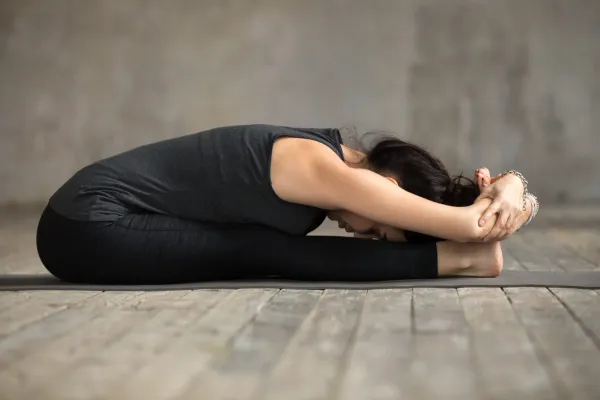
Steps:
- Maintaining an upright posture and flexing your toes toward you, sit up with your legs extended straight ahead of you.
- Stretch up and raise both arms above your head while taking a deep breath.
- Breathe out and lean forward from the hips, bringing your chin closer to your toes. As you move forward toward the toes rather than downward near the knees, maintain an upright posture.
- Grab your toes and pull to propel yourself forward if you can.
- Take a deep breath, raise your head a little, and extend your back.
- Move the navel slightly in the direction of the knees while exhaling.
- Do this motion two or three times.
- For 20 to 60 seconds, lower your head and take deep breaths.
- Extend your arms in front of you.
- Take a deep breath and raise yourself back up to a sitting position using your arm power.
- Exhale and bring your arms down.
Balasana (Child’s Pose)
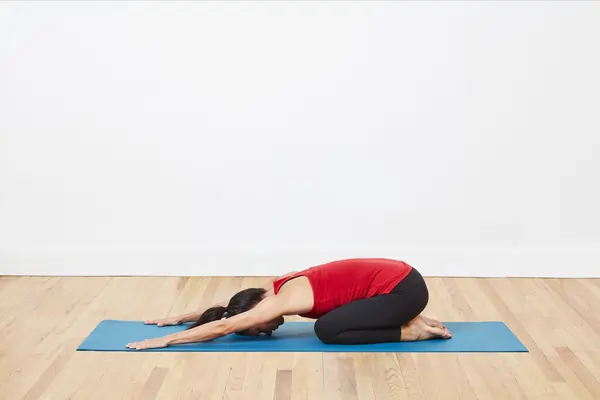
Steps:
- Align your wrists under your shoulders and place your knees hip-width apart. To ensure that the tops of your feet lie gently on the mat, point your toes straight back.
- Keep your knees apart and allow your big toes to gently contact. As you fold forward, this makes room for your chest and abdomen.
- Breathe out slowly and shift your hips in the direction of your heels. Pay attention to your thighs and knees and just go as far as is comfortable.
- Place your face on the mat or a cushion and let your chest drop naturally between or over your thighs.
- Put your arms in this position:
- Extended version: To lengthen your spine, extend your arms forward, palms down.
- Restorative version: For more profound relaxation, place your arms next to your body with your palms facing up.
- Let your shoulders drop away from your ears and your chest relax in the direction of the mat.
- Breathe in to extend your sides and back; breathe out to relieve tension. Depending on how comfortable you are, stay for 30 seconds to several minutes.
- Maintaining a long spine, slowly raise your torso upright while walking your hands back toward your knees.
Gomukhasana (Cow Face Pose)
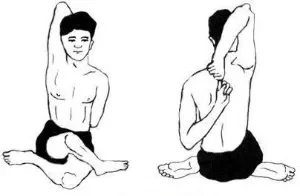
Steps:
- Sitting erect in the middle of your yoga mat, ensure that your head, neck, and spine are all balanced.
- Start by assuming the Seated Staff Pose. Maintain a straight line with your legs extended.
- From your knees, bend both of your legs. Now place your right thigh on top of your left thigh after moving your right leg over it.
- Now place your feet on opposing sides, equally spaced from the hips, and stack your knees on top of each other.
- For a few seconds, concentrate on taking deep breaths. Take a deep breath, raise your right arm, bend it at the elbow, and place your right hand behind your back.
- Now, bend your left arm from your elbow and stretch it behind your back from the side of your left oblique.
- Breathe out, then inhale deeply once more while holding hands.
- Hold your breath for a few seconds while straightening your spine, interlocking both hands, opening your chest, engaging your pelvis, and closing both eyes.
- Breathe out and carefully loosen your hands behind your back.
- Inhale, release your legs, and relax in staff pose.
Bhujangasana (Cobra Pose)
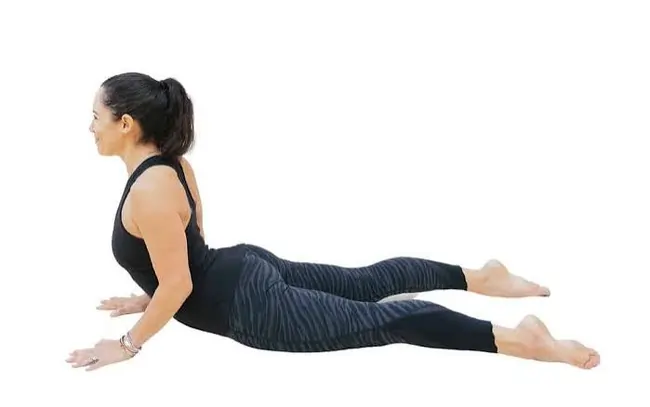
Steps:
- Extend your legs and gently press the tops of your feet into the floor while lying face down on the mat. Put the mat to your forehead.
- Spread your fingers widely, place your palms flat under your shoulders, and keep your elbows tight to your body.
- Gently engage your glutes while you press your feet, thighs, and legs into the mat.
- Take a breath, raise your chest using your back muscles, and press your pubic bone down.
- Expand your collarbones and raise your sternum forward by rolling your shoulders back and down.
- As comfortably as you can, straighten your arms while keeping your elbows supple and your eyes gently forward or slightly upward.
- Hold your breath continuously for 15 to 30 seconds if you’re a beginner, or up to 1 to 3 minutes if you’re an expert.
- Breathe out, gently place your forehead, shoulders, and chest on the mat, then tilt your head to one side to ease your neck.
Safety Precautions
Before adding or significantly altering a yoga routine, get the proper professional advice if you have a musculoskeletal injury, serious back or neck issues, recent surgery, joint inflammation, or ongoing pain associated with cycling.
Cycling and yoga have a lovely complementary quality. While the other allows you time to investigate the moves you could have overlooked along the road, the first asks you to proceed.
When practiced regularly and tailored to each rider’s needs, even brief yoga sessions can enhance a riding regimen. It doesn’t have to be difficult, drawn out, or demanding. Developing flexibility for its own sake is not the goal. It is to keep your movements diverse, pay attention to your body’s signals, and give recovery a real role in your training.
Start your next cycle before getting back on your bike. Sometimes it starts with how effectively you let yourself bounce back from the previous one.
Conclusion
All things considered, yoga for cyclists is a fantastic way to increase your strength, flexibility, and mobility while also making cycling simpler. Additionally, even if the yoga poses described above are excellent, there’s no need to incorporate additional possibilities. A healthier, more balanced body is the ultimate goal, after all.
FAQs:
Is yoga good for cyclists?
Can cyclists benefit from yoga? Yes, By enhancing range of motion, functional strength, balance, breathing, and focus, yoga helps with recovery and reduces the stiffness that repetitive cycling causes in the hip flexors, quadriceps, and calves.
What is the 80% rule in cycling?
The “80% rule” in cycling refers to polarised training, in which 20% of riding time is devoted to tougher efforts and the remaining 80% is spent at low intensity. This method separates simple endurance sessions from high-intensity exercises, as opposed to riding relatively hard every day.
Is cycling 20 km a day good?
That being said, those 20 kilometers will help you a lot and probably keep you quite fit, unless you eat more because you exercise (it is very easy to feel hungry and overeat after doing an activity). You will lose weight as long as you consume at a calorie deficit.
Is cycling better than the gym?
It does depend to some extent on your fitness objectives. Cycling won’t help you gain muscle mass as much as the free weights and equipment found in a gym. However, riding is a great way to increase general fitness and physical activity.
References:
- The Bicycling Editors. (2024, July 4). Yoga for cyclists: 11 essential poses to help you recover. Bicycling. https://www.bicycling.com/training/a20008906/yoga-for-cyclists/
- Alkayyal, M. (2026, October 6). Yoga And Stretching For Cyclists: Benefits And Poses To Try. https://www.puregym.com/blog/yoga-for-cyclists/. https://www.puregym.com/blog/yoga-for-cyclists/
- Watson, J. (2023, September 3). Yoga for Cyclists: 11 Best Yoga Sequences for Bikers. https://www.bikethesites.com/yoga-for-cyclists/. https://www.bikethesites.com/yoga-for-cyclists/
- The Yoga Institute. (2022a, July 4). Yoga for cyclists : Stretches and poses to support mobility and recovery. The Yoga Institute. https://theyogainstitute.org/yoga-for-cyclists