Gentle Yoga Routine for Better Sleep
Introduction
You may be struggling to get a good night’s sleep. You could be going to bed late, waking during the night, or just not feeling refreshed after 8 hours’ sleep.
A gentle yoga flow can help to encourage relaxation. Slow breathing combined with relaxing postures and holding postures can help move the body from ‘activating’ mode to ‘calm’ mode. Doing the right yoga before bed can therefore help to naturally relax your nervous system.
Within this article, we will show you 8 calming yoga postures to help you sleep, 1 easy yoga gesture (Mudra), and a 10-minute bedtime yoga sequence to try tonight.
Why Yoga Helps You Sleep Better
By stimulating the parasympathetic nervous system (relaxation response) in the body, yoga can cause slower breathing, relaxation of muscles, and inform the body that it is safe to relax. Studies suggest that slower breathing techniques can increase activity in the vagus nerve to increase relaxation in the body.
Gentle postures performed slowly can allow the body to enter a relaxed state. Forward bends, opening the hips, twisting postures, and rest postures with props can all assist in relaxing the body. Paired with controlled breathing, this can assist with reducing the feelings of restlessness often felt at night.
Studies have found that practicing yoga can be very effective in improving sleeping efficiency, duration, sleep issues, and daytime difficulties in midlife and older age groups. Although yoga is not a cure for all sleep problems, it can be a great natural addition to a bedtime routine.
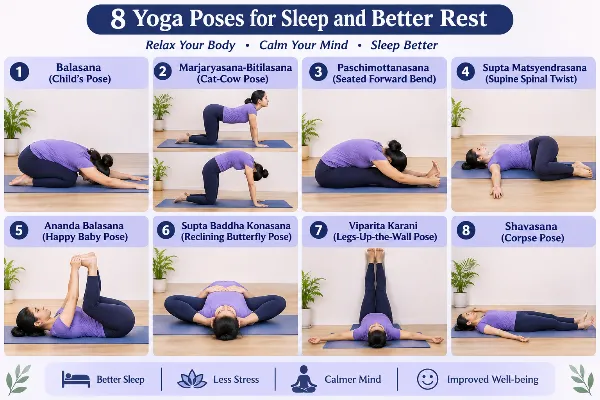
8 Yoga Poses for Sleep and Better Rest
Gentle poses that do not require much effort will help you get a good night’s sleep. Breathe gently and do not overstretch your body. The following poses can help:
Balasana (Child’s Pose)
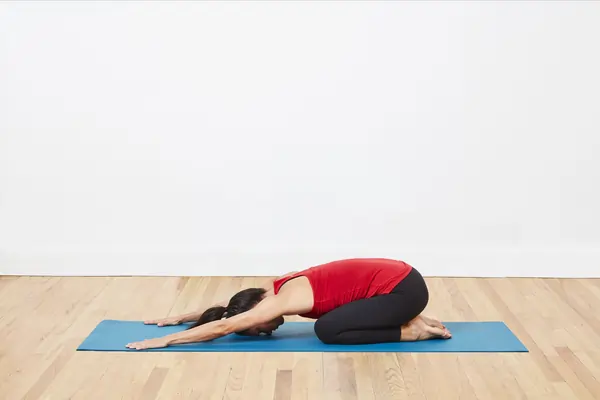
- Align knees so that they are hip-width apart and ensure that your wrists are under your shoulders. Point your feet straight back and rest the tops of your feet on the floor.
- Allow your big toes to lightly touch but keep your knees apart. This will give extra room around your tummy and chest.
- Exhale and slowly lower your hips towards your heels. Only lower as far as is comfortable.
- Allow your chest to come between or onto your thighs. Lower your forehead so it is resting on the floor (or bolster).
- Arms: To lengthen the spine, extend arms forwards with palms facing down.
- To gain more relaxation, place arms along your sides with palms facing up.
- Relax your chest and let your shoulders fall from your ears.
- Inhale and allow your back and sides to open. Exhale and release. Hold this pose for between 30 seconds and several minutes, depending on your level of comfort.
- Move your hands towards your knees and slowly return your upper body to an upright position. Ensure you have nice spinal length.
Marjaryasana-Bitilasana (Cat-Cow Pose)
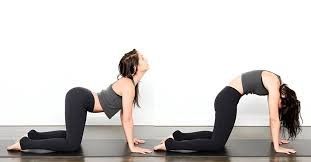
- Move into tabletop position. Hands should be in line with shoulders and knees to hips. Spread the fingers, and maintain a long spine and neck. Breathe slowly and evenly.
- As you inhale, lower your abdomen, lift your chest, create space across the collarbones, pull the shoulders down and away from the ears, lift your sit bones, and gently lift your gaze (Cow). Pause to take a few deep breaths. Feel the openness across your chest. You are ready to go back.
- As you exhale, press your palms into the floor, round your spine towards the ceiling, tuck your navel in, and lower your tail bone/neck. Feel a lengthening in your upper back (Cat).
- Repeat the flow of Cow Pose (on inhale) and Cat Pose (on exhale). Move with the rhythm of your breath. Imagine the wave beginning at your tailbone and moving up to the crown of your head.
- Repeat 5-8 times (1-2 mins), 8-12 times (2-3 mins) or 15-20 times (3-5 mins). If breathing is no longer even, prioritise the rhythm of your breath.
- Return to neutral tabletop. Take 2-3 easy breaths. You may wish to rest in Child’s pose for a few breaths.
Paschimottanasana (Seated Forward Bend)
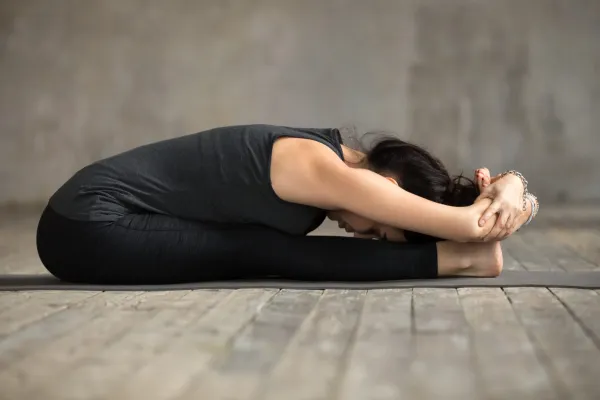
- Bring your legs straight in front of you. Press firmly into your sit bones. Toes are curled. Lengthen the spine.
- Bring your hands to your sides. Breathe 2-3 times evenly.
- Inhale, raise your arms. Open your chest. Create a gap between your ribs and hips.
- Maintain a long spine and allow your shoulders to relax.
- Exhale and fold forward from the crease of your hips. Lead the movement with your chest.
- Bend your knees if required to maintain a long and supported spine.
- Hold for as long as is comfortable. You may hold this position by:
- Resting your feet/ankles
- Resting your shins
- Using a strap around your feet.
- Do not push forward. Gently support the movement with your arms. The movement should come from your hips.
- Lengthen your spine on inhalation. If possible, deepen the pose slightly more on exhalation.
- Relax your head, neck, and shoulders and breathe slowly and steadily.
- Time in pose:
- Beginner: 30-60 seconds
- Intermediate: 1-3 mins
- Advanced: 3-5 mins
- You should feel a stretch in this pose, but not pain. If you feel any strain in your lower back or hamstrings in this pose, ease out of the pose.
- Gently engage your core. Inhale and raise your torso, leading with your chest.
- Lower your arms and return to Staff Pose. Hold for 2-3 breaths.
Supta Matsyendrasana (Supine Spinal Twist)
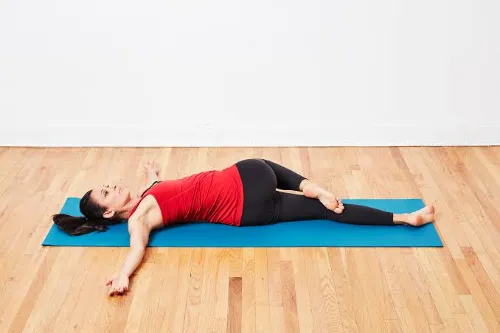
- Lie supine with legs straight and arms above your head forming a T. Take a few calming breaths and close your eyes.
- Flex your knees. Side-to-side hip movements will help relieve back pain.
- Extend your arms so they are straight with your shoulders. You can place your hands in either an upward- or downward-facing position. Ensure both your shoulder blades are pressed onto the floor.
- Exhale and gently lower both knees to the right side of your body. Stack or separate your knees. Let gravity gently lower your knees with no force.
- Turn your head to the left (opposite of knees) or keep the head neutral if there is tension in your neck.
- To deepen the twist, press gently on your upper knee with your right hand. If the twist is difficult or uncomfortable, place a small pillow or block under the knees.
- Hold for 1-3 minutes. Take long, deep breaths into your belly. Allow your body to fully relax with each exhale.
- Inhale and bring knees back centrally, whilst gently bringing knees into your chest to return to a neutral spine.
- Exhale and twist to the left. Turn your head to the right. Hold for the same amount of time.
- Bring knees back centrally. Hug knees into chest and then straighten your legs along the floor. Stay still in this position or move into savasana.
Ananda Balasana (Happy Baby Pose)
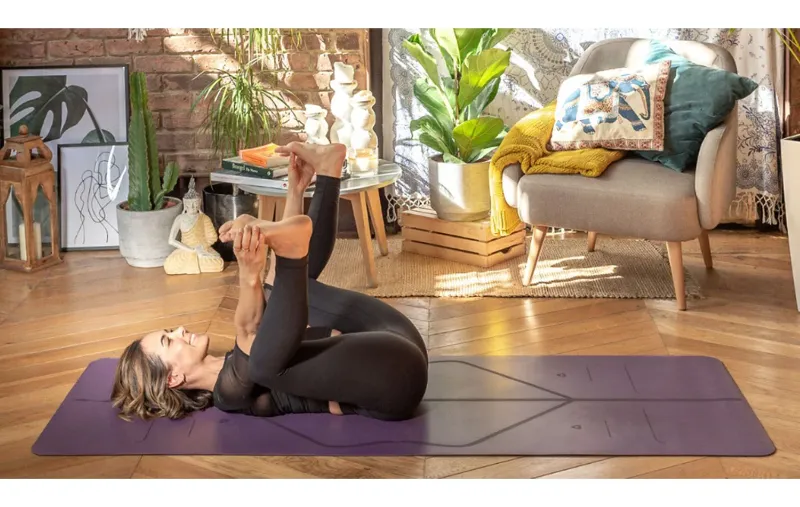
- Lie comfortably on your back. Breathe slowly and deeply.
- Exhale and pull both knees to your chest.
- Widen your knees beyond your torso so that they can be brought towards your armpits. Curl your toes so that the soles of your feet face upwards.
- Place your hands between your legs. Grasp the outside edges of your feet (little toe edge). If this is difficult, you can place a strap around your feet, or grasp your ankles or upper thighs.
- Bend your ankles so that your ankles are directly above your knees. This creates a 90-degree angle in your legs. Be sure to curl your toes and gently press them against your hands.
- Slowly push your feet down towards the floor, keeping the base of your back pressed to the floor. Allow your pelvis to open and lengthen your spine.
- Breathe deeply into your stomach. Gently swaying from side to side will help to stretch along your spine.
- Beginner: 30 seconds- 1 minute
- Intermediate: 1-3 minutes
- Restorative: 3-5 minutes
- Release pressure from your feet, and bring your knees together and back up to your chest.
- Straighten your legs flat on the mat. Rest for a few breaths.
Supta Baddha Konasana (Reclining Butterfly Pose)

- Sit erect, with a straight spine and straight legs. Ensure that your toes point upwards and your feet are together.
- Bend your knees and bring your feet together so that they are in line with your pelvic region. The soles of your feet should be together, forming a diamond between your legs.
- Place your hands around your feet. If needed, place them under your feet. Try to bring your heels as close as possible to your genitals.
- Breathe in slowly, keeping your back and chest straight.
- Lower your body into the position, resting your back on the ground. Place your arms along your inner thighs.
- Allow your muscles to relax. Take 5-10 deep breaths.
- To exit this pose, either straighten your legs and rest for a few minutes. Then turn onto your right side, and using your hands, gently sit up.
Viparita Karani (Legs-Up-the-Wall Pose)
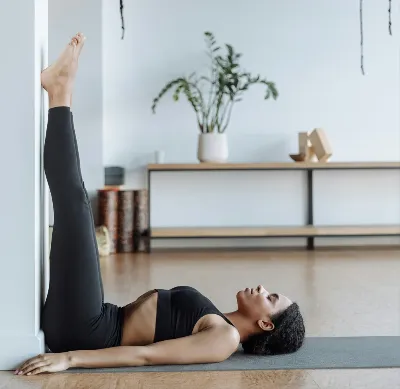
- Place your mat parallel to the wall. Place the bolster (if using) around 6-12” away from the wall.
- Adjust your posture so that your right hip is in contact with the wall.
- Place weight in forearms and allow legs to lift. Allow upper body to come down towards the ground.
- Move hips forwards or backwards to find a comfortable position.
- If using a bolster, place the sacrum (not low back) on the bolster. This should support the legs against the wall and cause little to no strain.
- Place arms either by the sides with palms facing up, or above the head, in a relaxed goal post position. Tuck the chin slightly to make it comfortable for the neck.
- Calm Nervous System
- Placing a folded blanket over your body can provide extra relaxation and warmth.
- Take 5-10 deep breaths and then let your breath settle back into a natural rhythm.
- Suggested hold times:
- Beginner – 5-10 mins
- Intermediate – 10-15 mins
- Restorative – 15-20 mins
Shavasana (Corpse Pose)
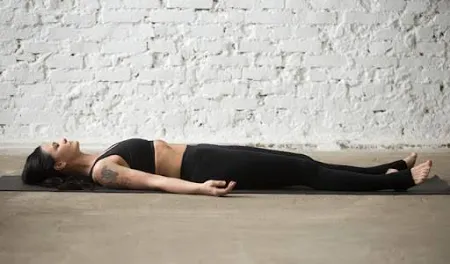
- Lie flat with your legs stretched out.
- Relax your arms so that they are just away from your body with palms uppermost. Relax your fingers.
- Ease your neck into a gentle curve so that your chin is just below level with your forehead. If needed, support your head.
- Close your eyes and let your facial muscles go slack. Gently relax the jaw, tongue, and muscles around the eyes.
- Breathe gently for a few moments. Return your breathing to a natural rate.
- Allow your whole body to feel heavy. Make sure that you are relaxing your shoulders, upper body, stomach, pelvis, and legs.
- Hold this position for between 5 and 20 minutes. Try to be relaxed, but alert.
- Breathe more deeply to exit the pose. Wiggle your fingers and toes and bend your knees. Roll onto one side and pause. Slowly move up into a sitting position.
Safety Tips
- Move gently and do not strain
- Do in a calm and comfortable place
- Avoid doing yoga straight after eating a large meal
- Breathe normally
- Place cushions or blocks under you to help
- Stop if you feel any pain, dizziness, or discomfort.
- Avoid vigorous exercise close to bedtime.
Conclusion
Gentle yoga can help you relax and get good quality sleep. Gentle yoga poses, deep breathing, and relaxation can help ease muscle tension, relieve stress during the day, and create a relaxing wind-down.
If practiced regularly and especially in the evenings, gentle yoga can lead to improved sleep. It does not matter how complex the postures are; just aim to practice regularly. Begin with a few easy movements. Be mindful of how you feel and create a calming routine for yourself.
From a physiotherapy point of view, practicing gentle yoga with appropriate sleeping positions, regular exercise, and good sleep hygiene can aid relaxation and improve your overall wellbeing.
FAQs:
What is a good yoga routine to do before bed?
A 10- to 15-minute yoga practice before bed helps remove physical tension from the day, relax the nervous system, and let your body know it’s time to relax.
How can I increase my deep sleep naturally?
Make lifestyle and environmental changes that let your body and brain know it’s time to transition into deep restoration if you want to naturally boost your deep sleep (slow-wave sleep).
Can yoga help with insomnia?
Indeed, if done regularly over time, yoga can help reduce the symptoms of insomnia and enhance the quality of sleep in general. Research indicates that it is a useful non-pharmacological support for severe or chronic sleep disturbances, but it is not a stand-alone treatment.
What not to do after yoga?
Avoid taking a shower right away, eating large meals, working out hard, or sitting in cold air just after yoga. Allowing your body to settle and calm down can help you avoid discomfort and maintain energy.
What to drink for quick sleep?
Warm milk, tart cherry juice, and chamomile tea can help your body unwind and wind down more quickly, but no beverage can put you to sleep right away. Drink them 30 to 60 minutes before bed and in tiny doses (approximately 6 to 8 ounces) to avoid waking up to use the restroom.
What is the yoga pose for sleeping?
The most ideal resting posture for pleasant sleep and general well-being, according to yoga and Ayurveda, is on your left side.
References:
- Rushali. (2026, November 4). Yoga for Better Sleep: 8 poses, a sleep mudra + a 10-Minute bedtime sequence. MyYogaTeacher. https://myyogateacher.com/articles/yoga-for-better-sleep
- Admin. (2026, January 31). Yoga for Better sleep: A gentle night routine. ATTUNE TO YOGA. https://attunetoyoga.com/yoga-for-better-sleep-a-gentle-night-routine/
- Suni, E. (2026, September 30). Yoga for sleep. Sleep Foundation. https://www.sleepfoundation.org/physical-activity/yoga-and-sleep
- Chilipad. (2026, October 16). ChiliPad. Chilipad by Sleepme. https://sleep.me/post/bedtime-yoga-poses-for-better-sleep