Yoga for Stroke Recovery
Introduction
Stroke has a significant emotional and socioeconomic effect in addition to being a serious health problem and source of long-term impairment. Options for long-term, sustainable therapies that help stroke survivors participate in worthwhile activities to deal with post-stroke life problems must be investigated. Rehabilitation may involve a variety of complementary techniques, such as yoga, and aims to restore function and cognition to the greatest extent possible.
Yoga is an Indian mind-body discipline that has gained popularity in the West. Yoga has been shown to be beneficial for individuals with a variety of physical and mental health issues. Yoga can be utilized as a self-administered activity in stroke therapy, according to a recent non-Cochrane systematic review.
How can Yoga provide support after a stroke?
Movement, balance, and perceptual issues may arise following a stroke. Additionally, language, focus, and memory are typically impacted. Depression or other psychological issues may result from the changing circumstances.
Regardless of the clinical picture, yoga can offer several health advantages as a supplemental treatment measure:
- Strengthening of tendons, ligaments, bones, and muscles
- Increased range of motion and mobility
- Encouragement of awareness, focus, and relaxation
- Improvement of postural control, proprioception, and balance
- Reduction of anxiety, depression, and stress
- Promotion of social aspects and well-being
- Brain and memory training
- Diminished pain
Making mistakes for neuroplasticity
It is essential to learn coping mechanisms for the altered circumstances of life following a stroke. It is necessary to relearn movements that were previously automatic. In this case, yoga can be quite beneficial.
Movements necessary for daily living will be practiced on the mat, which serves as a testing lab. Plan B might succeed if Plan A fails. Errors are acceptable and even encouraged. Toddlers would never learn to walk if they consistently quit up the first time they landed on their bottoms.
The movement pattern can be improved even if a particular exercise isn’t working presently. It’s possible that a portion of the exercise is successful or that the required muscles are already under conscious control. These are achievements.
Regular repeats are essential for stimulating the injured brain regions, especially for stroke survivors. Dead cell tissue can be regenerated in the brain. The brain will discover distractions even if some of the neurological highway’s streets are closed. This ability is known as neuroplasticity.
After a stroke, what should I think about Yoga?
A medical evaluation is the first step before beginning yoga practice if there are current physical and/or mental constraints.
Yoga is always achievable, independent of the limitations. Yes, at all times. Yoga is far more than just working out. Yoga is accessible to everyone, even those with severe disabilities.
The upper body can be moved if the patient is seated in a wheelchair. Patients who are bedridden can use visualizations. The brain is unable to determine whether a movement is executed or merely contemplated. The injured brain regions are reactivated by the stimuli received. The yogic concept can improve mental health and offer people hope.
How Do I Start Yoga After a Stroke?
An instructor with experience is essential. He or she should ideally have experience working with patients and be able to modify workouts to make them more useful.
There is a chance that the practitioner won’t notice possible harm in people who have hemiparesis or hemiplegia. It is the role of instructors to give appropriate instruction. Certain rehabilitation facilities provide customized yoga classes for stroke survivors. Private instruction may also make sense.
It is best to find out whether there are any patient-specific courses offered by the rehabilitation facility or the relevant physician. The first place to go can also be local yoga centers.
Is Yoga Beneficial for Post-Stroke Therapy?
People who have limits or long-term illnesses frequently feel overburdened. The urge to take action to promote healing arises in between therapy sessions and doctor’s appointments.
Everyone may do yoga, and it has several health advantages. Before beginning a yoga practice, a medical evaluation is always recommended.
Initially, patients should be under the supervision of knowledgeable educators. Physical overload is prevented by being mindful and honest about one’s own limitations.
The body benefits from movement, while the mind benefits from mindful breathing and meditation. Yoga can improve patients’ physical and emotional health when done safely.
Benefits of Yoga For Stroke Recovery
Yoga has several advantages for patients with strokes, particularly in terms of improving mobility and independence. Yoga is accessible despite severe movement disabilities and can enhance respiration, flexibility, and cognitive function. You’ll also discover how one yoga instructor used this technique to speed up her stroke recovery.
In order to help you heal, we hope this article encourages you to safely begin practicing yoga.
Improves Mind-Body Connection: Yoga’s demanding focus and attention requirements make it helpful for stroke recovery. Every motion is slow and purposeful.
Even if you are unable to perform the movement flawlessly, the focus needed to do so encourages brain activation. More movement aids in the neuroplasticity rebuilding process, particularly if it is repetitive.
Improves Balance, Range of Motion, and Strength: In a 2014 study, 37 stroke patients did yoga twice a week for eight weeks. Patients’ upper extremity strength, endurance, neck range of motion, and passive hip range of motion all improved by the end.
Patients were guided through a yoga practice while sitting, standing, or on the floor that included postures, breathing, meditation, and relaxation.
This shows that practicing yoga for stroke patients doesn’t require flexibility or complex poses. Simple things like meditation can have a significant impact.
Improves Walking and Balance: Mobility-impaired stroke survivors may have poor gait (walking style) and balance.
Fortunately, researchers found that yoga helped stroke survivors improve their walking speed and balance in the same 2014 study on yoga for stroke recovery.
Longer steps and improved coordination were signs of an improved gait. The best part is that the study had no intention of finding a link between yoga and improved gait!
According to researcher Tracy Dierks, “We did not focus on improving gait at all; the yoga intervention was designed to improve balance, not gait.” However, the majority of clinical gait assessments showed significant improvements.
Beyond their initial goal, researchers discovered advantages. This demonstrates the effectiveness of yoga for stroke patients.
Accessible for All Stroke Patients: Because yoga can be adapted to nearly any stage of recovery, it is also beneficial for stroke patients. You can begin with mental exercises and meditation even if you have post-stroke paralysis. You may perform these exercises in bed because they don’t involve any movement. Possibly you regain some mobility as you attempt to recover from paralysis following a stroke. You can next try chair yoga or assist your poses with props like foam blocks. This is a chair yoga pose performed by a stroke patient who credits her remarkable recovery to yoga.
Additionally, yoga can improve your cognitive function even if your stroke affected you more mentally than physically. A stroke may impair sustained attention, sequencing, and possibly even problem-solving skills needed for yoga practice. Your brain’s neuroplasticity is facilitated by regularly engaging in activities that demand higher-level cognitive skills, such as yoga.
Yoga can help those who have survived an occipital lobe stroke and may have experienced visual problems by encouraging them to use newly acquired compensatory skills. For instance, people with a visual field deficiency could use scanning techniques during a yoga session because of the visual demands of the practice, such as watching the instructor move around the room and analyzing their own placement. Many parts of stroke recovery can be greatly aided by yoga.
Reminds You to Take Breaths While Working Out: In all types of exercise, but especially in rehabilitation exercises, breathing is essential.
However, a stroke patient’s body may not be expanding to breathe deeply and reap the benefits of deep diaphragmatic breathing if they have trouble moving. This restricts the body’s and brain’s access to oxygen, which is detrimental, particularly during recovery.
Thankfully, yoga emphasizes the connection between action and breath. Inhale and take one step. Exhale and take a different route.
When you practice yoga for stroke rehabilitation, this focus on your breath will encourage you to take deep breaths. This will apply to your day-to-day activities.
Key Yoga Poses for Stroke Recovery
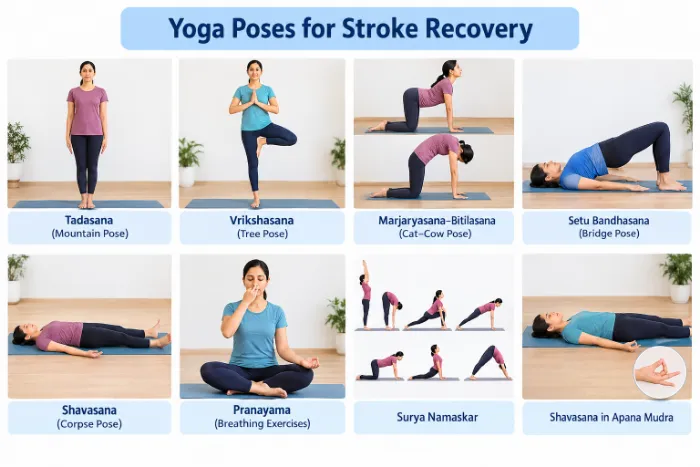
Tadasana (Mountain Pose)
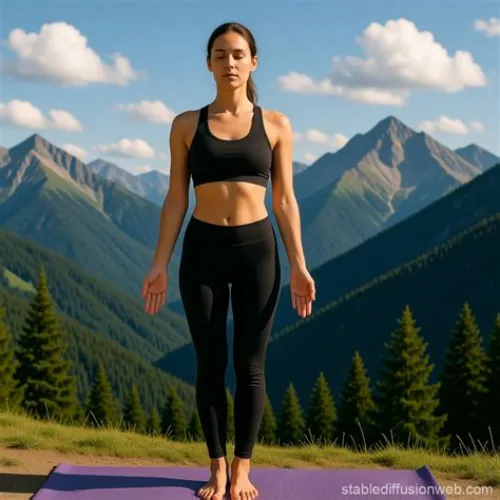
Enhances posture and strengthens the leg muscles.
How to Perform:
- Maintain a straight position; place your feet hip-width apart or together, and balance your weight on both feet.
- Avoid bending your knees, but ensure your legs remain straight.
- Maintain a neutral pelvis; softly contract your thigh and abdominal muscles.
- While maintaining a wide and relaxed chest, roll your shoulders back and forth.
- With your palms facing either inside or forward, let your arms fall naturally next to your body.
- Maintain an erect posture, look straight ahead, and keep your chin parallel to the floor.
- Gently stretch up to the top of your head to lengthen your spine.
- Breathe deeply and slowly, then hold the pose for 20 to 30 seconds.
- Repeat two or three times as comfortably as you can.
Vrikshasana (Tree Pose)
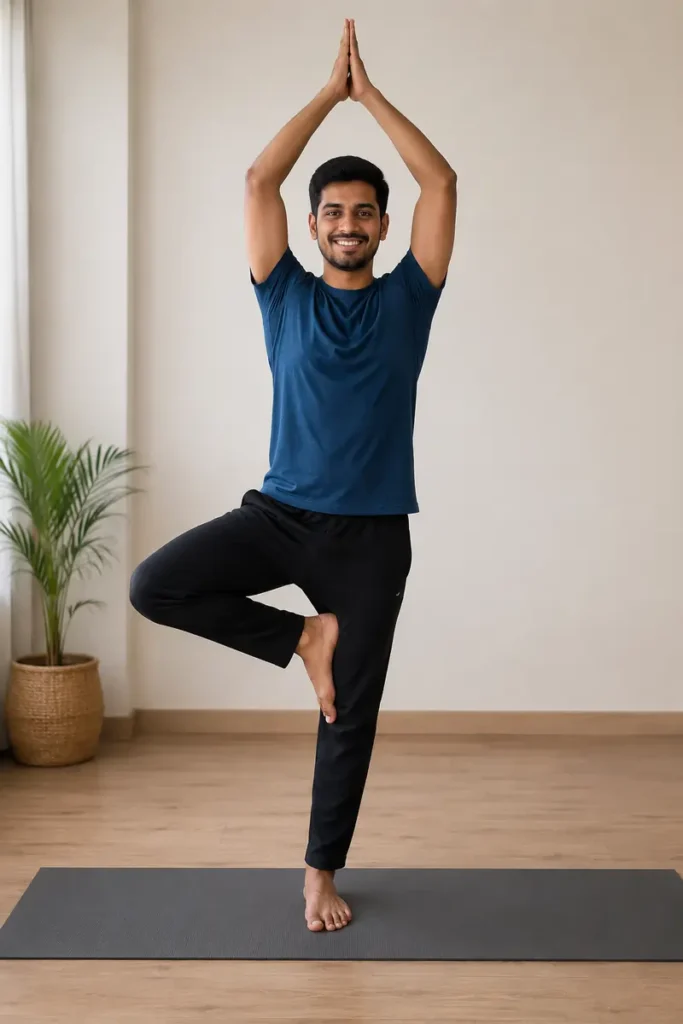
Enhances balance and concentration.
How to Perform:
- Put your feet together and stand up in Tadasana, or Mountain Pose.
- Transfer your weight to your left leg while maintaining stability.
- Place your right foot’s sole against your inner left thigh or calf while bending your right knee. Don’t put it right on the knee.
- Maintain an erect spine and keep your hips facing forward.
- In Namaste, put your hands together at your chest or raise your arms above your head.
- To assist you in staying balanced, direct your attention to a fixed place in front of you.
- Breathe slowly and maintain the position for 20 to 30 seconds.
- Gently lower your right foot and repeat on the opposite side.
- As comfortable, perform two to three repetitions on each side.
Marjaryasana–Bitilasana (Cat–Cow Pose)
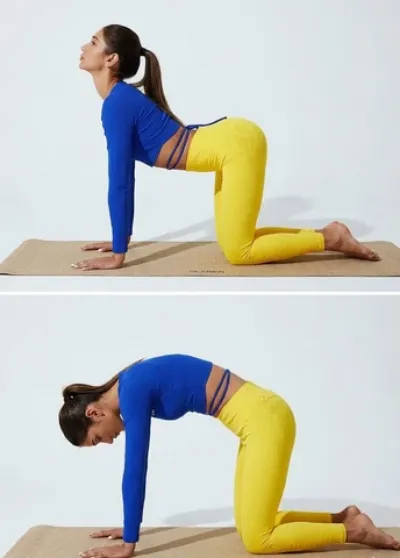
Encourages flexibility and reduces stiffness in the spine.
How to Perform:
- Start on your hands and knees while seated at a table.
- Maintain your knees behind your hips and your wrists close to your shoulders.
- With your eyes fixed on the ground, maintain a relaxed head and neck.
- Inhale: Cow Pose, which involves slowly arching your back, lifting your chest and tailbone, and softly looking forward.
- Exhale by drawing your abdomen inward, tucking your chin into your chest, and rounding your spine toward the ceiling (Cat Pose).
- Coordinate your breathing with the gentle, fluid transition between the two positions.
- Continue for 8–10 cycles, or until you feel comfortable.
- Return to a neutral tabletop position and relax.
Setu Bandhasana (Bridge Pose)
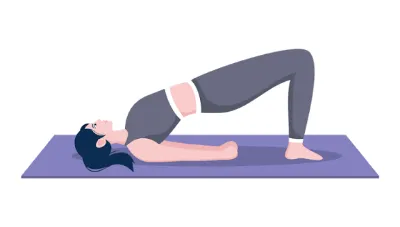
Opens the chest and strengthens the legs and back.
How to Perform:
- Bend your knees and place your feet flat on the ground, hip-width apart, while lying on your back.
- Keep your arms by your sides and your hands down.
- Bring your heels up to your hips.
- Take a breath and slowly raise your hips while keeping your feet firmly planted on the ground.
- Keeping your head and shoulders on the ground, raise your chest toward your chin.
- Don’t let your knees drop outward; instead, keep your thighs parallel.
- Hold the position for 15 to 30 seconds while taking regular breaths.
- Exhale, then slowly bring your hips back to the floor.
- Take a few deep breaths, then repeat two or three times.
Shavasana (Corpse Pose)
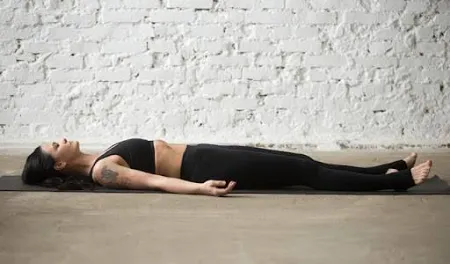
Reduces mental fatigue and promotes relaxation.
How to Perform:
- Lie flat on your back with your legs comfortably apart.
- Keep your arms by your sides and your hands facing up.
- Shut your eyes and let your body relax.
- Maintain a neutral, comfortable position for your head and neck.
- Breathe naturally and slowly.
- Your feet, legs, abdomen, chest, arms, shoulders, face, and mind should all be intentionally relaxed.
- Hold the position for five to ten minutes while remaining still.
- Move your fingers and toes gently to complete.
- Sit up comfortably after slowly turning to one side.
Pranayama (Breathing Exercises)
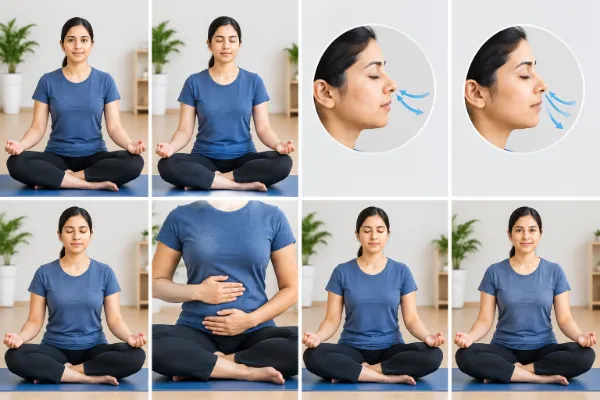
The transport of oxygen to the brain is improved by methods such as Nadi Shodhana (Alternate Nostril Breathing).
How to Perform:
- Maintain a straight back and relaxed shoulders when sitting comfortably.
- Closing your eyes and inhale deeply many times.
- Take a slow breath through your nose.
- Breathe out softly through your nose.
- Make an effort to breathe slowly, steadily, and deliberately.
- Don’t stretch; keep going for five to ten minutes.
- After you’re done, take a couple of normal breaths.
- Open your eyes slowly, then rest.
Surya Namaskar
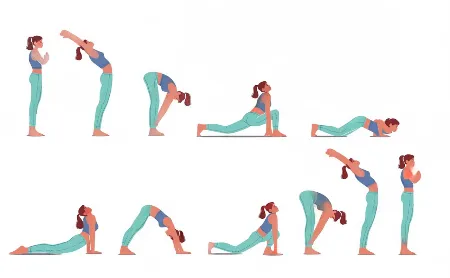
Surya Namaskar improves general body function, strengthens the cardiovascular system, and increases flexibility.
- Stand with your feet together and your arms by your sides.
- Inhale, raise your arms above your head, and gradually arch your back.
- Breathe out and reach for your toes while bending forward at the waist.
- Take a breath and lunge back with one foot, then the other.
- Breathe out, drop into a plank stance, and do a push-up.
- Take a breath and raise your chest so that it faces up like a dog.
- Breathe out and raise your hips into a downward-facing dog position.
- Take a breath, move one foot, then the other, and make a lunge.
- Breathe out, fold forward, and come back.
Shavasana in Apana Mudra
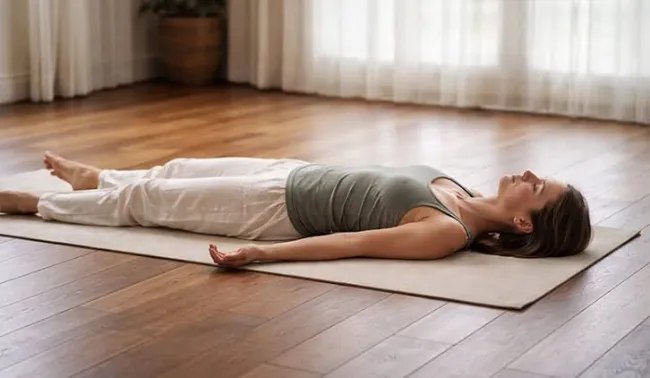
Deep relaxation, anxiety reduction, and stress management are all facilitated by Shavasana with Apana Mudra, which is necessary for stroke recovery.
- Lying on your back, extend your arms and legs.
- Put your hands in the Apana Mudra. With your other fingers outstretched, touch the tips of your thumbs to the tips of your middle and ring fingers.
- For five to ten minutes, close your eyes and relax in this position.
Precaution:
- Start with slow, gentle movements and gradually increase the difficulty based on your ability.
If you have issues with balance, coordination, or weakness, perform the exercises under the supervision of a trained person. - Use a chair, wall, or another stable object for support when doing standing poses to help prevent falls.
- Avoid holding your breath, using forceful breathing techniques, or doing intense pranayama practices unless instructed to do so.
- Do not push stiff or weak limbs into a stretch; movements should always be comfortable and controlled.
- Avoid making quick changes in position, especially moving rapidly from lying or sitting to standing.
- If you experience sudden dizziness, a severe headache, chest pain, unusual shortness of breath, or increased weakness, stop the exercise immediately.
- Keep the exercise area free from obstacles and use a non-slip mat for safety.
- If you notice new or sudden facial drooping, arm weakness, difficulty speaking, severe balance issues, or any other possible signs of a stroke, seek emergency medical help right away.
FAQs:
What activities should I avoid after a stroke?
After experiencing a stroke, it is important to avoid activities that involve forceful or uncontrolled physical movements, such as using unguided shoulder pulleys, exposure to high-stress environments, skipping prescribed rehabilitation exercises, and engaging in unhealthy lifestyle choices like smoking or consuming a diet high in salt.
Is Ayurveda good for stroke?
This indicates that stroke can be effectively treated with Ayurvedic therapy procedures (Pakshaghata). A stroke occurs when an artery in the brain is blocked or ruptures, causing certain brain cells to suddenly die from a lack of oxygen.
What are 85% of strokes caused by?
An ischemic stroke happens when a blood vessel that delivers blood to the brain becomes blocked. It makes up around 87% of all stroke cases. The primary reason for an ischemic stroke is atherosclerosis, which involves the buildup of fatty deposits, known as plaque, on the inner walls of the blood vessels.
How to stop a stroke in progress?
The staff in the emergency department will give special medicines to treat a stroke as it happens. The most common type of stroke, called an ischemic stroke, is treated with a drug known as tPA, which helps to break up clots.
What are the warning signs 7 days before a stroke?
Be ready to respond quickly when the initial signs of a stroke happen: weakness or drooping on one side of the body, confusion or changes in mental state, trouble speaking or speech that is slurred, blurred or double vision, and feeling dizzy. The quicker a person gets medical help for a stroke, the more likely they are to have a better result.
How to reverse a stroke before it happens?
If you are experiencing rare symptoms, it might be tempting to wait and see how things develop. However, there is no way to stop or reverse a stroke once it has started — only a healthcare professional can provide treatment. Any situation where a stroke is suspected should be treated as an emergency. It is crucial to call 108 immediately for assistance.
References:
- Checking your browser—reCAPTCHA. (n.d.). https://pmc.ncbi.nlm.nih.gov/articles/PMC6486003/
- Julia.Perus. (2026, July 27). Stroke and Yoga: What’s the Evidence? Tyromotion. https://www.tyromotion.com/stroke-and-yoga-what-the-evidence-says/
- Msotr/L, A. R. M. (2025, April 11). 5 Huge benefits of yoga for stroke patients (and how to get started). Flint Rehab. https://www.flintrehab.com/yoga-for-stroke-patients/
- Janagama, V. (2025, June 3). 5 huge benefits of yoga for brain stroke recovery and prevention. HCAH Blog. https://www.hcah.in/blog/5-huge-benefits-of-yoga-for-brain-stroke-recovery-and-prevention-a-step-by-step-guide/
- 6 yoga asanas that help in stroke prevention and recovery- Moneycontrol.com. (2023, September 26). Moneycontrol. https://www.moneycontrol.com/news/health-and-fitness/yoga-asanas-that-help-in-stroke-prevention-surya-namaskar-vajrasana-sukhasana-vrikshasana-shavasana-dandasana-11432481.html