Padahastasana (Hand-to-Foot Pose)
What is Padahastasana (Hand-to-Foot Pose)?
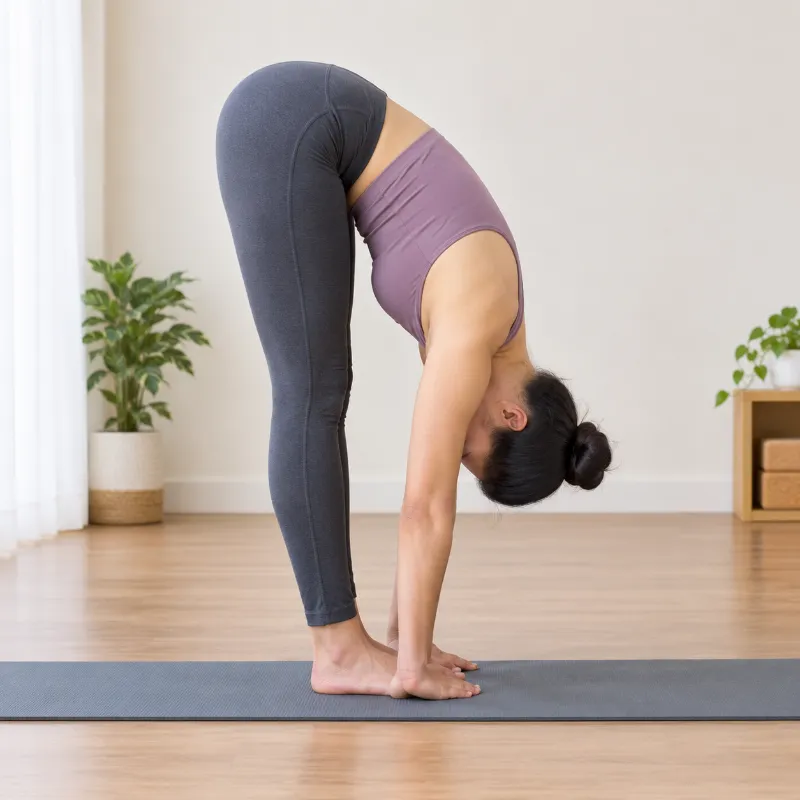
The standing forward bend known as Padahastasana (Hand-to-Foot Pose) produces a deep stretch across the hamstrings and spine by placing the hands under the feet. When done correctly, this intermediate yoga pose enhances flexibility, soothes the nervous system, and promotes healthy digestion.
Padahastasana: Overview and Meaning
Pronounced pah-dah-hahs-TAHS-anna, Padahastasana is also known as Hand-to-Foot Pose or Hand Under Foot Pose. Pada, which means “foot,” hasta, which means “hand,” and asana, which means “posture,” are the Sanskrit roots of the word. Together, they explain the characteristic movement of the pose, which is folding forward while placing the hands beneath the feet.
The standing forward bend known as padahastasana, which has its origins in Hatha yoga, is used to improve flexibility, relax the mind, and prepare the body for seated meditation. The posture has changed in modern yoga to emphasise accessibility and safety, with bent knees and props being recommended. These days, Padahastasana is frequently utilised in Vinyasa and Ashtanga-style practices, and it is highly regarded for mitigating the negative consequences of extended sitting and restricted movement.
The hand-to-foot pose gives the calves and hamstrings, which are frequently shortened by sedentary lifestyles, a deep stretch. The gentle traction created by placing the hands under the feet helps the spine to extend rather than compress.
Additionally, the pose supports circulation and calms the nervous system through moderate inversion advantages. Additionally, it promotes flexibility, balance, and a grounded sensation of relaxation while relieving tension throughout the entire back body.
At a Glance
- Sanskrit Name: पादहस्तासन (Padahastasana)
- Pronunciation: pah-dah-hahs-TAHS-anna
- English names: Hand-to-Foot Pose, Hand Under Foot Pose
- Pose Type: Standing forward bend
- Level: Intermediate
- Hold Time: 30 seconds to 2 minutes
- Main Advantage: Flexibility of the hamstrings and spine
- Strengthens: Knees and thighs
- Stretches: back, spine, calves, and hamstrings
Benefits of Padahastasana (Hand-to-Foot Pose)
Deep physical stretching, nervous system relaxation, and internal stimulation are all powerfully combined in padahastasana.
Physical Benefits of Padahastasana
The most well-known benefit of padahastasana is its capacity to lengthen the entire back, especially the hamstrings, which often get taut from extended sitting, inactivity, or ageing.
- Deep hamstring stretch: Enhances leg flexibility and relieves chronic tightness brought on by sedentary lifestyles
- Lengthens the posterior chain by stretching the muscles of the calves, hamstrings, glutes, and spine.
- Decompresses the lower back: Stiffness and compression can be relieved by applying light traction to the spine.
- Enhances spinal flexibility by lengthening and extending the vertebral column.
- Expands hip range of motion: A deep hip hinge expands hip mobility.
- Strengthens the thighs and knees by using the quadriceps to securely sustain the posture.
- Corrects forward-slouching tendencies and rounded shoulders to improve posture.
- Increases circulation: A slight inversion enhances the return of blood to the heart from the legs.
- Relieves tension in the neck and shoulders: Allowing the head to hang naturally eases strain on the upper body.
- Enhances body awareness and balance: Standing fold increases stability and proprioception
Mental and Emotional Benefits
The body is automatically encouraged to turn inward by the position, which reduces mental chatter.
- Causes the “rest and digest” parasympathetic response, which calms the neurological system.
- Lessens tension and worry: Mild inversion calms the psyche.
- Increases concentration and focus: The grounding effect improves mental clarity.
- Relieves mental exhaustion: The brain is refreshed by improved circulation.
- Encourages the release of emotions: Forward folding might assist in releasing stress.
- Promotes mindfulness by requiring focus on breathing and physical sensations.
- Develops self-awareness and patience: Flexibility doesn’t happen overnight.
Digestive, Energetic, and Holistic Benefits
The stomach, liver, and intestines can be stimulated by the forward fold position, which produces mild compression in the abdominal area. This could assist:
- Improve digestion and metabolism
- Relieve mild bloating or constipation
- Support healthy elimination
Therapeutic Applications (With Modifications)
When done attentively and with the right adjustments, Padahastasana can assist with:
- Chronic hamstring tightness
- Mild, non-acute lower back discomfort
- Stress-related tension and anxiety
- Fatigue caused by long hours of sitting
- Poor posture patterns
- Mild headaches linked to tension
- Digestive sluggishness
- Reap the benefits of Padahastasana. Schedule a free one-on-one class with a qualified yoga instructor.
How to Perform Hand-to-Foot Pose (Padahastasana): A Comprehensive Guide
With the help of this detailed guide, you can safely practice the position and progressively improve your flexibility.
Part 1: Preparing for the Pose
Before trying Padahastasana, try a brief test in Standing Forward Fold (Uttanasana):
- If you can reach your toes with your knees bent or straight, you are prepared to perform Padahastasana..
- Start by performing Uttanasana with bent knees for a few weeks if you experience severe tugging or strain. Hamstring flexibility develops gradually; there is no haste.
Props You May Need
- Yoga mat
- For tight hamstrings, two yoga blocks are highly advised.
- Wall nearby for balance (optional)
Warm-Up (Essential)
Always warm up for at least five minutes before executing Padahastasana:
- Cat–Cow Pose (10 rounds)
- Downward-Facing Dog (1–2 minutes)
- Fold forward while bending your knees for one minute.
- Sun Salutations A (3–5 rounds)
- Pyramid Pose (30 seconds each side)
- Ragdoll Pose (1 minute)
- It’s easy to strain cold hamstrings. Warming up reduces the chance of injury by enabling deeper stretching.
Part 2: Step-by-Step Instructions
- With your feet hip-width apart, stand erect at the front of your mat, extending your spine and providing equal grounding through both feet.
- While maintaining a relaxed neck, take a breath and raise your arms upward to create space along the sides of your body.
- Exhale, lower your arms and head, bend your knees widely, and hinge forward from the hips with a long spine.
- Bend your knees and place your hands beneath your feet with the palms facing up, or hold your ankles or blocks if needed.
- To build traction and deepen the stretch without pushing, gently pull the hands toward the heels.
- If your hamstrings permit, gradually straighten your legs; if there is any tension, keep your knees bent.
- Allow the crown of the head to sink toward the floor to relax the jaw and allow gravity to assist with the fold.
- Hold onto:
- 30 to 60 seconds for novices
- Intermediate: 1-2 minutes
- For up to three minutes, take deep, steady breaths (advanced).
- Extend your hands, bend your knees significantly, and carefully roll up to a standing position, raising your head last.
Common Mistakes and Alignment Tips
- Straight-leg raises increase the chance of injury.
- Excessive lower back rounding puts tension on the spine.
- Deeper bouncing may cause resistance in the muscles.
- Holding your breath will make you tense.
- Locking your knees puts you at risk for hyperextension.
- Pulling violently with the arms might put strain on the shoulders.
Alignment Checkpoints
- Knees bent as needed
- Spine long, not compressed
- Weight evenly distributed
- Head and neck relaxed
- Breathe slowly and steadily
Padahastasana Variations
Padahastasana can be modified to accommodate various body shapes and levels of flexibility. These adjustments and variations let you practice safely while gradually moving toward the full posture, regardless of how tight your hamstrings are.
Beginner-Friendly Modifications
- Padahastasana with Bent Knees
- Stand in a forward fold and bend your knees wide.
- Put your hands under your feet, palms facing up.
- Instead of straightening your legs, concentrate on stretching your spine.
- Without pushing deep, hold and breathe.
- Padahastasana with Hands on Yoga Blocks
- With your knees slightly bent, fold forward.
- Place one or two blocks under your hands instead of slipping them under your feet.
- Maintain a long spine while slowly bringing the chest closer to the thighs.
- Breathe steadily and hold pleasantly.
- Hands on Ankles or Shins
- Fold forward from the hips while keeping your knees bent.
- Hold your shins or ankles instead of placing your hands under your feet.
- While allowing your head and neck to relax, keep your spine long.
- To gradually increase flexibility, use this version.
Intermediate Variations
- Wide-Legged Padahastasana (Wide Stance Variation)
- Step three to four feet apart.
- Maintain a long spine while bending forward from the hips.
- Put your hands under your feet or hold your ankles.
- Let the torso dangle between your legs.
- Full Padahastasana (Classic Expression)
- Put your hands completely beneath your feet and fold forward.
- Strive to straighten your legs gradually.
- For traction, softly draw your hands toward your heels.
- Keep your breathing calm while you hold the stance.
- Dynamic Padahastasana in Flow
- From a standing position, perform Padahastasana.
- Hold for three to five breaths.
- Gently stand back up after bending your knees.
- To increase flexibility, repeat within a fluid sequence.
Advanced Variations
- Utthita (Lifted) Padahastasana
- Start in complete Padahastasana.
- Keeping your hands under your feet, contract your core.
- While keeping your equilibrium, raise your torso a little.
- With control, lower your back.
- One-Legged Padahastasana
- Put your weight on one leg and fold forward.
- Put your hands beneath your standing foot.
- Raise the opposite leg just behind you.
- As you breathe steadily, keep your equilibrium.
- Padahastasana with Arm Bind
- Fold the arms forward and bind them behind the back.
- After releasing the bind, slide your hands beneath the feet.
- Extend the body’s back and spine.
- Do not strain your shoulders while holding the stance.
Props and Support for Safer Practice
- Yoga blocks: To reduce strain, get closer to the floor.
- Folded blanket: For stability and comfort, place beneath heels.
- Wall: Offers support for equilibrium
- Yoga strap: Helps with leg alignment and prevents knee splaying
- Props are not a sign of limitation, but rather of clever technique. They enable the steady and safe development of flexibility.
Schedule a free one-on-one session right now to practice these variations under professional coaching!
Padahastasana: Precautions & Contraindications
When performed carefully, with bent knees, and with the right sequence, padahastasana is generally safe. However, some circumstances necessitate extra caution or total avoidance because it puts a lot of strain on the lower back and hamstrings.
Avoid Padahastasana If You Have:
- Hamstring tear or recent hamstring injury
- Recent back injuries or severe lower back discomfort
- Severe sciatica or active flare-ups
- Recent abdominal or pelvic surgery
- Detached retina or serious eye conditions
- Uncontrolled high blood pressure
- Severe osteoporosis or spinal fractures
- Vertigo or significant balance disorders
- If any of these apply, exercise only under a professional’s supervision or choose for softer options like seated forward bends.
Practice with Caution and Modifications
- Tight Hamstrings: Use blocks or ankle grips, keep the knees bent, and increase depth gradually over time.
- If you have chronic lower back discomfort, hinge from your hips with a long spine, softly engage your core, and leave right away if the pain gets worse.
- Mild Sciatica: If you get shooting or radiating pain down your leg, pause the position, avoid deep stretching, and practice very carefully.
- Pregnancy: After the first trimester, stay away from Padahastasana and only perform light, modified variations that have been approved by a doctor. Check out our comprehensive prenatal yoga guide here to learn yoga during pregnancy!
- High Blood Pressure (Controlled): Avoid the position, keep holds short, and leave gradually if blood pressure is out of control.
- Problems with your neck or knees: To avoid strain or hyperextension, keep your knees slightly bent and avoid hanging your head too far.
Critical Safety Guidelines
Do’s
- Before practice, spend at least ten minutes warming up.
- Bend knees as much as needed at all times
- Prioritise spinal length over depth
- Breathe steadily and smoothly
- Rolling up one vertebra at a time, carefully exit the posture
- Practice on an empty stomach
- Build flexibility gradually
Don’ts
- Don’t force straight legs
- Don’t bounce or jerk into the pose
- Don’t lock the knees
- Don’t hold your breath
- Don’t practice with cold muscles
- Don’t ignore pain signals
- Don’t compare your flexibility to others
- When to Stop Immediately
Exit the pose if you experience:
- Sharp or stabbing pain in the hamstrings
- Lower back pain (not a stretching feeling)
- Numbness or tingling in the legs
- Dizziness or nausea
- Pain behind the knees
- See a licensed healthcare professional if the discomfort continues.
Related Yoga Poses
By increasing spine length, forward-fold mobility, and hamstring flexibility, these poses enhance Padahastasana.
Seated Forward Fold (Paschimottanasana)
- Sitting forward, this bend lengthens the spine and gives the hamstrings a thorough stretch.
- Stretch your legs out in front of you while you sit.
- Breathe in to extend your spine and raise your arms.
- Exhale and fold forward from the hips.
- Holding the shins, feet, or a strap, take steady breaths.
Head-to-Knee Pose (Janu Sirsasana)
- One leg at a time, with a soft, asymmetrical forward fold.
- With one leg outstretched and the other foot pressed against the inner thigh, take a seat.
- Inhale and lengthen the spine.
- Exhale and fold over the extended leg.
- Breathe deeply while holding the foot or shin.
Intense Side Stretch (Parsvottanasana)
- A forward standing fold that strengthens the hamstrings and enhances balance and posture.
- Step one foot back into a staggered stance.
- To stretch the spine, square the hips and take a breath.
- Exhale and fold forward over the front leg.
- Hold firmly by placing your hands on the ground, blocks, or shins.
FAQs
What is Padahastasana good for?
Padahastasana is great for stretching the spine, relaxing the nervous system, and increasing hamstring flexibility. It helps reduce the tension brought on by extended sitting, enhances posture, aids in digestion, and gets the body ready for more difficult forward bends.
How long should you hold Padahastasana?
With their knees bent, beginners can hold Padahastasana for 30 to 60 seconds. Intermediate practitioners can hold for one to two minutes, whereas advanced practitioners can stay for up to three minutes. Always extend the time gradually, and stop if you experience discomfort.
How do Uttanasana and Padahastasana differ in their techniques and benefits?
The hands can rest on the floor, on the legs, or next to the feet in Uttanasana. Palms facing up, the hands are positioned beneath the feet during Padahastasana. This positioning of the hands gives the spine mild traction and produces a deeper hamstring stretch.
Is Padahastasana safe for lower back pain?
When performed with bent knees and appropriate hip hinging, Padahastasana may help treat mild, persistent lower back pain. However, if you have severe back pain or an injury, stay away from it. If the pain worsens, stop right away and see a doctor if necessary.
Schedule a free one-on-one session with a qualified yoga instructor to guarantee a secure and productive practice!
What are some effective ways to develop hamstring flexibility before practicing Padahastasana?
Practice Downward-Facing Dog, Uttanasana, Pyramid Pose, and seated forward folds on a regular basis. Practice regularly three to five times a week, warm up completely, and hold stretches for at least one to two minutes. Most people experience results in two to three months.
What factors may prevent someone from touching their feet while performing Padahastasana?
Tight hamstrings are the most common reason. The hamstrings are considerably shortened by prolonged sitting. This is very common and normal. Flexibility can be gradually increased by using blocks, bending the knees, and practicing frequently.
References
- Allen, W. (2025ac, December 31). Padahastasana. https://myyogateacher.com/yoga-asana/padahastasana
- Zehra, S. (2026i, August 11). Padahastasana (Hand Under Foot Pose): Steps, Benefits & Precautions. Habuild Blogs. https://habuild.in/habitology/asana-mudra/padahastasana/
- Requena, C. (2026, June 2). Padahastasana: the Hand-to-Foot Pose. kavaalya. https://kavaalya.com/blog/padahastasana-hand-to-foot-pose/