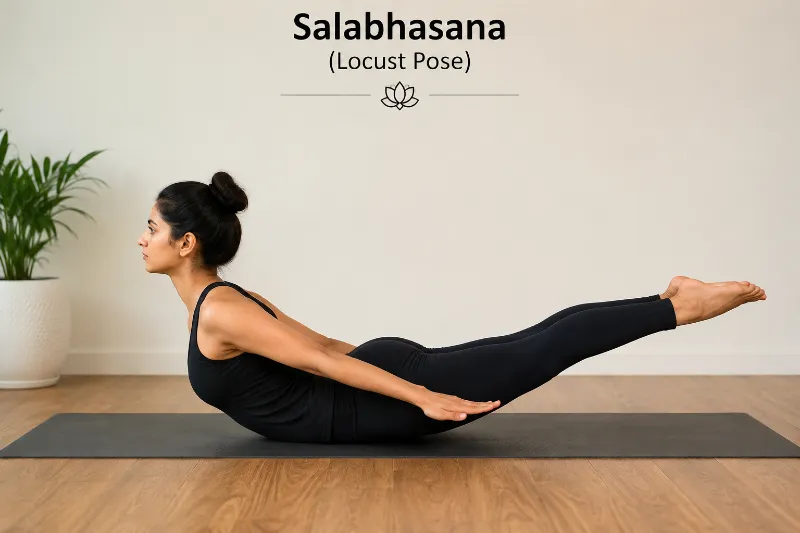
Salabhasana (Locust Pose)
What is Salabhasana (Locust Pose)?
Locust Pose, also called Salabhasana, is a yoga pose that trains your chest muscles and important chakras while preparing you for a backbend. Furthermore, with regular practice, this position can strengthen your core, allowing you to perform deeper backbends.
Locust pose belongs to the family of backbends. Deep tissues in your gut, tailbone, and spine are activated by this posture. Therefore, regular practice of this pose can help you strengthen your spine, lower back, and legs.
Overview & Etymology
- “Shalabh” is Sanskrit for “grasshopper,” and “asana” is Sanskrit for “pose.” The shape of a locust or grasshopper inspired the name of this prone backbend posture.
- Although the locust position is a practice of Hatha Yoga, it is not mentioned in early Hatha Yoga books.
- However, Swami Vishnudevananda, the creator of Sivananda Yoga, describes this pose in great detail in both his 1960 book Complete Illustrated Book of Yoga and his 1966 book Light on Yoga by B.K.S. Iyengar.
- Sanskrit Name: शलभासन
- Pronunciation: sha-la-BAHS-anna
- Pose Type: Backbend, Chest Opener.
- Also known as the locust pose
- The arms, legs, lower back, abdomen, glutes, spine, and neck are all strengthened.
- Stretches: Abdomen, Thorax, Navel, Quadriceps, and Lower Back
Muscle Work During Locust Pose:
- Arm and Shoulder Muscles
- Neck Muscles
- Chest Muscles
- Middle and Lower Back Muscles
- Core Muscles
- Pelvic Muscles
Health Benefits of Salabhasana
- Improves digestion-related functions.
- Heals digestive problems like constipation and IBS.
- Improves flexibility of the spinal cord.
- Lowers mild pain around the back, neck, and shoulders.
- Opens the Heart, Solar Plexus, Sacral, and Root Chakras.
- Enhances lower back and tailbone range of motion.
- Provides a deep tissue massage to the abdominal organs.
When to Avoid Performing Salabhasana
- Avoid this pose if you lack breath control.
- If you have heart, blood pressure, or asthma issues, stay away.
- Avoid if you’ve recently had pelvic, back, or abdominal surgery.
- Avoid during pregnancy, six months post-pregnancy, and menstruation.
- Avoid if you have degenerative disk disease, ulcers, a hernia, a spinal injury, or a neck injury.
How to do Salabhasana (Locust Pose)
There are four distinct components to the entire process of entering Salabhasana successfully:
Part 1 – Preparatory Poses for Salabhasana
In order to prepare for Locust Pose, it is crucial to warm up the shoulders, neck, spine, lower back, and legs. Start with some intense body stretches and gradually transition into the following yoga poses for full body activation:
Surya Namaskar (Sun Salutation)
1. If you exercise immediately after waking up, the Surya Namaskar flow will stimulate blood circulation in the upper torso, legs, and spine.
Let your muscles relax by performing sun salutations for at least ten or twelve rounds. Your joints, muscles, and ligaments will be protected from any unintentional harm in this way.
Bhujangasana (Cobra Pose)
- Cobra pose might help relieve lower back stress if you experience it. With your legs spread out behind you and your belly on the ground, lie down. Make sure your core and glutes are tight.
Now take a deep breath and raise your upper body off the mat while maintaining your arms near your chest. Hold this backbend stretch for a few seconds with your arms slightly bent. Then, gently release the pose.
Urdhva Mukha Svanasana (Upward-Facing Dog Pose)
- Because your body is not resting on the ground, your muscles will flex much more deeply in this pose, which is quite similar to the cobra stance.
The sole distinction between the upward-facing dog posture and the cobra position is lifting your knees off the mat while keeping your body weight on your palms and toes. For a few seconds, hold this pose.
Part 2: Step-by-Step Instructions to Perform Salabhasana
- The locust position helps develop your deep core and back muscles as well as lengthen and expand your spine.
- If you pay close attention to the following cues, this stance can help your lower back therapeutically:
Part 3: Things to Keep in Mind
Before beginning the locust position exercise, it’s crucial to remember a few things:
- Activate the abdomen: Your core muscles must be stable and active in order to raise your legs like a grasshopper.
- You may be weak in your lower back and core if you are unable to raise your legs. If that’s the case, try practising some core-strengthening asanas before your main practice.
- Avoid overworking your lower back: When your legs are lifted, overflexing around the tailbone can lead to lower back pain and discomfort. Try not to overtax your body, as this could cause damage.
Part 4: Relaxing Poses After Salabhasana
Make sure to finish your Salabhasana practice with these yoga positions because it’s crucial to decompress your entire spine after any backbend asana:
Advasana (Reverse Corpse Pose):
- From Salabhasana, enter the reverse corpse position by placing your legs on the mat and resting your forehead on the floor.
After stretching the lower back for extended periods of time, this pose is ideal for returning to a neutral position. Pay attention to your breathing and gradually feel your body’s tension release.
Uttana Shishosana (Puppy Dog Pose):
2. From Advasana, turn your arms and legs into a tabletop position. Push your hips halfway back toward your heels while slowly extending your hands.
This is a heart-melting, restorative yoga pose that will give you a relaxing stretch in your arms, shoulders, neck, and upper back. It will also ease any tension that has accumulated in the area of your lower back.
Adho Mukha Virasana (Forward Bend Hero Pose):
- From the puppy dog pose, shift your legs into the hero pose. With your head resting on the floor, position your body and rib cage between your legs.
Feel a deeper stretch from your lower back to your upper body as you extend both of your arms forward. Maintain this easy position until your lower back returns to its natural position.
Salabhasana Variations to Consider
The following asana modifications might help you either challenge your body or improve your posture, depending on your level of practice with Salabhasana.
Salabhasana with Resting Legs:
- Try using the locust stance to develop posture awareness in your body first if raising either of your legs is difficult for you.
Just keep both arms flexed at the back while lifting your upper body with your spine. Focus on using your lower body while keeping your legs flat on the floor.
Salabhasana with Elbows Bent:
- Try keeping your palms near your chest to strengthen your core so you can raise both legs.
Raise both of your legs after lifting your upper body by pressing your hands against the ground. If you can’t raise your legs higher, you can limit the range of motion of your tailbones in this variation of Salabhasana.
- Locust Pose Bound Hands: Try the bound arms form of the locust pose if you’re an advanced practitioner looking to push yourself.
Your arms are chained and hoisted in the air, while your legs are flexing back in the air. In addition to expanding your chest muscles, this stance stimulates your lower back.
FAQs
What are the benefits of Salabhasana?
Salabhasana offers several health benefits, including the following:
Enhances digestion.
Reduces lower back discomfort.
Aids in getting ready for more complex backbends.
The autonomic nerve system.
Enhances your posture when sitting and standing.
It aids in burning fat in the legs and abdomen.
Activates several Chakras, which promotes therapeutic healing.
Stretches and strengthens the neck, spine, navel, glutes, back, abs, and legs.
What is Ardha Salabhasana?
A simple variation of Locust Pose, known as “Half-Locust Pose” in English from Sanskrit, is Ardha Salabhasana.
Only one leg is elevated at a time in this stance rather than both legs being raised against gravity. In addition to making it simpler for novices to become more stable in the position, this will help you gradually increase your strength for the entire Locust position practice.
What is the meaning of Salabhasana?
Two Sanskrit terms, “Salabh,” which means locust or grasshopper, and “Asana,” which denotes posture or stance, are combined to form Salabhasana. Salabhasana literally translates as “locust pose” or “grasshopper pose.”
How do you cue Salabhasana?
Position yourself on your yoga mat on your stomach.
Place your hands under your thighs.
For a few seconds, place your head on your chin and concentrate on taking steady breaths.
Inhale deeply and engage your entire core and shoulders.
How long should you hold the Locust Pose?
You should aim to maintain the locust stance for five to ten seconds as a beginner. A more experienced yogi can maintain a position for 30 to 60 seconds or longer.
What is the locust pose good for?
Enhances the strength of the posterior chain, which includes the calves, glutes, hamstrings, rhomboids, trapezius, lats, and erector spinae. Stretches the front of the shoulders and the chest. Enhances posture. Can aid in the relief of lower and upper back discomfort.
References:
- Allen, W. (2025, August 26). Salabhasana. https://myyogateacher.com/yoga-asana/salabhasana
- Dr.Manasvi Patel. (2025). Locust Pose (Salabhasana) – How to Perform?, Benefits. Physiotherapy Treatment and Exercises at Home. https://homephysiotherapyexercises.com/locust-pose-salabhasana/
- Yoga Journal. (2025, February 27). Locust pose. https://www.yogajournal.com/poses/locust-pose/
- Locust Pose Yoga Pose (Salabhasana). Tummee. https://www.tummee.com/yoga-poses/Salabhasana


2 Comments