Yoga for Swimmers
Introduction
Yoga for swimmers is a focused dryland practice that builds mental toughness, respiratory strength, and shoulder mobility to improve swimming performance. Swimming and yoga both require controlled breathing, body awareness, and efficient movement patterns, unlike general flexibility exercises.
Yoga-aligned exercises have been shown to enhance inspiratory muscular strength, shoulder range of motion, and psychological control in competitive swimmers. These improvements lead to better stroke mechanics, more consistent training, and a greater ability to withstand pressure during a race. Coaches at swim camps have personally witnessed this across all age groups and ability levels.
Benefits of Yoga for Swimmers
Strength, flexibility, endurance, and mental focus are all necessary for swimming, a physically demanding activity. A swimmer’s performance can be improved, and injuries can be avoided by incorporating yoga into their training routine. Yoga provides a comprehensive method for enhancing your general swimming experience, regardless of whether you are a competitive swimmer or like swimming for fitness. The following are some major advantages of yoga for swimmers:
Becoming more mobile: As a swimmer, concentrating on mobility during a yoga practice helps to increase a joint’s range of motion and stretch muscle tissue, which enhances a joint’s strength and integrity.
Developing strength: The majority of professional swimmers and fitness swimmers will spend a fair amount of time in the gym, working out with weights and strengthening their core.
They can improve this by incorporating a yoga practice designed with swimsuits in mind. Upper and lower body strength, as well as core strength, are enhanced via the use of both dynamic and static poses. Since the strength acquired is useful, swimming may immediately benefit from it.
Understanding your body: Because yoga requires swimsuits to execute unfamiliar motions and increases nervous system variability, it’s a terrific approach to build awareness of your body.
This aids in the development of technical competency and makes it simpler for you to implement technical modifications or guidance.
Improving breathing coordination: It’s crucial to synchronize your breathing with your stroke technique when swimming. The effectiveness of your stroke may be increased by learning to breathe in unison with your motions, which keeps you comfortable during the action.
The phrase “effortless effort” is frequently used when practicing yoga. Exerting effort while moving effortlessly. Breathing is used to teach this ability, which has a direct connection to swimming.
Recovering after training: Yoga comes in a wide variety of forms, each with unique advantages. After exercising, swimmers frequently discover that their muscles are tense and stiff, making stretching or performing yoga difficult.
Restorative yoga, on the other hand, uses supports to help the body relax during poses. Additionally, it activates the parasympathetic nervous system, which improves the body’s ability to heal.
Preventing injury: Overuse injuries to the shoulders, knees, and lower back can result from swimming’s repetitive actions. By strengthening weaker muscles and loosening tight spots, yoga promotes balance in the body. Frequent practice helps prevent common swimming-related injuries, correct muscular imbalances, and enhance joint stability.
Recovery and Muscle Relief: After hard swimming sessions, muscles may feel tight and fatigued. Yoga promotes relaxation and increases blood flow, which helps muscles heal. Swimmers can work out more efficiently by doing gentle yoga poses and stretches that ease muscular tightness, lower inflammation, and speed up the healing process.
Improved Balance and Coordination: Effective swimming requires coordination and balance. Tree Pose and Eagle Pose are two yoga poses that help swimmers keep greater balance in the water by improving proprioception and body awareness. Smoother, more coordinated movements result from improved coordination, which improves performance as a whole.
Holistic Wellness: By supporting mental, emotional, and physical health, yoga improves overall well-being. This comprehensive approach can help swimmers sleep better, experience less stress, and feel better overall. Swimmers can lead more balanced and satisfying lives thanks to the mind-body connection that yoga promotes.
Best yoga poses for swimmers
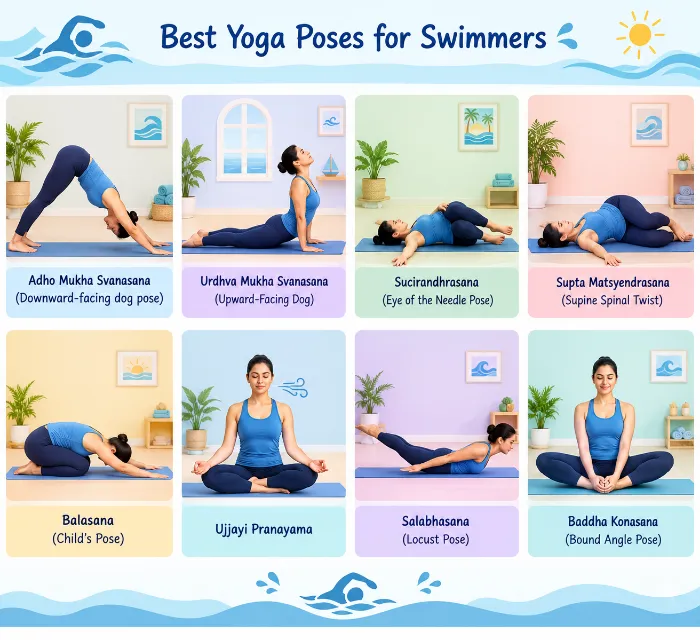
Adho Mukha Svanasana(Downward-facing dog pose)
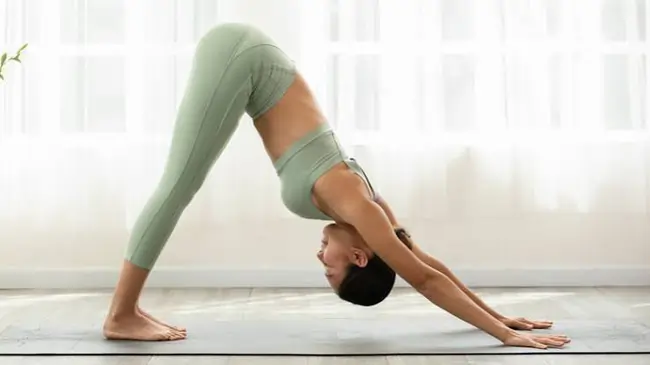
One of the finest stretches for swimmers is definitely the downward-facing dog. Your back, shoulders, chest, quadriceps, hamstrings, triceps, and calf muscles will all become stronger as a result. In addition to improving your ankle’s range of motion, this pose will help you become more conscious of your body. Your swimming pose will improve as a result of this heightened body awareness.
Steps:
- Put yourself on your hands and knees, all fours. Keep your legs hip-length apart and your hands shoulder-width apart. Make sure your knees are below your hips, and your wrists are precisely below your shoulders.
- Now press your palm against the ground, raise your knee, and use your buttocks to push forward and backward.
- Continue pushing backward and upward until your body forms an inverted V on the ground.
- You should fully extend your hands and upper body from your hips in a downward slant. Additionally, lengthen your legs such that your heels are in contact with the floor and your knees are straight.
- You can attempt to deepen the stretch by pushing your hip farther back and your chest farther down, or you can hold this pose for ten seconds.
Note: If you want to include a down-dog pose in your swimming warm-up, limit how much you stretch. Your muscles shouldn’t be overworked during the warm-up. If not, incorporate this pose into a session that is entirely unrelated to your swimming practice so that you can extend it to its fullest.
Urdhva Mukha Svanasana (Upward-Facing Dog)

The upward-facing dog is just as helpful as the downward-facing dog, especially due to the impact it has on your vital lats. This pose strengthens the upper-body muscles unique to swimming. This pose stretches your spine, which can help relieve swimming-related body aches.
Steps:
- Place yourself on all fours with your knees slightly behind your hips and your hands exactly below your shoulders.
- Now slowly descend to the floor, touching your chin and chest to the floor. Carry your weight down to the floor rather than just falling on it.
- Place your hands slightly behind your chest.
- Your shoulder blades are squeezed together, and your shoulders are back.
- Push yourself up now, then slowly extend your hands. As opposed to squeezing your shoulders, maintain them low, raise your chest, and slowly arch your head back.
- Just enough to raise your knees off the floor; increase this arch. After a comfortable number of breaths, carefully release the position and rest on your front.
Note: You must practice upward dog pose in a totally different session from your swimming because it is a core strength and flexibility exercise. Additionally, as you release this pose, try pushing back into the child’s pose as you lie on your front, hold it there for a few breaths, and then get up. This will prevent you from being injured.
Sucirandhrasana (Eye of the Needle Pose)
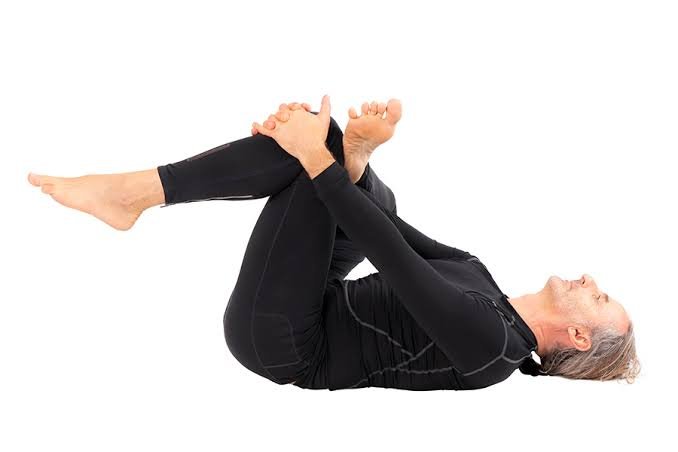
This position is ideal for strengthening your leg muscles, which are crucial for swimming.
Your hip, upper leg, and lower back muscles are gently opened up by the eye of the needle position. This is more of a flexibility-building exercise than a strength-building one. In contrast to the first two postures, the eye of the needle is a great way to stretch your thighs, hips, and lower back before swimming. Additionally, this pose helps stretch and strengthen your lower back, which will increase the distance you can cover with each stroke.
Steps:
- With your feet touching the floor and your knees folded, you lie on your back.
- As you would when standing upright, maintain a straight upper body. Keep your spine from adopting the floor’s contour. Keep your lower back off the floor in particular.
- Now raise your right leg and wrap your hands around the center of your hamstring.
- Place your left ankle over your right knee and your left leg over your left hand.
- Now, without raising your sitting bones, press your right leg against your hands as far away from your body as you can while maintaining an elevated lower back. Your lower back should feel stretched.
- Now, slowly bring your legs closer to your torso without allowing your lower back to come into contact with the floor. Feeling the stretch in your hips will be beneficial.
- On the opposite leg, repeat the pose.
Note: You can perform the eye-of-needle pose before or after swimming. It’s important to keep in mind that you don’t have to drag your right leg all the way down to your chest. The goal is not that. It is enough to pull it until your right knee is over your belly button. Your left leg’s side thigh muscle may sustain damage if you overpull your right leg.
Supta Matsyendrasana(Supine Spinal Twist)
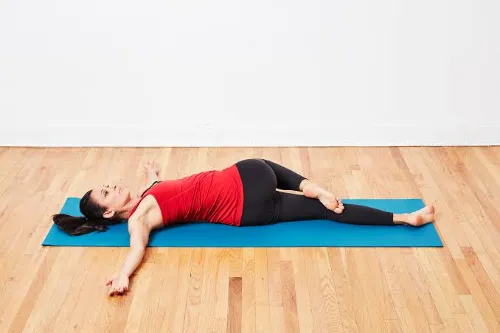
The most effective exercise for healing and treatment is the supine spinal twist. Among the many advantages of the position are the relaxation of the lower back, hips, and stiff spine. In addition to stretching your shoulders, upper back, and chest, the position clears your body of toxins. The supine twist can be your go-to comfort pose at the end of the day following intense swimming practice.
Steps:
- Rest on your back in a supine position.
- Take your right leg over your left knee and bend your right knee. Press your right heel into your left knee while positioning your right foot outside of it.
- Apply pressure to your right knee with your left hand, then pull the knee down toward the floor. The supine twist will be produced as a result.
- Maintain the center of your right chest while extending your right shoulder and arm to the right.
- To achieve the greatest amount of twist, keep slowly lowering your right knee till it meets the ground.
- Remember to take deep breaths into your spine.
- Perform the twist on the opposite side after holding your position for thirty seconds.
Note: You can attempt this pose at the conclusion of other dryland exercises or after swimming. Keep in mind that neither your right shoulder nor the shoulder on the other side of the twist should be forced to stay on the ground as you perform the twist. It is acceptable for it to lift slightly off the ground. Just be aware of it and avoid twisting your upper body.
Balasana (Child’s Pose)
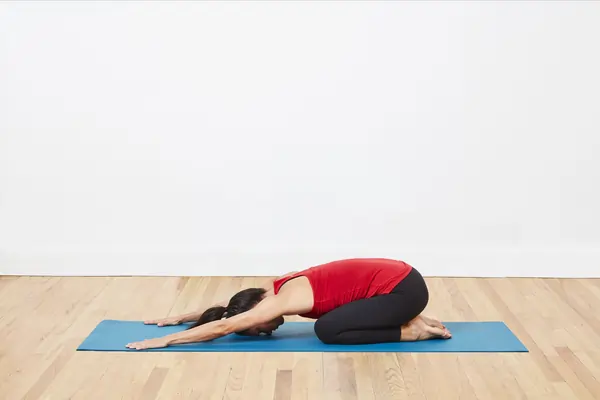
In the practice of yoga, child’s pose is well known for its ability to calm your body and relieve tension. But when it comes to swimming, child’s pose offers an additional advantage. It will increase a swimmer’s neck strength and flexibility. Additionally, this pose will stretch and lengthen your upper back.
Steps:
- Sit back on your heels and drop to your knees.
- Now fully lower your body until your head is on the ground and your chest is on your knee.
- Lift your hands and extend them straight in front of your head.
- Now extend your arms and upper body as far forward as you can while opening your shoulder blades, shoulders, upper back, and middle back.
- Inhale into your lower back for ten seconds.
- Do this exercise three times.
Note: You can perform child’s poses before or after swimming at the conclusion of any workout. Additionally, when stretching, remember to just utilize your arms and upper back. Keep your lower body stationary.
Ujjayi Pranayama
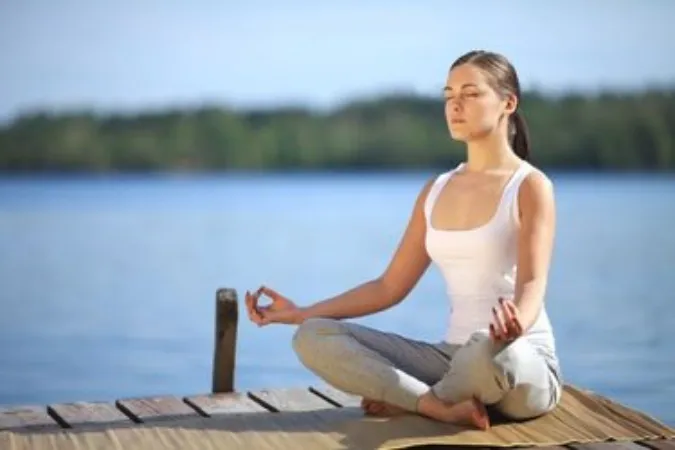
Since breathing is essential to swimming, Ujjayi Pranayama will be essential to your dryland yoga practice. In the case of swimming, this breathing exercise just improves lung function and capacity. You can learn limited breathing and improve your control over exhaling by practicing Ujjayi breathing.
Steps:
- Take a comfortable position with your legs crossed.
- Maintain a straight head, open shoulder blades, and a straight spine.
- Now take a big breath while tilting your head slightly lower and tightening your throat to block all airways.
- For ten seconds, hold your breath.
- Gently exhale through your left nostril while keeping your right nostril closed. As you exhale, raise your head straight.
- Perform this Pranayama five to ten times.
Note: This pranayama has practically immediate results. This pranayama can be included in any early morning routine, such as your swimming warm-up. Early in the morning is generally the best time to do pranayamas.
Salabhasana(Locust Pose)
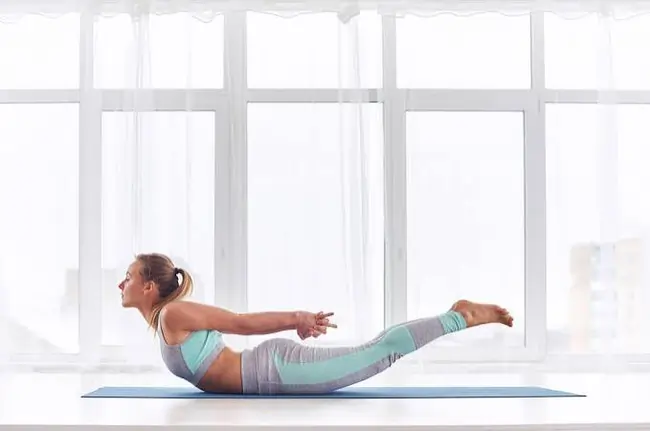
The Benefits: Like any other athlete, swimmers must acquire a mix of strength and flexibility to achieve maximum power. The core, spine, shoulders, chest, arms, and thighs can all be strengthened and lengthened at the same time using locust pose.
- Place your forehead on the ground while lying on your stomach with your arms by your sides, palms facing down.
- Bring your legs together so that your heels are slightly apart and your big toes contact.
- To stretch your lower back, extend your tailbone toward your heels.
- Raise your arms, legs, head, and upper body off the ground as you inhale. To keep your neck long, keep your gaze on the ground.
- Reach out through the top of your head, raise and extend your chest, and stretch through your fingertips and toes. Hug your legs together and raise them from the backs of your upper thighs. Breathe in.
- After holding this position for 30 to 60 seconds, exhale to let go. To relieve tension in your lower back, rock your hips forward and back.
Baddha Konasana (Bound Angle Pose)
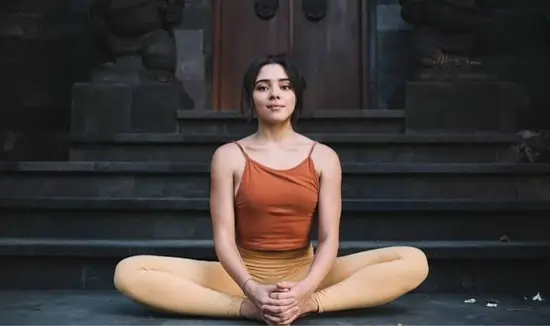
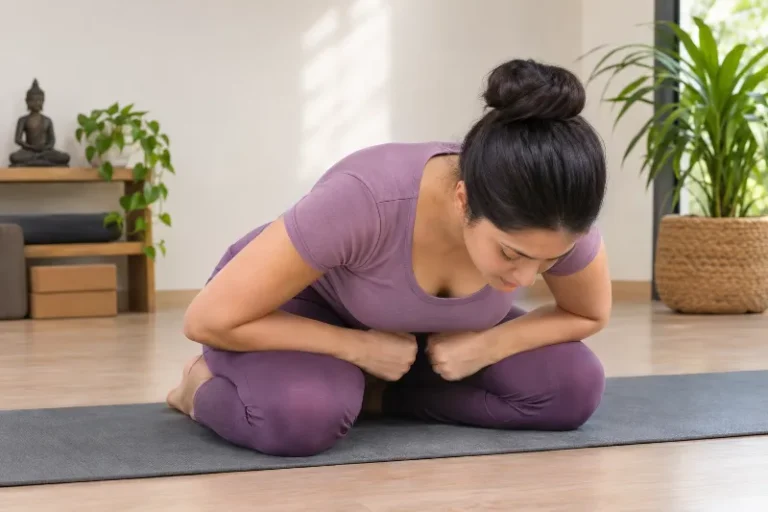
The benefits of Bound Angle Pose are essential for swimmers who perform the breaststroke or experience hip congestion. In order to enhance your strength and range of motion with every kick, it promotes a healthy external rotation of the hips and gives your hips and groins a deep stretch.
Steps:
- Place your legs out in front of you while you sit comfortably.
- You may want to sit up on a block or a blanket if you have tight hips or if sitting upright causes your lower back to round.
- Bring your feet to the floor and bend your knees until they are only a few inches from your crotch.
- Bring the soles of your feet together and let your knees drop open to the sides.
- Bring your hands to your ankles while maintaining a long spine.
- Allow the pull of gravity on your knees to widen your hips. You don’t need to keep the big-toe sides of your feet glued together or push your knees down; they may naturally spread slightly apart.
- Sit up straight as you breathe in; remain upright and concentrate on lengthening your spine as you exhale. You may need to think about increasing the stretch if you can open your feet like a book while keeping the pinky-toe edges of your feet together.
- For a more intense variation, tilt slightly forward from your hip creases while continuing to stretch your spine. Take a 30- to 60-second breath here.
Safety Precautions:
Although yoga is usually safe, it’s crucial to practice mindfully:
- Don’t push yourself too hard or outside your comfort zone.
- Avoid holding your breath for too long.
- Practice in a quiet, well-ventilated area.
- See a specialist if you have any respiratory issues.
- If you get pain or vertigo, stop right away.
Conclusion
Swimming is an excellent kind of exercise on its own. You can achieve the highest level of athleticism by combining yoga and swimming, which can have amazing benefits. Yoga will undoubtedly improve your swimming, regardless of whether you swim for fitness and leisure or for competitiveness.
Yoga can improve several aspects of swimming. The two essential components of swimming, strength and flexibility, can be improved with yoga. Additionally, some yoga poses can improve your breathing and reduce muscle fatigue, two aspects of strength and flexibility that are equally crucial.
FAQs:
Does yoga help swimmers?
By expanding shoulder range of motion, developing mental toughness, and strengthening respiratory muscles through breathwork, yoga enhances swimming performance. Even if improvements in sprint time take longer to manifest, research indicates that these advantages promote aerobic performance and training consistency.
Why are swimmers so toned?
The upper body is where the improvements begin; top swimmers have well-developed pecs, deltoids, and lats. They didn’t obtain those by mistake; because swimming involves frequent overhead motions, it concentrates a lot of muscular growth, strength, and endurance in the upper body.
What not to do before swimming?
Avoid: Eating a lot before swimming: Eating a lot before swimming may make you feel heavy in the water and cause you to tire out more quickly, which will shorten your swimming session.
Which is better, gym or swimming?
Which is better for losing weight, going to the gym or swimming? Both are the answers! Swimming burns a lot of calories and is beneficial for cardiovascular health. However, gaining a lot of muscle in the gym is crucial since it burns more calories at rest.
Do swimmers have a longer lifespan?
The risk of death was 28% lower for swimmers and 27% lower for aerobic exercisers. These were the decreases following the scientists’ adjustment for potential risk factors for early mortality, such as smoking.
References:
- Swimcamp. (2026, May 29). Yoga for Swimmers: 8 Evidence-Based Practices. https://swimcamp.com/blog/yoga-for-swimmers-8-evidence-based-practices/Swimcamp. (2026, May 29). Yoga for Swimmers: 8 Evidence-Based Practices. https://swimcamp.com/blog/yoga-for-swimmers-8-evidence-based-practices/
- Effectdigital. (2020, April 10). Benefits of yoga for swimmers. Masters Swimming Hub. https://www.swimming.org/masters/benefits-of-yoga-for-swimmers//
- Smith, S. (2024, September 13). The benefits of yoga for swimmers — YOGA UNLIMITED. YOGA UNLIMITED. https://www.yogaunlimitednc.com/blog/the-benefits-of-yoga-for-swimmers