Best Yoga Poses for Weight Loss
Is it Possible to Lose Weight With Yoga?
If you’re new to weight loss, yoga is one of the greatest options, especially if you practise intermittent fasting. For this reason, we suggest yoga as the ideal morning exercise for intermittent fasting. If you are in a class with people who can easily balance on their heads, it could initially seem scary. Take your time and discover your own route.
There are variations to every stance on this list of yoga poses for weight loss. If you’re just getting started, concentrate on the changes and go at your own speed. Practice holding these positions for at least 15 to 20 minutes three times a week to build your strength.
Yoga Asanas to Lose Weight
Yoga is an age-old controlled behaviour that dates back thousands of years. Yoga provides the skills and methods we need to live a tension-free, stress-free life.
Are there any weight-loss yoga poses?
Yoga poses are a great way to work out and lose weight. Our bodies release the hormone cortisol in response to stress, which can lead to weight retention, especially in the abdomen. Yoga for weight loss lowers cortisol and stress levels, which facilitates weight loss.
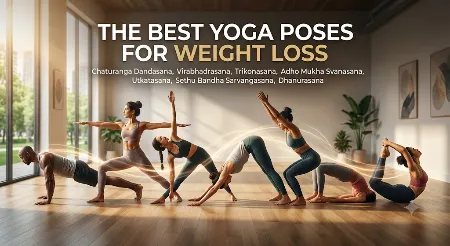
Best Yoga Poses for Weight Loss:
- Surya Namaskar
- Chaturanga Dandasana
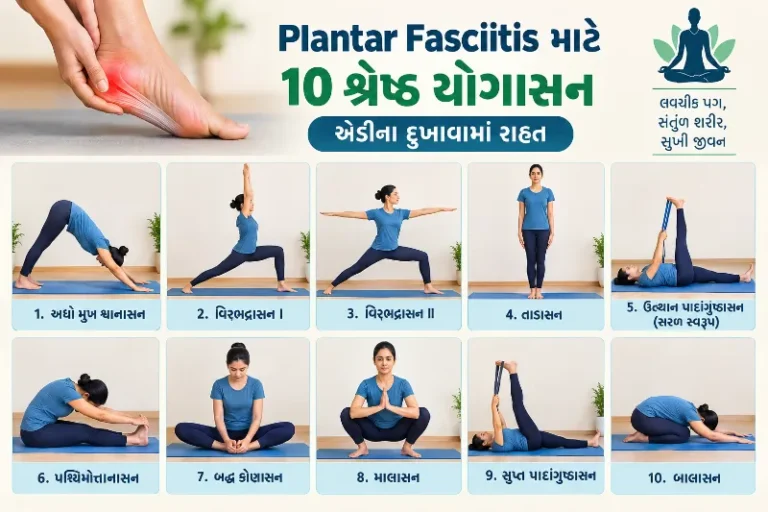
- Virabhadrasana
- Trikonasana
- Adho Mukha Svanasana
- Utkatasana
- Sethu Bandha Sarvangasana
- Dhanurasana
Surya Namaskar (Sun Salutation)
Have a tight deadline? Do you want to feel in shape but are unsure how? Greetings from Surya Namaskar’s world. Surya Namaskar, which translates to “sun salutation,” is a set of twelve yoga positions.
The nicest thing about Sun Salutation is that it’s ideal for “super busy” people who frequently lament their inability to practice yoga due to time constraints. An excellent cardiovascular workout is achieved by performing at least 12 sets of Surya Namaskar quickly, ideally at sunrise. These poses can be calming and meditative, and they help tone the muscles when done slowly. Additionally, you can appreciate the stretch and feel your body becoming more flexible.
Sun Salutations serve as a great bridge between warm-ups and challenging yoga poses, even though they are essentially an activity in and of themselves. To relieve body stiffness, begin your early morning yoga practice with some warm-up stretches. After that, you can perform a few rounds of Surya Namaskar to improve your body’s flexibility and get it ready for the strenuous yoga posture sequence.
Benefits
- Complete body fat burning
- Increases metabolism
- Increases body flexibility and muscle strength.
- Positively affects endurance
- Lessens tension
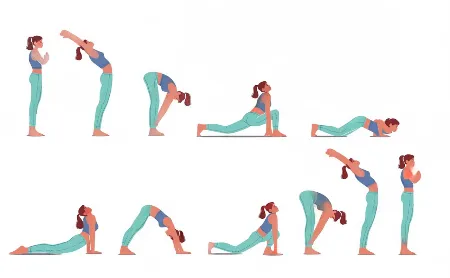
Why Surya Namaskar is good
That’s not all, though. Every portion of the body can benefit from regular Sun Salutation practice in a number of unusual ways. The entire body, from top to bottom, is greatly impacted by these potent yoga positions, including the heart, liver, colon, stomach, chest, throat, and legs. It guarantees the healthy operation of the stomach, intestines, and nerve centres while also purifying the blood and enhancing blood circulation throughout the body. Everyday Sun Salutation practice aids in balancing the body’s three constitutions, Vata, Pitta, and Kapha.
Surya Namaskar (Sun Salutation) is a sequence of 12 yoga poses performed in a continuous flow. It is one of the most effective full-body yoga routines, improving strength, flexibility, cardiovascular fitness, and supporting weight loss. When practised regularly with proper breathing, it helps increase calorie expenditure, boost metabolism, and enhance overall well-being.
Chaturanga Dandasana
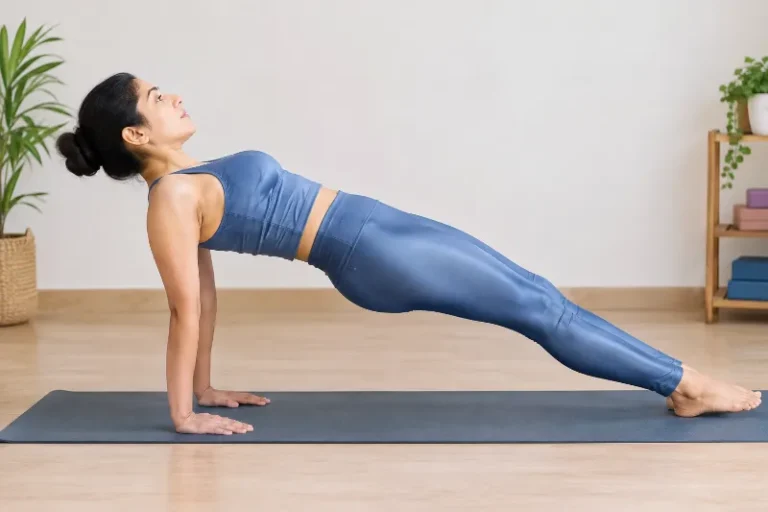
A powerful yoga pose that helps with weight loss is Chaturanga Dandasana, sometimes referred to as Phalakasana or Plank Pose. Chaturanga Dandasana strengthens all of the body’s muscles by working the arms, shoulders, legs, and core.
Additionally, by enhancing the connection between the mind and body, the careful practice of Chaturanga Dandasana promotes good food and lifestyle choices.Therefore, by improving strength, endurance, metabolism, and general well-being, incorporating Chaturanga Dandasana into a daily yoga practice can help with weight management goals.
Benefits
- Aids in belly fat reduction
- Enhances shoulder and core strength
- Enhances posture all around
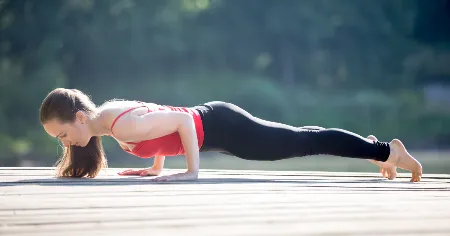
How to Do Chaturanga Dandasana
- Take a seat in Vajrasana.
- Put your hands beneath your shoulders
- With your toes facing inward, straighten your legs until they are parallel to the ground and a few inches above it.
- Breathe out. Get into the plank position. Breathe out.
- Take a seat in Vajrasana.
Guidelines for General Safety
- Before practising, fully warm up.
- Before descending, move a little forward.
- Keep your elbows near your ribs.
- At a 90-degree elbow bend, stop
- Keep your shoulders at or slightly above your elbows.
- Work your legs, glutes, and core during
- Continue to breathe
- When the form begins to malfunction, make changes.
Virabhadrasana (Warrior Pose I, II, and III)
The stories of Virabhadra, a formidable warrior formed to re-establish order, are where the term “Warrior Pose” originates. Holding this pose in yoga promotes inner strength, mental toughness, and groundedness, just as the warrior represents bravery and tenacity.
Benefits
- Your glutes and thighs will tone.
- Boosts balance
- Increases endurance
Types of Virabhadrasana
Virabhadrasana comes in three main forms:
- Virabhadrasana I (Warrior I): Maintains one foot forward while concentrating on hip opening, chest expansion, and arm stretch.
- Virabhadrasana II (Warrior II): Focuses on hip lateral stretching, leg strength, and endurance. At shoulder height, the arms are extended sideways.
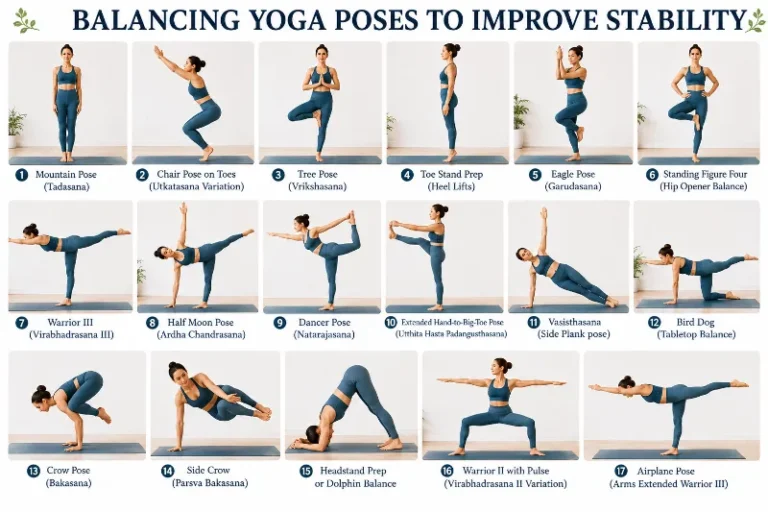
- Virabhadrasana III (Warrior III): This balancing pose, in which the body is nearly parallel to the ground, strengthens the legs and core and enhances concentration.
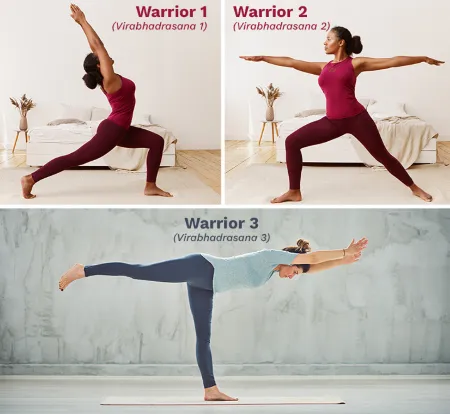
How to perform Virabhadrasana I
- Start with a tall, grounded posture in Mountain Pose (Tadasana).
- Turn your left foot slightly outside at a 45-degree angle and step it back three to four feet.
- Step 3: Make sure the front (right) knee remains just above the ankle when you bend it to a 90-degree angle.
- Step 4: Look up while raising both arms upward with palms facing each other.
- Step 5: Hold the stance for five to eight breaths while squaring your hips toward the front.
- Step 6: Let go and switch to the other side.
How to perform Virabhadrasana II
- How to Perform Virabhadrasana II, or Warrior II Pose
- From Mountain Pose, take a wide step with your feet approximately four feet apart.
- Turn your left foot slightly inward and your right foot 90 degrees out.
- With the palms facing down, extend both arms out to the sides parallel to the floor.
- Bend your right knee over your ankle while keeping your thigh parallel to the ground.
- Hold your gaze over your right hand for five to eight breaths, then switch sides.
How to perform Virabhadrasana III
- Start in the Warrior I stance.
- Lift your rear leg straight behind you and lean your torso forward.
- Keep your arms parallel to the floor, either near your ears or extended.
- Maintain a strong core and square hips. After holding for a few breaths, drop gradually.
Guidelines for General Safety
- Despite this, most people can safely practice Warrior II.
- To relieve strain on the knees, people with knee problems should be cautious and may need to adjust the stance.
- A study indicated that while standing yoga postures can strengthen the lower limbs and accomplish the goal of musculoskeletal rehabilitation, improper exercise planning might actually result in injuries, so you should see your healthcare physician and use extreme caution.
Trikonasana (Triangle Pose)
Trikonasana is another name for Triangle Pose. The Sanskrit term trikonasana means “triangle only,” which is why it is named triangle pose. This yoga pose can help reduce weight in the thighs, waist, and stomach. Triangle Pose, or Trikonasana, helps people lose weight in a number of ways. As you stretch and extend the body laterally, this pose works the legs, core, and obliques, among other muscle groups.
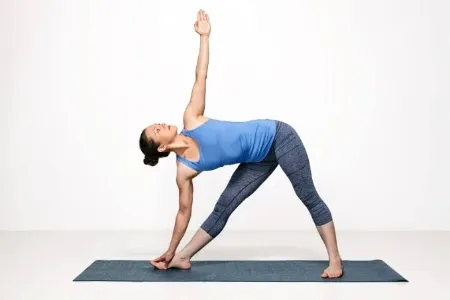
How to do this yoga pose:
- On a level surface, lie flat on your back.
- Your arms should be by your sides, and your feet should stay together.
- Now take a deep breath and raise both your feet and your chest off the ground as you exhale.
- Your arms should extend toward your feet as you do this.
- Make sure your fingers, eyeballs, and toes are all in a straight line.
- The contraction of your abdominal muscles will cause the area surrounding your navel to become stiff.
- Breathe deeply while maintaining the stance for a short while.
- Now, gently release the posture and settle back into a comfortable position on the ground as you exhale.
Guidelines for General Safety
- If you have severe back discomfort, you shouldn’t perform this pose.
- This asana should not be performed by people who have slipped discs.
- Don’t do this while your blood pressure is high or low.
- If headaches are present.- avoid.
- It should be avoided if back and neck issues are more serious.
- When you have a migraine, you shouldn’t do it.
- This should not be done in hyperacidity.
Adho Mukha Svanasana (Downward Dog Pose)
A foundational pose that works several muscle groups at once is downward dog. First of all, this pose works the arms, shoulders, core, back, and legs all at once. Meanwhile, this pose’s elongation of the spine and stretching of the hamstrings and calves can help with flexibility and posture, improving general physical health and well-being.
Benefits
- tones the core, arms, and legs.
- enhances blood flow
- releases tension
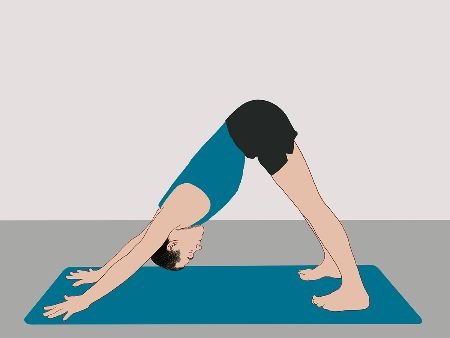
How to do this yoga pose:
- Get on your hands and knees.
- Make a table so that your hands and feet serve as the table’s legs and your back serves as its top.
- As you exhale, raise your hips, straighten your knees and elbows, and arrange your body into an inverted V.
- The hands are shoulder-width apart, while the feet are parallel to each other and hip-width apart.
- Put your hands firmly on the ground.
- Take deep, long breaths while maintaining the downward dog stance. Aim for the navel.
- Exhale. To go back to the table position, bend your knees.
Guidelines for General Safety
- Most people, even pregnant women, can feel safe.
- who have shoulder or wrist problems should be cautious and adjust the stance as needed.
Utkatasana (Chair Pose)
Utkatasana, sometimes referred to as Chair Pose or Fierce Pose in English, is named after the Sanskrit words utkata, which means fierce, forceful, or unsteady, and asana, which means posture. The pose’s dual character is written in the name.
Utkatasana is incorporated into our daily sessions at Habuild as both a solo strength-building hold and a standing sequence posture. It is practised at a level suitable for each member, and live instruction ensures that each student’s form protects the knees and spine throughout.
Benefits
- More calories are burned
- Increases gluteal and leg strength.
- Increases stamina
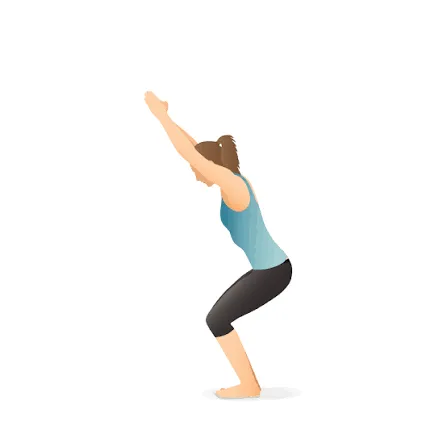
Variations of Utkatasana
- Standard Classical Utkatasana
- Twisted Chair, Parivrtta Utkatasana Variation
- Advanced Balance Utkatasana on Tiptoe
How to do Utkatasana (Chair Pose)
- Your feet must be slightly apart, and you must stand upright.
- Next, extend both of your hands in front of you, palms down. Avoid bending both hands at the elbows.
- Gently press your pelvis down and bend your knees as if you were sitting in a chair.
- You must visualise reading a newspaper or typing on a computer in order to perform the Chair Pose more effectively.
- Maintaining your hands parallel to the ground is crucial.
- You need to be aware of the posture and expand your spine.
- Continue to breathe normally.
- You ought to lower yourself into the position.
- Once finished, you can either lie down or sit in Sukhasana.
Guidelines for General Safety
- If you keep smiling, you can hold the position for a longer period of time.
- By keeping your feet together, you can strengthen your inner thigh muscles.
- Keep your feet hip-width apart, though, if you’re feeling unsteady.
- The head and neck should always line up with the spine.
Sethu Bandha Sarvangasana(Bridge Pose)
Setu Bandhasana is a potent backbend with many physical and mental advantages. The name refers to the practice of forming a bridge-like shape with the body and is derived from the Sanskrit words Setu (bridge), Bandha (lock or bind), and Asana (position).
Setu Bandhasana yoga is a beginner-friendly inverted backbend that can be used to improve flexibility, get ready for deeper backbends, and experience the advantages of an inversion without being upside down.
Benefits
- Fortifies the posterior chain
- It encourages thyroid stimulation.
- Enhances posture in general
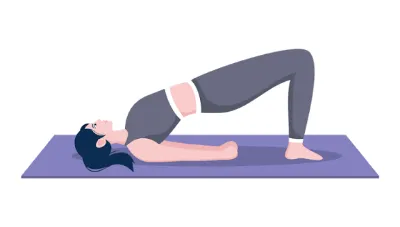
How to do this yoga pose:
- Lying on your back, bend your knees and spread your feet hip-width apart. Keep your arms at your sides and your hands down.
- Ensure that your feet are securely planted on the mat and that they are sufficiently near your glutes.
- Contract your core and gently press your lower back into the floor to close any space between your spine and the mat.
- As you take a breath, raise your hips toward the ceiling by pressing down with your feet and raising your spine off the ground one at a time.
- Make sure your head, neck, and shoulders are flat on the ground while keeping your thighs parallel and your knees in line with your hips. For stability, use your inner thighs.
- If it’s comfortable, you can stay on top of your shoulders by pressing your arms into the mat and clasping your hands beneath your back as your hips rise.
- Concentrate on taking deep, steady breaths while holding the pose for approximately thirty to sixty seconds (or up to 10 breaths), and use your core and glutes.
- Avoid tilting your head during the posture to maintain alignment, and keep your chin slightly tucked to protect your neck.
- To release, always let out a breath and slowly return your spine to the mat until your hips are lightly resting on the ground.
- Perform three sets of ten to fifteen repetitions.
Guidelines for General Safety
- Not warming up in advance
- Toes out to the side
- Not using the inner thighs
- Raising the chest
- Allowing the knees to come into contact
- Hip dropping
- Arching back
Dhanurasana(Bow pose)
The bow position, also known as Dhanurasana (pronounced Dha-nur-AAH-suh-na), is a back-bending yoga practice. The pose’s name comes from the form your body adopts.
In Sanskrit, “asana” denotes pose or posture, and “dhanur” signifies bow. This pose increases the spine’s strength and flexibility. When performing this asana, balance and core muscle strength are crucial.
This stance has a strong relationship to Indian mythology, where the bow is frequently mentioned as a component of armour. Similar to how a warrior benefits from having a strong bow, this asana requires strength and determination as you ease into the pose.
Getting Ready for the Bow Pose
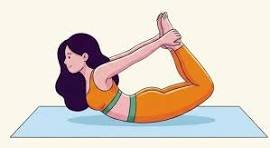
How to Perform the Bow Pose
- Lie down on your stomach to start the bow pose.
- You can use a yoga mat or lie down on the ground.
- Bend your legs upward so that your feet’s soles are toward your head.
- Hold your ankles with your hands behind you on either side.
- As you inhale, raise your chest off the ground and raise your legs into the air using your hands.
- Keep a soft smile on your face and look directly ahead. Hold this stance for a few deep breaths.
- Just bend as much as you can without going overboard.
- As you exhale, lower your legs and chest to the floor after maintaining the pose for 15 to 20 seconds. Put your arms and legs on the ground and take your hands off your ankles.
Guidelines for General Safety
- Perhaps avoid it or adjust it if you have lower back pain, such as slip disc.
- When bearing weight on your shoulders, be cautious and grip your ankles from the outside to make your shoulders feel much more secure and stable.
- During pregnancy, this should be avoided.
- Instead of attempting to bend backwards, concentrate on expanding your chest and pressing your ankles against your hands.
- This pose should be avoided or done very lightly by those who have hypertension or hypotension.
General Benefits
- All of the body’s vital organs benefit from improved blood circulation.
- Strengthens the torso and lower back.
- Stretches the hamstrings, calves, and spine
- Strengthens the arms, shoulders, and core
- Yoga Increases Metabolism and Burns Calories to Help Lose Weight
- Develop Lean Muscle with the Greatest Yoga Poses for Losing Weight
FAQs
How much weight loss is possible with Surya Namaskar?
3500 calories are included in one pound of fat.
Therefore, burning between 300 and 400 calories on average is necessary if one wants to lose one pound of weight per week. Now, as was previously said, a single 3.5 to 4-minute Surya Namaskar session can help you lose about 13.90 calories. In other words, it takes about 18 minutes to lose 250 calories, 25 minutes to lose 350 calories, and 40 minutes to lose 500 calories.
What kind of yoga is most effective for reducing abdominal fat?
When done regularly, poses like Utkatasana can help reduce belly fat.
Is yoga safe for beginners who are overweight?
Yes, however, you should perform positions gently and ideally under supervision.
Is yoga more beneficial than going to the gym?
Yoga and the gym are very different in character, despite the fact that both are equally effective. Your body and mind are strengthened at the same time via yoga. The gym is primarily about incorporating physical activity into your daily routine. It also has to do with preference.
References
- Nidhi. (2026). The Complete Body Workout for Weight Loss: Surya Namaskar – Sri Sri School of Yoga. Sri Sri School of Yoga. https://srisrischoolofyoga.org/in/blog/the-complete-body-workout-for-weight-loss-surya-namaskar
- NOVI Team. (2024). Yoga Poses for Weight Loss | NOVI Health. NOVI Health. https://novi-health.com/library/yoga-poses-for-weight-loss
- rakshak. (2025). Setu Bandhasana (Bridge Pose). The Art of Living – Making Life A Celebration. https://www.artofliving.org/in-en/yoga/yoga-poses/setu-bandhasana-bridge-pose
- Tata AIG. (2021). Surya Namaskar for Weight Loss | Tata AIG Blog. Tata AIG. https://www.tataaig.com/knowledge-center/health-insurance/surya-namaskar-for-weight-loss
- MASSH. (2026). 8 Best Yoga Poses and Diet Plan for Weight Loss. MASSH. https://massh.in/blogs/8-best-yoga-poses-and-diet-plan-for-weight-loss