Yoga For Diastasis Recti
What is Diastasis Recti?
Diastasis recti occurs when the muscles in the abdominal wall separate due to the connective tissue running down the midline of your tummy becoming overstretched and thin. This causes the rectus abdominis muscles (six-pack muscles) to separate laterally.
Diastasis recti will occur in most pregnancies and can last months or even years after birth. The most visible symptom is a pooch belly. As a result, many healthcare professionals will often overlook the impact this condition can have on the body and simply consider it a cosmetic concern.
The main cause of Diastasis Recti is pregnancy. Any activity that consistently causes you to push your abdomen forward can cause your connective tissue to stretch and cause your abdominal muscles to separate.
What causes it?
However, you may notice that the linea alba has stretched and thinned due to pressure on those muscles. If it becomes overly stretched, the rectus muscles may separate when relaxed. Some people may be able to train their muscles to bring them back together, but they may also suffer from losing core strength, which can affect their pelvic floor function.
The integrity of the Linea Alba tissue and width of the rectus muscles. This tissue should feel springy and offer some resistance to finger pressure.
There may also be a slight bump between your abs. Sometimes referred to as doming or coning (I refer to it as a shark fin). This can often be noticed during an exertion movement, where the increased internal abdominal pressure pushes against the thinned linea alba, or when moving from a recumbent/lying position.
How can you measure diastasis recti?
You can measure diastasis recti using the following:
- Palpate the midline from the sternum to the pubis to see how you are feeling.
- Measure three fingers above, below, and at the navel. What sort of tension are you feeling? (Sometimes called marshmallow). Is the muscle beginning to sag? Do you feel some tension and recoil?
- Repeat the measuring, but this time exhale, lift your head and shoulders slightly, and tuck your chin into your chest.
We would like to test how tight and wide the linea alba can be. We don’t want to see separation between the muscles or feel the sharp inner edge of the rectus abdominis. Ideally, you should feel tension in the midline. This will give you a very basic idea of how the rectus is reacting to being engaged.
Once you have done that, you need to exhale and bring your ribs down and your pelvic floor up. Check to see whether there is more tension now. Some people will find their abdominals dome or loaf when they lift their head. This is purely due to the rectus muscle being engaged and not the Transverse Abdominals (TA). This shows us we need to focus on engaging our TA. If you can locate the ASIS points and move them in and out one inch, you will feel the TA engaging. The muscles should be tight and engaged.
Can postnatal yoga help to heal diastasis recti?
By helping to correct many of the issues such as alignment, breathing, and postural issues that may be preventing you from healing, postnatal yoga can help you heal your diastasis recti! We will also help you to reconnect with your core and strengthen any weak or stretched muscles from your pregnancy.
What you should focus on to cure your separation from pregnancy is:
Training and strengthening your core muscles: The diaphragm, pelvic floor, multifidus, rectus, obliques, and transverse abdominals are all core muscles that need strengthening. To allow proper stabilisation, the core needs to have all the muscles present in equal amounts. If there are issues with any of the core components, then the pelvic floor (often overactive) can compensate too much.
Pelvic floor muscles: Pelvic floor dysfunction can have an effect on healing from diastasis recti. If these muscles are very tight, then they won’t be able to stretch as much when you inhale. This will increase intra-abdominal pressure and put pressure on the weak midline (linea alba).
Open the ribs in the back: Lateral abdominal muscles and back ribs should be open. If the connective tissue between the rectus abdominals (linea alba) is unable to move, then there is an easy path for internal pressure and breathing along the line of least resistance. This will cause an increase in diastasis. The tight back ribs will restrict movement of the diaphragm. This can cause tightness in the posterior pelvic floor. The front ribs will flare more due to the reduction in size of the side and back ribs. This may affect the healing of diastasis.
Posture changes: As your pregnancy progresses, you may have noticed that your posture has changed to compensate for your growing bump. This can lead to a forward head position, increased rib cage, and anteriorly rotated hips. This can cause excess pressure on your overstretched abdominal muscles, leading to pain in your back, neck, and pelvis.
After giving birth, it is important to ‘back it up and stack it up’ to align your neck, ribs, and pelvis. This will help you have a great feeling in your back and will help you release tension from your core and activate your ab muscles.
- To do this:
- Evenly distribute your weight between your feet.
- Retract your thighs
- Place your rib cage onto your pelvis, keeping your pelvis balanced.
- Tuck your chin slightly.
This will include postures from yoga that help with good alignment. Including relaxing poses for your pelvic floor, back, and chest muscles, and strengthening poses to work on your glutes and hamstrings.
What yoga poses and movements should you approach with caution for diastasis recti?
When considering what yoga poses to teach students with diastasis recti, we need to consider if they are able to generate tension in the linea alba using their abdominal muscles or if coning/ doming is happening. If there is coning/ doming, then we know we need to modify or remove the pose. We do not want to cause excessive pressure on the connective tissue, causing it to open further.
We should be cautious with these poses and breathwork.
Belly Breathing: Belly breathing can make diastasis recti worse due to the pressure placed on the abdominal muscles. Focus your breathing in your back and sides. This is called 360 breathing. This will help stretch your abdominal muscles. When breathing into your side and back ribs, your transverse abdominals will stretch eccentrically. Belly breathing will not stretch your transverse muscles eccentrically.
Rib Flare: A pressure problem is the issue here. Pressure will take the easiest route, so if we flare our ribs and cause our abdominal muscles to be overstretched, then pressure will continue to push the pressure forward into the connective tissue.
Focus on good posture and tuck your ribs up to your pelvis.
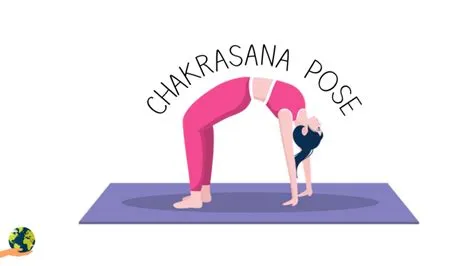
Cow Pose: As you move into cow pose, you might want to avoid going too low in your front body to allow your diastasis recti to heal and put extra strain on your linea alba. Inhaling into a deep back bend can cause extra strain on your overly stretched abdominal muscles, so we would not recommend.
Instead, try to gain some mobility in your top thoracic spine (upper back) and have some stability in your lower back.
Backbends: As mentioned above, we also need to know about the rib flare and anterior force that can happen when there is a diastasis. If the ribs are flared, then there will continue to be an anterior force on the connective tissue. This will not allow healing to occur. However, backbends could be a nice addition to the class for those without a diastasis.
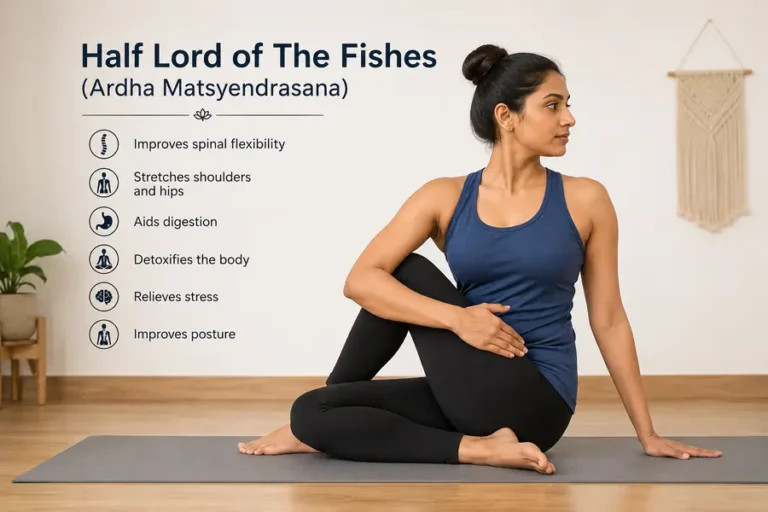
Deep twists: The organs in your pelvis will create downward force. If you’re really twisting deeply, then someone with a very weak pelvic floor may find they are under too much pressure. In this case, try to keep your focus on twisting your upper body rather than twisting deep into your abdomen.
Pranayama with breath retention: People who suffer from weak pelvic floor muscles and diastasis can have problems. Diastasis is caused by pressure issues; taking a breath hold will cause increased intra-abdominal pressure. Air will be forced into the weakened connective tissue and fall into the compromised pelvic floor as it takes the path of least resistance.
Yoga poses that help to heal postpartum diastasis
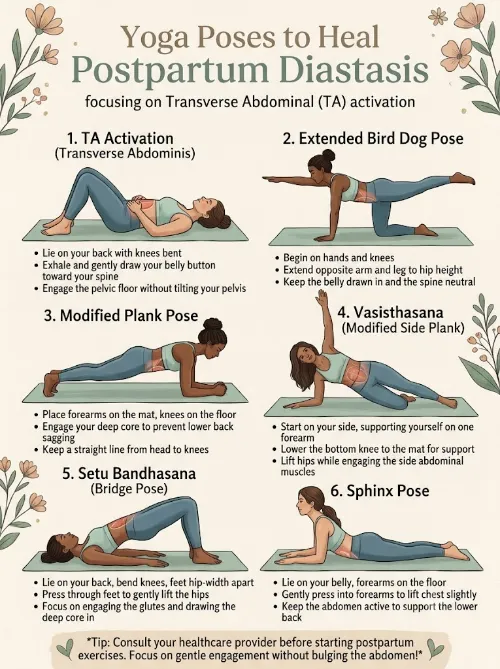
Correctly using your core and doing exercises/poses to strengthen your transverse abdominis, obliques, rectus abdominis, back, and pelvic floor is vital to aiding the healing of diastasis recti. Here are some yoga poses that can be used to help treat diastasis recti.
Transverse Abdominal (TA) Activation
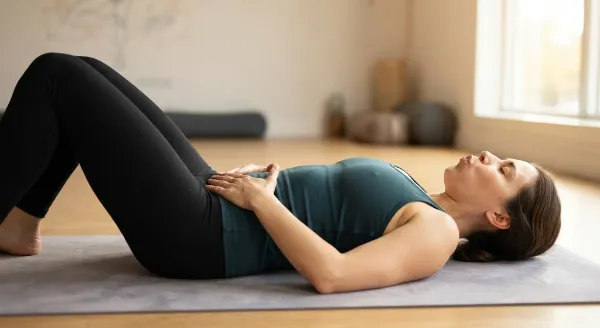
Steps:
- One of the first things you will learn in postnatal yoga is how to engage your transverse abdominals. This is the deepest layer of your front abs that works like a corset. We then need to ensure that your pelvic floor and TA are working together.
- Remember that when you force air out, you can see the transverse abdominals kick in. Try breathing with a ‘HA’ rhythm (or blowing into a balloon). I tell them to lie on their backs with a natural spinal curve, breathe down to their pelvic floor, place their hands on their lower abdomen, and feel the breath move in.
- As they exhale, try lifting their pelvic floor. You could even try to pull their hip bones towards each other. This will show whether their lower tummy comes in or goes flat.
- Once you have established a good base of breathing and TA muscle integration, you can move on to other exercises such as heel slides, dead bug, cross-body activation, etc.
Extended Bird Dog Pose
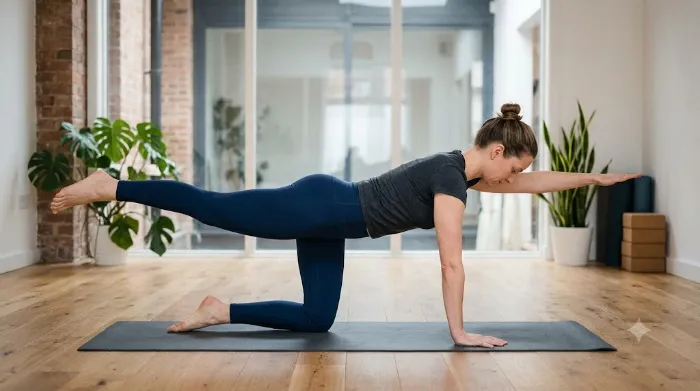
This is one of my favourite core strengthening positions. It may look simple, but it can make a big difference to stability in your core. The core consists of your abs and also your diaphragm, pelvic floor, and back muscles. This activates your whole core.
Loading your linea alba using a bird dog can help with connective tissue regeneration after birth. If you are noticing any coning or doming in your abdomen, you should move away from this.
Steps:
- Get into a four-point kneeling position.
- Keep your back straight and engage your core.
- Lift your left leg behind you and reach your right arm out in front of you.
- Do not allow your back to round, and keep your hips level.
- Hold the position for a few seconds, breathing steadily.
- Repeat with the opposite arm and leg. Return to the starting position.
Plank Pose
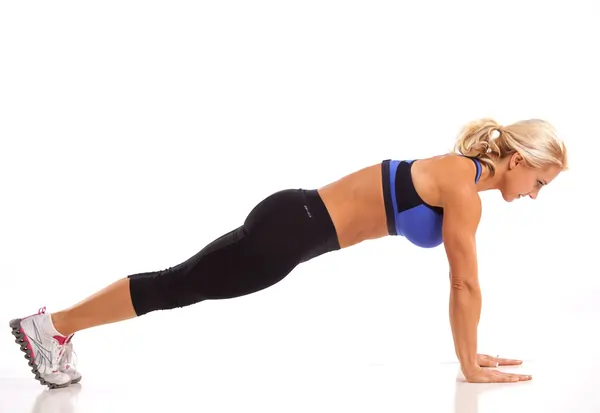
Variation is king when it comes to planking. It helps us to really respect and practice what our body needs right now.
Those with significant doming and diastasis recti will get a lot out of planking against the wall. Place your knees on the floor and place a block between your thighs. Half plank. I love using a block here, as it may help stabilise your pelvis and core, align your tailbone, and wake up your adductors.
For those who do not have coning/doming and have good abdominal muscle activation, then planks can be an effective exercise. It depends on how your muscles are activating.
Steps:
- Place your hands directly beneath your shoulders.
- Keep your body straight from your head to your heels.
- Lift your legs into a straight line.
- Engage your stomach and core.
- Keep your lower back from sagging and ensure your hips are level.
- Inhale and exhale whilst looking down at your mat.
- After holding the pose for between 15-30 seconds (or as long as is comfortable), slowly lower your knees.
Vasisthasana (Side Plank Pose)
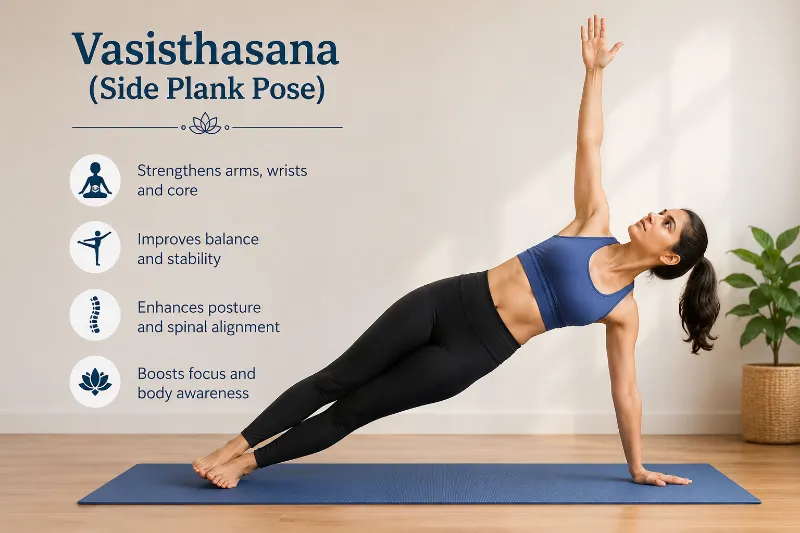
Side planks are a great way to focus on your core stability. (If required, get your knees down). To avoid movement of the spine, aim to stack your ribs and pelvis. If you’re getting any sinking or bulging in your linea alba, then you won’t be okay with this version yet.
Steps:
- Begin in plank position by placing your hands behind your shoulders.
- Lay your weight on your right hand and twist your body round.
- Lift your left arm to the ceiling whilst placing your left foot on top of your right.
- Keep your head to heels aligned.
- Inhale and exhale evenly whilst engaging your core muscles.
- Repeat on the opposite side once you return to the starting position after holding the position for between 10-20 seconds.
Setu Bandhasana (Bridge Pose)
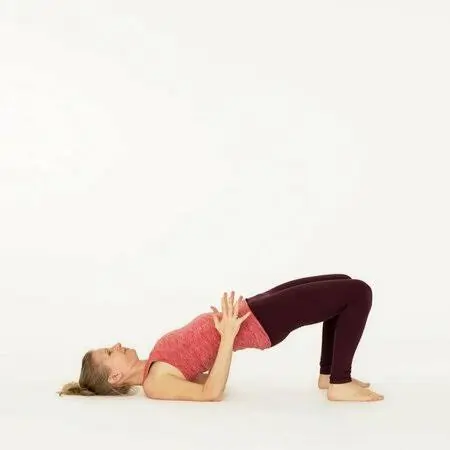
Bridge pose (Setu Bandha Sarvangasana) is a yoga pose that helps to stretch and strengthen the back.
Steps:
- Lie on your back with your knees bent and feet flat on the floor. Your feet should be hip-width apart.
- Place your palms face down and arms by your sides.
- Exhale and lift your hips to the ceiling. Press your arms and feet into the floor.
- Lower your shoulders and upper arms onto the floor with your hands clasped underneath your pelvis.
- Ensure your ribs don’t flare as you lift your hips and lengthen your tailbone towards your knees.
- Throughout your time in this pose, you will be doing some basic compressions. As you inhale, engage your core by gently pulsing your pelvic floor and abdominal muscles up and in towards your spine. Allow your abs to release slightly.
- Slowly bring your spine down vertebrae by vertebrae back to the floor. Exhale to release out of the pose.
Salamba Bhujangasana (Sphinx Pose)
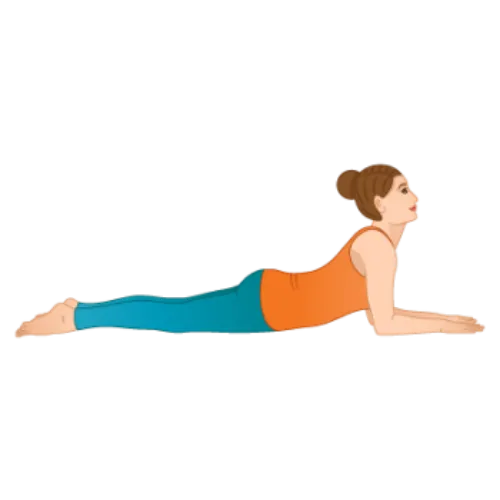
Sphinx poses are another name for the modified cobra pose. These poses provide all the benefits of forward body stretches but without the danger of separating your ribs and top abdominal area. They’re a fantastic alternative to a full wheel backbend, as all they do is gently stretch the front body without putting pressure on your spine or creating instability in your ribcage.
Steps:
- Forearms on the floor.
- Allow your hips to sink into the floor for stability.
- Using your arms to lift your torso, lift your upper body forward at an angle off your hips. Ensure your hip bones are firmly on the floor. This will create a gentle but effective stretch as the front of your body elongates due to the gentle, pleasant pulling force. Breathe throughout this movement.
- Ensure you don’t open your lower ribcage throughout. Keep your ribs in neutral.
Note: You should not do this activity if you are pregnant.
Prevent Diastasis Recti with These Simple Daily Habits
Poor Posture: It can help reduce stress on the abdominal muscles and help balance the weight through your body. Poor posture can cause increased intra-abdominal pressure in the pelvic floor; for example, a tucked pelvis and protracted ribs. A bulge may appear in the lower abdomen due to incorrect alignment, and this can cause weakening of the core over time.
Avoid heavy lifting: Incorrect lifting techniques can cause tightness in your abdominal muscles. To avoid diastasis recti, you must keep pressure off your stomach by lifting with your legs and not bending at your waist. Examples of heavy lifting include carrying shopping bags, holding your baby on one hip, and using a front-loading baby carrier.
When lifting your baby or toddler from the floor, it is best to be on one knee and pull them up towards you. Try to keep your body straight by keeping your shoulders above your hips. You should also use your legs to help lift your child up.
Pushing a Stroller with Forward Flexion: Having a nice slow walk with your little one is great for your health and mind, but if you are not careful can leave you with some serious strain on your back and tummy muscles. Bending over your pram into a forward flexion is a key position to avoid, even if you have strong core muscles. Keep your posture nice and long and pull your abdomen in.
Bulging Abs Forward When You Sneeze & Cough: Any action that causes forceful pressure on your abdominal muscles can cause diastasis recti. When we sneeze, cough, blow our nose, or even vomit, the connective tissue that binds our abdominal muscles together (linea alba) will be under extreme pressure. This will affect your core strength and function. Maintaining good abdominal positioning during even the smallest physiological actions can help reduce further injury.
Conclusion
Yoga can help manage Diastasis Recti. This is because it can improve breathing, improve posture, and improve core strength. If performed correctly, gentle, focused exercises will help to encourage healing. This can also help to strengthen the deep abdominal muscles. Not all yoga poses will be suitable.
You should avoid any poses that cause your tummy to dome or bulge, or cause pain. Choose the correct exercises to suit your needs and recovery by consulting a licensed physiotherapist or medical professional. With patience, consistency, and correct guidance, yoga can help encourage a safe and successful recovery.
FAQs:
Can yoga help with diastasis recti?
Postnatal yoga can help heal diastasis recti by putting your body back into correct alignment, breathing patterns, and posture to allow you to recover. We will also help you reconnect with your core and strengthen any weak or stretched muscles from your pregnancy.
How can I reduce my diastasis recti?
Never lift anything heavier than your baby.
When you are sitting or standing up from lying down, always roll onto your side and use your arms to help you lift up.
Don’t do any exercises that make you protrude your stomach, like sit-ups or crunches.
Can I get a flat stomach with diastasis recti?
Yes! You can obtain a flatter stomach despite your rectus diastasis. This can be achieved by specifically stimulating your deep abdominal muscles every day.
What to eat to reduce diastasis recti?
Oranges, kiwis, strawberries, pineapple, dark green leafy vegetables, red peppers, tomatoes, avocado, asparagus, sweet potatoes, carrots, and broccoli are a few examples of bright and tasty fruits and vegetables that contain these nutrients. Try to have some protein in all of your meals, as it is needed to help repair tissues.
Is it safe to do yoga 2 weeks postpartum?
Both people can benefit from practicing postpartum (or postnatal) yoga. This can help reduce stress and feelings of despair after giving birth by focusing on healing and recovery. You can start practicing yoga a few days to weeks after birth, depending on how your birth went.
How long to fix diastasis recti at home?
A moderate gap (2-3 fingers) will generally improve with conservative treatment within a 6-12 week period. A moderately large gap (3-4 fingers) will take between 3-6 months of consistent training to see any improvement.
References:
- Deb, Deb, & Deb. (2024, July 24). Postnatal yoga and Diastasis Recti. Prenatal Yoga Centre – prenatalyogacenter.com. https://prenatalyogacenter.com/postnatal-yoga-and-diastasis-recti/
- Postpartum yoga exercises for diastasis recti. (2023, February 6). Every Mother. https://every-mother.com/empower/diastasis-recti-exercises-postpartum-yoga