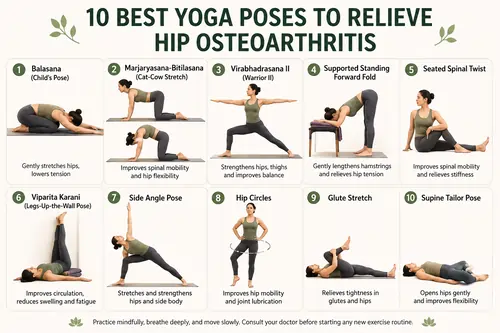
10 Best Yoga Poses to Relieve Hip Osteoarthritis
Introduction
Giving up movement is not necessary if you have osteoarthritis; in fact, one of the best ways to manage joint pain and stiffness is to practice gentle, mindful exercises like yoga. Yoga for osteoarthritis is a low-impact method that respects your body’s limitations while preserving flexibility, strengthening muscles around affected joints, and reducing inflammation.
Selecting safe yoga poses that promote joint health without triggering symptoms or further discomfort is essential.
Understanding osteoarthritis and the Role of Yoga
Millions of individuals worldwide suffer from osteoarthritis, which results in joint pain, inflammation, stiffness, and decreased range of motion. Both rheumatoid arthritis and osteoarthritis, the two most prevalent forms, benefit from mild exercise that doesn’t put excessive stress on the joints.
Because yoga has three key components—gentle stretching to maintain flexibility, strengthening to improve joint stability, and breathing methods to assist in managing pain and reduce stress—it is very effective for managing arthritis. In contrast to high-impact workouts, yoga lets you move at your own speed and adjust positions to suit your comfort level.
Benefits of Yoga for Hip Osteoarthritis Joints
Physical Benefits
There are several benefits to doing yoga for joint pain. Your range of motion, which is frequently restricted by arthritis, is preserved and even enhanced by the mild stretching. By strengthening the muscles around joints, strengthening poses relieve strain on injured bone and cartilage.
Additionally, weight-bearing yoga postures promote bone density, which is crucial for those with rheumatoid arthritis who may be more susceptible to osteoporosis. Many yoga poses require balance, which improves coordination and prevents falls.
Mental and Emotional Wellness
Mental health is adversely impacted by chronic pain. The stress and anxiety that frequently accompany arthritis can be reduced by yoga’s emphasis on breathing and awareness. By promoting body awareness, the exercise helps you differentiate between beneficial stretching and detrimental tension.
After adopting yoga to their daily routines, many people with arthritis report feeling less defined by their illness and more powerful. No matter how altered, the feeling of achievement that comes from finishing a practice improves confidence and promotes well-being.
Safe Yoga Poses for Hip Osteoarthritis
The goal of choosing yoga poses for arthritis is to maintain joint health while staying away from postures that put unnecessary stress or twist. These are a few of the safest and most beneficial poses:
Balasana (Child’s Pose)
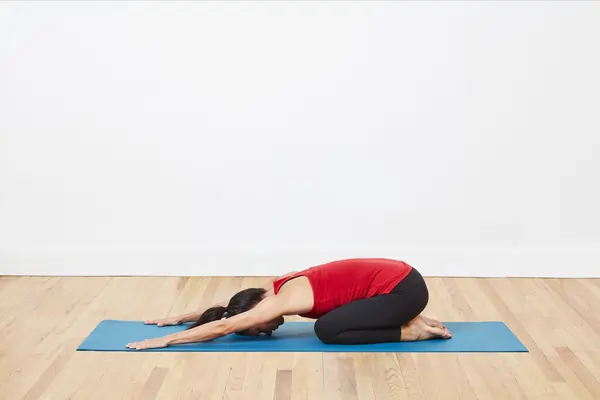
- Without putting excessive stress on the joints, this mild resting position stretches the lower back, thighs, and hips.
- It’s a great position for relaxing the nervous system and taking pauses while practicing.
- For additional support, place a folded blanket between your hips and heels or below your knees.
- Place your knees on the floor and sit back on your heels.
- Keep your knees slightly apart and your big toes together.
- Lower your chest to the floor by bending forward.
- Put your arms next to your body or extend them forward.
- Take a deep breath, relax, and maintain the stance for 30 to 60 seconds.
Marjaryasana-Bitilasana (Cat-Cow Stretch)
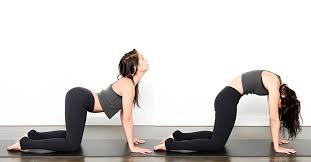
- The spine is gently stretched, and the core muscles are strengthened by this flowing action.
- The rhythmic motion is completely adaptable to your comfort level and relieves neck and back tightness.
- Only move within a pain-free range and at a gentle level.
- Take a tabletop posture and begin on your hands and knees.
- Inhale, lift your head, and create a cow pose by bending your back.
- Tuck your chin in and circle your back (Cat Pose) after exhaling.
- Do this five to ten times while breathing.
- Take a neutral position again and relax.
Virabhadrasana II (Warrior II)
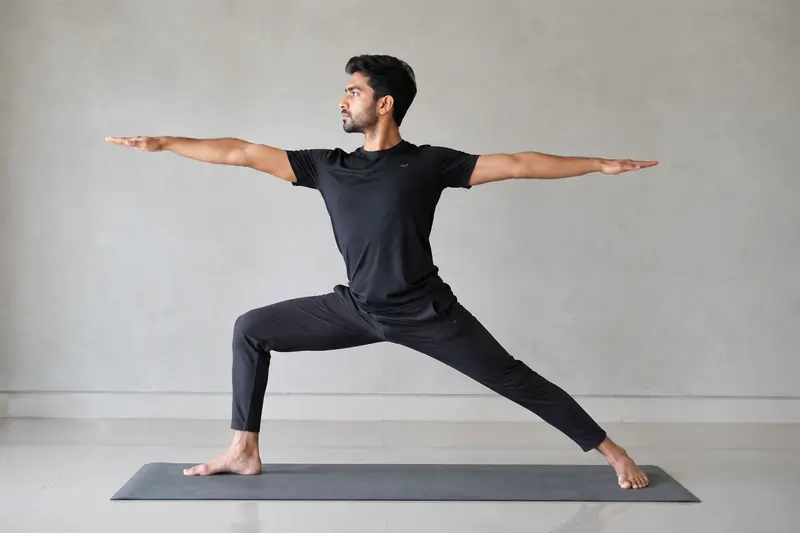
Without applying excessive stress on the joints, a modified Warrior II expands the hips and strengthens the legs.
Virabhadrasana II (Warrior II) Steps:
- To avoid stretching too much, keep your front knee above your ankle.
- This position strengthens the hip and knee joints and promotes balance.
- Place your feet widely apart.
- Bend your right knee and extend your right foot.
- Maintain a strong, straight left leg.
- Stretch both arms to shoulder level and look over the right hand.
- After a few breaths of holding, change sides.
Supported Standing Forward Fold
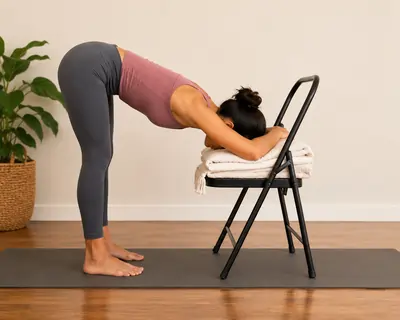
- This modified forward fold gently stretches the lower back and hamstrings while using a chair or blocks for support.
- The support allows you to completely manage the depth of the stretch while relieving pressure on the knees.
- Place your feet hip-width apart.
- Put some blocks or a chair in front of you.
- Fold forward and hinge at the hips.
- Place your forearms or hands on the support.
- After holding for a few breaths, gently get to your feet.
Seated Spinal Twist
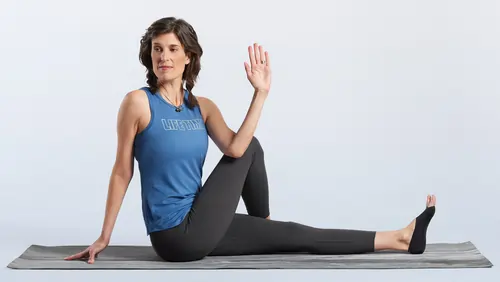
Mild twisting may relieve back tightness and improve spinal mobility.
- If you find it difficult to descend to the floor, try this position while sitting in a chair.
- Never try to twist; just go as far as is comfortable.
- Extend your legs while sitting.
- Put the foot outside the left leg and bend your right knee.
- Turn your body to the right.
- Look over your right shoulder while keeping your left elbow outside your right knee.
- Hold for a few breaths, then repeat on the other side.
Viparita Karani (Legs-Up-the-Wall Pose)
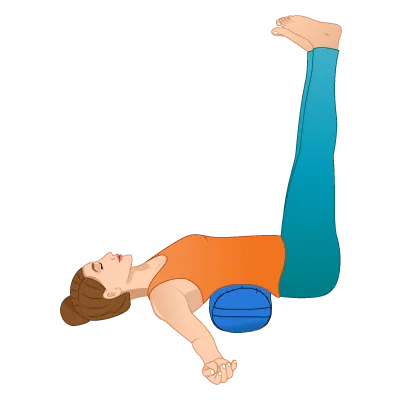
- This restorative position, which is fully passive, reduces swelling in the legs and feet.
- It may be held with little effort for several minutes and is quite effective in reducing inflammation.
- Take a side seat next to a wall.
- Lift your legs toward the wall while lying on your back.
- Maintain your hips toward the wall.
- Let your arms drop to your sides and unwind.
- Hold the position for a few minutes, then slowly release it.
Side Angle Pose
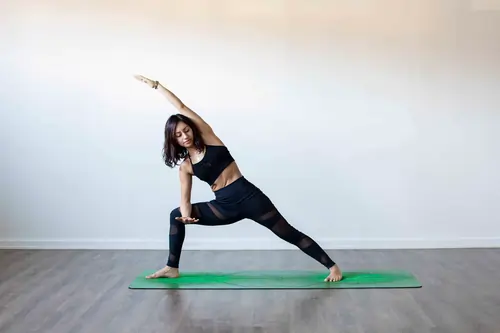
- Turn the right foot out 90 degrees and angle the left foot in 45 degrees while keeping your feet about 4 feet apart.
- Keeping the knee exactly above the toes, bend the right knee. With your left arm extended next to your left ear, bring your right elbow to your bent right knee.
- The objective is to draw a single, continuous diagonal line from the extended left arm to the rear left foot.
- The arm shouldn’t be aimed directly at the ceiling. The eyes are beyond the outstretched fingers.
- Lift out of the supporting elbow rather than tightening or falling in the lower shoulder.
Hip Circles
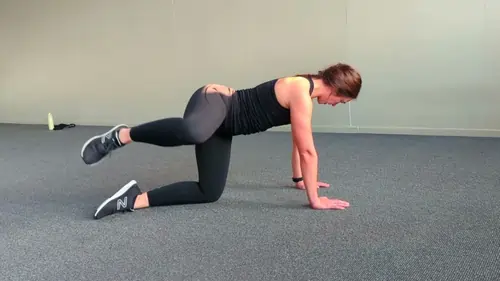
- Put one hand on the knee and bring it near to the chest.
- Make five to seven circles around the knee in each direction.
- Breathe softly as you move.
- These are little circles. Maintain a relaxed back on the ground.
- Continue with the opposite knee.
Glute Stretch
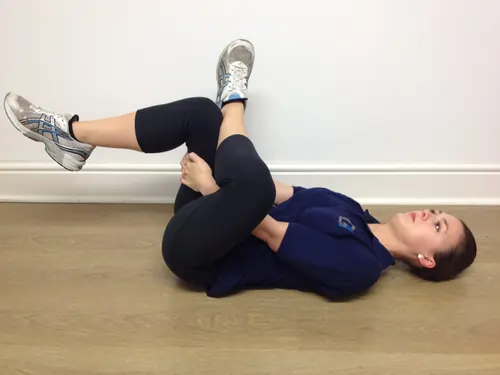
- Place the left ankle just above the knee while the right leg is bent and the foot is on the ground.
- Using a belt around the leg or two arms on either side of the upper leg, move the right leg closer to you if it feels comfortable.
- In this stretch, take slow, deep breaths. You may perform this stretch more easily if you position one foot against the wall instead of holding your leg.
- The distance between you and the wall would be around shin-length.
- Repeat with the opposite leg after holding for five to eight breaths.
Supine Tailor Pose
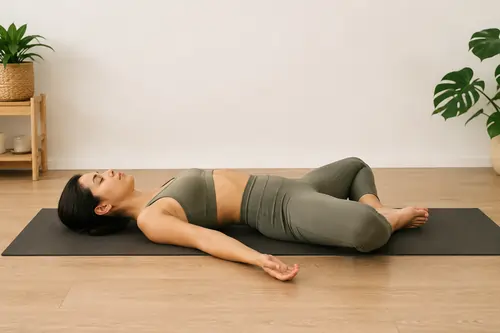
- With your knees out to the side and your feet’s soles together, lie on your back.
- If it’s comfortable, take a few minutes to rest like this.
- Supporting the legs can help them relax more, so you might choose to use pillows to support both knees.
To strengthen the hip joints:
Leg Raise
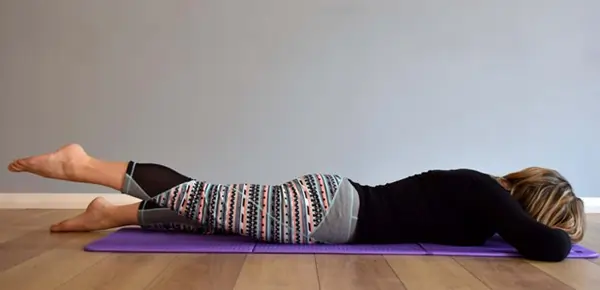
- With your hands on your forehead, lie on your front. Breathe out and raise one leg while keeping both hips on the mat.
- The leg should not be raised too high. Feel how that works your lower back and glutes.
- For each leg, repeat four times.
Setu Bandhasana (Bridge Pose)
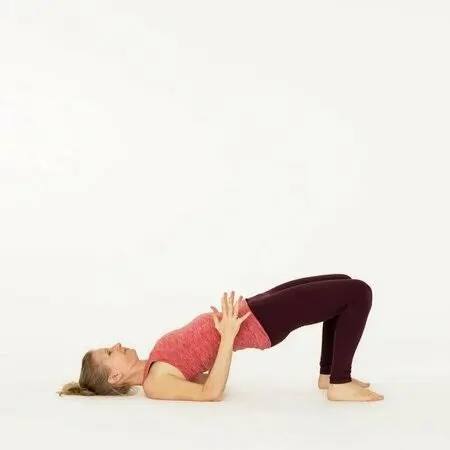
Setu Bandhasana (Bridge Pose) Steps:
- Position yourself on your back with your feet hip-width apart and close to your torso. You may test out various foot distances. For instance, putting the legs shoulder-width apart will train the hips differently.
- The palms of your arms are raised when you stretch them alongside your body. This results in a more open position for the shoulders.
- Pose of a bridge: Breathe out, tilt your pelvis, roll your spine off the ground, and place your weight on your feet. Breathe in and remain in that position.
- Ensure that the weight remains on the feet.
- Breathe out and lower your back. Breathe in while the body is still down. As you repeat a few times, make sure the motion is smooth and comfortable.
- Hold the upper posture for three to four calm breaths if it seems comfortable.
- Lastly, take six to seven breaths while keeping your knees close to your chest.
Types of yoga to try with Hip osteoarthritis
Yoga comes in a variety of forms, from quick positions to extended, complex poses.
If you have osteoarthritis, you might want to start with the following gentle yoga poses:
- Iyengar: This focuses on maintaining a balance between flexibility and strength. To aid with position changes, a variety of props and other supports are provided.
- Anusara: This focuses on activities using images.
- Kripalu: This promotes meditation over bodily alignment.
- Viniyoga: This coordinates movement and breathing.
- Phoenix Rising: This incorporates both therapeutic and physical poses.
Tips for doing yoga without pain:
To begin a hip training program without making your hip pain worse, use these suggestions:
- As you gain strength and endurance, gradually increase the number of exercises you perform each day from one or two.
- To improve blood flow to the hips and reduce tension in the soft tissues, apply a hot pack to your hip, buttock, or front of your upper thigh before beginning the exercises.
- Use an ice pack after stretching to dull aches and pain caused by exercise and to lessen swelling and inflammation.
- To avoid discomfort and damage in the future, do the exercises on a regular and consistent basis.
- A physical therapist should be seen if any exercise worsens your hip discomfort or causes pain to radiate down your leg. They can suggest the best course of action for your hip osteoarthritis and modify these stretches and exercises according to your specific needs.
FAQs:
Is yoga good for osteoarthritis in the hips?
Yoga is indeed a great treatment for osteoarthritis in the hips. Low-impact, gentle exercises help relieve chronic pain, strengthen the muscles supporting your hip joint, and reduce stiffness. Additionally, it increases synovial fluid circulation, which enhances joint health.
Is yoga good for osteoarthritis in the hips?
You should stay away from high-impact exercises like sprinting and jumping, sports like tennis and soccer that require quick pauses or twists, and working out on uneven ground if you have hip osteoarthritis. Additionally, avoid overstretching weak joints, disregarding discomfort, or being motionless for extended periods of time without taking rests.
Can hip osteoarthritis get better?
Once the cartilage is worn down, hip osteoarthritis cannot be treated or reversed, although symptoms can greatly improve. Targeted physical therapy, weight loss, and low-impact exercises are examples of conservative therapies that significantly reduce pain and improve joint function, frequently postponing or removing the need for surgery.
How serious is osteoarthritis of the hip?
Hip osteoarthritis is a dangerous, progressive disorder in which the protective cartilage deteriorates. If left untreated, it results in crippling stiffness and persistent pain that severely restricts movement and everyday tasks like putting on shoes. In more severe cases, it may permanently change your level of freedom.
References
- Büssing, A., Michalsen, A., Khalsa, S. B. S., Telles, S., & Sherman, K. J. (2012). Effects of yoga on Mental and Physical Health: A summary of reviews. Evidence-based Complementary and Alternative Medicine, 2012, 1–7. https://doi.org/10.1155/2012/165410
- Cheung, C., Wyman, J. F., Resnick, B., & Savik, K. (2014). Yoga for managing knee osteoarthritis in older women: a pilot randomized controlled trial. BMC Complementary and Alternative Medicine, 14(1), 160. https://doi.org/10.1186/1472-6882-14-160
- Kolasinski, S. L., Neogi, T., Hochberg, M. C., Oatis, C., Guyatt, G., Block, J., Callahan, L., Copenhaver, C., Dodge, C., Felson, D., Gellar, K., Harvey, W. F., Hawker, G., Herzig, E., Kwoh, C. K., Nelson, A. E., Samuels, J., Scanzello, C., White, D., . . . Reston, J. (2020). 2019 American College of Rheumatology/Arthritis Foundation Guideline for the Management of Osteoarthritis of the hand, hip, and knee. Arthritis Care & Research, 72(2), 149–162. https://doi.org/10.1002/acr.24131