Ardha Chakrasana (Half Wheel Pose)
What is Ardha Chakrasana (Half Wheel Pose)?
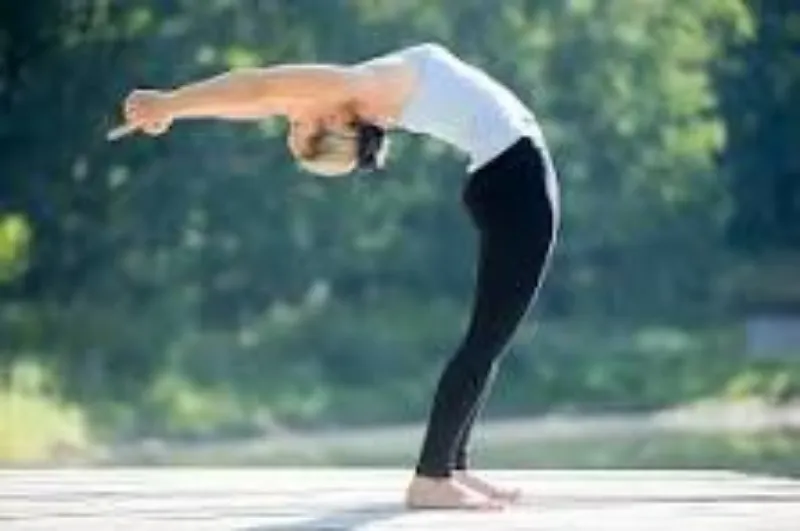
Ardha Chakrasana, also known as Half Wheel Pose, is a mild standing backbend in which the feet remain firmly grounded as the chest rises and the spine arches backward. This beginner-friendly yoga pose improves the back muscles that promote good posture, opens the chest, and extends the front body.
When done correctly, Ardha Chakrasana can enhance spinal range of motion, mitigate the negative effects of extended sitting, and prime the body for deeper backbends like Camel Pose and Wheel Pose.
Overview and Meaning of Ardha Chakrasana
Ardha Chakrasana, which means Half Wheel position, is derived from the Sanskrit terms ardha (half), chakra (wheel), and asana (position). Instead of the complete arch of Wheel Pose, the posture’s form, where the spine curls into a gently backward arc, is reflected in the name. Because they raise the chest, extend the breath, and counteract the inclination to curl inward under stress, backbends are frequently linked to openness and vigor in yoga.
The Hatha Yoga tradition is the foundation of Ardha Chakrasana, which is frequently taught as a prelude to more difficult backbends. Compared to many floor-based backbends, it provides a more accessible and safe method of exploring spinal extension because it is performed standing. These days, it is frequently utilized in therapeutic yoga, Hatha, Vinyasa, Sivananda, and Iyengar to open the chest, enhance posture, and combat everyday habits like slouching and extended sitting.
Anatomically, Ardha Chakrasana strengthens the muscles that support the spine and produces a slight extension of the neck, upper back, and lower back. While the chest, hip flexors, abdomen, and front of the neck stretch and open, the back muscles, glutes, hamstrings, and upper back support the posture. This combination promotes a more upright, energetic posture, increases lung capacity, and broadens the collarbones.
At a Glance
- Sanskrit Name: अर्धचक्रासन (Ardha Chakrasana)
- Pronunciation: ARD-hah chak-RAHS-anna
- Standing Backward Bend, Standing Back Arch, and Half Wheel Pose are their English names.
- Pose Type: Standing backbend/heart opener
- Level: Beginner to Intermediate
- Each round lasts 15 to 30 seconds; repeat 3 to 5 times.
- Morning or mid-practice after warming up is the ideal time to practice.
Benefits of Ardha Chakrasana (Half Wheel Pose)
The easy yet effective standing backbend known as Ardha Chakrasana (Half Wheel Pose) expands the front body and strengthens the muscles that support the spine. Frequent practice helps relieve tension brought on by extended sitting, boost vitality, and improve posture.
Physical Benefits
- Ardha Chakrasana opens the chest and facilitates better breathing by stretching the muscles in the chest, expanding the rib cage, and giving the lungs more room to work. This can help prevent shallow breathing, which is associated with bad posture, and increase breathing capacity.
- Strengthens the back and enhances posture: The backbend is actively supported by the erector spinae, rhomboids, trapezius, glutes, and hamstrings. Over time, this aids in reestablishing more upright alignment, strengthening the posterior chain, and relieving upper back stress.
- Stretches the front body: The soft backward arch lengthens the chest, throat, hip flexors, and abdominal muscles—areas that frequently get taut from extended sitting and forward-leaning behaviors.
- Boosts spinal flexibility: This pose gradually improves general spinal mobility by promoting balanced extension through the lumbar, thoracic, and cervical spines.
- Encourages good digestion and metabolic function: The stretch across the abdomen may gently stimulate the digestive organs.
- Enhances stability and strengthens the legs: Engaging the thighs, glutes, and feet actively protects the lower back, stabilizes the body, and enhances standing balance.
- Relieves neck strain and opens the shoulders: Lifting the chest and rolling the shoulders back can ease tension in the neck, shoulders, and collarbones.
- Ardha Chakrasana prepares the body for deeper backbends by increasing the strength, flexibility, and self-assurance required for more difficult backbends like Wheel Pose, Bow Pose, and Camel Pose.
Mental and Emotional Benefits
- Energizes and elevates mood: Backbends assist in boosting alertness and energy levels by naturally stimulating the neurological system.
- Stress and anxiety are lessened by opening the chest, which promotes deeper breathing and relaxation reactions in the body.
- Increases confidence: Positive body language and an open chest are frequently linked to confidence.
- Combats mental fatigue: After extended periods of sitting or strong mental activity, backbends’ invigorating properties can revitalize the mind.
- Develops bravery and openness: Backbends are frequently referred to as “heart-opening” positions that promote resilience and emotional openness.
- Enhances focus and awareness: It takes focus and body awareness to maintain alignment and balance during a standing backbend.
Energetic and Spiritual Benefits
- Activates the Heart Chakra (Anahata): Raising the chest is linked to emotional openness, compassion, and connection.
- Activates the Throat Chakra (Vishuddha): Traditionally, communication and self-expression have been associated with the soft opening of the throat region.
- Promotes energetic openness: Backbends are thought to facilitate the easier passage of prana, or essential life force, through the body.
- Produces an uplifting, energizing effect: After practicing backbends, practitioners frequently describe feeling lighter, more energized, and emotionally open.
- Even though Ardha Chakrasana has many advantages, it shouldn’t take the place of expert medical care. If you have a back, neck, or cardiovascular disease, you should always see a doctor before practicing.
With professional direction, enjoy the advantages of Ardha Chakrasana for better posture. Make your free one-on-one appointment with licensed Indian yoga instructors right now!
How to Do Ardha Chakrasana (Half Wheel Pose): Step-by-Step Guide
You can safely practice Ardha Chakrasana while progressively increasing your back strength, chest openness, and spinal flexibility with the guidance of this detailed tutorial.
Part 1: Preparing for the Pose
Check in with your body before performing Ardha Chakrasana:
- You are ready to try the position if your chest can elevate painlessly and your spine feels warm.
- Start with a reduced range of motion and use wall support if necessary if you have neck pain, hip flexor tightness, or back stiffness. Backbending becomes better with time; there is no urgency.
- Props You May Need
- Open space to stand
- Yoga mat (optional)
- Wall nearby for support (optional)
- Comfortable attire that permits complete range of motion
- Warm-Up (Vital): Prior to performing Ardha Chakrasana, always warm up for a minimum of eight to ten minutes.
- Cat–Cow Pose (10–15 rounds)
- Cobra Pose (20–30 seconds, 2–3 rounds)
- Standing Side Stretch (5–8 times each side)
- Shoulder Rolls (10 in each direction)
- Standing Chest Opener (20–30 seconds)
- The backbend feels safer, smoother, and more supportive when the shoulders, chest, and spine are warmed.
Part 2: Step-by-Step Instructions
- With your feet hip-width apart, stand up in Mountain Pose, stretching your spine and ensuring that both feet are grounded equally.
- Gently bring the elbows toward each other while placing both palms on the lower back close to the sacrum, with the fingers pointing downward or slightly inward.
- To stabilize the spine, firmly press through the feet, contract the thighs and glutes, and gently draw the lower abdomen inside.
- Breathe in, raise the sternum, roll the shoulders back, and widen the collarbones.
- Instead of collapsing into the lower back, start to arch backward from the upper back while maintaining strong, stable legs.
- If it seems comfortable, raise the chest a little higher and let the hips go forward a little to go a little further into the position.
- Hold for three to five breaths, breathing steadily and slowly without exerting yourself.
- To come out, contract your core and carefully raise your torso back to an upright position while supporting your lower back with your hands.
- Before repeating Mountain Pose, take a few deep breaths and observe the pose’s impact.
- Hold for:
- 10–15 seconds (beginners), 2–3 rounds
- 20–30 seconds (intermediate), 3–5 rounds
- Up to 30 seconds (advanced), 5–8 rounds
- The posture may cause your hip flexors, chest, and abdomen to stretch, as well as your back muscles to contract and your front body to feel elevated. You shouldn’t have intense pressure, lightheadedness, or severe pain in your lower back.
Common Mistakes and Alignment Tips
- Lumbar spine compression may result from merely arching the lower back.
- Inactive legs: This causes the lower back to be overworked.
- Neck strain or vertigo may result from forcing the neck back.
- Collapsing shoulders forward: This lessens the openness of the chest.
- Tension and instability are produced when one holds their breath.
- Going too far too fast: This raises the possibility of injury.
- Regular practice of Ardha Chakrasana can help develop backbending confidence in a safe and stimulating way.
Half Wheel Pose Variations
There are various levels of practice for Ardha Chakrasana, or Half Wheel Pose. While more skilled practitioners can deepen the pose and add balancing challenges, beginners can safely explore spinal extension by varying the depth of the backbend or employing support.
Beginner Modifications
Wall-Supported Ardha Chakrasana
- Provides stability and self-assurance while mastering the backbend.
- Face away from a wall and stand about an arm’s distance away.
- Put your hands shoulder-high on the wall behind you.
- Lift your chest and gently press your palms on the wall.
- Allow the wall to support your backbend while you lean back a little.
- Because the wall prevents excessive arching, this form is great for novices.
Hands on Hips Version
- introduces and maintains tiny, controlled backbending with little strain.
- In Mountain Pose (Tadasana), stand erect.
- Instead of your lower back, place both hands on your hips.
- Raise the chest and recline a little.
- Hold for a moment, then stand again.
- This adjustment maintains the backbend’s smallness and control.
Chair-Supported Backbend
- adds balance assistance for novices or seniors.
- Hold the backrest while standing behind a chair.
- Firmly plant the feet on the ground.
- Gently arch backward after raising the chest.
- To stay balanced, use the chair.
- This variation permits a safe backbend while minimizing balance issues.
Intermediate Variations
Arms Overhead Backbend
- Opens the shoulders and chest more deeply.
- Place your feet hip-width apart and assume Mountain Pose.
- With the palms facing one another, raise both arms upward.
- Raise your chest and start a little backbend.
- While keeping your equilibrium, extend your arms slightly back.
- Since the hands are no longer supporting the lower back, the intensity is increased in this variation.
Ardha Kati Chakrasana (Half Lateral Wheel)
- Gently arches the spine while stretching the sides of the torso.
- Place your feet hip-width apart and stand erect.
- Put the left hand on the hip and raise the right arm overhead.
- Open your chest a little and tilt your torso to the left.
- Repeat on the other side after holding for a short while.
- This position combines a slight backbend with a side stretch.
Pulsing Backbend
- increases flexibility and mobility by moving dynamically.
- Place your hands on your lower back as you stand.
- Breathe in and arch backward gently.
- Breathe out and straighten up again.
- Repeat eight to ten regulated pulses.
- Back flexibility is enhanced, and the spine is warmed by this variant.
Advanced Variations
Deep Backbend with Head Release
- increases the elongation of the spine and openness of the chest.
- Put your hands on your lower back while maintaining a tall stance.
- Elevate the chest and make a deep arch backward.
- Gently let the head return.
- Keep your legs and core firmly engaged.
- Use this variation only if your spine and neck are in good condition.
One-Legged Half Wheel
- intensifies the hip stretch and adds a balance challenge.
- Do a little backbend in Ardha Chakrasana.
- Raise one leg slowly behind you.
- Using your standing leg, keep your balance steady.
- After a brief hold, flip sides.
Props & Accessibility
- If your movement, balance, or confidence when backbending feel restricted, use a chair or wall for support.
- To make the stance seem more stable and secure, keep your hands supported at all times.
- Instead of attempting to achieve a deep backbend, work with a very narrow range of motion.
- If your back feels constricted, concentrate more on raising your chest than on bending deeply.
- To prepare the shoulders and upper back, start with some mild stretches that open the chest while lying down.
- To provide support and ease during preparation stretches, place a bolster or rolled blanket beneath the upper back.
- Rather than pushing a single deep hold, repeat smaller motions more frequently.
- Use wall support and avoid deep spinal extension during the first trimester of pregnancy by maintaining a very gentle backbend.
- For elders, strength, stability, and better posture should take precedence over depth or flexibility.
Precautions & Contraindications in Ardha Chakrasana
- Even though Ardha Chakrasana (Half Wheel Pose) is generally safe and suitable for beginners, it nonetheless extends the spine. To safeguard the lower back, neck, and balance, it is imperative to practice with awareness and good alignment. Before attempting the position, speak with a healthcare provider if you currently have any health issues.
Avoid Ardha Chakrasana If You Have:
Absolute contraindications include the following circumstances:
- Backbending may impede the healing of tissues in cases of recent back surgery or severe spinal injuries.
- Spinal extension may worsen symptoms of herniated or protruding disks.
- Deep backbends can raise the risk of spinal compression fractures in those with severe osteoporosis.
- Acute neck injury: The already delicate cervical muscles can be strained by lowering the head back.
- Uncontrolled hypertension: Backbends can impair blood flow and raise blood pressure.
- Recent abdominal surgery: Healing may be hampered by stretching the abdomen.
- Backbending might exacerbate symptoms of an acute headache or severe migraine.
- Vertigo or balance issues: Standing backbends can make you more susceptible to lightheadedness or falls.
- Deep backbends during the second and third trimesters of pregnancy might cause lower back and abdominal discomfort. See this comprehensive guide to learn more about prenatal yoga.
- Scoliosis or severe spinal deformities: The position may need specific treatment assistance.
Practice With Caution & Modifications If You Have:
- Mild Lower Back Sensitivity: Just do a slight backbend and use wall support. To stabilize the spine and prevent compressing the lumbar area, use your glutes and core muscles.
- Neck Sensitivity: Rather than lowering your head back, maintain a neutral posture. Instead of deeply bending through the neck, concentrate on raising the chest.
- Controlled High Blood Pressure: Avoid holding the position for extended periods of time and practice a very gentle version with the head neutral. Breathe steadily and exhale gradually.
- During the first trimester of pregnancy, practice with minimal backbend and simply wall support. If you experience any discomfort, stop the pose and steer clear of deep spinal extension.
- Tight Hip Flexors: The front of your hips may feel very stretched. To support the lower back, move slowly while maintaining leg activity.
- If you feel lightheaded or dizzy, keep your eyes forward instead of upward and carefully break out of the stance. Moving suddenly can worsen vertigo.
General Safety Guidelines
DO’s
- Before attempting backbends, carefully warm up your spine with mild movements.
- Activate your glutes and legs: Robust legs protect and stabilize the lower back.
- Avoid collapsing into your lumbar spine by lifting through your chest first.
- Keep your breathing steady: Controlling your breathing promotes steadiness and relaxation.
- Start small: Instead of pushing the stretch, gradually deepen the stance over time.
DON’Ts
- Without warming up, practice
- pushing the backbend past a range that is comfortable
- Keeping your breath in
- Disregarding the body’s pain signals
- After eating, practice right away (wait at least two to three hours).
When to Consult a Healthcare Provider
Before performing Ardha Chakrasana, speak with a physician, physical therapist, or licensed yoga therapist if you have:
- Prolonged neck or back pain
- Scoliosis and disk issues are examples of spinal disorders.
- Osteoporosis or issues with bone density
- Elevated blood pressure or heart problems
- Expectancy
- Injuries or recent surgeries
- The pose is carefully modified for your body with the help of a professional.
Backbends can be safely practiced with skilled coaching and individualized guidance. Make an appointment for a complimentary one-on-one class with qualified yoga instructors right now!
Related Yoga Poses
- It is a logical evolution from Half Wheel Pose because it deepens the opening of the chest and extends the spine.
- Put your hands on your heels or lower back while kneeling with your knees hip-width apart.
- Start arching back from the upper spine after raising the chest.
- Keep your legs moving and your hips stacked over your knees.
- After holding for a few breaths, slowly stand back up.
Upward-Facing Dog (Urdhva Mukha Svanasana)
- makes a strong opening through the chest and front body while strengthening the arms and back.
- With your palms next to your lower ribs, lie on your stomach.
- Lift the thighs and chest off the ground by pressing onto the hands and tops of the feet.
- Keep the shoulders away from the ears and widen the collarbones.
- Hold for three to five breaths, then carefully descend.
Bow Pose (Dhanurasana)
- Incorporates a deeper stretch across the chest, abdomen, and thighs with back strengthening.
- Bend both knees while you lie on your stomach.
- Hold the feet or ankles by reaching behind.
- Take a breath, then raise your thighs and chest off the ground.
- After a few breaths of holding, gradually release.
- Strengthens the back and opens the chest in a supported backbend that is suitable for beginners.
- With your feet hip-width apart and your knees bent, lie on your back.
- Raise the hips and press onto the feet.
- Maintain steady knees while rolling the shoulders slightly beneath the chest.
- After holding for five to ten breaths, slowly lower the spine.
FAQs
What is Ardha Chakrasana good for?
Half Wheel Pose, or Ardha Chakrasana, opens the chest, strengthens the back muscles, and enhances posture. Because it counteracts slouching and rounded shoulders, it is especially helpful for persons who spend a lot of time sitting or working at a desk. Additionally, the pose prepares the spine for deeper backbends and gives the body energy..
How long should you hold Ardha Chakrasana?
The position can be held for 10 to 15 seconds and repeated two to three times by novices. Advanced practitioners can repeat the pose up to eight times, while intermediate practitioners can hold it for 20 to 30 seconds for three to five rounds. Instead of maintaining the position for too long, concentrate on appropriate alignment and fluid breathing.
What is the difference between Ardha Chakrasana and Full Wheel Pose?
Ardha Chakrasana is a beginner-friendly standing backbend in which the hands are placed on the lower back for support. Lying on the ground with your hands and feet supporting your entire body, you can perform Full Wheel Pose (Urdhva Dhanurasana). It is a very difficult and profound backbend that calls for a great deal of strength and flexibility.
Schedule a free one-on-one session with a knowledgeable Indian yoga instructor to practice both positions safely and successfully!
Is Ardha Chakrasana safe for lower back pain?
By strengthening back muscles and enhancing posture, Ardha Chakrasana can help reduce minor back ache when performed slowly and with correct alignment. However, those who have acute injuries, severe back pain, or herniated disks should only practice under a professional’s supervision.
What muscles does Ardha Chakrasana work?
The erector spinae, rhomboids, trapezius, glutes, and hamstrings are all strengthened by the Ardha Chakrasana. Additionally, it creates balanced strength and flexibility along the front and back of the body by stretching the pectorals, abdominal muscles, hip flexors, and throat region.
What pose should I do after Ardha Chakrasana?
To balance the spine after performing a backbend, it is beneficial to do a counterpose. Good choices consist of:
Balasana, or child’s pose; Uttanasana, or standing forward bend
Paschimottanasana, or seated forward bend
These poses assist the spine in returning to a neutral position while gently stretching the back body.
References
- Allen, W. (2026j, March 17). Ardha Chakrasana. https://myyogateacher.com/yoga-asana/ardha-chakrasana-half-wheel-pose
- Zehra, S. (2026a, August 7). Ardha Chakrasana (Half Wheel Pose): Steps & Benefits. Habuild Blogs. https://habuild.in/habitology/asana-mudra/ardha-chakrasana/
- Potdar, S., & Potdar, S. (2025, February 26). Ardha Chakrasana (Standing Backward Bend) – The Art of living. The Art of Living – Making Life A Celebration. https://www.artofliving.org/in-en/yoga/yoga-poses/ardha-chakrasana-standing-backward-bend