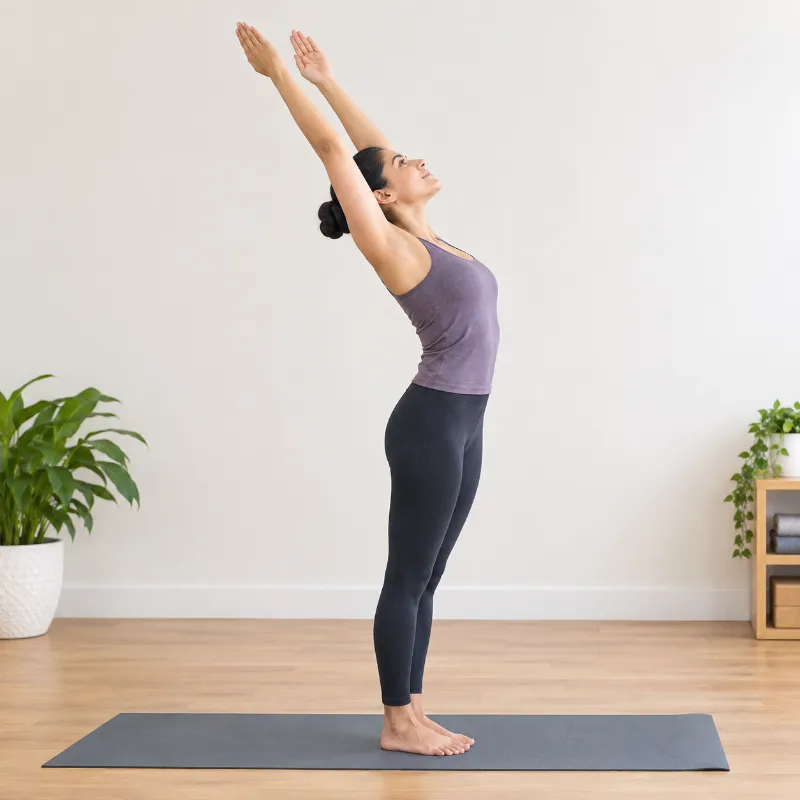
Hasta Uttanasana (Raised Arms Pose)
What is Hasta Uttanasana?
Hasta Uttanasana (Raised Arms Pose) is a simple standing yoga pose that involves stretching the arms upward while gently lengthening the spine and opening the chest. It helps improve posture, enhance flexibility in the shoulders and upper body, and promote mindful breathing.
One of the most popular yoga poses worldwide, it is also known as Urdhva Hastasana (Raised Hands Pose) in various traditions. It is the first movement of Surya Namaskar.
When performing the hasta uttanasana yoga pose, the practitioner stands in Tadasana and sweeps both arms overhead, either facing or pressing their palms together. As the arms ascend, a mild thoracic backbend is created. The eyes follow the thumbs slightly backwards and upward. From the fingertips, the lateral body, chest, anterior thighs, and feet are all stretched.
Hasta Uttanasana is taught at Habuild as the second pose in the Surya Namaskar sequence, which begins each day’s practice, as well as a stand-alone pose.
Key Highlights
- Occurs twice in Surya Namaskar, in the sequence’s second and eleventh positions.
- It is one of the most popular poses in the world and is also known as Urdhva Hastasana in various traditions.
- As the arms sweep overhead, the eyes follow the thumbs upward and slightly back.
- From the fingertips to the chest to the feet, the stretch is constant.
- Uses an extension-based digestive stimulus in place of forward-fold digestive compression.
- Serves as the sequence’s initial standing position, signifying the metaphorical start of practice.
- One of the most basic standing backbends in yoga, Hasta Uttanasana, also known as the Raised Arms Pose, is the second and eleventh pose in the traditional Surya Namaskar (Sun Salutation) sequence. In addition to improving thoracic extension and opening the chest, the Hasta Uttanasana yoga pose also creates the energising tone of upward expansion that characterises the entire Surya Namaskar practice.
Hasta Uttanasana Benefits
Physical Benefits
Opens the Chest and Improves Thoracic Extension
The forward-rounded chest and thoracic kyphosis of desk posture are directly countered by Hasta Uttanasana, which opens the anterior chest, stretches the pectorals, and restores the thoracic extension that modern sitting gradually erodes.
Stretches the Anterior Body from Fingertips to Toes
Lengthening the lateral torso, extending the intercostal gaps, expanding the abdomen, and generating traction throughout the entire front body from hands to feet are all benefits of the full hasta uttanasana for the anterior chain.
Improves Shoulder Mobility and Overhead Range of Motion
Hasta Uttanasana’s arms reaching overhead develop the scapular upward rotation and shoulder flexion range of motion necessary for good shoulder function, which is immediately applicable to all overhead yoga postures and daily activities.
Stimulates the Digestive Organs and Improves Posture
In addition to the compression stimulation of forward folds, the raised-arms backbend’s abdominal stretch provides an extension-based digestive activation that stimulates the digestive organs.
Mental and Emotional Benefits
Cultivates an Upward, Expansive Energy and Positive Outlook
Raising one’s arms to the sky is a physical gesture that reflects an open, expansive, and receptive mind. Hasta Uttanasana is frequently described by practitioners as a pose that instantly elevates mood and fosters a feeling of energetic spaciousness.
Prepares the Mind and Body for Practice
Hasta Uttanasana, the second position in Surya Namaskar, marks the start of deliberate practice, with the mind turning inside and the body expanding upward. It becomes a daily ritual of preparation and intention because of its placement in the sequence.
How to Do Hasta Uttanasana Video
How to Do Hasta Uttanasana — Step-by-Step Instructions
Key Principles
The backbend is not lumbar but thoracic. There’s no forward flare of the lower ribs. The gaze follows the hands without straining the cervical spine, and the neck remains long. If the shoulders are tense, the arms stay shoulder-width; the palms can only come into contact overhead if the shoulders are relaxed.
Step 1: Stand in Tadasana
Stand in Tadasana with your feet together, your arms by your sides, and your spine erect. Create the breath.
Step 2: Inhale and Sweep the Arms Outward and Upward
Take a breath and extend both arms upward and out to the sides, making a broad arc from the sides to directly overhead.
Step 3: Bring the Palms Together or Parallel Overhead
If the shoulders permit, bring the palms together as the arms extend overhead; otherwise, keep them parallel and facing one another. The arms are a little ahead of the vertical.
Step 4: Gently Arch the Upper Back
Allow the upper back to gently arch, with the chest opening toward the ceiling and the sternum rising upward. The lumbar spine does not compress; the lower ribs remain in place.
Step 5: Gaze Upward Toward the Thumbs
As the arms ascend, turn your sight upward and follow the thumbs. The chin rises without straining the cervical spine as the neck slowly stretches.
Step 6: Hold and Return
Hold for three to five breaths, or continue to the next Surya Namaskar exercise. Breathe out and sweep your arms back down to go back.
Breathing in Hasta Uttanasana
Inhale to raise the arms; the action and breath should be coordinated so that the entire inhalation and the entire arm rise coincide. Throughout the hold, take deep breaths. To transition or return, exhale. The position is mostly driven by the breath.
Preparatory Poses Before Hasta Uttanasana
- Before raising the arms, the upright spinal base is established with Tadasana (Mountain Pose, 5 breaths).
- Before the overhead extension, warm the shoulder joint with ten rounds of shoulder rolls and arm swings.
- Before the standing backbend, the anterior chest is opened in Cobra Pose (Bhujangasana, 5 breaths).
- Ten rounds of Cat-Cow Flow warm the thoracic spine in preparation for the mild backbend.
Hasta Uttanasana in Surya Namaskar
At the start of Surya Namaskar, Hasta Uttanasana is typically practised just after Tadasana.
A common sequence is:
- Tadasana – Standing Pose.
- Hasta Uttanasana – Raised Arms Pose.
- Uttanasana – Standing Forward Bend.
- Proceed with the remaining steps of Surya Namaskar.
The stance facilitates the change from standing straight to bending forward.
Variations of Hasta Uttanasana
- Variation 1: Hasta Uttanasana with Shoulder-Width Arms — Accessible
- Instead of bringing the palms together, keep the arms parallel and shoulder-width. This accessible version eliminates the need for shoulder flexibility and permits the opening of the chest without causing shoulder strain.
- Variation 2: Hasta Uttanasana with Interlaced Fingers — Intermediate
- The inverted grip produces a different shoulder and thoracic stretch quality that expands the lateral body more forcefully. Interlace the fingers and turn the palms upward overhead.
- Variation 3: Hasta Uttanasana as Dynamic Flow — Surya Namaskar
- Hasta Uttanasana, which is performed as the second and eleventh position of Surya Namaskar, is a dynamic breath-synchronised movement that produces the heat and energy of the Sun Salutation sequence. The inhale and arm lift make a single, cohesive action.
Common Mistakes to Avoid in Hasta Uttanasana
- The backbend of Hasta Uttanasana originates from the thoracic spine; however, it arches from the lower back instead. Avoiding lower back arching is advised because it compresses the lumbar discs.
- Lower ribs flaring forward: When the arms rise, the lower ribs remain in and down. A lumbar rather than thoracic backbend is indicated by flaring ribs.
- The neck softly stretches, the chin rises, the eyes follow the thumbs, but the back of the neck remains long and free of cramps.
- Since Hasta Uttanasana is an inhale-based position, the breath must stay full and expansive throughout the hold. The energetic and chest-opening effects are diminished when breath is held.
- Bringing the palms together while the shoulders are tight: Tension in the neck and shoulders results from forcing the palms together when the shoulders are not open enough. Until shoulder flexibility permits a comfortable touch, keep the arms shoulder-width apart.
Who Should Practise Hasta Uttanasana?
Those with Rounded Shoulders and Desk Posture
One of the best daily remedies for desk workers’ forward-rounded chest and thoracic kyphosis is Hasta Uttanasana, whose raised-arms chest opening immediately counteracts the postural collapse caused by extended sitting.
Everyone Practising Surya Namaskar
Every yoga practitioner performing Surya Namaskar does Hasta Uttanasana, the second position of the Sun Salutation; therefore, proper technique in this fundamental posture is crucial to the integrity of the entire sequence.
Is Hasta Uttanasana Good for Beginners?
Yes, Hasta Uttanasana is one of the most accessible poses in yoga and is usually taught to new practitioners as their second movement. Any need for flexibility is eliminated by the shoulder-width arm variation. From the first session, the live instructors at Habuild teach proper thoracic backbend mechanics and breath synchronisation.
Make Hasta Uttanasana a Part of Your Practice
The most basic and often practised chest-opening pose in the yoga tradition is Hasta Uttanasana, a raised-arms gesture of upward expansion that opens the session, warms the anterior body, and establishes the energetic tone of practice.
Thoracic extension, shoulder mobility, and chest postural uprightness all improve with regular daily practice, whether it is done as the second movement of Surya Namaskar or as a stand-alone pose.
Surya Namaskar, which includes Hasta Uttanasana, opens Habuild’s daily sessions. Live adjustments guarantee proper thoracic mechanics from the outset. There is a 14-day free trial to begin your first seven days.
Start practising yoga for free for 14 days right now with Habuild!
Beginner Tips
- Without a backbend, begin with your arms elevated.
- Distribute your weight evenly and maintain a solid gait.
- Instead of bending deeply, concentrate on extending the spine.
- Keep your breathing smooth.
- Practice for 15–30 seconds at first.
- Repeat 2–3 times if comfortable.
- Use a wall for balance if needed.
Precautions and Contraindications
While many healthy individuals can perform Hasta Uttanasana, some people should adjust the pose.
- Avoid deep backbends if you have an acute back injury.
- People with neck pain should keep the head in a neutral position.
- Those with shoulder problems should avoid forcing the arms overhead.
- If you experience dizziness, stop and rest.
- People with balance difficulties can practice near a wall.
- A trained prenatal yoga instructor should be consulted, and a comfortable, modified version should be used by expectant mothers.
- Before beginning a new fitness regimen, anyone with a medical issue should consult a healthcare provider.
- If the posture results in acute pain, numbness, or unexpected discomfort, stop right away.
Conclusion
A straightforward but effective yoga pose, Hasta Uttanasana incorporates arm elevation, chest opening, and slight spinal extension. It can support the growth of postural awareness, mindful breathing, and flexibility.
Beginners should avoid forcing the backbend and concentrate on appropriate alignment. It can be an important component of a well-rounded yoga practice if done frequently and comfortably.
FAQs
What is Hasta Uttanasana?
The second and eleventh position of Surya Namaskar is called Hasta Uttanasana, or the Raised Arms Pose. In this pose, both arms sweep overhead with a gentle thoracic backbend, the palms pressing together or parallel, and the gaze following the thumbs upward. It enhances shoulder overhead range of motion, expands the chest, and stretches the anterior body.
What are the hasta uttanasana benefits?
Chest and anterior chain opening, thoracic extension improvement, shoulder overhead mobility development, postural correction for rounded shoulders, digestive organ stimulation through extension, and the expansive raised-arms gesture’s energetic uplift and mood enhancement are the main benefits of hasta uttanasana.
What is the hasta uttanasana yoga pose in Surya Namaskar?
Hasta Uttanasana is ranked second (after Tadasana) and twelfth (before going back to Tadasana) in Surya Namaskar. The arm raise and backbend are correlated with the inhale; the breath and movement are coordinated as a single, cohesive action that produces the Sun Salutation’s heat and energy.
How to do Hasta Uttanasana correctly?
Pose in Tadasana. Breathe in and raise your arms. Keep your palms parallel or bring them together overhead. Permit a mild thoracic backbend, keeping the lower ribs in place and the sternum raised. With the neck extended, raise the eyes to the thumbs. Hold for the entire breath or continue on to the following exercise.
What is the difference between Hasta Uttanasana and Urdhva Hastasana?
In contemporary usage, the expressions are essentially the same; they both refer to the lifted arms aloft position. While Urdhva Hastasana (upward hands position) is utilised as the stand-alone standing pose, Hasta Uttanasana (intense hand stretch) is specifically employed in the Surya Namaskar setting. The method and advantages are the same.
References
- Zehra, S. (2026g, August 11). Hasta Uttanasana (Raised Arms Pose): Steps, Benefits & Precautions. Habuild Blogs. https://habuild.in/habitology/asana-mudra/hasta-uttanasana/
- Yogshala, R. (2026, January 1). 6 Incredible health benefits of Hasta Uttanasana (Raised Arms Pose). Rishikul Yogshala. https://www.rishikulyogshala.org/blog/the-incredible-health-benefits-of-hasta-uttanasana-raised-arms-pose/
- HASTA UTTANASANA (RAISED ARMS POSE) – AVIYOG GROUP. (n.d.). AVIYOG. https://www.aviyoggroup.in/hasta-uttanasana-Raised-Arms-pose