
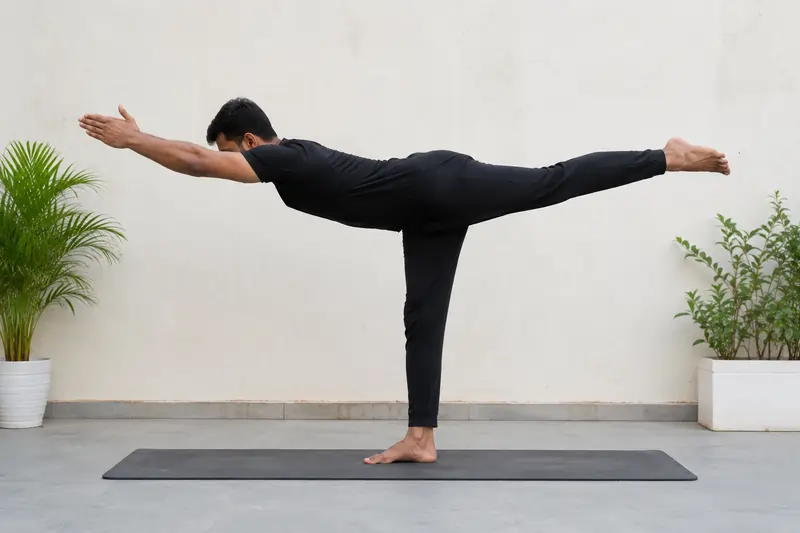
Virabhadrasana III (Warrior III)
Introduction
Standing on one leg might sound simple until you try Warrior Three. This pose draws strength from your back, fires up your core, and pushes your arms forward while lifting your rear leg behind you. It’s not just about staying upright – it’s motion held still. Your body stretches front to back, grounded yet reaching. Think of a straight line slicing through air, built by muscle and breath. Stories say the warrior came from fury, born out of loss and purpose. He wasn’t gentle. But his stance now teaches control.
One foot rooted, the rest extended into space. Not floating – pressing. Each part fights to prevent collapse. Hips stay level even as shoulders roll open. Eyes fix ahead, not searching, simply seeing. Breath keeps the rhythm when wobble hits. You do not force shape – you grow into it. Over time, effort softens without losing edge. There is no finish line here. Only small shifts each time you step onto the mat.
Sanskrit
Virabhadrasana III (veer-ah-bah-DRAHS-anna)
Virabhadra = the name of a fierce warrior, an incarnation of Shiva, described as having a thousand heads, a thousand eyes, and a thousand feet; wielding a thousand clubs; and wearing a tiger’s skin.
Understanding the Shape of Warrior III
Key Principles
Maintaining a single, straight line from the extended heel to the crown, keeping the hips level with both hip points facing the floor, and deliberately pressing through the standing heel to avoid forward pitching are three non-negotiable concepts.
Virabhadrasana 3 — Step by Step
Step 1: Starting in Virabhadrasana 1
Start in Virabhadrasana 1 pose — Keep right foot forward and left foot back while arms are raised overhead. This is the standard Warrior III entry point.
Step 2: Shift Weight Forward
Move your entire weight forward onto your right foot. The main anchor for balance is the drishti, which is a single stationary point 30 to 40 cm in front of the standing foot.
Step 3: Tip Forward and Lift the Leg
Lift your left leg behind you and tip your chest forward as you exhale. Tip slowly and deliberately — not rushing.
Step 4: Extend to Full T-Shape
Press through your left heel as you aggressively extend your left leg. Straighten the right leg while standing, gradually. Resist the left hip going upward and maintain both hips level.
Step 5: Arms Forward and Hold
For the modification, extend your hands on your hips or your arms forward beside your ears. Hold for 5–8 breath cycles with a steady breath.
Step 6: Return and Switch Sides
- On an exhale, return to Warrior I.
- Reverse the foot position
- Repeat on the left side.
- Always practise both sides equally.
Beginner’s Tip:
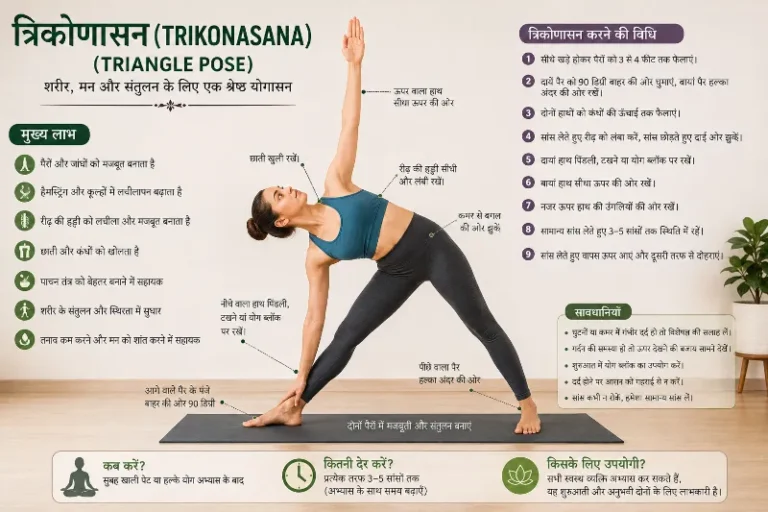
If you struggle with entering this posture from Virabhadrasana I, try performing Trikonasana (Triangle Pose) first.
After that, turn your torso to the right and raise your left leg directly behind you to enter Virabhadrasana III. For more stability, you can also practice using your fingertips on blocks positioned under your shoulders.
Breathing
Slow, sustained exhalations deepen the balance and gradually release muscle clutching. Together, the calm breath and drishti stabilize each other. Any breath disruption immediately affects the balance quality.
Preparatory Poses
- Virabhadrasana 1 (5-8 breaths)
- The immediate entry pose, Virabhadrasana 1 (5–8 breaths), establishes hip alignment before single-leg balance.
- Vrikshasana (Tree Pose)
- Before the additional complication of the horizontal body, Vrikshasana (Tree Pose) establishes single-leg balance and gaze-point focus.
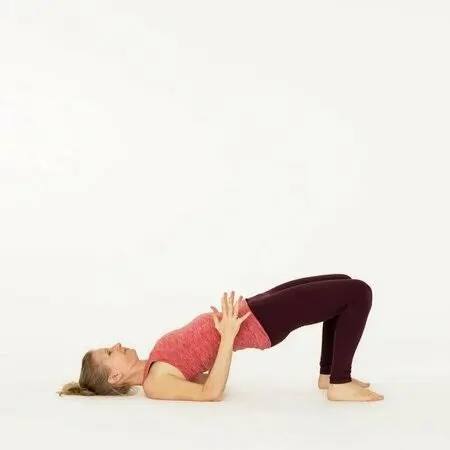
- Setu Bandhasana (Bridge Pose)
- Before Warrior III’s posterior chain demand, Setu Bandhasana (Bridge Pose) activates the glutes and hamstrings.
Contraindications
- This is a safe posture for all, unless you have an ankle injury that prevents you from balancing.
- High blood pressure or heart problems
- Hip injury
Benefits
- Promotes balance and strength
- Strengthen the shoulders, core, hamstrings, ankles, outer hips, and calves Muscles
- Builds strength in the ankles and legs
- Helps develop better standing posture in daily life
- Strengthens the shoulders and back
Flow with Warrior III
This flow is good for more seasoned practitioners.
From Downward Facing Dog (Adho Mukha Svanasana), step your right leg in between the hands and place your left foot at a forty-five-degree angle for Warrior II (Virabhadrasana II). Take 5 breaths. Slide your left hand down the left leg, coming into Exalted or Reverse Warrior (Viparita Virabhadrasana).
Take 5 breaths. Transfer the weight from your back foot to your right foot and come into Warrior III. Take five breaths. Transition through Adho Mukha Svanasana to repeat on the second side.
Conclusion:
A steady rhythm here builds stamina, piece by quiet piece. Muscles learn new patterns through repetition, nothing more. The hips stay square, aligned like doors facing forward without swinging open. Each session carves deeper into control, less wobble, fewer corrections.
Balance shifts subtly, never fixed, always adjusting beneath you. Strong feet support sharp attention – both grow quieter over time. Posture improves because tension finds release where movement flows freely. Coordination rises not from effort but from repeated stillness within motion.
Beginners may stumble at first; that is normal ground, not failure. Alignment matters most when fatigue pulls form apart. Strength enters gradually, hidden inside small holds and silent counts. The mind stays present simply because the body demands it now. This shape asks for truth and offers resilience in return. Practice returns what discipline plants day after day.
FAQs
What are the benefits of Virabhadrasana III (Warrior III)?
Virabhadrasana III (Warrior III) helps strengthen the legs, core, back, and shoulders. It also improves balance, stability, and concentration.
Can beginners practice Virabhadrasana III (Warrior III)?
Yes, beginners can practice Virabhadrasana III (Warrior III) with wall support or by keeping the raised leg lower. Regular practice improves confidence and balance.
How long should I hold Virabhadrasana III (Warrior III)?
You can hold Virabhadrasana III (Warrior III) for 15–30 seconds on each side. Gradually increase the duration as your strength improves.
Who should avoid Virabhadrasana III (Warrior III)?
People with serious balance issues, recent injuries, or certain medical conditions should practice Virabhadrasana III (Warrior III) carefully and seek professional guidance.
Does Virabhadrasana III (Warrior III) help improve posture?
Yes, Virabhadrasana III (Warrior III) strengthens postural muscles and promotes better body alignment. This can contribute to improved posture over time.
References:
- Dr.Nidhiphysio. (2024, October 10). Virabhadrasana 1,2, 3: Health Benefits,Types, How to do? – Mobile Physio. Mobile Physiotherapy Clinic. https://mobilephysiotherapyclinic.in/virabhadrasana-yoga-health-benefits-steps/
- Birch, B. B. (2025, June 16). Asana Column: Virabhadrasana III (Warrior Pose III). Yoga Journal. https://www.yogajournal.com/practice/yoga-sequences/asana-column-virabhadrasana-iii-warrior-pose-iii/
- Yoga Journal. (2025f, February 28). Warrior 3 Pose. https://www.yogajournal.com/poses/warrior-iii-pose/
- Warrior III – Virabhadrasana III – The Yoga Collective. (2022, February 3). The Yoga Collective. https://www.theyogacollective.com/poses/warrior-3-virabhadrasana-3/
- Marley, O. (2016, October 7). WARRIOR 3 OR VIRABHADRASANA III POSE — Yoga with Olivia. Yoga With Olivia. https://www.yogawitholivia.co.uk/blog/2016/10/7/warrior-3
- Carla, E. A. (2026, March 3). How to do Virabhadrasana III pose | Warrior 3 Pose. Merrymaker Sisters | MerryBody Online Studio: Unlimited Yoga, Pilates and Meditation. https://themerrymakersisters.com/how-to-do-virabhadrasana-iii-pose/
- Noël, J. (2024, February 26). How to do Warrior III pose (Virabhadrasana III) — Jacqui Noël Yoga. Jacqui Noël Yoga. https://www.jacquinoelyoga.com/blog/how-to-do-warrior-iii-pose-virabhadrasana-iii

One Comment