Urdhva Hastasana (Upward Salute or Raised Hands Pose)
What is Urdhva Hastasana (Upward Salute)?
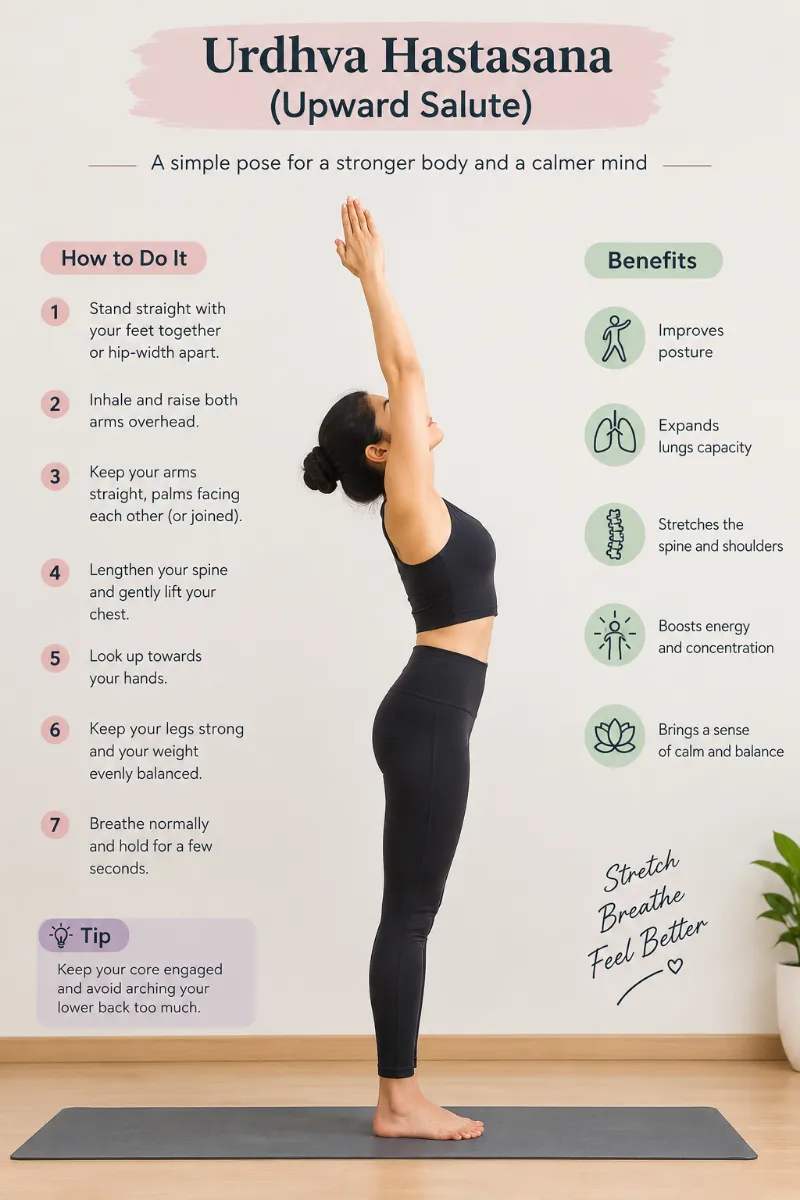
Urdhva Hastasana (Upward Salute or Raised Hands Pose) is a simple standing yoga pose that involves raising both arms overhead while keeping the body upright and balanced. This pose helps improve posture, stretch the shoulders and spine, enhance flexibility, and promote better body awareness.
Upward Salute offers a crucial balance between lift and grounding, despite its seeming simplicity. In addition to enhancing posture and fostering a sense of stability and expansion, rooting with the feet while reaching upward through the fingertips helps develop body awareness.
Overview and Meaning
Urdhva Hastasana, which means Upward Salute or Raised Hands position, is derived from the Sanskrit words urdhva (upward), hasta (hand), and asana (position). The posture’s primary action—the arms extending aloft while the body remains grounded through the feet—is reflected in the name. Reaching skyward without losing contact with the earth below is a yoga position that symbolizes lift and stability.
Today, Surya Namaskar (Sun Salutation) and contemporary standing sequences are the main ways that Urdhva Hastasana is recognized. It is frequently seen early in the flow on an inhale in Hatha, Vinyasa, and Ashtanga yoga, where it is a popular practice. Because it helps prevent collapsed posture, restricted shoulder mobility, and the compressed upper body that frequently results from extended sitting and screen time, it is particularly relevant now.
From an anatomical perspective, Urdhva Hastasana is a standing stretching pose that combines lift through the arms and spine with grounding through the legs. In order for the arms to reach aloft without collapsing into the lower back, the legs remain active, the feet root into the ground, and the core maintains the spine. The position simultaneously lengthens the side body, expands the chest, and increases shoulder mobility.
At a Glance
- Sanskrit Name: ऊर्ध्वहस्तासन (Urdhva Hastasana)
- Pronunciation: OORD-vah hahs-TAHS-uh-nuh
- English Names: Raised Hands Pose and Upward Salute
- Stance Types: Foundational posture, standing stance, and upward stretch
- Level: Easy for beginners
- Time: 3–5 breaths in a static hold or 1 breath in flow
- Ideal Time: When performing standing exercises, Sun Salutations, or a posture reset
- Principal Advantages: Enhances posture, lengthens the spine, expands the shoulders and chest, and increases body awareness
Benefits of Urdhva Hastasana
Despite its straightforward appearance, Urdhva Hastasana provides a helpful blend of length, lift, and postural awareness. The position facilitates the clear and accessible organization of the entire body by connecting planted legs with an upward reach through the arms.
Physical Benefits
The Upward Salute is particularly beneficial for strengthening standing alignment and expanding the space between the upper body and spine.
- Lengthens the side body and spine: After extended periods of sitting or slouching, reaching the arms aloft can help provide lift through the waist, rib cage, and spine.
- Enhances posture and body awareness: The pose teaches you how to stand straight while paying closer attention to the alignment of your spine, shoulders, and ribs.
- Opens the shoulders and chest: Controlled arm lifting promotes healthy shoulder mobility and a mild expansion of the chest.
- Builds light strength through the legs and core: Despite the pose’s apparent emphasis on the upper body, the legs and abdominal muscles remain engaged to maintain balance and a stable spine.
- Encourages fuller breathing: The breath may flow more freely and feel more expansive when the chest is wide and the spine is long.
Mental and Emotional Benefits
Upward Salute frequently has a cheerful, vigilant, and upbeat vibe without being overpowering.
- Enhances presence and focus: Bringing attention to the body and the present moment can be achieved by coordinating the upward stretch with breath.
- Boosts energy at the beginning of practice: Sun Salutations frequently feature this position because of its open, awakened shape.
- Strikes a balance between effort and ease: The position teaches how to reach upward without needless stress while remaining grounded through the feet.
- Enhances breath-body connection: The interaction between movement, posture, and breath can be improved by practicing the pose thoughtfully.
Energetic and Holistic Benefits
Urdhva Hastasana is a position of lift, openness, and upward-moving energy that is frequently encountered in traditional yoga.
- Activates the Root Chakra (Muladhara): Grounding, stability, and steadiness are supported by the powerful connection made through the feet.
- Opens the Heart Chakra (Anahata): The lift through the chest is linked to emotional ease, openness, and receptivity.
- Promotes the passage of upward energy: A distinct sense of expansion over the entire body is produced by reaching through the arms while remaining grounded underneath.
- Supports meditative awareness in motion: The pose can assist in making standing exercises and Sun Salutations more mindful since it makes such an obvious connection between breath, posture, and attention.
- Instead of being tense, the Upward Salute should be roomy. It is preferable to utilize a modified form rather than forcing the entire curve if lifting the arms overhead causes pain in the shoulders, neck, or lower back.
Develop a stronger, safer yoga practice from the ground up by practicing with qualified Indian yoga instructors. Get a free one-on-one consultation now!
How to Do Urdhva Hastasana (Upward Salute): Step-by-Step Guide
You may practice Urdhva Hastasana with improved alignment, more full-body awareness, and a steadier breath by following this detailed guide.
Part 1: Preparing for the Pose
Check in with your body before performing Urdhva Hastasana:
- You are prepared to practice Tadasana if you can stand in the posture with ease, steady balance, and easy breathing.
- Use a softer arm position and concentrate on length rather than height if raising the arms overhead strains the shoulders, neck, or lower back.
Props You May Need
- Yoga mat (optional)
- Alignment support wall (optional)
- A nearby chair can help with balance (optional).
Warm-Up
The body can be ready for the Upward Salute with a few easy motions:
- Roll your shoulders ten times each way.
- 8–10 rounds of cat–cow pose
- Standing Side Stretch (three to five breaths per side)
- Tadasana (5 breaths)
- Breathe as you gently raise your arms five times.
- This preparation aids in opening the shoulders, stretching the spine, and raising awareness before lifting the arms.
Part 2: Step-by-Step Instructions for Upward Salute Pose
- Start in Tadasana (Mountain Pose) with the feet hip-width apart or together, depending on what feels the most solid. Keep your arms by your sides and ground both feet equally.
- Lift through the kneecaps without locking your knees to gently activate your legs.
- Gently engage the thighs while drawing the lower abdomen in just enough to stabilize the spine. Instead of tipping forward, maintain a neutral pelvis.
- When taking a breath, sweep your arms out to the sides and overhead, or raise them forward if it feels better for your shoulders. Only raise your arms as high as it feels good for you. If it is comfortable, the palms can contact or face one another.
- As soon as the arms are raised, continue to extend up with your fingertips while maintaining your footing. To prevent the lower back from overarching, allow the chest to open naturally while gently restricting the front ribs.
- Maintain a long neck and ease the shoulders away from the ears. It is acceptable if the biceps approach the ears without tension. Keep your arms a little broader if not.
- Hold the pose for three to five breaths in a static hold or one breath in a flow. Increase the length of your body’s sides with each breath. Firmly root through the feet with each exhale.
- Exhale and carefully lower your arms back to your sides to emerge, or if you’re performing Sun Salutations, go on to the next pose.
Common Mistakes and Alignment Tips
- Tension in the neck might result from shoulders sliding up toward the ears.
- Alignment advice: When reaching upward, maintain a gap between your shoulders and ears.
- Overarching the lower back: When the ribs thrust forward, this frequently occurs.
- Alignment tip: Gently contract the front ribs and lightly engage the core.
- The neck and shoulders may be strained if the arms are forced overhead.
- Alignment tip: Keep your shoulders relaxed and raise your arms only as high as you can.
- Tension-locking the body: The stance may become rigid rather than open.
- Alignment tip: Soften the face, jaw, and breath while keeping the arms and legs dynamic.
- Urdhva Hastasana becomes more than just an overhead stretch when done correctly. It turns into a fundamental pose for learning to simultaneously stay grounded, extended, and in touch with the breath.
Upward Salute Variations
It is possible to modify Urdhva Hastasana to accommodate varying degrees of comfort, balance, and shoulder mobility. While some modifications offer side bending or a gentle backbend for more experienced practitioners, others make the position more approachable for novices.
Beginner-Friendly Modifications
Bent Elbows Variation
- Lessens shoulder strain and improves accessibility in situations when overhead motion is restricted.
- Start Tadasana with both feet steadily grounded.
- Take a breath and raise your arms aloft.
- Instead of completely straightening the arms, maintain a little bend in the elbows.
- Breathe steadily and maintain your posture.
Feet Hip-Width Apart
- A firmer foundation, particularly for novices or those who experience instability when standing with their feet together.
- Place your feet about hip-width apart.
- Evenly ground both feet.
- With a steady breath, raise your arms above your head.
- Keep your legs moving while holding for a few breaths.
Variations for Tight Shoulders or Neck Sensitivity
Arms Slightly Forward
- Reduces compression in the neck and shoulders while preserving the length of the spine.
- Maintain a straight posture and relaxed shoulders when performing Tadasana.
- Inhale deeply, then lift your arms above your head, keeping them slightly ahead of your ears.
- Maintain a relaxed neck and a forward gaze.
- Hold for a number of breaths without
Intermediate Variations
Parsva Urdhva Hastasana (Side-Bending Upward Salute)
- the side body stretch and heightens awareness of the waist, ribs, and shoulders.
- With both feet equally planted, perform Urdhva Hastasana.
- Breathe in to extend your fingertips upward.
- Breathe out and slowly tilt to one side without falling forward.
- After a few breaths, go back to the center and do it again on the opposite side.
Prayer Hands Overhead
- Raises the difficulty through the shoulders and upper arms and produces a more concentrated overhead position.
- In Urdhva Hastasana, stand erect.
- If your shoulders permit, bring your palms together overhead.
- Keep your arms moving and your shoulders away from your ears.
- Hold your breathing steadily and smoothly.
Gentle Backbend Variation
Upward Salute with Mild Backbend
- prepares the body for easy standing backbends in Sun Salutations and adds a slight chest-opening action.
- With a long spine and strong legs, begin Urdhva Hastasana.
- First, raise your chest and fingertips upward.
- Without lowering yourself into your lower back, add a small backbend through your upper spine.
- If there is any compression, keep the lower abdomen supportive and go back to neutral.
Props and Accessibility
- If pulling the palms together seems constrictive, keep your arms shoulder-width apart.
- Bend your elbows slightly if holding your arms straight overhead is causing you discomfort.
- Raise the arms only halfway overhead if a complete lift puts undue strain on the shoulders or neck.
- To improve stability and balance, place your feet hip-width apart.
- Use your hands or back near a wall to practice alignment awareness and support.
- If looking up makes your neck tense, keep your eyes forward.
- When adding a backbend, consider lifting before you even lean back.
Precautions and Contraindications
Even though Urdhva Hastasana is a pose suitable for beginners, your body should still feel roomy, stable, and at ease. It is preferable to use a reduced form rather than forcing the entire expression if lifting the arms aloft causes strain.
Practice With Caution and Modifications
- If you have shoulder pain or restricted shoulder range of motion, keep your arms wide, lift them only partially, or keep your palms facing each other rather than bringing them together.
- If you have a history of neck pain or neck tightness, keep your eyes forward, relax your shoulders away from your ears, and refrain from putting your arms too far back next to your ears.
- Lower back sensitivity: Focus on stretching upward rather than leaning back, gently contract the ribs, and lightly engage the core.
- Shoulder, arm, or upper spine injuries or surgeries: Practice only under a doctor’s supervision and use a reduced range of motion as necessary.
When to Modify
If you observe: Pick a softer variation of the position.
- Squeezing the shoulders
- The arms raise, squeezing the neck.
- The ribs thrusting forcefully ahead
- Lower back compressive force
- Breathing in the form is difficult.
- These indicate that the pose requires a modified arm posture, less range of motion, or improved support.
General Safety Guidelines
- Commence by standing steadily.
- Instead of using momentum, raise your arms with control.
- Don’t strain your shoulders.
- To support the spine, gently contract your core.
- Throughout the position, breathe steadily.
- Step out of the formation gently and deliberately.
When to Consult a Healthcare Provider
Prior to practice, see a medical expert if you have:
- Persistent shoulder injury or discomfort
- Recurrent or acute neck discomfort
- Upper body surgery recently
- Persistent pain in the lower back when reaching overhead
- Any ailment that restricts the safe movement of the arms above
- Make an appointment for a free one-on-one session with a certified Indian yoga teacher to practice foundational postures with improved alignment and safety.
Urdhva Hastasana: Related Poses
To develop the strength, stability, and awareness of your upper arms required for Urdhva Hastasana, try these related postures.
- Teaches you to raise your arms aloft without sacrificing spinal support while strengthening your legs and core.
- Place your feet either together or hip-width apart.
- Send your hips back and bend your knees as though you were sitting in a chair.
- Keep your chest raised as you raise your arms overhead.
- After a few breaths of holding, stand back up.
Virabhadrasana I (Warrior I)
- strengthens the legs, opens the hips, and extends the upper reach to improve upon the Upward Salute.
- Retrace one foot from the standing position and tilt it slightly outward.
- Square the chest forward and bend the front knee.
- With your spine extended, raise both arms overhead.
- After holding for a short while, switch sides.
Vrksasana (Tree Pose) with arms overhead
- strengthens the high lift and grounded legs of Urdhva Hastasana while enhancing balance and concentration.
- Put all of your weight on one foot and stand tall.
- Put the other foot on your inner thigh, calf, or ankle.
- With your shoulders relaxed, raise your arms upward.
- Hold firmly, then change sides.
Crescent Lunge with arms raised
- keeps the raised arm position of the Upward Salute while strengthening the legs and opening the hip flexors.
- From standing, take a high lunge by stepping one foot back.
- Maintain a powerful rear leg while bending the front knee.
- Lift through the chest and raise both arms overhead.
- After holding for a few breaths, switch sides.
FAQs
Urdhva Hastasana vs. Tadasana: what’s the difference?
With the arms at the sides and an emphasis on posture, alignment, and grounding, Tadasana (Mountain Pose) offers a neutral standing foundation. Building on the same foundation, Urdhva Hastasana (Upward Salute) increases shoulder mobility, lengthens the spine, and strengthens the sense of upward reach by raising the arms overhead. To put it simply, Urdhva Hastasana is the foundation with the arms up, while Tadasana is the foundation itself.
Where does Urdhva Hastasana appear in Sun Salutations?
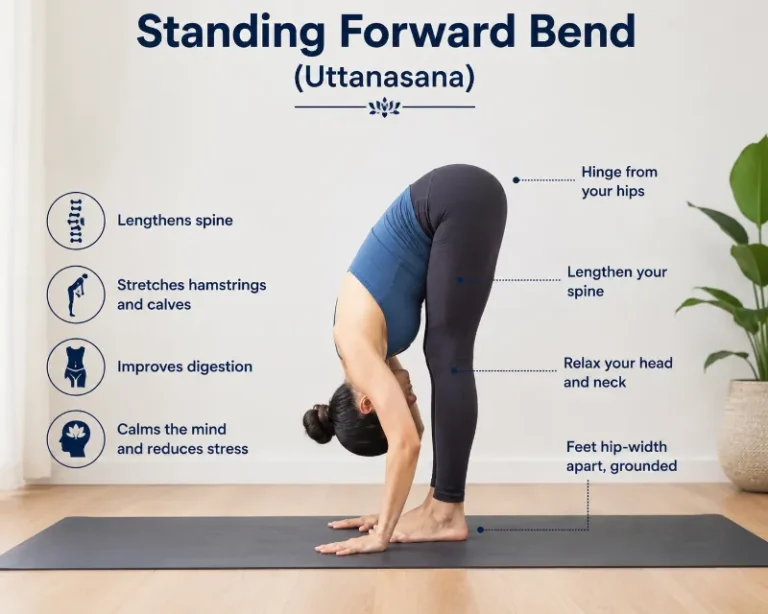
The second position in Surya Namaskar A and B (Sun Salutations) is Urdhva Hastasana. With an inhale and your arms raised overhead, you transition into it from Tadasana (Mountain Pose). You then release your breath into Uttanasana (Forward Fold). When practicing the Sun Salutation, it is repeated several times.
What are the main benefits of Upward Salute?
This pose can help you become more conscious of your posture, extend your entire body, open your chest, and develop greater breath-movement synchronization. Additionally, it can be stimulating, particularly if you practice it at the start of a series.
What is Parsva Urdhva Hastasana?
A side-bending version of the pose is called Parsva Urdhva Hastasana. With both feet firmly planted, you slowly lean to one side from the upward-reaching stance. This version highlights the body’s length through its sides.
Why does Urdhva Hastasana hurt my shoulders?
When mobility is restricted, the shoulders scrunch up against the ears, or the arms are forced overhead, shoulder soreness frequently results. The stance can be made more comfortable by limiting the range of motion, relaxing the neck, and widening the arms.
References
- MyYogaTeacher. (2026b, September 28). Urdhva hastasana. https://myyogateacher.com/yoga-asana/urdhva-hastasana
- Yoga Journal. (2025, March 24). Upward salute. https://www.yogajournal.com/poses/upward-salute/
- Ashish, Y. (2024, July 12). Urdhva Hastasana (Upward Salute): Procedure, benefits & contraindications – Fitsri Yoga | Yoga Alliance certified online yoga School. Fitsri Yoga | Yoga Alliance Certified Online Yoga School. https://www.fitsri.com/poses/urdhva-hastasana