Astavakrasana (Eight-Angle Pose)
What is Astavakrasana (Eight-Angle Pose)?
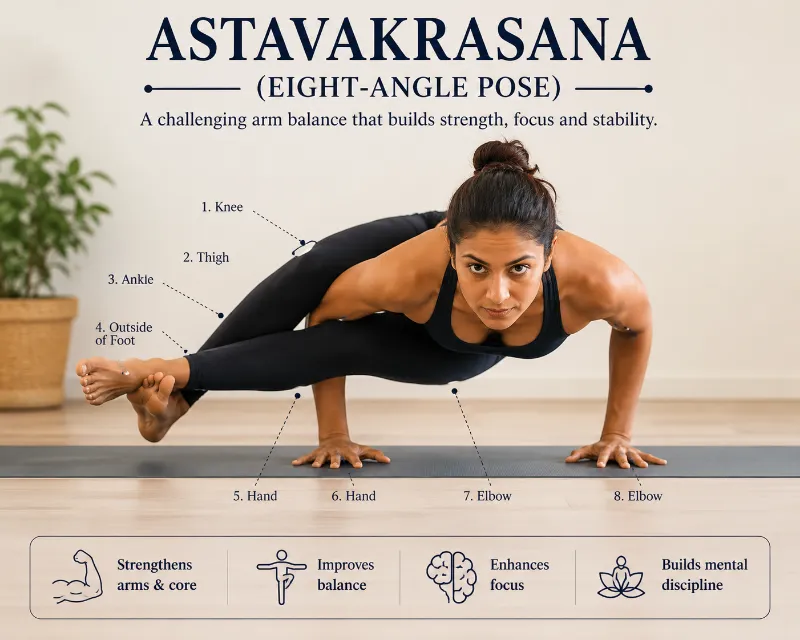
Eight-Angle Pose, or Astavakrasana, is a contemporary yoga pose for arm balancing. It takes a lot of strength in your arms, back, and core to maintain the body sideways on your arms for even a short while in this pose. Because it requires considerable arm and core strength, this position is difficult for everyone.
The eight-angle posture involves bending your arms like Chaturanga arms and balancing your body sideways on one arm at a moment. This stance helps you tone your entire body while also strengthening the link between your mind and muscles.
Find someone to notice you and get on the mat immediately if you’re eager to master this powerful asana.
Overview & Etymology
Astavakrasana derives its name from Sanskrit terms such as “Astavakra,” a disabled sage who served as King Janaka’s spiritual mentor.
The word “Astavakra,” which literally means “eight curvature,” refers to the sage’s eight handicap bends. “Asana,” which means posture or position, is the next word.
There is no old Hatha yoga literature that references the eight-angle posture. The 19th-century gymnastics book Vyayama Dipika made the initial mention of this.
Later, Krishnamacharya in Mysore accepted it, and his pupils adopted it as well. One of them, B.K.S. Iyengar, formally established this pose as a modern yoga pose in his book “Light on Yoga,” published in the 20th century.
- Sanskrit Name: अष्टावक्रासन
- Pronunciation: ah-STAH-vah-KRAH-sah-nah
- Pose Type: Arm Balance
- Also known as: Eight-Angle Pose
- There is strength in the arms, wrists, shoulders, glutes, and core.
- Stretches for the wrists, shoulders, traps, legs, spine, and forearms
Muscles Worked
Astavakrasana works a number of muscles, such as:
- Core and abdominal muscles
- Triceps and other arm muscles
- Shoulders and upper back
- Chest muscles
- Hip flexors
- Inner and outer thighs
- Gluteal muscles
Health Benefits of Astavakrasana
- Increases body balance.
- Improves core strength.
- Enhances flow of Prana (energy).
- Enhances focus and concentration.
- Stretches the glutes, hamstrings, quads, and calves.
- The mind-to-muscle connection is enhanced by high focus.
- Tones the glutes, thighs, arms, shoulders, and belly.
- Strengthens the forearms, traps, shoulders, back, and wrists.
When to Avoid Performing Astavakrasana
- Avoid if you have a herniated disc.
- Avoid holding the pose for too long.
- Avoid if you have elbow or wrist arthritis.
- Avoid if you have inflammatory knee arthritis.
- Steer clear if you’ve had major surgery or injuries.
- Avoid during pregnancy and the menstrual cycle.
- If you’re a novice and have no experts nearby to help, stay away.
How to do Astavakrasana (Eight-Angle Pose)
Check out the four main sections of our comprehensive Astavakrasana guide.
Part 1 – Preparatory Poses for Astavakrasana
A strong core, flexible wrists, and movable shoulders are necessary for the eight-angle posture. Here are some yoga poses to help you get ready:
- Take a few deep breaths while positioned on a table. Then take a breath and take one back step at a time. Your palms should be pressing into the mat, your toes should be touching, and your glutes, back, and neck should all be in one line.
Regularly hold this plank posture for one to three minutes to strengthen your wrists, shoulders, and all of your core muscles.
Paripurna Navasana (Full Boat Pose):
- With your hands behind you, assume a sitting position on your sit bones. Make sure both knees are bent, and your legs are together. Tighten your core muscles by contracting your navel while you inhale and expand your chest.
In order to balance on your sit bones, descend very slightly. Breathe out, then raise your legs straight up with your feet pointing. To push yourself farther, raise your arms from behind and align them with your pointed legs. Hold this stance for a few seconds.
Chaturanga Dandasana (Four-Limbed Staff Pose):
- Take a few breaths while starting in the plank posture. Now get on your toes so your shoulders are past your wrists and begin moving your body forward.
Now, keep your elbows close to your ribs and slowly bend them. Lower your body until your elbows form a 90-degree bend. To strengthen your shoulders, wrists, and back, hold this pose.
Part 2: Step-by-Step Instructions to Perform Astavakrasana
The eight-angle position can be practiced by following these steps:
- Step 1: Take a seat in the staff position. Keep your hands by your sides and your legs out in front of you.
- Step 2: Hold your right foot in both hands while bending your right leg. Cradle your leg sideways, bring your foot near to your chest, and feel for any tense muscles.
- Step 3: Bring your right leg over your right arm while taking several deep breaths. Make sure your right leg is raised to a 90-degree angle with the floor.
- Step 4: Get ready for the “Elephant Trunk Pose” by curving your right leg over your right shoulder, keeping your left leg out in front, and placing both hands on the mat at your sides.
- Step 5: Take a few deep breaths and settle in. Tighten your core, take a deep breath, and bend your left leg such that your left foot hooks around your right leg.
- Step 6: Lift your lower body off the mat while using your fingers to press against it while exhaling deeply.
- Step 7: Hinge your upper body forward, keep your legs sideways in the air parallel to the floor, and bend your arms at a 90-degree angle, as in Chaturanga Dandasana.
- Step 8: Keep your body balanced by focusing on your breath, muscles, and senses. Breathe softly while holding this stance for a short while.
- Step 9: Release by placing your pelvis on the yoga mat and taking a few breaths back in Staff pose. Lastly, do the same thing on the opposite side.
Breath Awareness:
Inhale: While using your fingers, pelvis, and core, take a breath before getting off the mat.
Breathe out as you lift your pelvis off the mat and enter Chaturanga arms.
Beginner’s Performance Duration: Hold Astavakrasana for ten to thirty seconds on each side.
Advanced Performance Time: Perform Astavakrasana for 30 to 90 seconds on each side.
Part 3: Things to Keep in Mind
Here are some posture indicators to follow when doing the eight-angle pose because any ideal arm balance posture necessitates alignment awareness:
Maintain a strong core: Before attempting Astavakrasana, you should strengthen your back, thighs, and abs. You can’t raise your lower body off the surface if your core isn’t engaged.
Verify where your hands are: Just below your shoulders, place the palms of your hands. To enable you to smoothly bend your elbows for the Chaturanga arms formation, keep them away from your glutes.
Part 4: Relaxing Poses After Astavakrasana
For a quicker recovery after Astavakrasana, try these counter-poses.
Wrist Rotations:
- Long periods of time spent balancing your entire body on your wrists can impede blood flow. This could have an impact on your wrist joint mobility and safety.
So, immediately following your arm balancing exercise, clench your palms into a fist, begin to rotate them in a clockwise direction, and then repeat in a counterclockwise direction. For smooth blood circulation throughout, repeat this 100 times in each direction.
Cow Face Arms Stretch Pose:
- This pose is for you if, after practice, you’re experiencing stiffness in your elbows, neck, shoulders, and spine.
To begin, raise your right arm straight and overhead. Bring the palm of your right arm behind your back by bending it. Now extend your left arm from the lower left side of your belly and attempt to grab the fingers of your right hand.
After interlocking both fingers, take a deep breath, open your chest, and straighten your back. To help your upper back, shoulders, and spine relax, hold this stretch for a few minutes. Repeat on the opposite side after releasing and switching arm positions.
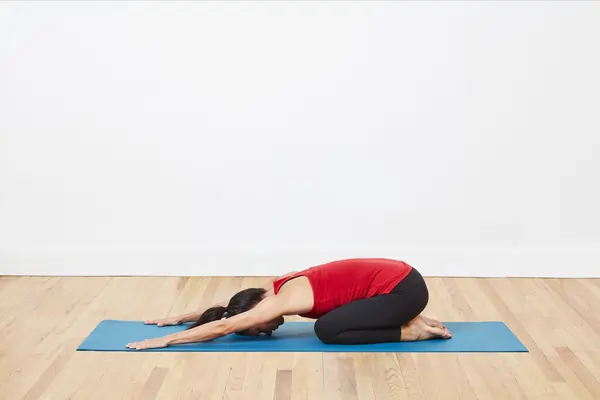
- Sitting on your heels with your big toes touching, kneel at the edge of the mat. Make sure the distance between your thighs is hip-width. Take a deep breath, raise both arms, and begin to bend your upper body forward.
As you place your hands, head, and chest on the mat, exhale. Then, take a few deep breaths to completely relax your upper body. For three to five minutes, maintain this posture to achieve a state of deep calm.
Astavakrasana Variations to Consider
Over time, these intermediate-level posture modifications will assist you in developing your strength and mind-muscle connection for the primary position:
Eka Hasta Bhujasana (Elephant’s Trunk Pose):
- Before attempting the eight-angle arm balance, novices should learn this foundation stance. First, bend your right leg while sitting in the staff position. Flex your right foot straight at a 90-degree angle with the ground after first bringing it near to your chest.
Place your right arm behind your right knee, bend it, and place it on your right shoulder. Place both palms at the side of your glutes while maintaining your left leg in front.
Now contract your core, use your palms to press into the yoga mat, and raise your lower body off the mat. For three to five breaths, hold this elephant trunk stance. Then, release, unwind, and repeat on the opposite side.
Ardh Parsva Kakasana (Half-Side Crow Pose):
- This variant is appropriate if you have trouble keeping your pelvis upright each time you try to extend your legs sideways. In order to stabilize your pelvis in an asymmetrical arm-balance with bent legs, practice the side Crow posture and develop a mind-muscle connection before extending your legs.
Put both of your palms shoulder-width apart on the mat, squat, and turn your upper body to the right. Take a deep breath, contract your core, create Chaturanga elbows, and place your right knee on your left elbow.
Lean forward while gradually shifting your weight from your toes to your wrists. When doing arm balancing, make sure your knees are bent and placed on top of one another.
As you become accustomed to this version, your muscles will become more stable, allowing you to quickly stretch your legs in the eight-angle stance.
Precautions
- Astavakrasana is an advanced pose and should not be forced.
- Avoid or modify the pose if you have wrist, elbow, shoulder, or hip injuries.
- Beginners should learn it under the guidance of an experienced yoga instructor.
- Warm up the wrists, shoulders, hips, and core before attempting the pose.
Common Mistakes
- Placing too much weight on the wrists
- Allowing the shoulders to collapse
- Not engaging the core
- Trying to lift the legs before establishing a stable hand position
- Holding the breath
- Forcing the hips into the position without adequate mobility
FAQs
Can beginners perform Astavakrasana?
Astavakrasana is a powerful pose and is mostly executed by advanced practitioners. Beginners should not perform Astavakrasana without appropriate core and arm strength.
What are the different preparatory poses in Astavakrasana?
Combine Navasana, Chaturanga Dandasana, Hindolasana, and Eka Hasta Bhujasana in a warm-up sequence to prepare your full body muscles for the Astavakrasana practice.
What are the benefits of Astavakrasana yoga?
Benefits of Astavakrasana yoga include strengthening your arms, shoulders, core, and wrists. Plus, it helps enhance your focus, improves body balance, and increases muscle mass in your upper body.
What are the different variations in Astavakrasana?
The following are different variations of Astavakrasana, and each of them targets similar types of muscle groups:
Lolasana
Titibasana
Mayurasana
Parsva Bakasana
Who should avoid performing Astavakrasana?
Avoid if you have arthritis or you are a beginner with zero professional guidance. Also, women should temporarily avoid this pose during pregnancy or menstruation cycle.
What Yoga Pose Can Be Practiced After Astavakrasana for a Balanced Sequence?
It’s recommended to stretch your arms in the Cow-Face pose after Astavakrasana, move your wrists and shoulders in circles (both clockwise & anti-clockwise), and relax your spine in the Child’s pose after your Astavakrasana practice.
References
- Allen, W. (2025c, August 26). Astavakrasana. https://myyogateacher.com/yoga-asana/astavakrasana
- Eight angle pose. (2016, June 25). https://yogainternational.com/article/view/eight-angle-pose/?srsltid=AfmBOooV4r4VqgCrX9hgCsUpzjkwCimuT6N3UUOj_zuDna8ffdDWnMsQ
- Yoga Journal. (2025h, February 25). Eight-Angle pose. https://www.yogajournal.com/poses/eight-angle-pose/