
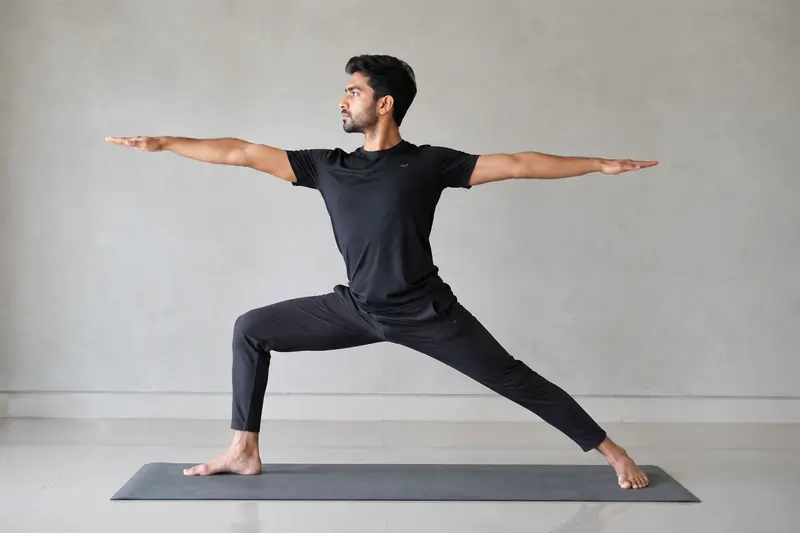
Virabhadrasana II (Warrior II)
Introduction
Virabhadrasana II (Warrior II Pose) is a powerful standing yoga posture that strengthens the legs, improves balance, and enhances overall body stability.
Named after a legendary fighter from old Indian tales – Virabhadra – it stands for boldness, power, and sharp attention. From a standing start, step feet far apart, lower into the leading knee, extend both arms sideways, eyes fixed past one’s fingertips.
Holding this pose may build endurance, loosen tight hips and shoulders, sharpen concentration, and foster self-assurance deep inside.
Basics of Virabhadrasana II: Warrior Two Pose
Standing strong across today’s yoga classes, one pose shows up again and again – Warrior II, named after a mythic warrior but felt in every grounded step.
Its form cuts through noise: legs spread firm, arms stretched like wings, eyes locked ahead without wavering. Power lives here, yes – but also stillness, held close beneath open palms and steady breath. The body works hard while the mind stays quiet, almost too quiet for such motion.
Just because you see it often in fast-moving sequences or first-time sessions doesn’t mean it’s simple. This pose demands sharp attention across every part, from toes to outstretched fingers, working at once. Though familiar, Warrior II hides deep layers beneath its surface appearance.
- From ancient stories to body mechanics, here’s a look at one essential yoga pose. Rooted in legend, it carries echoes of old spiritual beliefs. Built on a precise structure, its form follows specific bodily lines. Each movement links bone, muscle, and breath in a slow sequence. Holding it tight brings strength and stillness, yet demands awareness.
- Many slip into uneven weight or strained joints without noticing. Slight shifts change its feel – some stretch longer, others stand taller. Through time, forms have branched subtly apart.
The Mythical Roots of the Warrior Tale
Start with a story older than most think – Virabhadra was born from fury, shaped by divine rage. This stance carries more than stretched limbs; it holds a legend stitched through ancient chants. Look past muscle and bone.
Into myth folds meaning, layer after quiet layer. A warrior arrives not on earth but from a god’s broken heart. Every reach outward begins there.
A strong fighter called Virabhadra gives this stance its name. From ancient Sanskrit roots comes the tale:
- Vira stands for hero – some call it warrior. A strong name, really – one that carries weight without trying too hard.
- Blessed? That is what Bhadra can mean. Goodness fits too. Sometimes it carries a sense of auspicious moments. Each shade lands differently depending on where you hear it.
- Asana means “posture” or “seat.”
The Story of Shiva, Sati, and Daksha
- Deep in old tales, Shiva adored his partner Sati without reserve. Still, her father, King Daksha, despised Shiva’s wild habits and barefoot path. Out of spite, he hosted a grand ritual feast – one that welcomed every ruler and deity across existence – yet left out both Shiva and his daughter.
- Even though she knew it would be hard, Sati went to the event just to face her father. Once there, Daksha mocked her and spoke badly of Shiva in front of everyone. Hurt beyond words by how he treated her, she quietly took a seat. Still seated, she turned inward, focused deeply, then let an inner flame rise until nothing remained.
- Out of nowhere, sorrow took hold of Shiva when word came about Sati’s passing. A wild anger followed close behind. With force, he tore out a strand of tangled hair and hurled it down onto the earth. What resulted from that was unexpected: a gigantic figure with hands full of blades and eyes full of pure rage appeared, formed like a storm. Born straight from that moment stood Virabhadra.
The Three Stages of the Warrior
- Back then, yoga lineups told a story – Warrior One, Two, Three unfolding like moments in Virabhadra’s fight. Each stance marks a shift, not just in posture but in tale. From first clash to full advance, the body moves through legend. These forms aren’t random; they trace steps across an old battlefield. The sequence holds time within its angles and breath.
- A strong figure rises, breaking through the soil like a sudden storm. This pose mirrors that moment – fists lifted high, stepping forward where few dare go. From ancient tale to steady stance, arms stretch skyward as if pulled by wind. One foot anchors deep while the other moves ahead without warning. The body becomes legend, rooted yet ready.
- A strong stance appears. This pose shows a fighter spotting his mark across chaos. He moves forward, eyes locked ahead. The space around fades as focus sharpens. One arm stretches out, another pulls back like tension before release. His feet root into the ground. Breath slows. Everything aligns – body, sight, purpose – all still, yet ready. Out comes the focused blow – each motion sharp, purposeful – as he drives forward without pause. This pose captures that instant, mid-stride, where balance meets intent.
Standing in Warrior II pulls you deeper into the story’s next part. This pose does not stir wild, unfocused energy. It shapes clear power, grounded balance, a quiet readiness. From that place, breaking past mental blocks becomes possible – past self-doubt, past confusion.
Anatomical Blueprint Inside the Body?
One foot presses down hard as the other stretches wide. While legs dig into the earth, arms reach out like branches catching wind. Muscles in the hips tighten just enough to hold steady.
The chest lifts slightly, pulling shoulders back without strain. Knowing which parts move – and which stay still – keeps everything working safely.
The Lower Body As Foundation
- The front leg supports much of your body’s load during this move. The knee stays at ninety degrees because the quads resist extension slowly. To stop the knee from caving in, outer hip muscles twist the thigh bone outward slightly. Glutes on the side activate strongly right here. Weight distribution shifts subtly but constantly through foot placement.
- Foot pressing out, and the back leg holds everything steady. With the knee locked tight, the quad muscles stay active throughout. Through the outside part of the foot, lower leg muscles called peroneals push downward. That rear hip stays wide open and stretched back by the glute max, doing its job. Stability comes from this grounded position, acting like a built-in stop.
- The Pelvis and Core Form the Body’s Central Balance Point
- Most people get mixed up about how the pelvis ought to move. Though many call it a hip opener, the pelvis actually rests slightly turned toward the front corner of the mat instead of facing straight along its length. Trying to square the hips fully may twist the back knee and irritate the sacroiliac joint.
- To prevent too much curve in the lower spine, deep abdominal muscles – the rectus and transversus abdominis – draw gently inward. This subtle engagement holds the pelvis steady without strain.
The Upper Body Expands
Arms held out sideways? That’s your deltoids staying active. Instead of just hanging there, they hold everything steady at shoulder height. From below, the lower trapezius pulls inward while rhomboids tighten slightly behind the back. This team keeps the shoulder blades pressed flat and aligned. A longer neck follows naturally when tension stays low. Posture improves without effort because these muscles balance each other.
Outward arm movements pull the chest muscles wide, easing breath into the lungs. Stretching happens across the front of the shoulders when limbs move apart. This motion invites fuller air intake without effort. Expansion of the pecs supports natural deep inhales. Movement here links limb position to respiratory depth. As arms extend away from the centre, space grows between ribs. Opening across the chest follows the limb direction. Breathing shifts as muscles across the torso lengthen.
Technical Guide to Alignment
- Start by grounding one foot firmly while stretching the other sideways. From there, roll each toe into place before shifting weight evenly across both legs. Now extend an arm forward as if reaching through fog. Let the back heel settle at a slant just after the front knee bends like a hinge. Breathe once, twice – then adjust the hips to face the long edge of the mat. Each piece clicks only when the base holds steady beneath.
- Begin by planting yourself. Stand tall along the long side of your mat. Move your feet far apart – around three and a half to four feet, close to one leg’s full span. Jump gently if it feels smoother. Face your right foot fully outward, aiming at the mat’s narrow edge. Shift your left foot inward just a bit, maybe between fifteen and forty-five degrees. Press the outside edge of your back heel down hard. Line up the heel of your front foot with the inner arch of the one behind.
- Bending the right leg fires up strength below the waist. As you breathe out, ease your right knee forward until it aligns above the ankle. Try getting the upper part of that leg level with the ground, forming a sharp corner at the joint. Take a peek at your foot – your kneecap ought to stay visible. Not seeing it? That means it’s drifting too far inside, so guide it slightly outward, toward the outer edge of the foot.
- Start by shifting your right foot so it faces the far edge of the mat, fully open at a right angle. The left foot then tilts just a little inward – roughly a small turn, like fifteen degrees. Now adjust until the back heel lines up exactly with the space under the front foot’s toes. Position matters most when both feet find their balance point.
- Outstretched arms float level with the ground. Breathe in while lifting both limbs sideways until they meet at shoulder height. Fingers stretch forward like rays of light. Hands turn palm-down without tension creeping into the shoulders. Let weight drop from the neck, easing muscles below the earline.
- Breathe out as you ease into a deep lunge. Let the right knee drift forward, hovering above the ankle, shin standing straight up. Try to level the right thigh with the ground if your body allows. Watch the knee – it must stay wide, nudged toward the outer edge of the foot. Never let it dip past the toes. A solid line forms when everything lines up just right.
- Stare ahead now – pick a spot past your right fingertips. Stay balanced through the core, chest open without tipping toward the front leg. Face turned fully to the right, eyes locked steady. Let each breath last slowly and fully while holding still. Five rounds minimum, maybe ten if it feels clear. Time moves differently when you stay put like this.
Safely Leaving the Pose
As you breathe out, push down through the outer edge of your right foot to extend the front knee fully. Line up both feet so they face forward, let your arms drop naturally by your hips, then settle back into Mountain Pose.
Following that, go through the identical steps again but switch sides – this time leading with the left – to keep strength even from one side to the other. With each round, notice how stability shifts subtly underfoot.
Virabhadrasana II Strengthens Legs, Improves Balance, Opens Hips, Enhances Focus, Builds Endurance
Regular practice of Warrior II transforms both physical health and mental resilience:
- Strengthens legs and hips
Front leg fires up – quads, hams, glutes work hard to stay low in that wide stance. The back foot pushes down through the calf and side of the thigh, keeping everything steady. Muscles grow firm and defined simply by holding the shape. - Open hips chest
Outward twists at the hips define how this position lines up, opening those joints to ease stiffness from too much desk time. While that happens, reaching overhead stretches the front body, giving breathing room deeper into the lungs. - Improved core and posture stability
When the torso stays balanced, the body stops tipping ahead or behind. This shift turns on the hidden stomach and back support muscles. Better alignment while upright follows naturally through daily activities. - Stimulates Abdominal Organs
Inside the belly and pelvis, muscles at work give a soft squeeze to organs, helping food break down while quietly lifting how energy gets used. A quiet rhythm forms when those deep layers stay active, nudging metabolism forward without force. - Cultivates Focus and Mental Stamina
Staring without blinking at one spot above your hand slows down thoughts that rush too fast. Holding the position, body tense and steady, adds strength to your focus, layer by layer. A quiet certainty grows – not loud, but solid – when you stay put even as muscles shake.
When Not to Use and Safety Notes
- Though Warrior II brings strong healing benefits, adjustments work better when dealing with particular physical issues.
- If you have high blood pressure, try not to hold your arms up for long periods – rest them on your hips when possible. Instead of twisting your neck, keep your eyes facing forward. For neck or cervical problems, looking sideways over your front hand is best avoided. Let your spine stay natural by gazing straight ahead.
- When dealing with knee or hip discomfort, shorten how far you step into the lunge. Your front leg doesn’t need to reach ninety degrees – only go as deep as feels right. During pregnancy, stand close to a wall so you can steady yourself if needed. Take a wider base with your feet to allow room for your belly and improve balance.
Beginner-Friendly Advice
- Starting with yoga? Try these tweaks to ease into the pose step by step. Each change helps your body learn slowly, without strain. One small shift at a time creates steady progress. Over days, movements begin to feel more natural. The goal isn’t perfection – it’s showing up consistently. Little adjustments open space where tension once lived. With patience, reaching further becomes possible. Your breath guides each part of the way forward.
- The back foot flat on the wall helps keep balance. Leaning into it stops sliding. The surface holds steady without effort.
- Start by noticing how your body tilts. New people tend to pitch forward over the leading leg. Think of your backbone as a rod dropping straight down through the middle of your mat. Hips stacked under shoulders like blocks in a tower.
- Take a break for your arms. When shoulders start to feel heavy, stay in the pose, yet rest hands on hips awhile. Breathe here. Then, reach the arms out once more when ready.
Conclusion
Warrior Two stands as quiet proof – yoga moves, breaths, lives. Effort fills the body; stillness grows in the thoughts. Facing your hidden fighter helps you stay cool when things press hard. With time on the mat each day, stance deepens, spine lifts, and attention sharpens.
FAQs
What is Virabhadrasana II (Warrior II Pose)?
Virabhadrasana II, commonly known as Warrior II Pose, is a standing yoga posture that strengthens the legs, improves balance, and enhances focus and stability.
What are the benefits of Warrior II Pose?
Warrior II helps strengthen the legs, ankles, and core, improves stamina, opens the hips and chest, and promotes better balance and concentration.
Is Warrior II suitable for beginners?
Yes, Warrior II is a beginner-friendly yoga pose. It is commonly taught in yoga classes because it helps build strength, stability, and body awareness.
How long should I hold Warrior II Pose?
Most practitioners hold Warrior II for 20–60 seconds on each side while maintaining steady breathing and proper alignment.
Which muscles are worked in Virabhadrasana II?
Warrior II primarily engages the quadriceps, hamstrings, glutes, calves, core muscles, shoulders, and back muscles.
References:
- Lifted Lotus Online Yoga School. (n.d.). Warrior II Pose instructions: How to practice Virabhadrasana II. https://courses.onlineyoga.school/pages/warrior-ii-pose-instructions-how-to-practice-virabhadrasana-ii
- Hennah, A. (2018, November 2). How to do Warrior II (Virabhadrasana II). Liforme. https://liforme.com/blogs/blog/how-to-do-warrior-two?srsltid=AfmBOoqOQq6gw0EMW9WxjxrmZDPduU4p55zercG9_eMhkX1AxrBQwq3a
- Virabhadrasana II – Warrior 2 Pose — Yoga Alignment Guide. (n.d.). Yoga Alignment Guide. https://www.yogaalignmentguide.com/virabhadrasana-ii-warrior-2-pose
- Virabhadrasana II – Warrior 2 Pose — Yoga Alignment Guide. (n.d.-b). Yoga Alignment Guide. https://www.yogaalignmentguide.com/virabhadrasana-ii-warrior-2-pose
- Baloni, B. (2026, May 26). Virabhadrasana 2 (Warrior Pose): 10 Powerful Benefits, Procedure & Key Tips. Rishikul Yogshala, Rishikesh. https://www.rishikulyogshalarishikesh.com/blog/virabhadrasana-2/
- School, A. Y. (n.d.). Warrior 2 pose : How to Practice Virabhadrasana 2. https://www.arogyayogaschool.com/blog. https://www.arogyayogaschool.com/blog/warrior-2-pose-virabhadrasana-ii/
5 Comments