Surya Namaskar (Sun Salutations)
What Is Surya Namaskar (Sun Salutations)?
A dynamic and invigorating yoga sequence, the 12 flowing poses of Surya Namaskar, sometimes called Sun Salutations, warm the entire body, improve circulation, and synchronize breath with movement. Pronounced “SOOR-yah nah-mahs-KAHR,” this fundamental practice is one of the most popular yoga sequences and is renowned for strengthening, improving flexibility, and waking the body and mind.
In just a few minutes each day, Surya Namaskar is a straightforward yet effective method to improve mental clarity, increase mobility, and strengthen muscles, regardless of experience level. It is just as effective as a thoughtful morning routine, a stand-alone workout, or a warm-up.
Overview & Meaning of Surya Namaskar
Surya Namaskar, which means “Salutation to the Sun,” is derived from the Sanskrit terms Surya (Sun) and Namaskar (Salutation). The 12 poses in the sequence, which represent harmony and conformity to natural cycles, are customarily linked to the 12 signs of the zodiac. Recognising the sun as a source of energy and your own inner power, clarity, and awareness are symbolised by yoga.
The Raja of Aundh advocated the present version of Surya Namaskar as a useful daily exercise, which helped it gain popularity in the early 20th century. Additionally, it is connected to Samarth Ramdas, a saint from the 17th century who emphasized both physical and spiritual discipline.
By the middle of the 20th century, Surya Namaskar had become a standard warm-up and energising practice in yoga institutions all over India. As yoga gained popularity throughout the world, Sun Salutations became acknowledged as a comprehensive mind-body exercise that was suitable for both novice and expert practitioners. It is still one of the most popular yoga poses today, practised in homes, studios, and wellness centres all over the world.
The most popular forms are incorporated into many yoga styles, such as Hatha, Ashtanga, Vinyasa, and Power Yoga:
- Surya Namaskar A (Traditional): 12-step sequence
- Surya Namaskar B (Intermediate) is a 17-step flow with extra strength postures.
- Classical/Sivananda Style: Like A, but with particular breathing techniques
- Surya Namaskar C: A more advanced variation
At a Glance
- Sanskrit Name: सूर्यनमस्कार (Surya Namaskar)
- Pronunciation: SOOR-yah nah-mahs-KAHR
- The English names are Sun Salutations and Sun Salutation Sequence.
- Type: Yoga Flow Sequence (Vinyasa)
- Twelve poses (Surya Namaskar A) and seventeen poses (Surya Namaskar B).
- Level: Beginner to Advanced
- Duration: ~2–3 minutes per round
- Ideal Time: On an empty stomach, early in the morning
- Key Advantages: Cardiovascular health, flexibility, and full-body exercise
Surya Namaskar (Sun Salutations) Video
Benefits of Surya Namaskar (Sun Salutations)
Learn the safest and most efficient way to perform Sun Salutations by scheduling a free one-on-one session with a qualified Indian yoga instructor.
Because Surya Namaskar engages all major muscle groups, enhances mobility, increases strength, and promotes emotional equilibrium, it is frequently referred to as a comprehensive workout for the body and mind. Among the several advantages are:
Physical Benefits of Surya Namaskar
- Full-Body Strengthening: Each exercise works the arms, shoulders, core, back, hips, and legs, providing you with a well-rounded, practical workout.
- Improved Cardiovascular Health: The flowing tempo boosts heart rate, enhances blood flow, and promotes overall heart and lung health.
- Weight Management and Metabolic Support: Surya Namaskar combines flowing movements with controlled breathing, helping increase physical activity and support calorie expenditure.
- Increased Flexibility: Consistent practice makes the spine, hamstrings, hips, chest, and shoulders more flexible.
- Improved Posture and Spine Health: Backbends and forward bends stretch and realign the spine, reducing stiffness from prolonged sitting.
- Digestive System Stimulation: The sequence supports gut health and digestion by gently compressing and stretching the abdominal region.
- Improved Respiratory Function: Deep, slow breathing strengthens the lungs and increases breathing capacity in general.
- Hormonal and Endocrine Balance: The coordination of breathing and movement stimulates endocrine glands, which supports stable hormone production.
- Enhanced Joint Mobility: Sun salutations are particularly beneficial for individuals with tight joints since they lubricate key joints.
Mental & Emotional Benefits
- Stress Reduction: By stimulating the parasympathetic nervous system, the breath-led flow helps reduce stress and anxiety.
- Improved Focus and Mental Clarity: Breathing in time with movement improves focus and induces a sense of meditative flow.
- Increased Energy: Sun salutations are perfect for morning practice or lunchtime recharge since they gradually awaken the body.
- Better Sleep Quality: The practice’s soothing rhythm aids in nervous system regulation, encouraging deeper, more restful sleep.
- Better Mood and Emotional Stability: Consistent practice increases emotional stability and releases endorphins.
- Develops Mental Resilience and Presence: Repeating the routine fosters discipline and mindfulness.
Spiritual & Energetic Benefits
- Balances All Seven Chakras: A balanced energetic flow is produced by each pose, which activates a distinct energy centre.
- Activates Dormant Energy Pathways: Inner vitality (Kundalini Energy) is awakened by the upward-rising movement patterns.
- Connects You to Natural Rhythms: By practising before dawn, you can synchronise your internal clock with the cycles of nature.
- Prepares the Mind for Meditation: The flow produces a peaceful, concentrated state by clearing mental clutter.
Therapeutic Applications
When used appropriately, Surya Namaskar is frequently advised for:
- Type 2 diabetes
- Controlled high blood pressure
- PCOS and hormonal imbalance
- Depression and anxiety
- Insomnia
- Chronic stiffness and lower back discomfort
- Osteoporosis prevention
- Menopausal symptoms
- Before starting a new regimen, if you have a chronic illness or injury, speak with your healthcare physician.
How to Do Surya Namaskar (Sun Salutations): Step-by-Step Guide)
Practising Surya Namaskar with a steady breath, conscious movement, and appropriate alignment yields the best results. Everything you need to get started safely is included in this guide, from setting up your area to doing your first round of Sun Salutations.
Part 1: Preparation for the Sequence
While Surya Namaskar is a warm-up in and of itself, a quick mobility exercise helps get your muscles and joints ready:
Neck, Shoulder, Wrist & Ankle Circles
- Make the body ready for activity by releasing the main joints.
- Rotate each joint slowly in one direction.
- Continue making smooth, controlled circles in the opposite direction.
Cat-Cow Pose (Marjaryasana-Bitilasana)
- Warms up the spine and releases stiffness.
- Inhale while raising your chest and arching your back (Cow).
- Draw your tummy in and round your back while exhaling (Cat).
- Continue flowing with your breath.
- Repeat for 10-15 rounds.
Downward-Facing Dog (Adho Mukha Svanasana)
- Opens hamstrings, calves, and shoulders.
- Press your hands firmly into the mat while raising your hips into an inverted V.
- Gently pedal your heels and extend your spine.
- Hold and breathe steadily.
Standing Forward Bend (Uttanasana)
- Relieves stress and gently lengthens the back body.
- Let your arms and head drop as you bend forward from your hips.
- Keep your knees slightly bent if needed.
- Breathe deeply and soften your shoulders.
- For novices in particular, these motions lessen stiffness and smooth out the sequence.
Part 2: Step-by-Step introductions
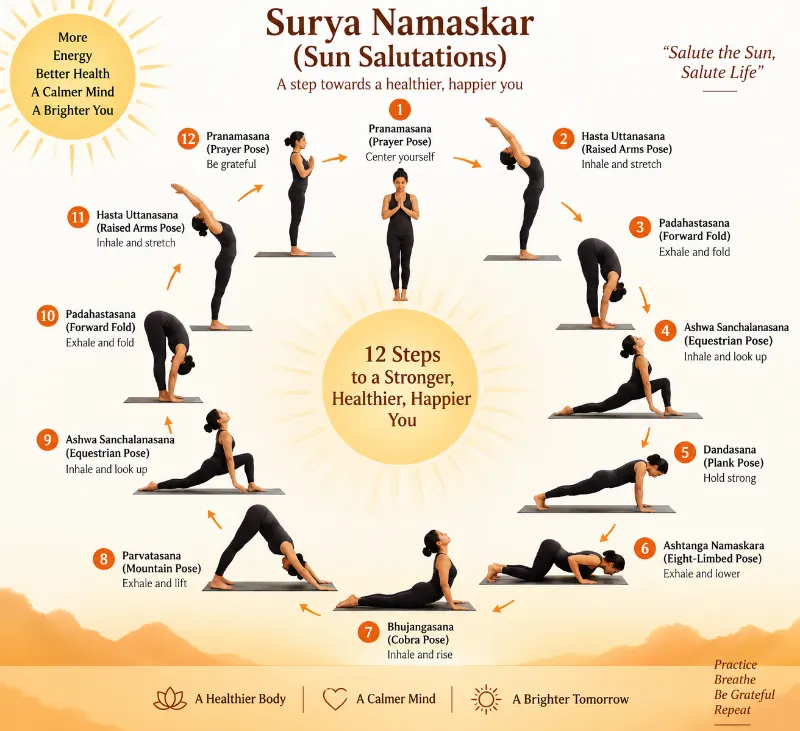
Surya Namaskar A moves in unison with each breath. 12 positions in a full round. Repeat with a different stepping leg to finish the entire cycle.
Below is the simplified step-by-step sequence:
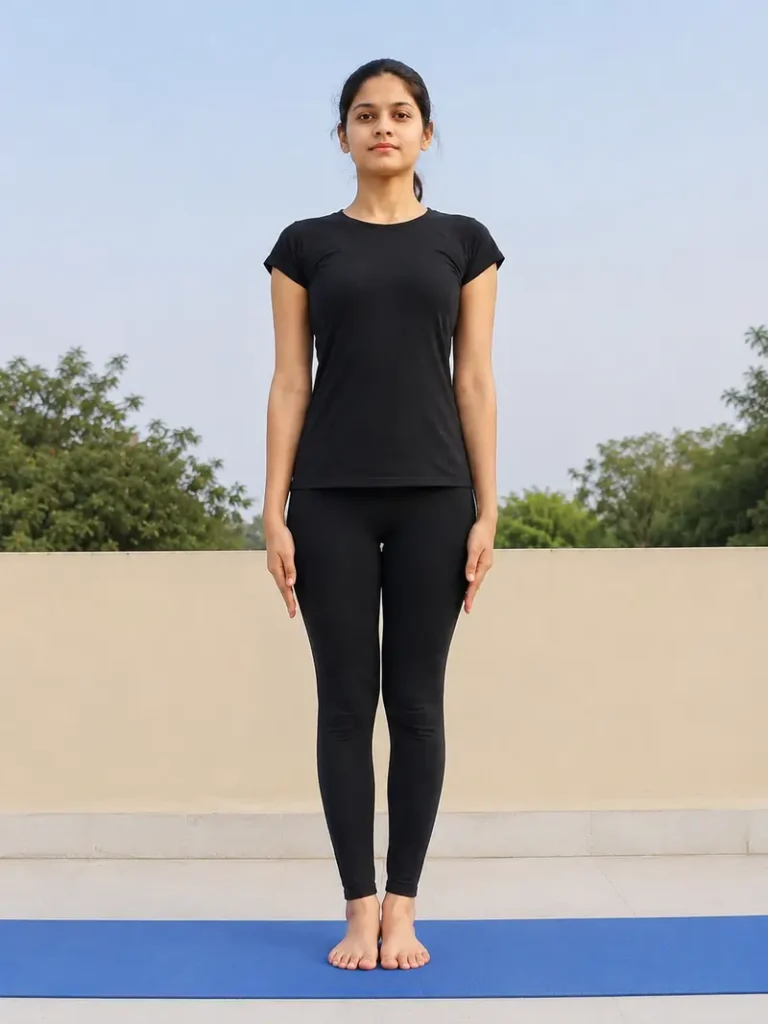
- Pranamasana (Prayer Pose): Stand erect in front of your mat with your feet together. Exhale or take a natural breath. In the center of your heart, bring your palms together. Grasp both feet and soften your gaze.
- Raised Arms Pose, or Hasta Uttanasana: Inhale, sweep your arms aloft, and then softly arch back. Keeping your biceps near your ears, extend your spine.
- Hasta Padasana (Standing Forward Bend): Exhale by folding forward from your hips and bringing your hands to your feet. To prevent strain, bend your knees if necessary.
- Inhale as you step back with your right leg in Ashwa Sanchalanasana (Low Lunge). Maintain a stacked left knee over your ankle. Look ahead and raise your chest.
- Release the breath and hold the left leg back to create a straight line from the head to the heels in the Dandasana (Staff Pose). Keep your hips from sagging and use your core.
- Ashtanga Namaskara (Eight-Limbed Pose): Exhale by dropping your knees, chest, and chin to the floor while maintaining a raised hip position.
- Bhujangasana (Cobra Pose): Inhale, move your body forward, and use your back power to raise your chest. Keep your shoulders loose and your elbows slightly bent.
- In Adho Mukha Svanasana (Downward Dog), elevate your hips into an inverted V as you exhale. Lengthen your spine by firmly pressing your palms into the mat.
- As you inhale, step your right foot forward between your hands in Ashwa Sanchalanasana. Keep your gaze forward and your chest raised.
- Hasta Padasana: Exhale, then take a step forward with your left foot before bending back forward.
- Hasta Uttanasana: Take a breath, extend your arms overhead, and slowly arch while maintaining a strong core.
- Pranamasana – Exhale: Return to standing by bringing your palms back to your heart.
How Many Rounds Should You Do?
- 3–5 rounds (2- 3 minutes per round) for beginners
- Intermediate: 12 rounds (conventional)
- Advanced: 54 or 108 rounds (festivals and special events)
Common Mistakes & How to Fix Them
- Keeping your breath in. Rather, focus on inhaling deeply and slowly. Breath is the flow’s foundation.
- Hurrying through the order. Think about slowing down and coordinating each movement with your breathing.
- In lunges, push the knee past the ankle. Rather, place the knee just above the ankle.
- Plank Pose: sagging. Make sure your core is active and that your shoulders and heels are in a straight line.
- In the Cobra, only arm strength is used. Think about rising with your back muscles while pressing your hips down.
- Learn how to align with real-time adjustments. Schedule a free one-on-one class with a skilled Indian yoga instructor right now!
Surya Namaskar Variations
Beginners, intermediate practitioners, seniors, and those with mobility issues can all modify the Surya Namaskar sequence. The modifications listed below allow you to customise the practice to your body and objectives, whether you want to make the flow easier or more difficult.
Beginner Modifications
If you’re new to Sun Salutations, you can safely develop strength and confidence by slowing down and adding assistance.
Knees-Down Options
- In both Low Lunge stances, maintain a low back knee. For more support, lower your knees to the mat in Plank Pose. Rather than performing the Eight-Limbed Pose (Ashtanga Namaskara), fully lower your chest and belly.
Use Props for Comfort
- When performing forward folds, place blocks beneath your hands to ease the strain on your hamstrings. To keep yourself stable during transitions, wrap a strap across your thighs.
Slower Pace
- Instead of moving with each inhalation and exhale, take two to three breaths in each pose. As a result, the sequence is simpler and more contemplative.
Built-in Rest
- If you’re feeling worn out or breathless in between rounds, take a break in Child’s Pose.
- Before transitioning into conventional or faster-paced flows, these beginner-friendly choices assist you in developing appropriate alignment and strength.
Surya Namaskar B (Intermediate)
In Ashtanga and Vinyasa yoga, Surya Namaskar B is a vigorous, heat-building version. It adds two crucial strength postures and has 17 positions rather than 12:
- The addition of Chair Pose (Utkatasana) at the start of the series
- After every lunge, add Warrior I (Virabhadrasana I).
- This version improves hip mobility, leg strength, cardiovascular intensity, and general stamina. For practitioners who are currently at ease with Surya Namaskar A and need a more potent, strength-focused practice, it is perfect.
Here’s what the flow looks like:
- Utkatasana (Chair Pose): Inhale, raise your arms aloft, sit your hips back, and bend your knees deeply. Don’t lower your chest.
- Uttanasana (Standing Forward Bend) – Exhale: Bring your hands down to the floor and fold forward from your hips. If necessary, keep knees soft.
- Ardha Uttanasana (Half Lift): Inhale, extend your spine, place your fingertips on the floor or your hands on your shins, and look ahead.
- Chaturanga Dandasana (Low Plank): Exhale by stepping or jumping back and lowering yourself halfway while keeping your elbows close.
- Urdhva Mukha Svanasana (Upward-Facing Dog): Take a breath and open your front body by lifting your chest, extending your legs, and straightening your arms.
- As you exhale in Adho Mukha Svanasana (Downward-Facing Dog), raise your hips into an inverted V shape.
- Virabhadrasana I: Right Side (Warrior I): Take a breath, step forward with your right foot, and then turn back, heel down. Squaring your hips forward, raise your arms and chest upward.
- Chaturanga Dandasana: Exhale by bringing your hands down, taking a step back, and lowering yourself halfway.
- Breathe in Urdhva Mukha Svanasana and raise yourself back into Upward-Facing Dog with a wide chest.
- Breathe out of Adho Mukha Svanasana and go back to Downward Dog.
- Inhale as you step forward with your left foot and turn your back heel down in Virabhadrasana I, Left Side (Warrior I). Keeping your hips square, ascend into Warrior I.
- Chaturanga Dandasana – Exhale: Controllably descend through Chaturanga.
- Inhale to return to the Upward-Facing Dog pose in Urdhva Mukha Svanasana.
- Adho Mukha Svanasana: Exhale and return to the downward-facing dog position.
- Ardha Uttanasana (Half Lift): Take a breath, jump or step to the top of your mat, and extend your back.
- Uttanasana – Exhale: Relax your head and neck by folding forward.
- Utkatasana (Chair Pose) – Inhale: To return to Chair Pose, bend your knees and sweep your arms back overhead.
- To finish the round, return to Tadasana (Mountain Pose), exhale, and stand erect with your arms by your sides.
Advanced Variations
These choices increase involvement and intensity for seasoned professionals:
- Faster Flow: A hot, cardio-enhancing practice is produced with one breath per action.
- Jump Backs and Jump Throughs: Make a fast transition from forward fold to lunges or planks.
- Additions to Arm Balance: Use floating transitions or versions of Crow Pose.
- 108 Sun Salutations: A customary routine used for introspection and discipline during solstices or significant life events.
Props & Accessibility
Seniors, those with restricted mobility, and those with joint problems can all benefit from Surya Namaskar.
- Wall Support: Excellent for lunges and Raised Arms Pose balance.
- Chair-Assisted Sun Salutations: Perfect for elderly people or those who are unable to get to the floor.
- During lunges or Eight-Limbed Pose, place a bolster or cushion beneath your knees for comfort.
- During the first trimester of pregnancy, maintain your feet hip-width apart for stability, move slowly, and steer clear of deep backbends. See our comprehensive pregnant yoga guide here!
- The program is now inclusive and accessible for all body shapes and levels of fitness thanks to these improvements.
Surya Namaskar Precautions & Contraindications
Like any physical activity, Surya Namaskar is usually safe, but it’s crucial to respect your body’s limitations. Use the following precautions to ensure a safe, long-lasting practice if you have a current medical condition, injury, or mobility issues.
Avoid Surya Namaskar if You Have:
Practising Sun Salutations should be avoided or put off if you are experiencing:
- Recent abdominal, knee, or spinal surgery
- An active herniated disk or severe back injury
- Uncontrolled high blood pressure
- Pregnancy (2nd–3rd trimester)
- Severe arthritis, particularly in the wrists and knees
- Unstable cardiovascular conditions or recent heart surgery
- Acute spinal conditions, such as sciatica flare-ups
- Before beginning the procedure, speak with your healthcare physician if any of the aforementioned apply.
Practice with Caution If You Have
Surya Namaskar can still be performed under specific circumstances, but only with adjustments and careful timing:
- During the first trimester of pregnancy, avoid deep backbends, move slowly, and avoid abrupt changes. If you feel lightheaded or hot, stop right away.
- Avoid backbending if you have lower back pain. Always put comfort first and use moderate transitions to strengthen your core.
- If you have wrist pain or weakness, try doing Plank and Downward Dog on your fists, using wedges, or switching to your forearms. Pressure can also be lessened by wall versions.
- High Blood Pressure (Controlled): Perform fewer rounds, move slowly, and avoid holding your breath. Don’t use heated or rapid variations.
- Menstruation: For the majority of people, gentle sun salutations are safe. If you are uncomfortable, avoid inversions, avoid deep backbends, and keep your movements gentle.
- Beginners: Do three to five slow rounds at first. As needed, take breaks, drop knees in a plank, and use blocks.
General Safety Guidelines
- Practice on an empty stomach
- Warm up your joints before starting
- Never hold your breath; always keep it steady.
- Build rounds gradually over weeks
- Avoid pushing into pain or strain
- Drink water after practice rather than during to stay hydrated.
- Make changes without thinking twice.
- The secret to a secure and reliable practice is to pay attention to your body.
Surya Namaskar: Related Yoga Poses
These supplementary positions work well with Surya Namaskar, supporting a smoother flow throughout the sequence and assisting in the development of strength and alignment.
Warrior I (Virabhadrasana I)
- Enhances hip and shoulder stability and increases lower body strength.
- Ground the heel while taking a step back.
- Square your hips forward and flex your front knee.
- Stretch your back and raise your arms high.
Chair Pose (Utkatasana)
- Enhances balance and produces heat while strengthening the back, legs, and core.
- Recline as though you were in an imaginary chair.
- Maintain a raised chest and knees behind your toes.
- Contract your core and extend your arms upward.
- Enhances body awareness, posture, and grounding.
- With your feet hip-width apart, stand erect.
- Relax your shoulders and lengthen your spine.
- Take a deep inhale and lift through the top of your head.
FAQs
What is the recommended daily number of Surya Namaskar?
To safely gain stamina, beginners might begin with three to five rounds.
The conventional norm for intermediate practitioners is often 12 rounds.
For deeper discipline or special occasions, advanced yogis can practice 54 or 108 rounds.
As you advance, pay attention to your body and increase gradually.
How do Surya Namaskar A and B differ in their sequence, movements, and overall practice?
Surya Namaskar A is perfect for beginners because it consists of 12 stages and basic poses.
Surya Namaskar B, on the other hand, increases heat and strength work by adding Chair Pose and Warrior I to its 17 stages.
The breath-led flow is identical in both sequences; however, B is more demanding and better suited for intermediate practice.
Schedule a free one-on-one session now to practice Surya Namaskar and its variations under professional direction!
How many calories does Surya Namaskar burn?
Depending on your weight and speed, each round burns between 13 and 15 calories. A 12-round workout can burn between 150 and 180 calories. A 108-round workout might burn between 1,300 and 1,500 calories.
It’s an effective aerobic exercise that increases flexibility and strength.
When is Surya Namaskar best performed?
The best time is in the morning, on an empty stomach, ideally at sunrise. This increases morning vitality and synchronises your body with natural rhythms.
Is Surya Namaskar good for weight loss?
Yes. Sun salutations increase metabolism, burn calories, and build lean muscle. They promote general hormonal balance, lessen stiffness, and increase endurance.
They can greatly aid in healthy weight loss when paired with regularity and attentive eating.
Can beginners do Surya Namaskar? What are the Surya Namaskar’s Twelve Steps?
Definitely! Surya Namaskar A is easy to use and ideal for novices. Bend your knees in forward folds, begin slowly with a few rounds, and drop your knees in a plank if necessary.
Strength and flexibility develop organically with regular practice.
References
- Allen, W. (2025, December 1). Surya Namaskar. https://myyogateacher.com/yoga-asana/surya-namaskar
- Bernhard. (2026, June 23). Surya World – Yoga & Ayurveda Teacher Training. Surya World. https://surya-world.org/training/
- Smith, E. N. (2023, March 2). Surya Little: Yoga for Women’s Health – Adapting your practice to the cycles of life. YogaUOnline. https://yogauonline.com/yoga-health-benefits/yoga-wellness/surya-little-yoga-for-womens-health-adapting-your-practice-to-the-cycles-of-life/

One Comment