Tittibhasana (Firefly Pose)
What is Tittibhasana (Firefly Pose)?
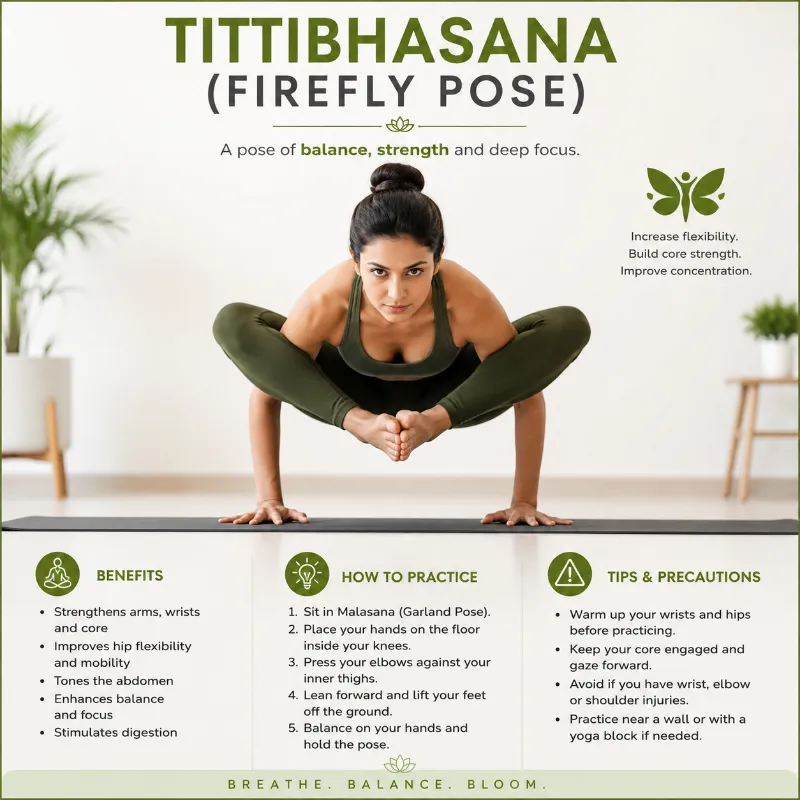
Hatha yoga’s Tittibhasana, also known as the Firefly position, is an intermediate arm balance pose. It can be incorporated into yoga flow sequences to improve the flow of energy throughout the body and is a component of the second Ashtanga Primary Series.
The Firefly Pose helps to release tense hamstrings and glute muscles while testing one’s arms and core power.
For an arm balance routine, tittibhasana is not seen to be the best place to start. However, with consistent practice and appropriate direction, it may still be mastered; stay tuned to find out more.
Overview & Etymology
Tittibhasana is a mixture of two Sanskrit words: “Asana,” which means position or posture, and “Tittibha,” which means firefly.
In Ashtanga vinyasa yoga, tittibhasana is described as an intermediate yoga pose. Tittibhasana is referred to as Dwi Hasta Bhujasana in B.K.S. Iyengar’s book Light on Yoga. Dwi Hasta Bhujasana is an advanced variation of Hasta Bhujasana.
According to Hindu mythology, a pair of Tittibha birds are the source of Tittibhasana. A female Tittibha was once afraid to deposit her eggs close to the sea, but the male persisted, so she did it nevertheless.
When the water heard this, it made the decision to simply wash the birds’ eggs away in order to teach them a lesson. The bereaved couple went to Lord Garuda, the bird monarch, who asked Lord Vishnu to return their eggs through prayer.
The terrified ocean did not want to confront the wrath of the highest deity. He had to return the couple’s eggs as a result.
Yoga frequently employs fables as metaphors. Here, the yogi’s trust is represented by the Tittibha (insects), while the sea stands for delusion and ignorance.
Regular practice can help a yogi achieve ultimate equilibrium in life by neutralizing and controlling their Chitta (aspects of ego consciousness), just as the little Tittibha couple triumphed over the powerful sea.
- Sanskrit Name: टिट्टिभासन
- Pronunciation: TEE-tee BAH-sah-nah
- Pose Type: Arm Balance
- Also known as: Firefly Pose
- Strengthens the upper back, shoulders, core, wrists, and arms.
- Stretches: Legs, Core, Shoulders, and Traps
Key Muscles Involved
Tittibhasana mainly engages:
- Abdominal muscles
- Triceps and biceps muscles
- Wrists and forearms muscles
- Shoulders muscles
- Hip flexors
- Inner thighs muscles
- Hamstrings
- Lower back muscles
Health Benefits of Tittibhasana
Physical Benefits
- Strengthens the arms, wrists, and shoulders
- Builds core strength and stability
- Engages the abdominal and back muscles
- Improves hip and hamstring flexibility
- Develops balance and body coordination
- Helps improve overall muscular control
Mental Benefits
- Improves concentration and focus
- Encourages body awareness
- Builds confidence in challenging yoga practices
- Can promote a sense of control and mental steadiness
When to Avoid Performing Tittibhasana
- Avoid after surgery.
- Avoid if you have a hernia.
- Avoid if you have a severe injury.
- Steer clear if you have wrist or elbow arthritis.
- If your low back ache is persistent, stay away.
- Avoid during pregnancy and the menstrual cycle.
- Steer clear if your upper back, neck, or spine are tense.
How to do Tittibhasana (Firefly Pose)
In order to balance the arm, Tittibhasana demands a lot of strength from your wrists, shoulders, upper back, and core. In contrast, the practitioner’s lower body has to be fully warmed up for the hip-opening transition.
We will therefore lead you through a few warm-up poses before progressively moving on to the primary postural steps and relaxation sequence.
Lastly, learn a few simple Firefly Pose variations and adjustments to tailor your practice to your comfort level.
Roll out your yoga mats when you’re ready, and let’s start with the firefly yoga pose.
Part 1 – Preparatory Poses for Tittibhasana
Use these preparatory positions to increase blood flow in your lower body, arms, wrists, and core:
- Get down on your hands and knees on a table. As you extend your legs out behind you, maintain your palms in contact with the floor and spread your fingers widely apart.
Hold the plank position for a few minutes while tightening your core and using your shoulders. In addition to strengthening your core balance, this position will help you exercise your arms, upper back, wrists, and shoulders.
Navasana (Boat Pose)
- In order to perform the firefly balancing feat, navasana will strengthen your core. Place both knees together and settle into a comfortable sitting position.
Bring your thighs closer to your chest, lift your feet off the mat, flex your arms in front of you, and contract your navel.
Surya Yantrasana (Compass Pose)
- Put your right leg near to your chest while seated to start. Place your right knee over your right shoulder by threading your right arm beneath your right leg.
Put your right palm on the carpet and grasp your right foot with your left palm. Lastly, take a slow breath and begin extending your right leg straight up like a compass needle.
To prepare your quadriceps, hamstrings, and glutes for the primary posture, repeat on the other side.
Part 2: Step-by-Step Instructions to Perform Tittibhasana
The Tittibhasana A or Firefly Pose A version can be practiced as follows:
- Step 1: Take five to ten deep breaths while in a forward-folded position.
- Step 2: Place your hands just below your heels by sliding your arms through the space between your knees.
- Step 3: Position your shoulders directly below your knees. Spread your palms on the floor and firmly grasp the yoga mat with your fingers as you do this.
- Step 4: Begin lowering your glutes until your feet are flat in front of your palms, your palms are pressed into the mat, and your thighs are resting on your arms.
- Step 5: Take a deep breath, look forward, raise each foot off the ground one at a time, and extend your legs straight.
- Step 6: As you begin to balance in the firefly position, make sure your thighs are firmly squeezing your body, your collarbone is wide, and your core is active. Maintain this position for a few seconds.
- Step 7: Take a deep breath and return your feet to the floor one at a time. Take several deep breaths while in the forward fold position, then let go.
Breath Awareness:
- Breathe in while contracting your core and entering the arm balance phase.
- When you’re ready to end the stance, exhale and perform a post-arm balancing act.
- Breathe in and out before beginning the pose, while maintaining the stance, and after practicing.
- For beginners, the firefly stance should be maintained for 15 to 30 seconds.
- Advanced Performance Time: Maintain the firefly pose for 30 to 90 seconds.
Part 3: Things to Keep in Mind
It’s a good idea to pay attention to the following postural clues when striking the firefly stance for the first time:
Take your time: A lack of breath coordination may be the cause if you are following all the instructions but are still unable to balance. Beginners enter the balancing act so quickly that they neglect to synchronize their breathing.
Since tittibhasana is a difficult pose, hurrying it would only make your practice worse. Therefore, be sure to take your time during every stage, whether it’s the warm-up, the main stance, or the cool-down.
Grip the mat: The firefly posture can be difficult for beginners who have the incorrect hand grip. Your fingers won’t assist you in gripping the mat if they are stuck together.
This can be fixed by spreading your fingers wide and pressing your palm’s base into the ground first, then your fingers.
A solid grasp will protect your wrist from harm and provide a great foundation for balance.
If you feel like your neck hurts, your wrist is trembling excessively, or your shoulders are under pressure, just leave with awareness.
If you feel uncomfortable, stop the posture immediately since you risk serious damage if you don’t pay attention to your suffering.
Part 4: Relaxing Poses After Tittibhasana
After practicing firefly pose, it’s normal to feel extremely agitated and overwhelmed. To help you rest and rejuvenate, try these asanas:
Adho Mukha Svanasana (Downward Facing Dog Pose)
- Fold forward to exit the firefly pose. Now extend your feet backward, forming a triangle with your body on top.
Flex your chest deeply into the ground and release the breath slowly. You will experience a reenergizing of your shoulders, traps, arms, wrists, hamstrings, and spine after holding this pose for a few minutes.
Ananda Balasana (Happy Baby Pose)
- Bend your legs while lying on your mat if you’re still experiencing tension in your legs and back. To open your glute muscles, grasp your feet with your palms and press your knees toward the floor.
Shut your eyes and sway your body like a baby lounging in a cradle. Your entire body will relax as a result of this stance.
Tittibhasana Variations to Consider
Use the following posture variations to ease or improve your firefly pose practice:
Bhujapidasana (Firefly Pose With Crossed Feet):
- This is a great way to be ready for the firefly posture. Lean your upper body forward while you are squatting. Make sure your legs are over your shoulders by threading your arms beneath them.
Now use your upper body muscles to stoop down while bending your elbows and holding onto the yoga mat with your palms. Lastly, press into your hands, tighten the core, cross your feet over one another, and achieve complete balance.
Hold this version until your legs are strong enough to extend straight.
Tittibhasana B (Firefly Pose B):
- As a yoga flow, advanced practitioners can execute variants of the firefly pose. Tittibhasana A, B, C, and D are some of the firefly pose variations that typically make up this sequence.
After you’ve accomplished Tittibhasana A, move into the forward folding position and start to gently slide your torso between your legs.
Lastly, reach your hands behind your back and firmly interlace your fingers to stretch the lower body deeply. To improve hip mobility and core balance, advanced yogis can hold this version for one to five minutes.
Common Mistakes
- Placing too much weight on the wrists
- Before gaining sufficient hip flexibility, try to straighten your legs.
- Allowing the shoulders to collapse
- Holding the breath while balancing
- Practicing without adequately warming the hamstrings, hips, and wrists
Precautions
Since tittibhasana is an advanced pose, it should be done slowly. If you currently have a wrist, shoulder, elbow, hip, or hamstring ailment, avoid or adjust the pose. Beginners should initially build the strength and flexibility required for the pose while practicing under the supervision of a skilled yoga instructor.
Best Preparatory Poses
- Before attempting Firefly Pose, try these useful poses:
- Malasana (Garland Pose)
- Bakasana (Crow Pose)
- Lolasana (Pendant Pose)
- Forward Fold
- Happy Baby Pose
- Plank Pose
- Chaturanga Dandasana
FAQs
Can beginners perform Tittibhasana?
Tittibhasana should be avoided by novices with weak arms and inconsistent core strength. Only when your muscles are fully warmed, engaged, and powerful should you strike the firefly pose.
What is Tittibhasana good for?
Tittibhasana is beneficial for strengthening balance, strength, concentration, and mental-muscular synchronization.
What are the benefits of Tittibhasana?
Many body parts, including the core, shoulders, wrists, forearms, back, triceps, and hip flexors, can benefit from Tittibhasana. It also provides a deep stretch for the adductors, hamstrings, and outer hips, which enhances the flexibility and mobility of the lower body.
What are the different preparatory poses in Tittibhasana?
Before beginning your Tittibhasana practice, you should master some great preparatory poses, such as Phalakasana, Purna Navasana, Upavistha Konasana, Surya Yantrasana, and Bakasana.
What are the different variations in Tittibhasana?
You can either increase the strain by pointing your feet directly toward the sky or try reducing the pressure by crossing your feet or bending your elbows slightly. These posture indicators are all popular Tittibhasana variations.
Who should avoid performing Tittibhasana?
If you have any shoulder, wrist, forearm, or neck pain or injuries, it’s recommended to avoid doing Tittibhasana.
Women who are pregnant or menstruating, as well as senior individuals with back and spine discomfort, should completely avoid this pose.
References
- Allen, W. (2025a, August 25). Tittibhasana. https://myyogateacher.com/yoga-asana/tittibhasana
- Panigrahi, G. V. (2026c, August 17). Firefly Pose (Tittibhasana): Benefits & 3 Prep Poses. Vinyasa Yoga Academy Blogs. https://vinyasayogaacademy.com/blog/benefits-of-firefly-pose/
- Yoga Journal. (2025, March 14). Firefly pose. https://www.yogajournal.com/poses/firefly-pose/